Jay Fisher - Fine Custom Knives
New to the website? Start Here
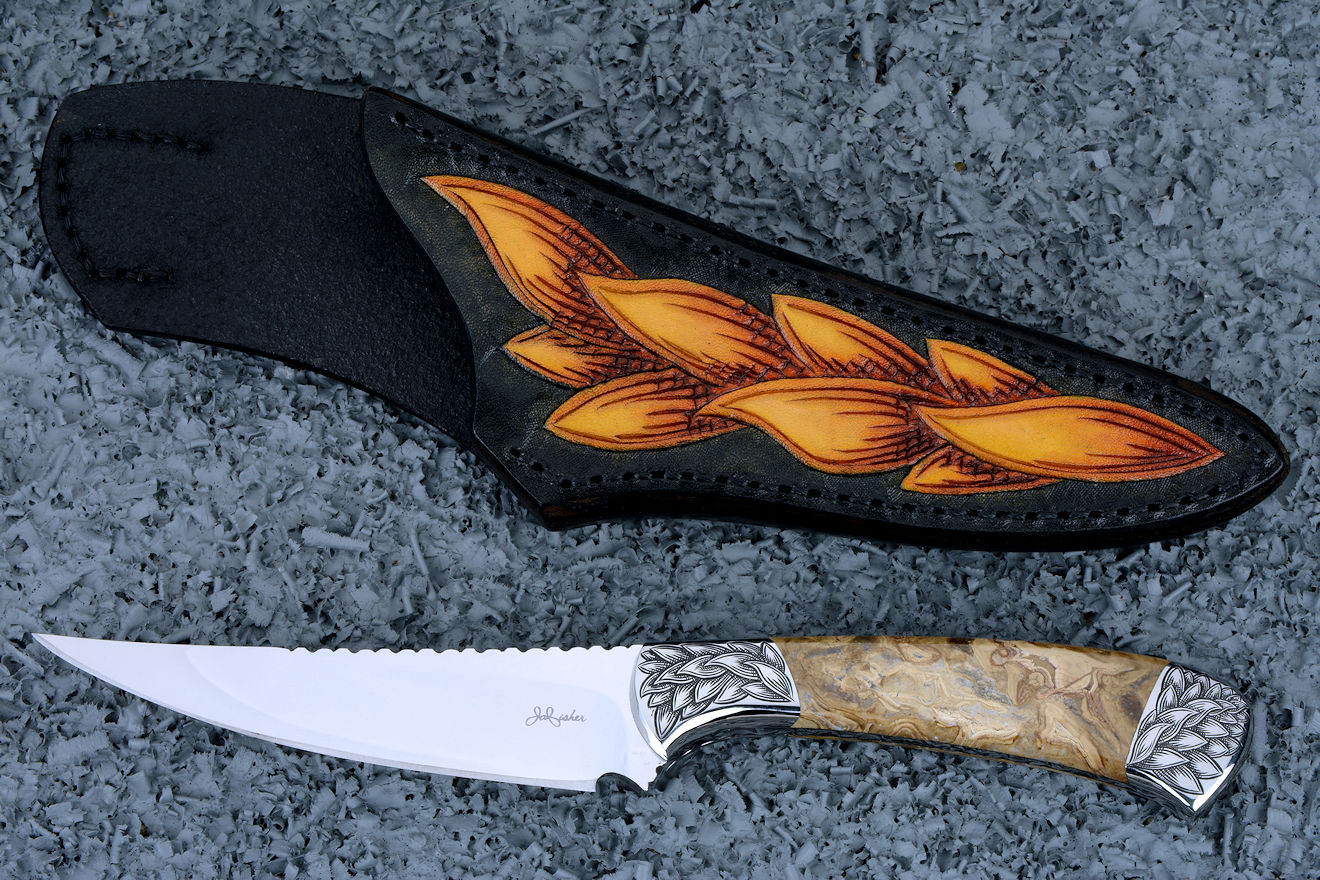
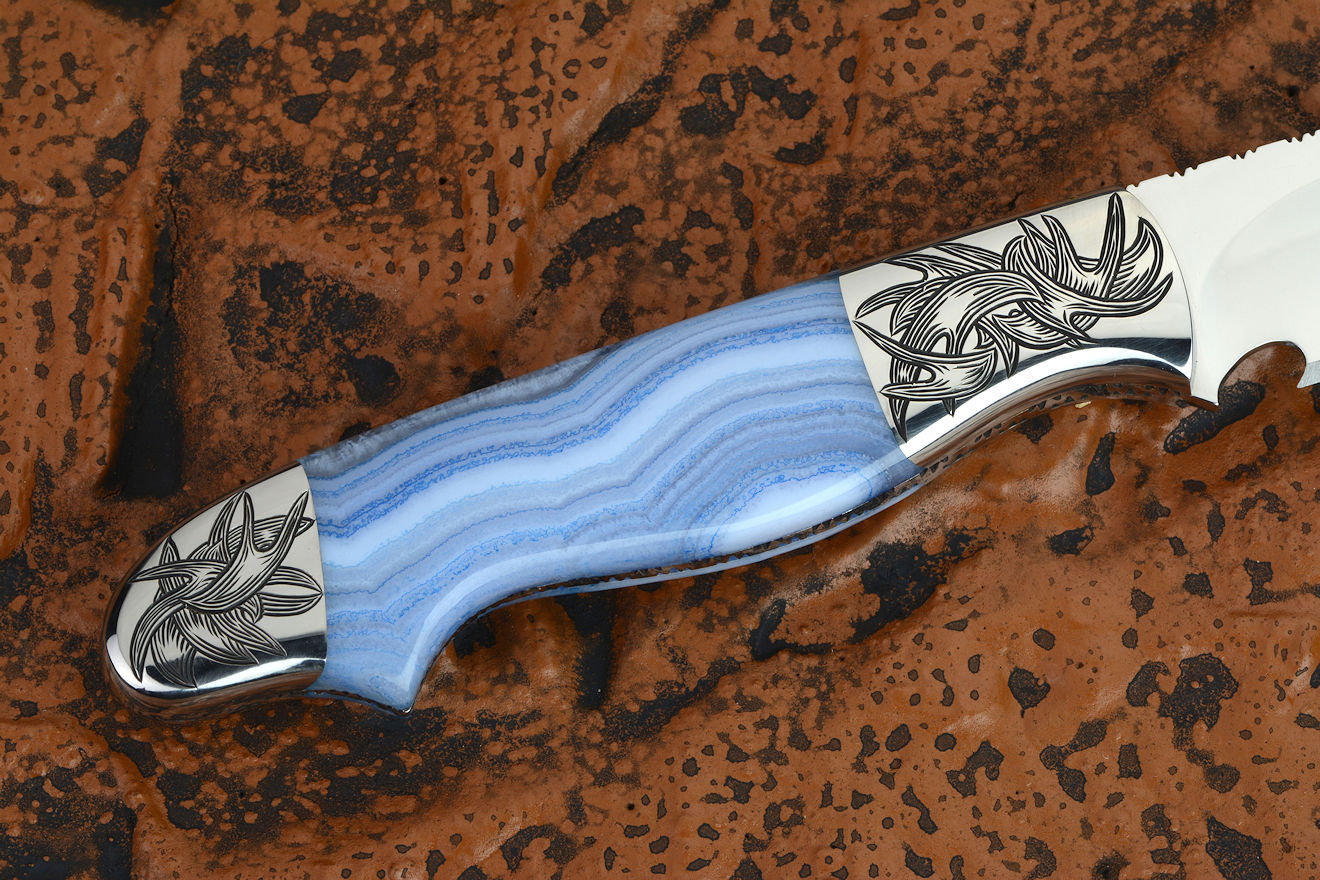
"Talitha"
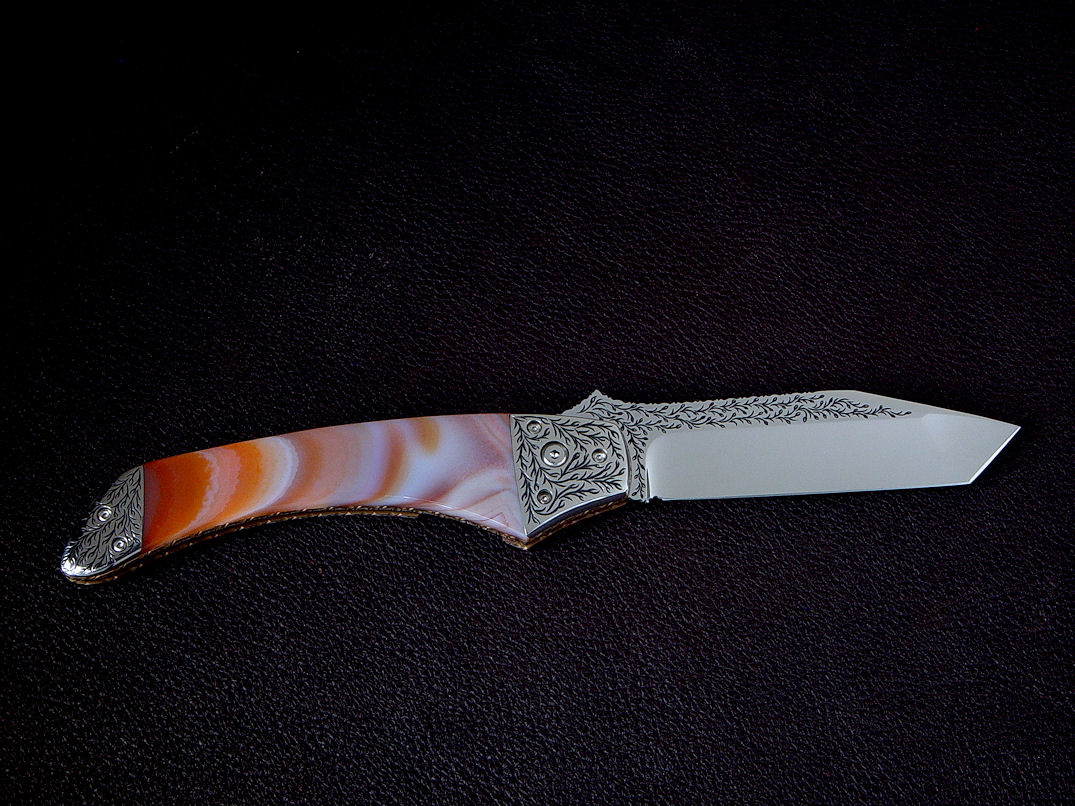
I have one goal, to make fine knives, working with clients and their ideas and also independently designing, and improving my skill year after year. A great deal of this effort is continually invested in embellishment. Embellishment is one of the major factors in a knife's appeal, value, and unique nature.
If you are well-versed in fine custom knives, you might realize how rare it is to find an artist who does it all. Most knife makers excel in one or two phases of the tradecraft, and often leave embellishment to other artists. I've never been comfortable with someone else completing my projects, so I don't farm out or contract other's work on my knives. Starting with design work, I make the blades, fittings, and handles. I make the sheaths, stands, and cases. I photograph, detail, archive, and create and maintain this website. If the knife has only my name on the blade, all of the work done to make, finish, and archive the work is my own. In all of these pursuits, it's sometimes surprising to discover that one of the most time and skill-intensive areas of focus in a fine knife is the embellishment.
There is an old saying that an artist's work is never finished, that he merely, at some point, abandons it. This is the artist's bane. I may be happy with the piece, and indeed, it may look complete to others. But to me, a piece often isn't complete unless it's tastefully embellished. These are, after all, handmade custom knives, so some unique handwork seems necessary and appropriate. Handmade custom knives benefit greatly in value and investment quality from fine embellishment. Beyond all these reasons though, is beauty. Beauty in knives means a particularly graceful, ornamental, or elegant quality.
Beauty cast upon weapons and tools may seem foreign to many Americans. That could be because we are a utilitarian culture, producers of usable, reliable goods, meant to be work-ready, dependable, and tough. I suppose you could say Americans themselves are that way. For whatever your political style, one thing is certain, we're a hard-working society, perhaps the hardest-working in the world. I don't want to get into a geopolitics here, but I believe that is one of our greatest attributes: that we work hard and are prolific producers. That could be why we value utility. We want tools that work, vehicles that work, machines, products, and people that work without glitz, glamour, or gaudiness. And somewhere along the way, we've misplaced our interest in beauty. Beauty is superficially seen in Hollywood and the media, fleeting and often insincere. In hard goods, useful tools or items designed to last through the centuries, though, the beauty instilled by the original artist lives long after his presence.
What is beauty? Is it the gorgeous supermodel spinning around a signpost in Manhattan with a lean figure and pigments accenting her facial details? Is it an oil painting by a master who lived four hundred years ago? Is it a southwestern sunset? One thing about beauty, it is like the ocean, you know it when you see it. And though you may experience beauty in a simple, utilitarian custom knife with clean lines, a rudimentary blade, and flat, polished bolsters, you might wonder what it would be like if it were finely detailed with every inspiration the artist could apply.
If beauty isn't reason enough, take a look at it from the descriptive verbiage: customization, which means to build, fit, or alter according to individual specifications. Embellishment makes a knife unique, particularly if the embellishment does not exist on any other knife. This makes the knife "one of a kind," thus increasing its value. Even mass producers of knives see this worth, and that is why they crank out numbered "limited edition" styles of knives. Sometime in the future, this etched application of a numbered set is supposed to make a knife appreciate. It's a sad attempt to borrow the idea and mimic true customization by master craftsmen. More on that below.
For the macho types that only consider blades as tools, weapons, and pieces of sharp metal to be torturously utilized in cutting line, scraping metal, stabbing your enemy, or dressing game, this is for you: One of my finest clients, a rather famous person and well-educated historian of war and military engagements looked at one of my fine embellished daggers and said: "It would be an honor to have that shoved in your guts." There you go, forget beauty; it's about honor!
I always try to remember that this isn't about society, or value, or culture, or even me. It's about you. So when I take the time and considerable effort to embellish a custom knife, I am thinking about my client or patron, either realized or potential, and his interpretation of what I envision for the knife, sword, or dagger. Yes, the ideas, details, and execution are mine, but artistic concepts are shared, that's why they're art; like beauty, they're known when seen.
You bet; perhaps some of the oldest history we know. You've read on this site (I hope) on the FAQ page, the Blades page, the Handles page about the history of man's first tools and weapons. Throughout time, man has embellished his tools and weapons. Some historians, archaeologists, anthropologists, and academics claim that this was an attempt to gain mystical power over his task, opponents, or prey, and these scholars might even attach a religious significance to these markings, carvings, inlays, imagery, and extra work for the artist.
I have a somewhat different slant. While not discounting these reasons, I think that too many trained intellectuals seek to find esoteric, superior motives as their expensive training and great investment of time and study dictates. After all, these are well-trained professionals, and someone has paid for that education. But most of them have never made something with their hands, carried a piece of steel at their side, used it to get them out of a pinch, and wanted to recreate or honor the significance of that experience. We value the experiences we have had and will have with an edged weapon or tool, so we impart imagery to it to reflect that. The maker must mark his effort to set it apart, and the user associates the item with an event, and that is how embellishment starts. Then, the man who carries the knife, sword, or dagger must relate to others this experience. So the piece is made with a depiction of a great battle, or the image of an animal, or his name, or his service dates, or his quest. That way, he can show it to his allies, cohorts, and strangers and account the experience, brag, or maybe even lie...
And then there are the flourishes. Why would we put plants, and paisley (dolphin and fish imagery), and curves, and flowers, and flowing lines on our tool or weapon? I believe this imagery does several things. Depictions of living things relates the inorganic nature of the cutting tool to its environment and reflects life back into the inanimate edged tool. And the flowing lines reflect motion and the fluid movement capable in the knife, sword, or dagger. It relates the knife to its use or environment. From an artistic perspective, a blank, plain surface of steel can be monolithic and boring, and to the creative person, presents a blank canvas for study and expression. From the businessman's point of view, embellishment like engraving adds a great deal of value to the piece, and makes it more attractive for sale. Now, I could get into the genetic need to relate geometric and representational patterns within our mental constructs, perhaps derived on a genetic level through unique human brain processing by illustration and elaboration, but I don't want to stray too far.
Please remember this: some of the most valuable historic items in existence today are knives, swords, tools, and weapons, and the most valuable of these are encrusted with jewels and gemstones, elaborately engraved, etched with images, carved, gilded, inlayed and awash in precious metals, and cherished in the vaults of private collectors and museums.
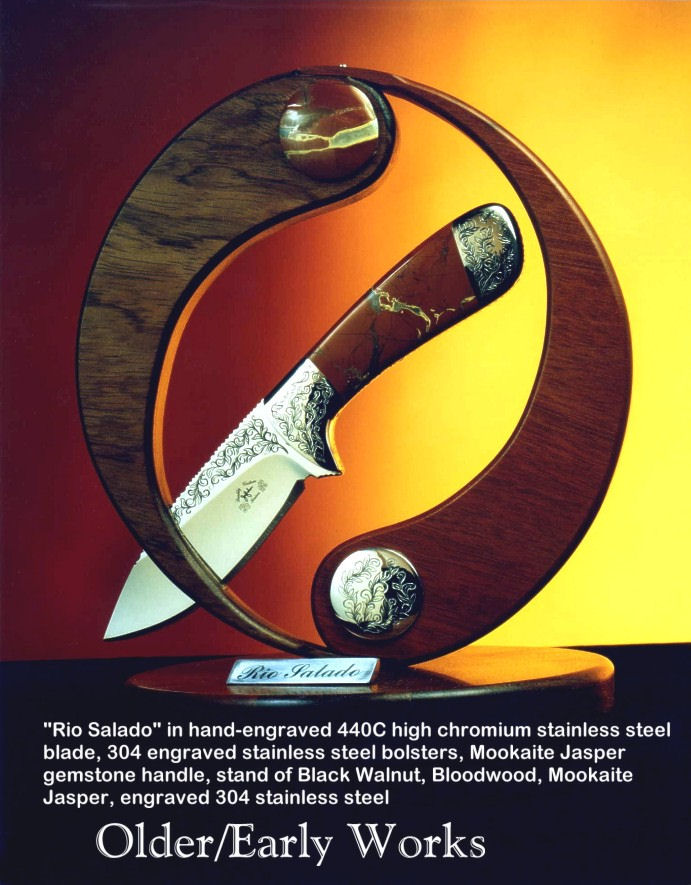
It's true, the best knives have names, not model numbers. A model number is just a number. It's a cold, impersonal registration of one of a long line of repetitive patterns, suggesting a factory has produced all the numbers leading up to the model, and will crank out a never ending list of faceless numbered pieces after that number. Your model numbered knife is somewhere in the monotonous string of digits.
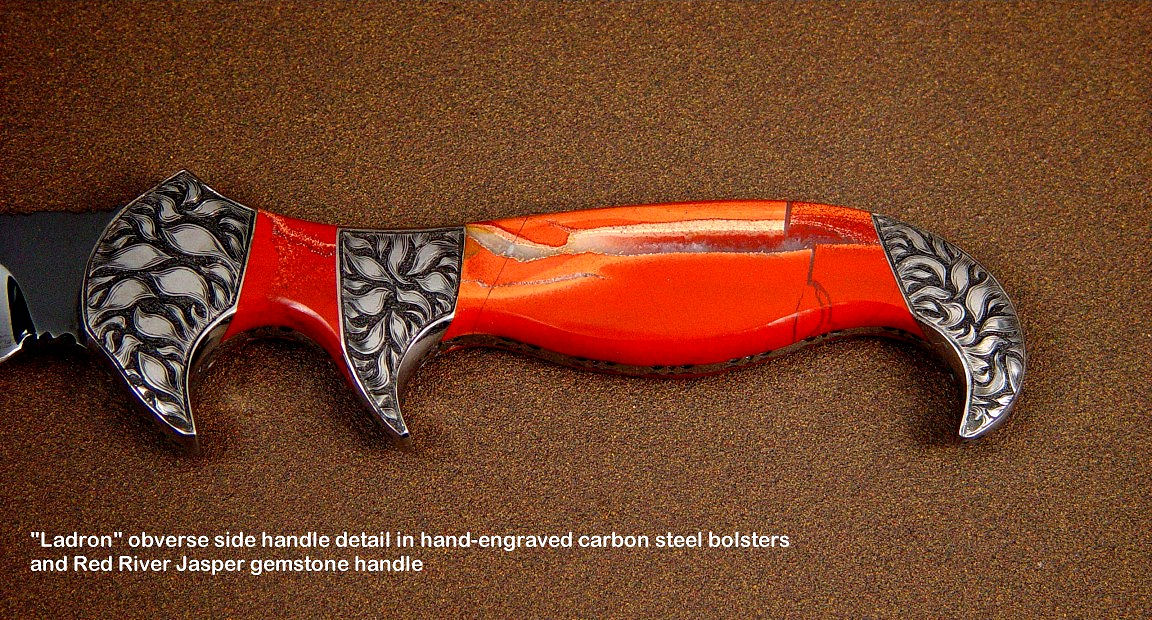
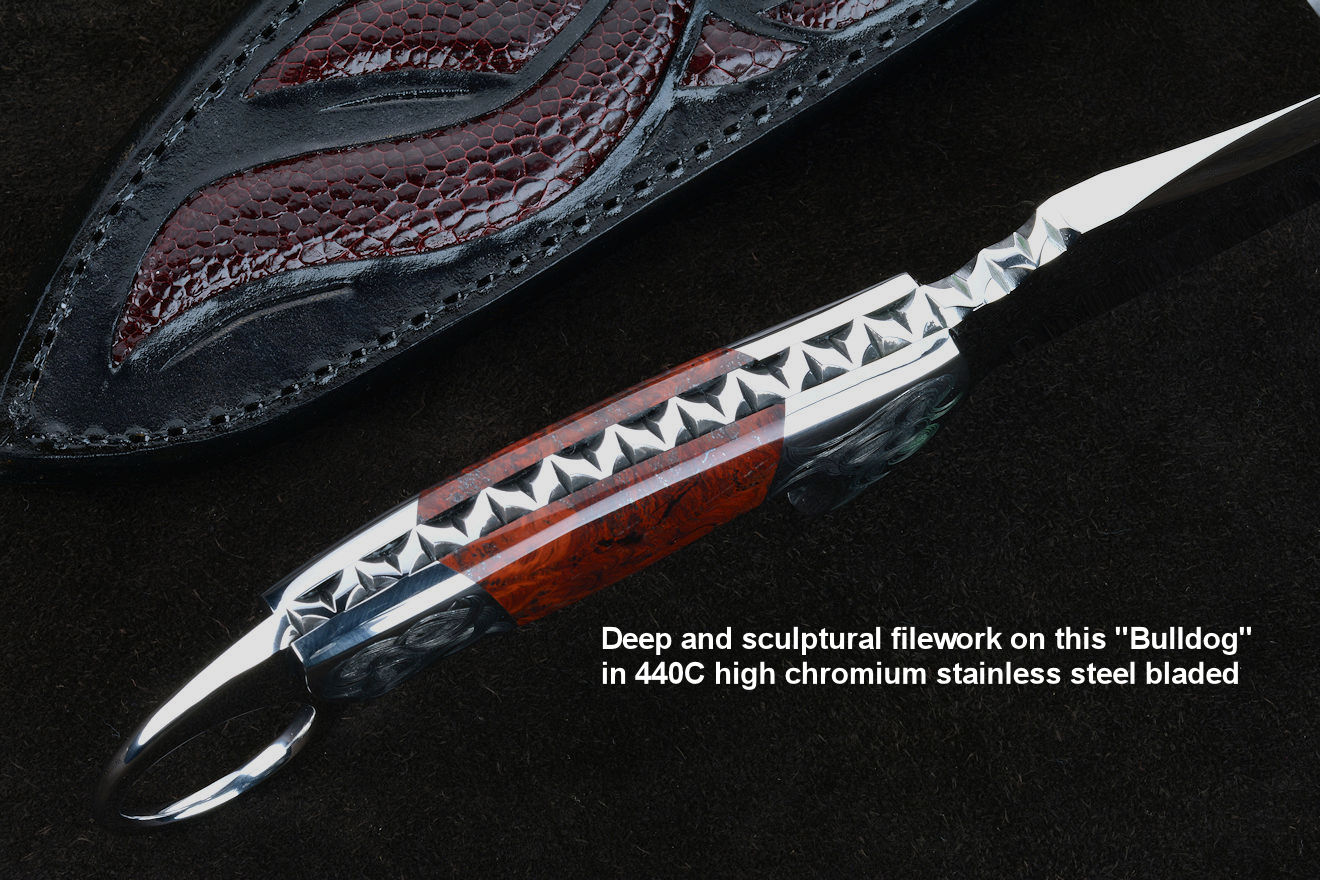
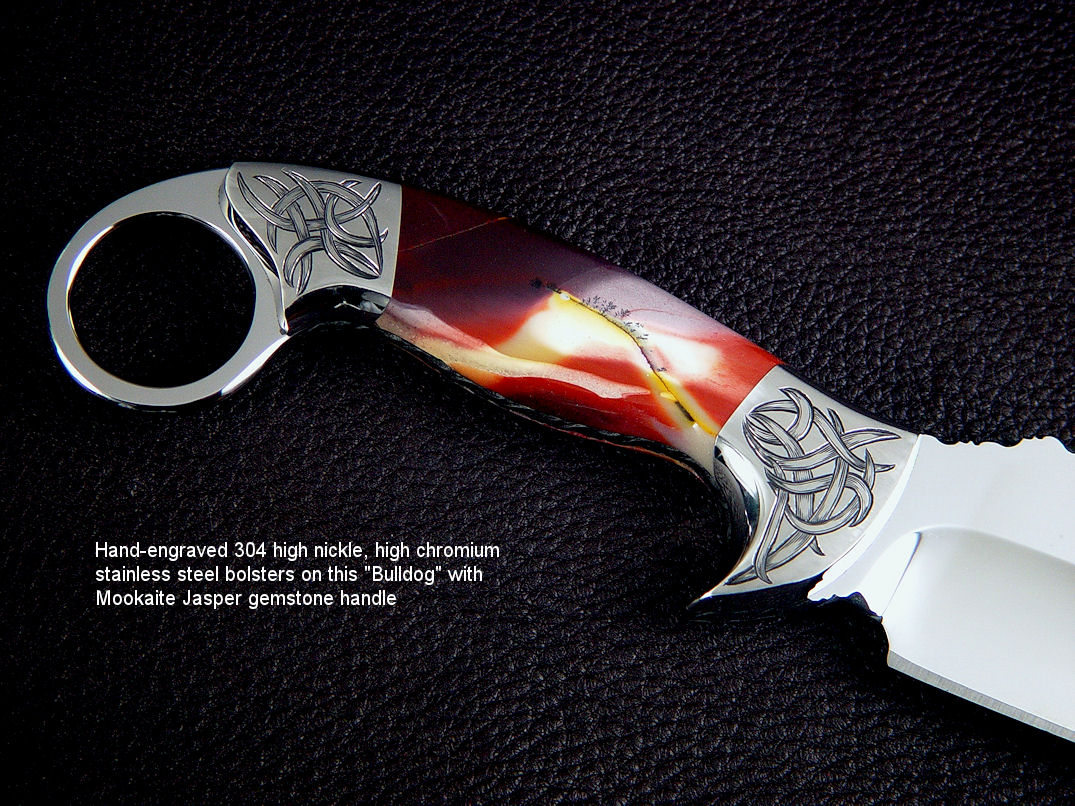
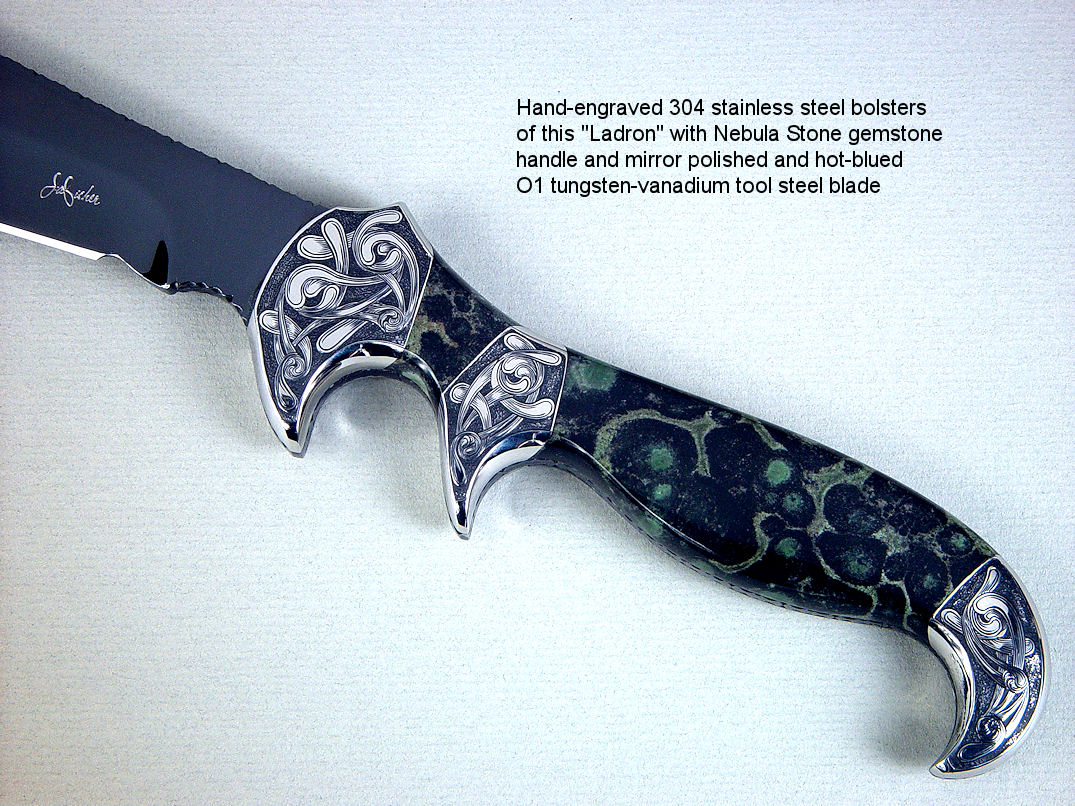
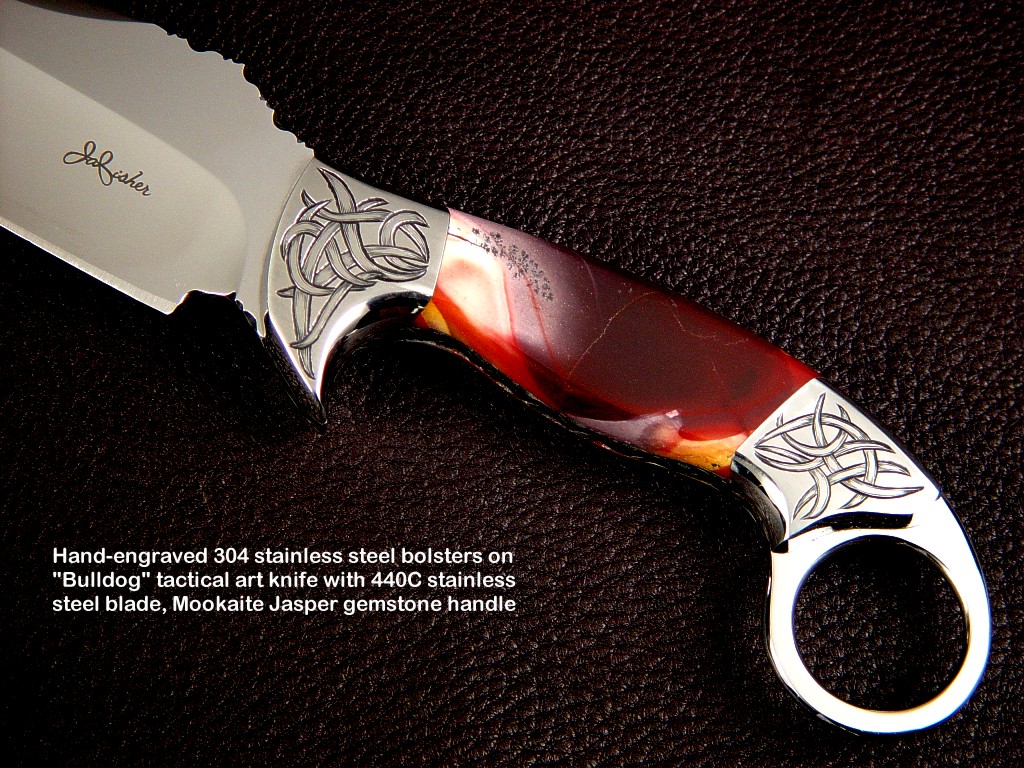
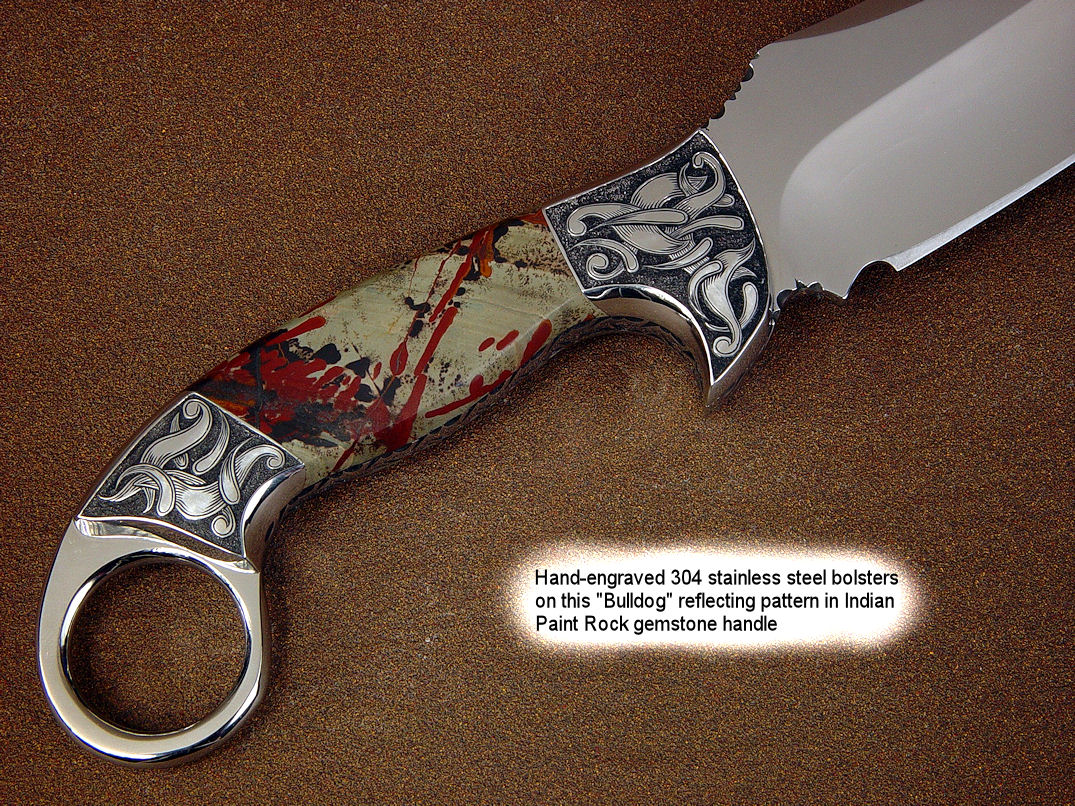
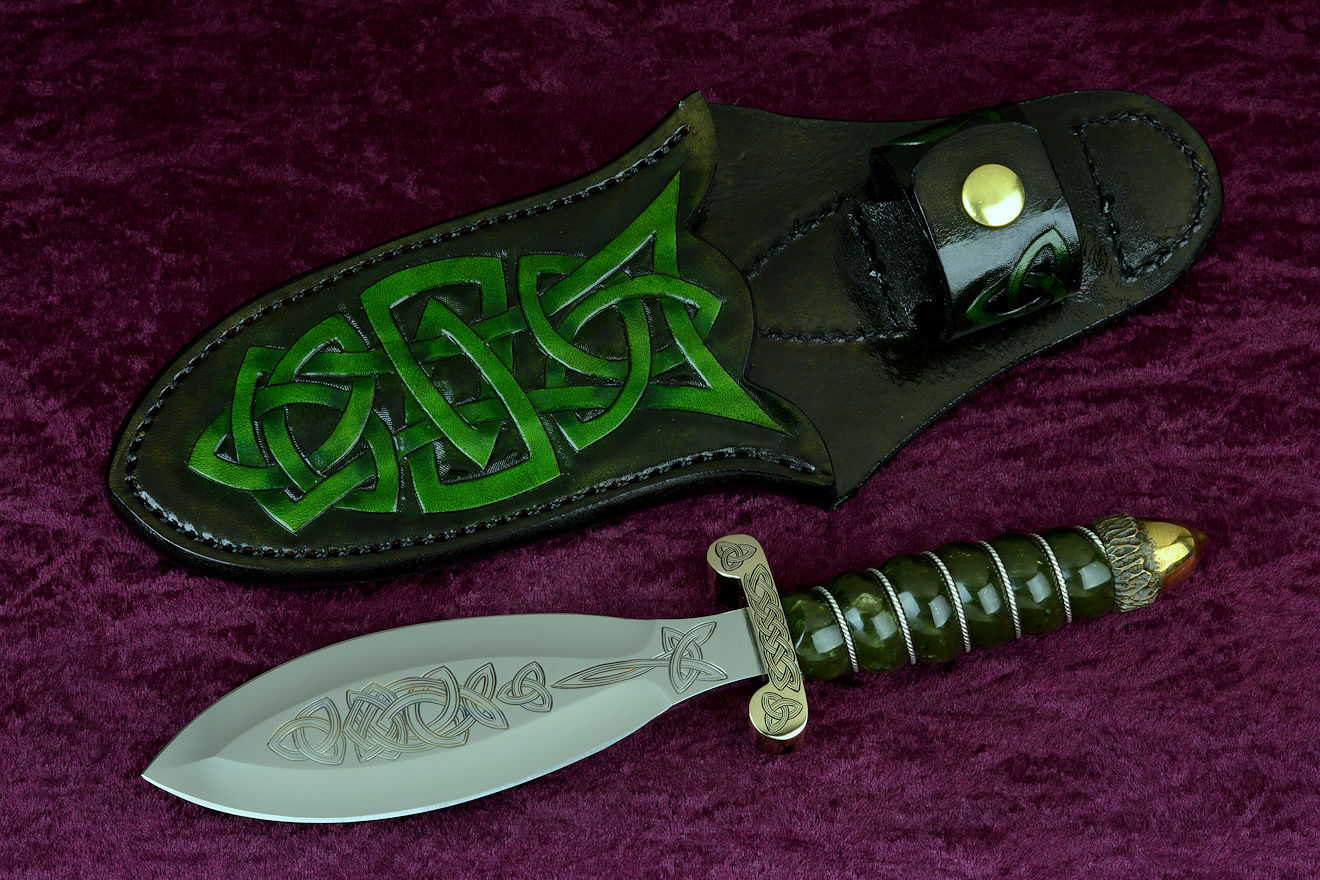
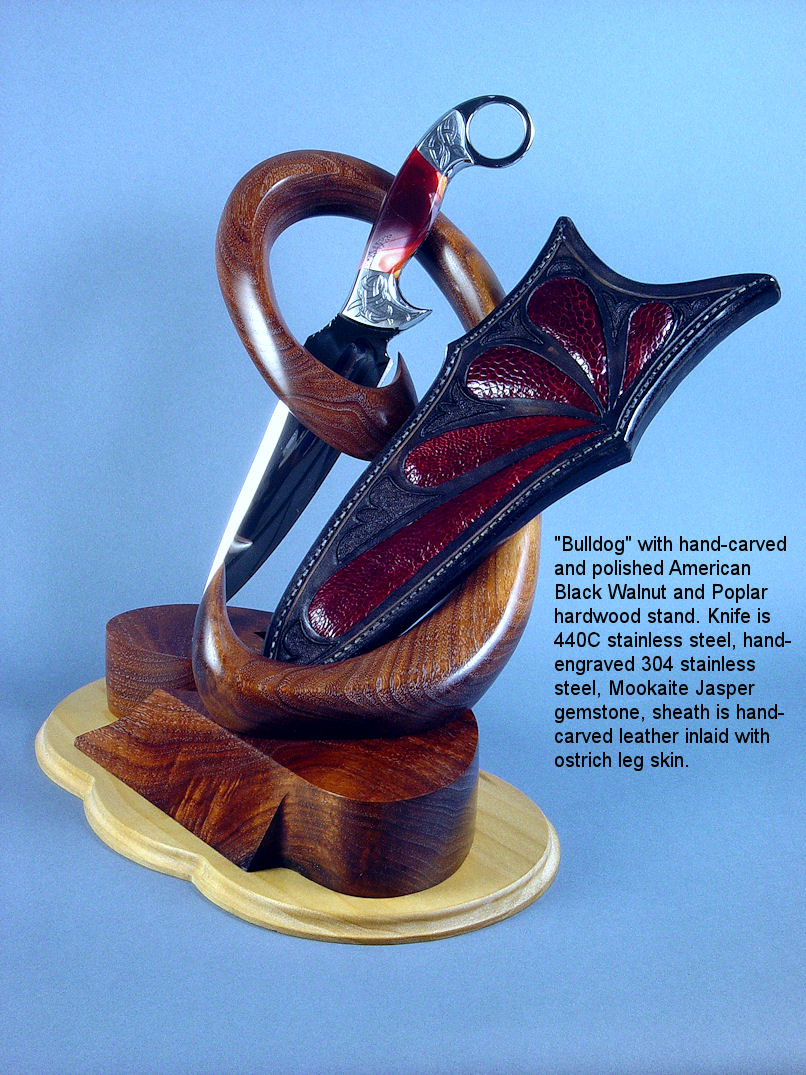
A name personalizes the knife. It adds to the knife's flavor, animation, and style. It defines the knife by purpose or intent. While I try to stay away from knife names like Slasher, or Stabber, there is some mystique in a name like Bulldog or Ladron. Incidentally, the name Bulldog comes from the Bastogne Bulldogs of the 101st Airborne, the Battalion of my son, and their mascot. He designed this fine knife for combat use. Ladron is named for a mysterious singular mountain in south central New Mexico, and it is the Spanish word for thief. It was a favorite area to hike when I lived nearby, and I would have loved to carry this knife there.
Many of my knives have southwest and specifically New Mexico place names. The Land of Enchantment has a flavor that suits artistic creation, and the place names seem appropriate. I've lived here nearly all my life, and I try to honor those many memories with a fitting name to a matching style of knife.
You've probably noticed that many of my knife names originate in the stars. That is, they are names of stars in the cosmos. Many of these patterns are Gerry Hurst's, left to us when he died. He didn't have names or numbers for them, so in order to catalog them, my wife and I reached for names he probably would have liked, names of the heavens. Then, I carried on the tradition in new designs. and even name some for features and areas on planets in our own solar system. Somehow, cruising through the names, one will stand out as fitting and complimentary for a pattern. Take the name Horrocks. It's a crater system on the moon. The name sounds like a powerful warrior, so how could it be more fitting for a large, heavy, curved combat knife?
Some of the names on my patterns are the names of our grandchildren. I'll bet you can't tell which ones. Hint: no, it's not Draco!
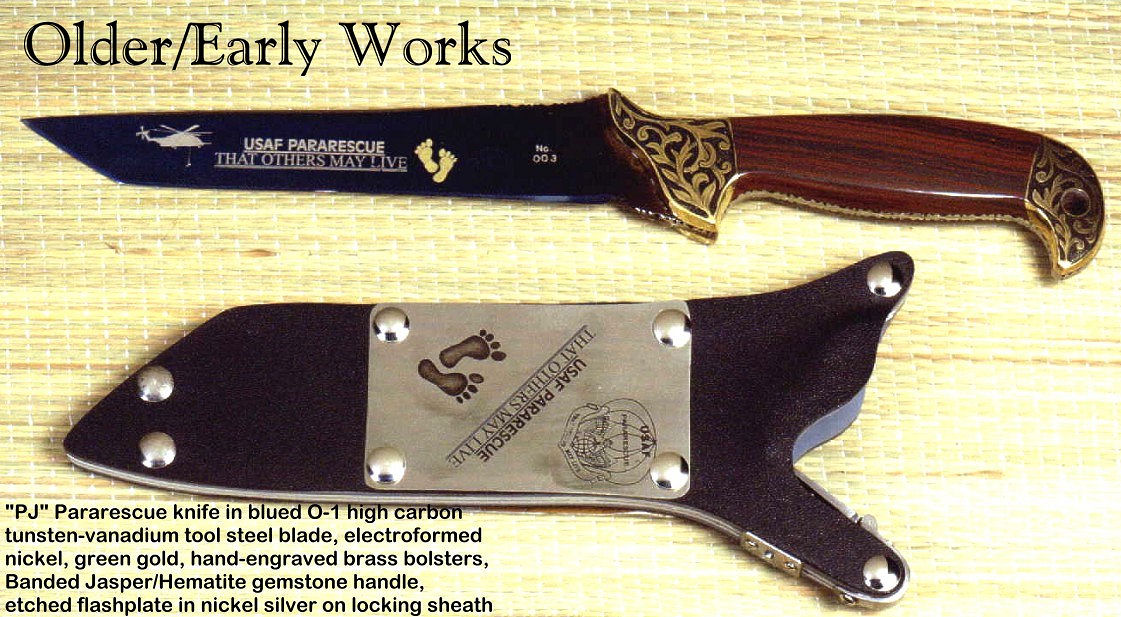
Some names describe the blade shape itself, like Sheepsfoot, or Reverse Paring, or Half Moon Skinner. Other names describe the use of the knife like Game Set: Caping, or Carving. Other names bear the names of the designer who worked with me on the design of the knife, like Sanchez, Berger, or Gibson Trailhead. You'll also see the designation Magnum on a few of my blades. These are larger evolutions of an original design, for example the Nihal Magnum is a larger combat version of the Nihal.
The neat thing to know is that a name gives a knife personality. We are creatures of words, and words mean things. Our language is more than just a way to share and express, it is a way to characterize, personalize, and animate those objects we use, cherish, and ultimately leave behind.
Mr. Fisher,
I just wanted to tell you that your work is quite exceptional. I found your site when I
was doing a search for embellished knives. I am just learning to engrave and carve and
it is always interesting to see what others are doing along those lines.
My husband makes knives occasionally and we enjoy the beauty of a well made blade.
I started reading your first page of funny emails you posted and decided after reading the
first page I should stop as I was laughing too much.
Your knives are quite beautiful and I really like the engraving you do. Not everyone
likes the 'flowers and scrolls' and that doesn't always fit the weapon anyway.
Anyway, just wanted to let you know that I will use your pictures as inspiration to do
my own kind of work. Thanks for sharing your work.
Sincerely,
Sue Schroerlucke
Sidney OH
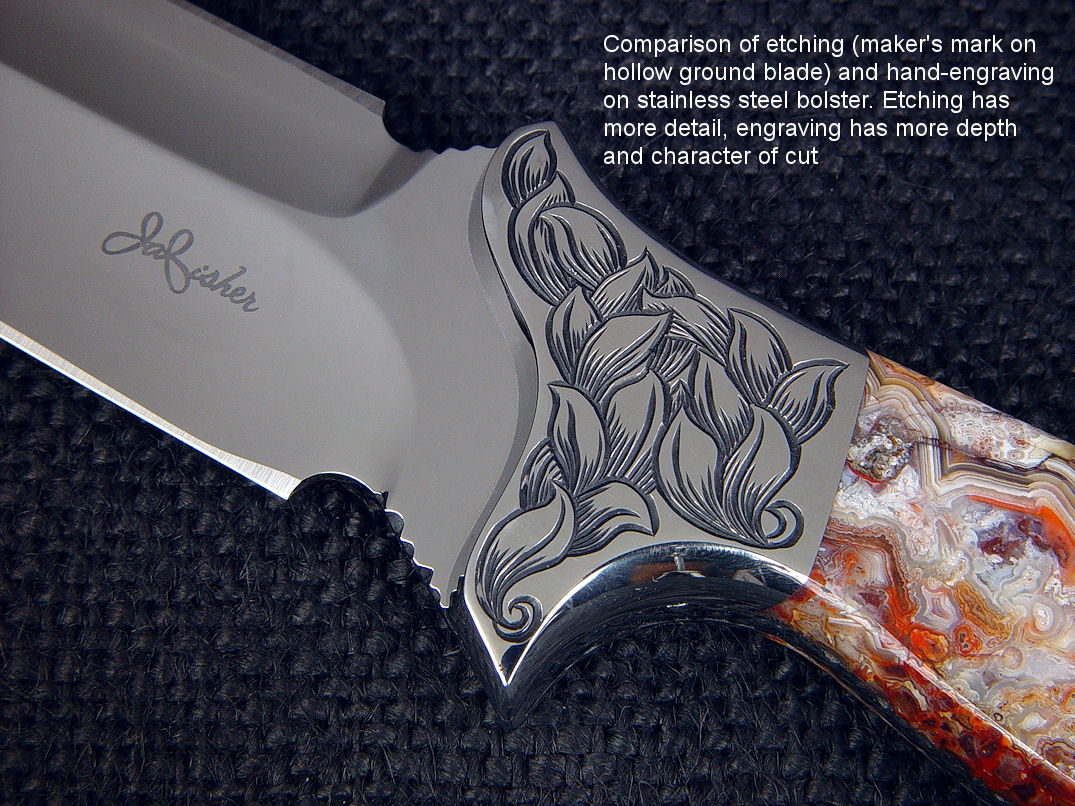
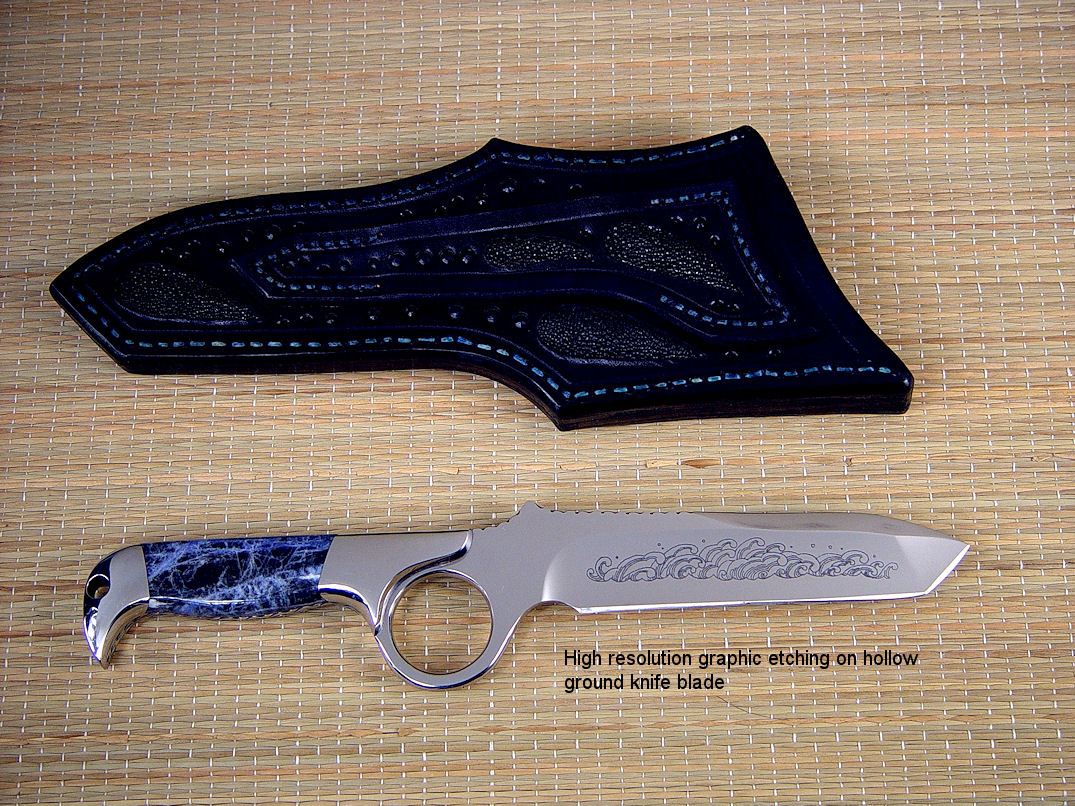
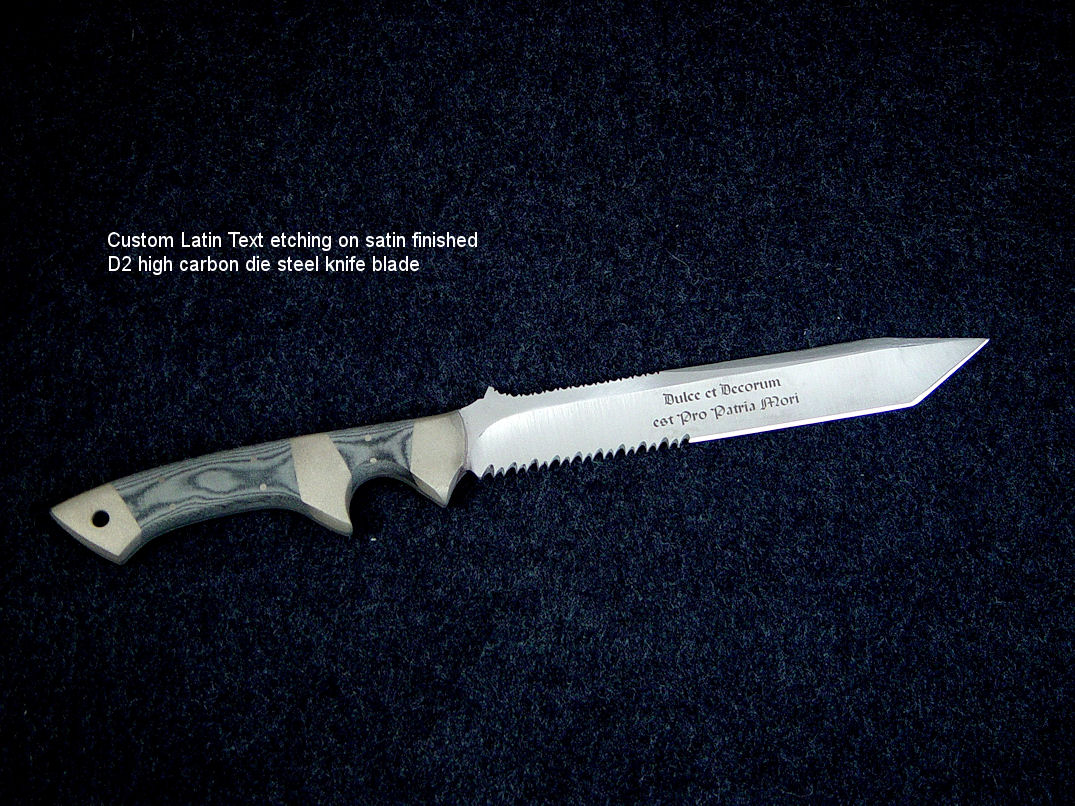
Etching is the process of cutting into a material (usually metals) with acid. In the old days, a layer of beeswax and asphaltum (ancient Egypt) was coated onto metal and a burin (or scraper) was used to scrape away a design in the wax, then the metal was dipped or coated in acidic liquid, and the exposed metal was etched (cut) away. A lot of armor was etched this way, as were countless swords, daggers, halberds, partisans, maces, and other early weapons. Firearms, too were etched. The cut, being rough and irregular, was usually darker than the surrounding metal. Etching shows up best on a mirror or brightly finished metal as the cut is dull and grainy.
Today, there are still some artists who etch in the traditional way. Unique, multi-step etching processes can create great works of art, and the process is well demonstrated in the jewelry industry. Many metallic items today are etched, nearly all machine tool cutters and drills for instance, and many metal pieces that need to be permanently identified are etched in industry.
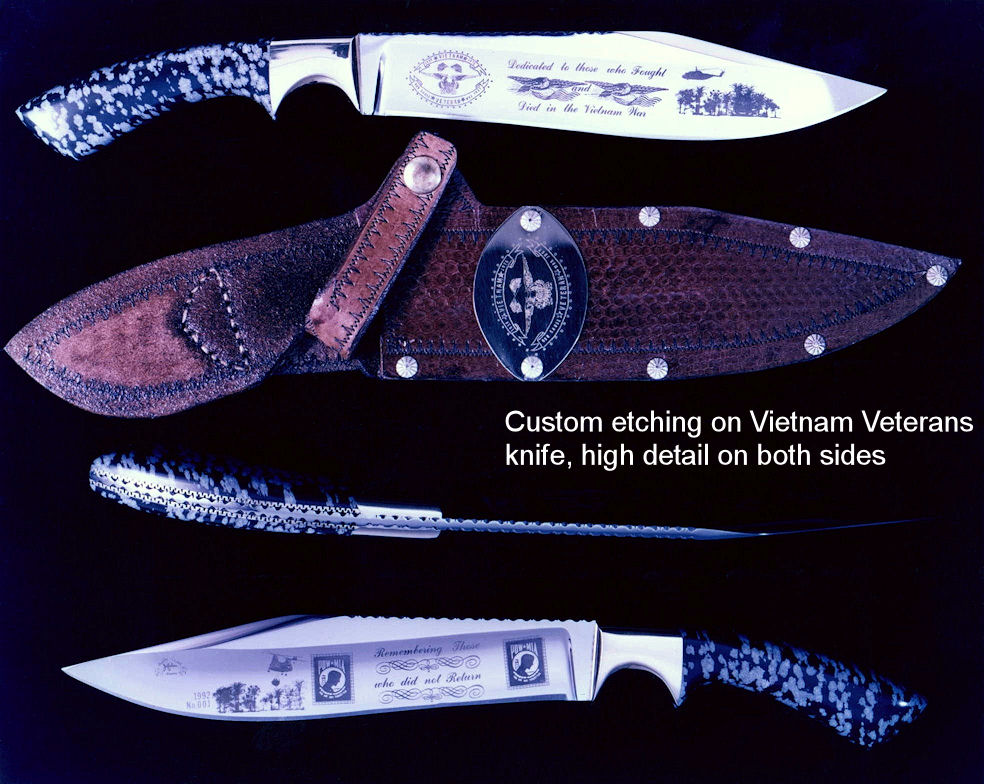
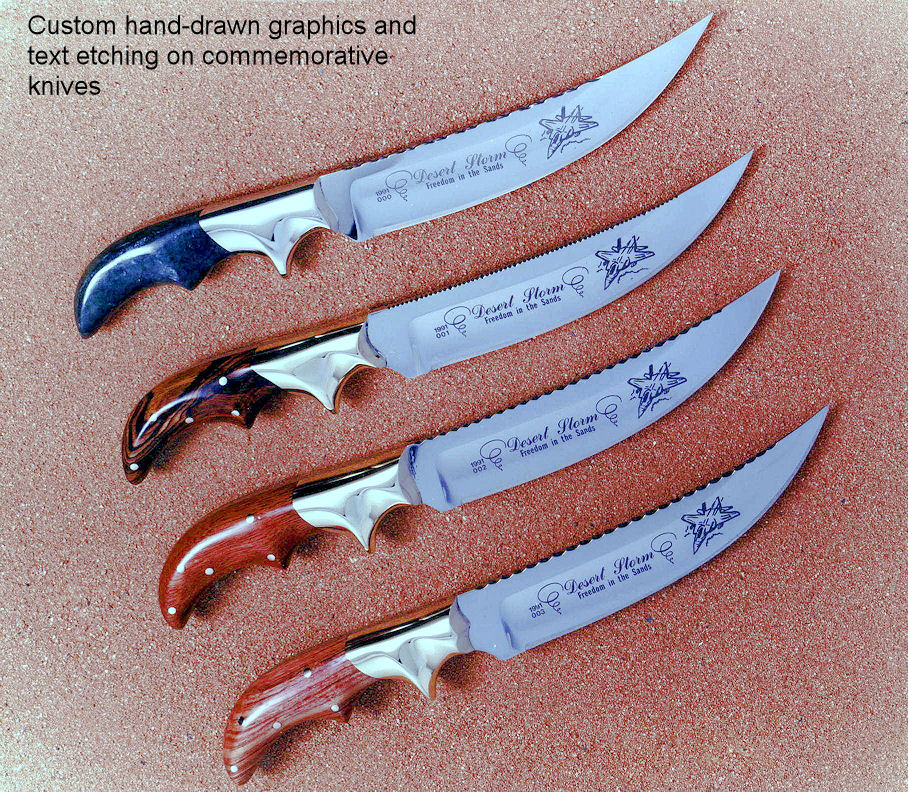
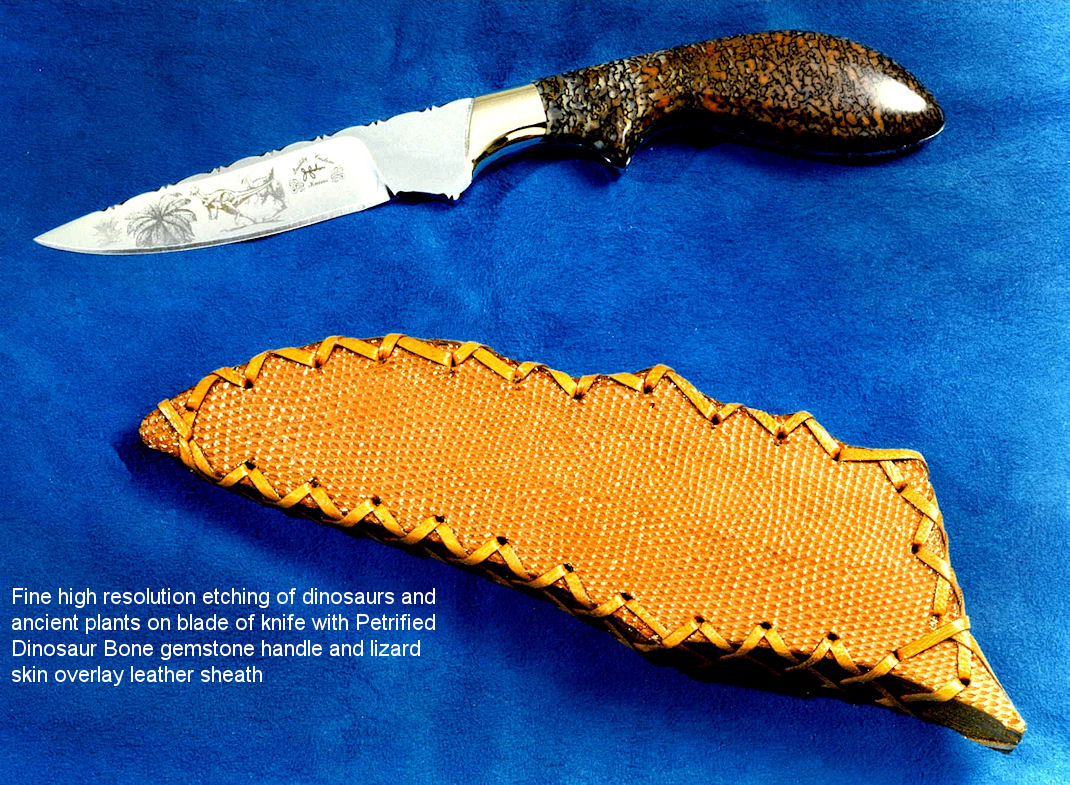
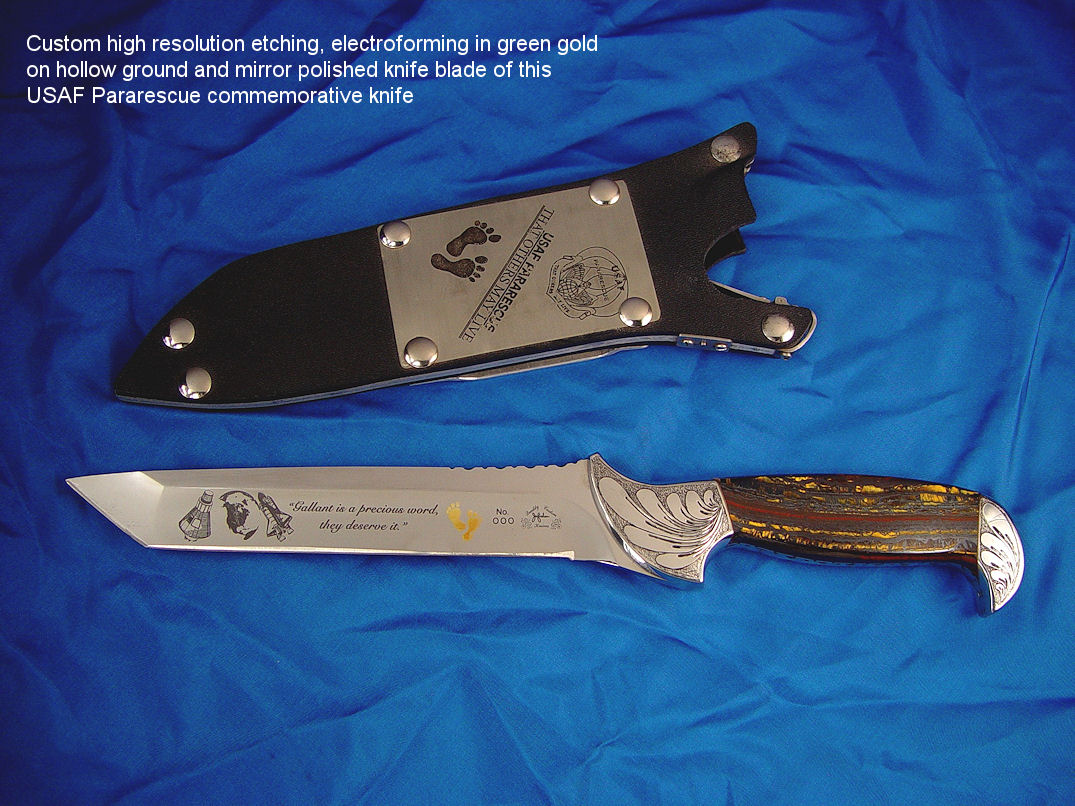
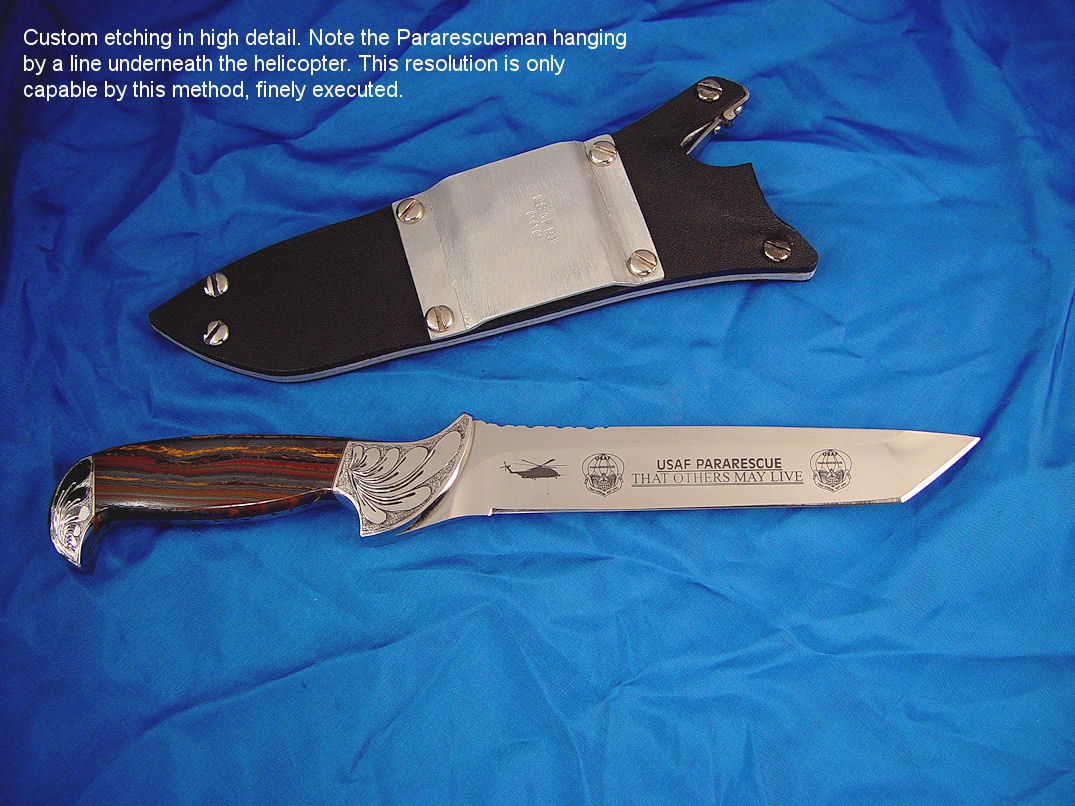
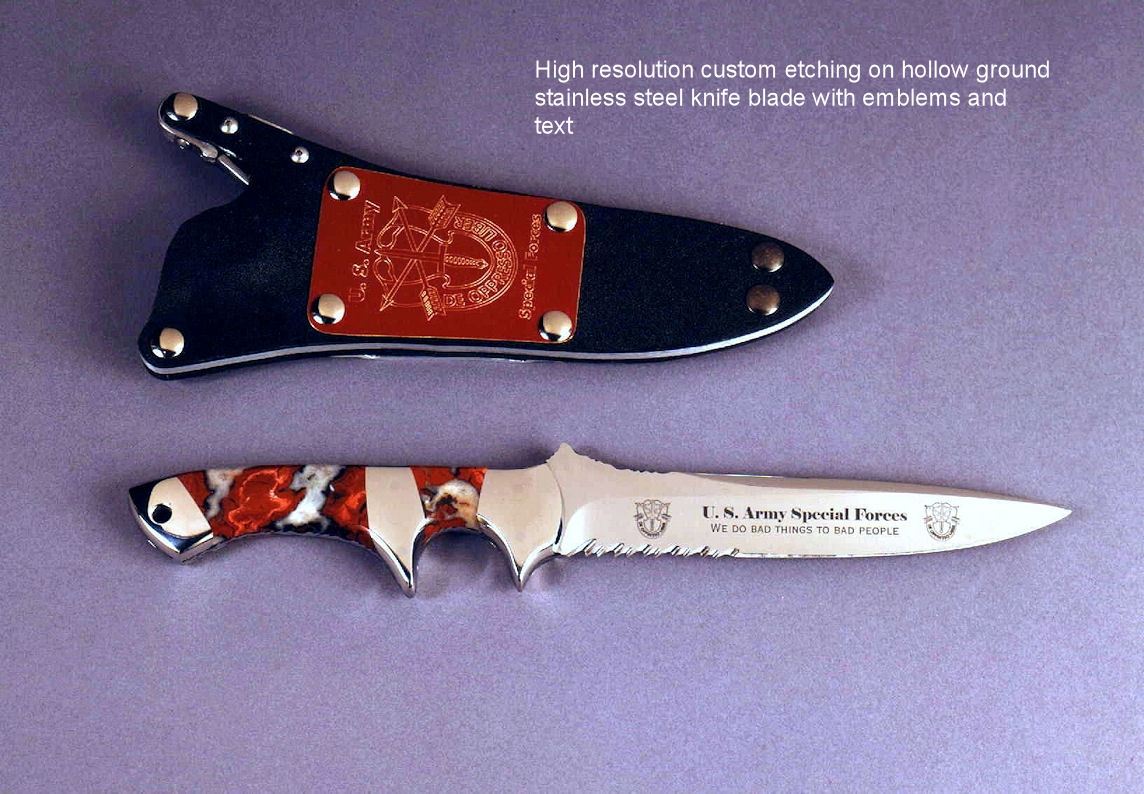
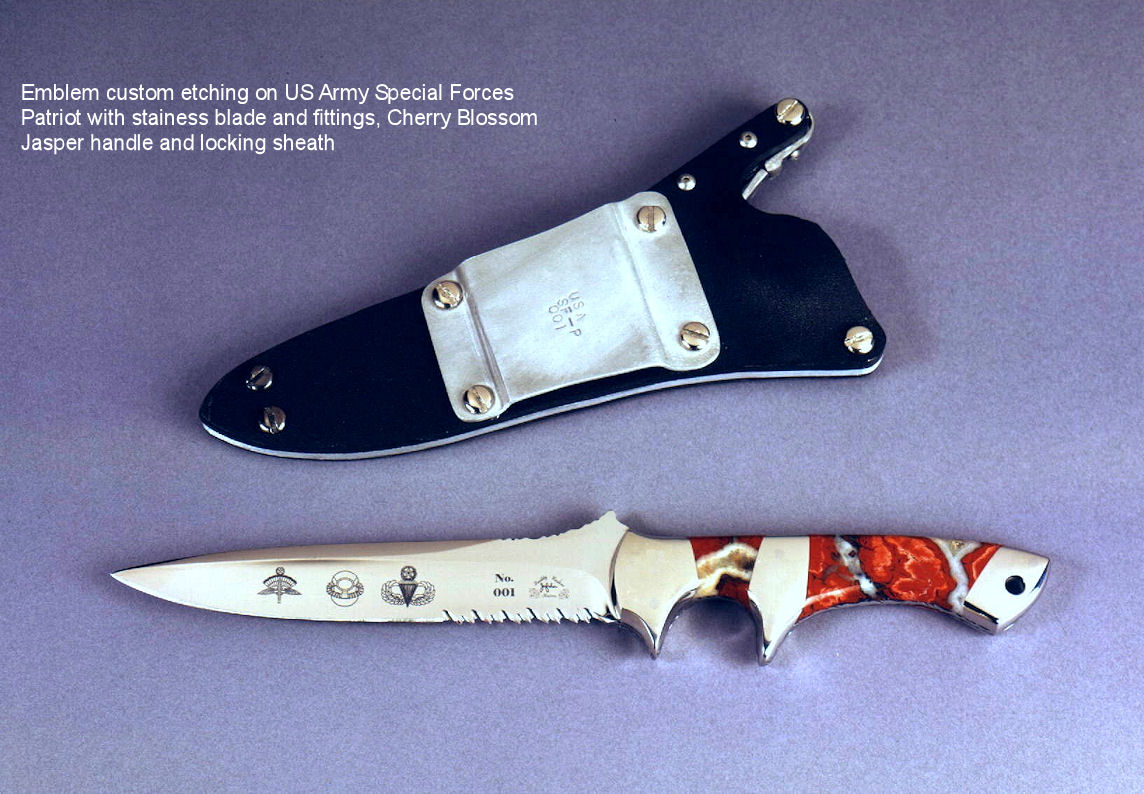
Simply put, my custom etching is remarkably better than old processes, cheap processes, or what is offered by nearly every other knife maker or manufacturer in modern times.
Today, etching process has been industrialized, masking methods improved, and electric current added to the process to aid in etching corrosion-resistant metals. In the knife field, factories etch imagery in blades, often in "limited edition" production runs, with some animal, event, publicity-driven cause, motion picture promotion, or just about anything they think will sell their products. Since these processes are automated, the object is speed of production, not quality of image or detail of the cut, so the etching is rough, with fuzzy borders, very shallow, and poor. With laser engraving some automated processes can personalize or individualize the imagery somewhat, but the laser, too, creates a fairly rough image.
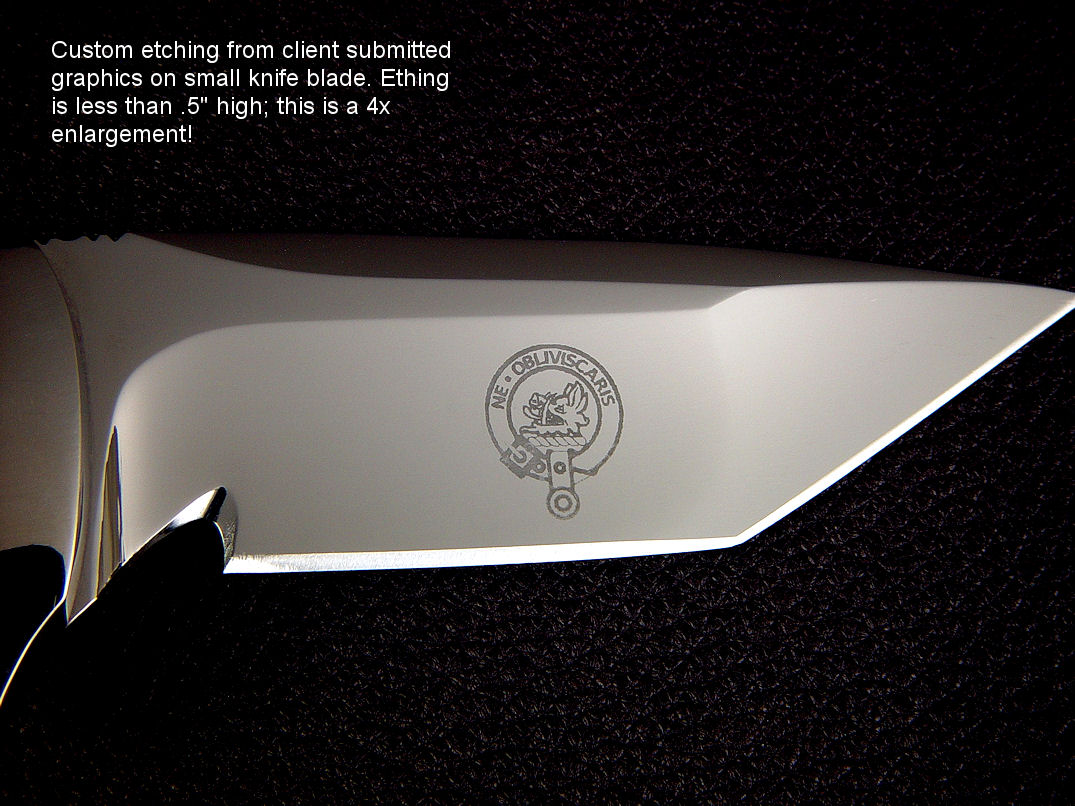
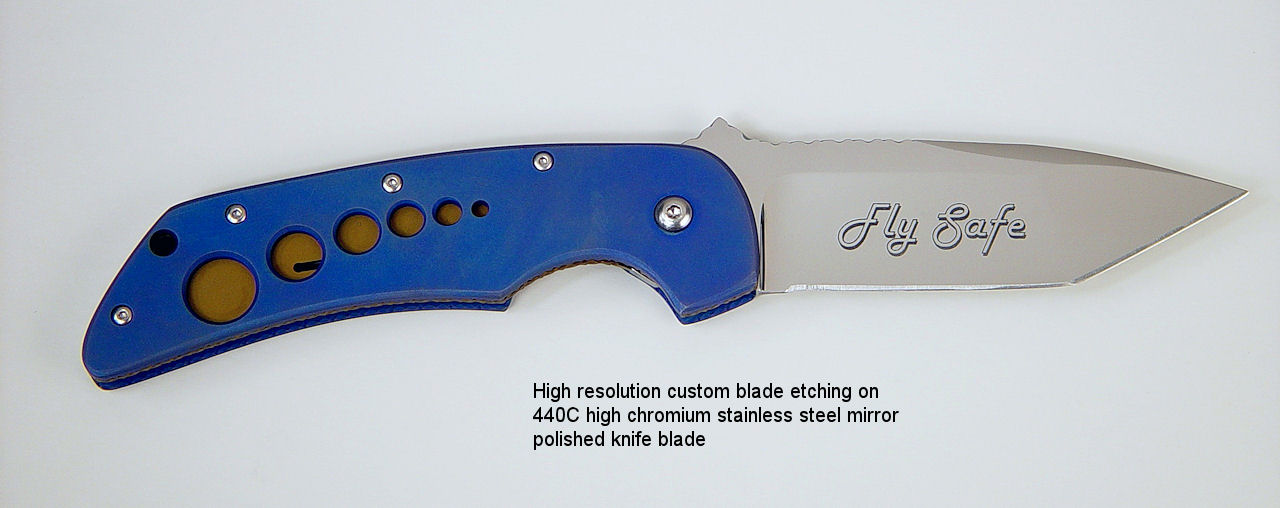
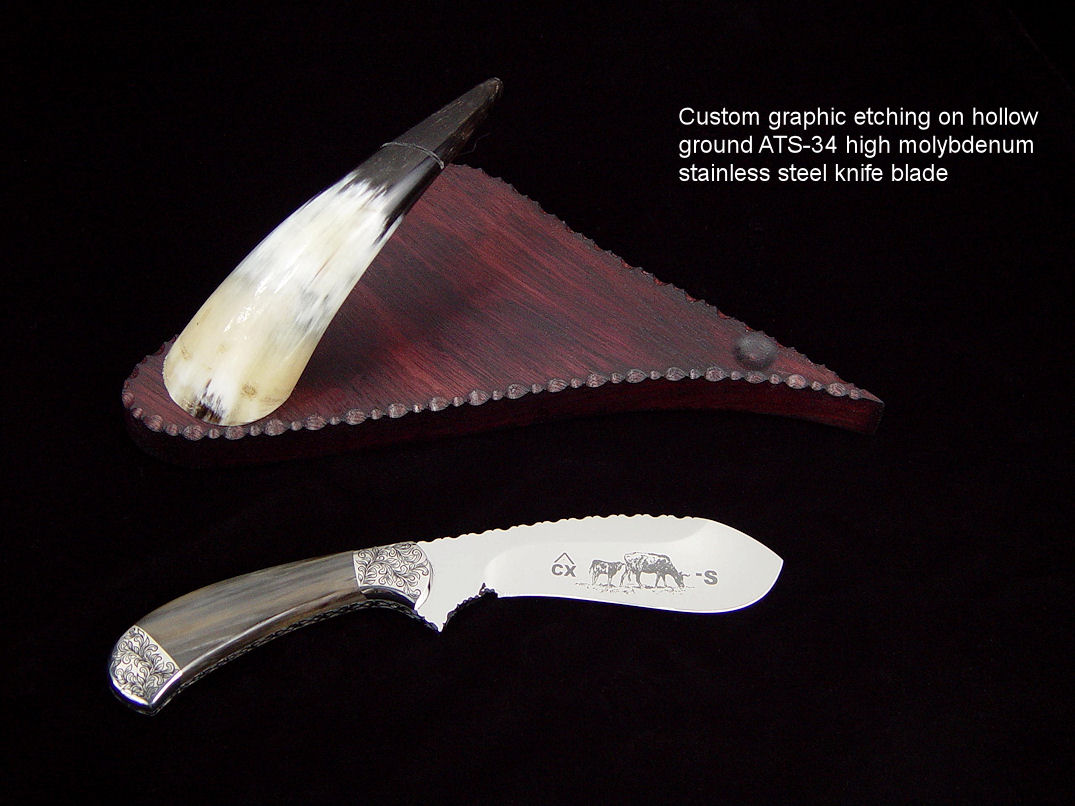
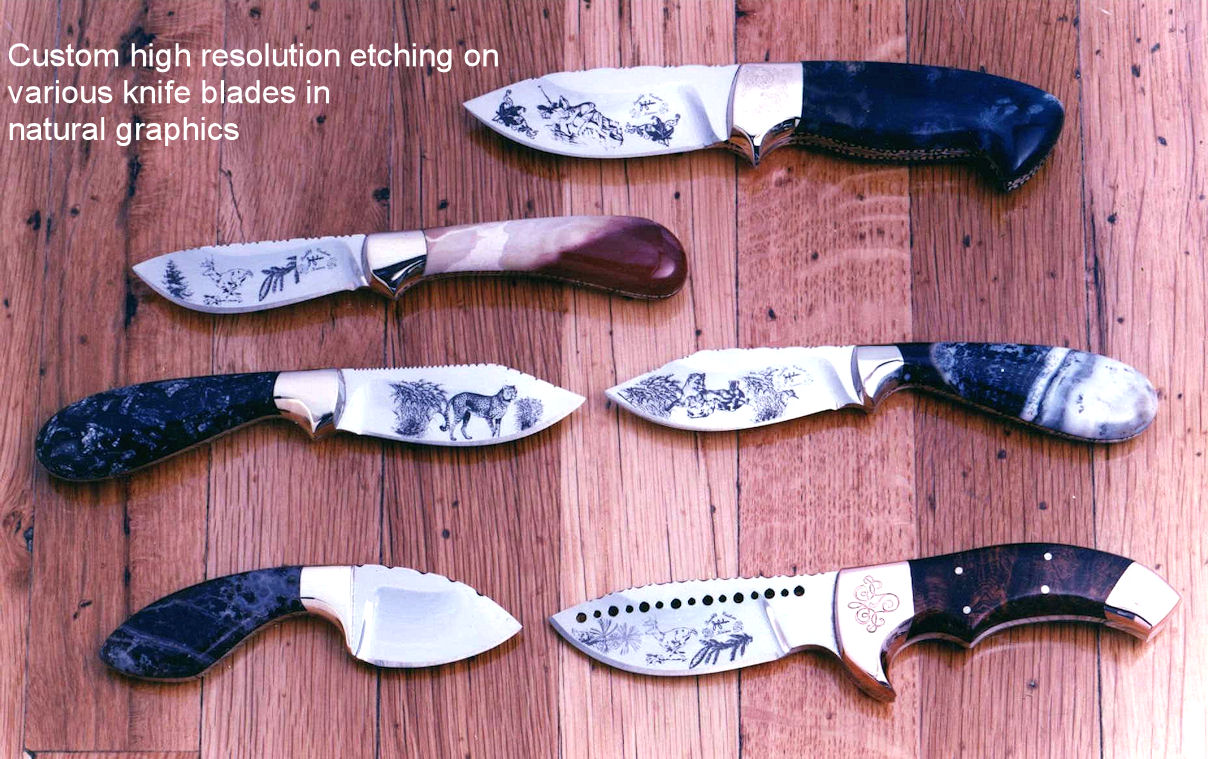
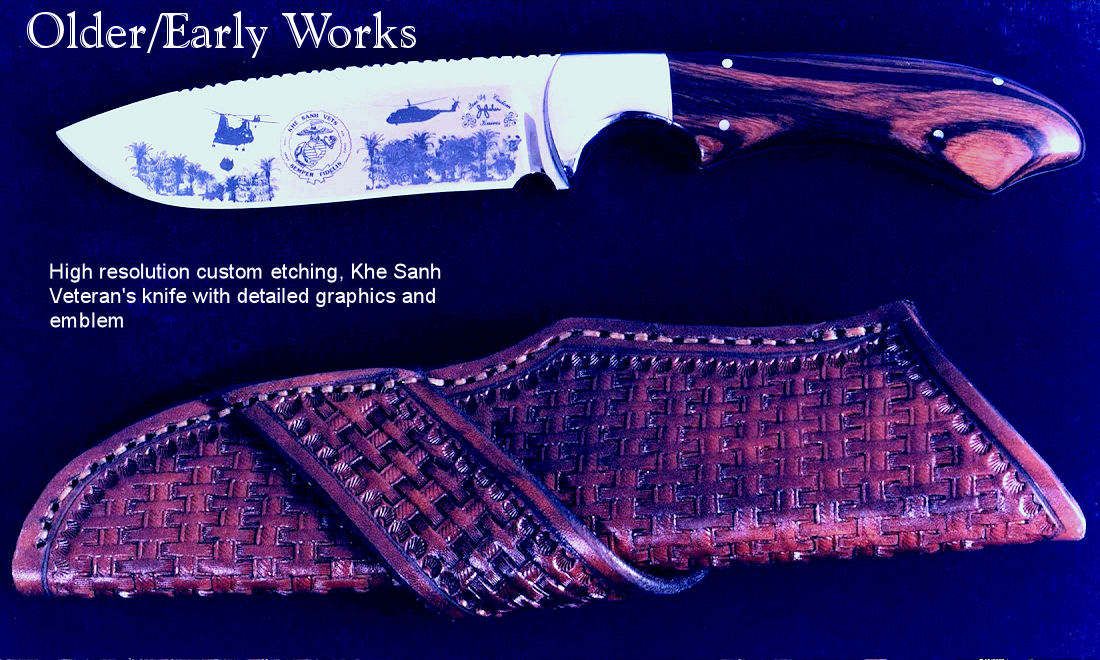
My etching process is different, and it is markedly better. I worked for six years to perfect the process, and have line resolutions to 1/100,00th of an inch. My etching is clean, crisp, and even. It never has fuzzy edges, and even if you examine it under a microscope, you'll be impressed. The etching is deep, dark, and permanent. How do I do it? Sorry, my process is proprietary. Several companies and numerous knife makers have begged me to sell the process to them, but I haven't. Maybe when I'm older, but I'm not done playing with it yet... I've got a few elaborate projects, etching of gemstone, and other things I've got to do first.
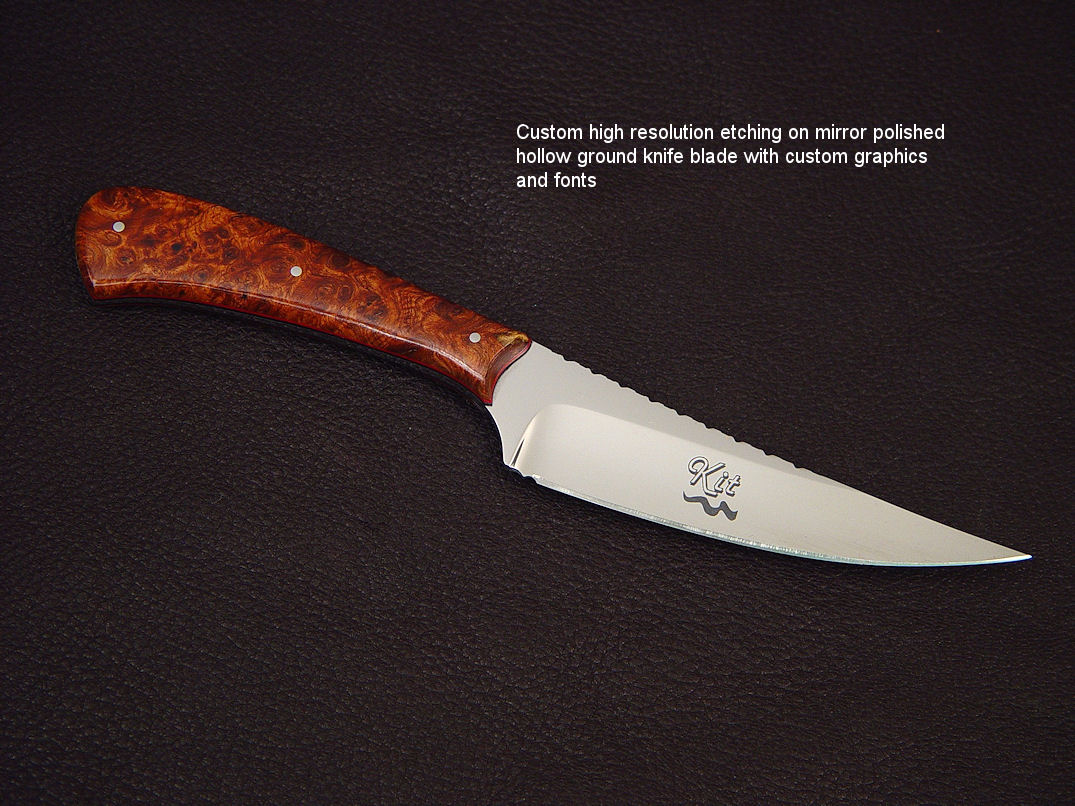
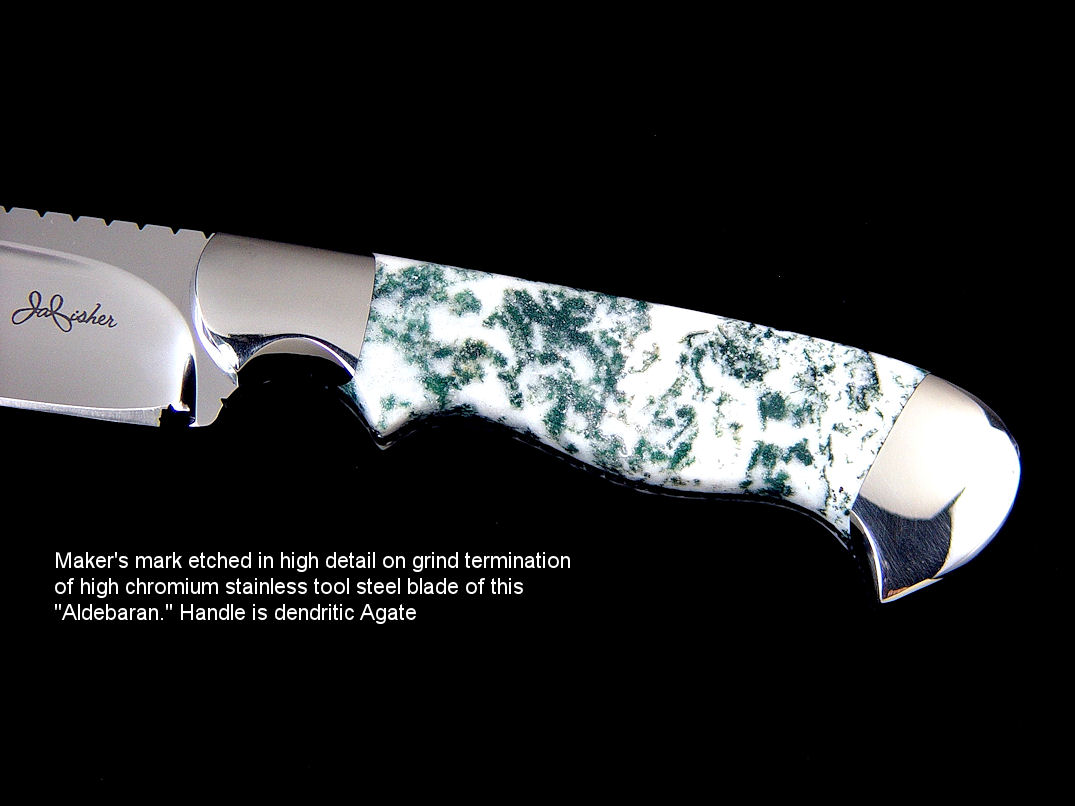
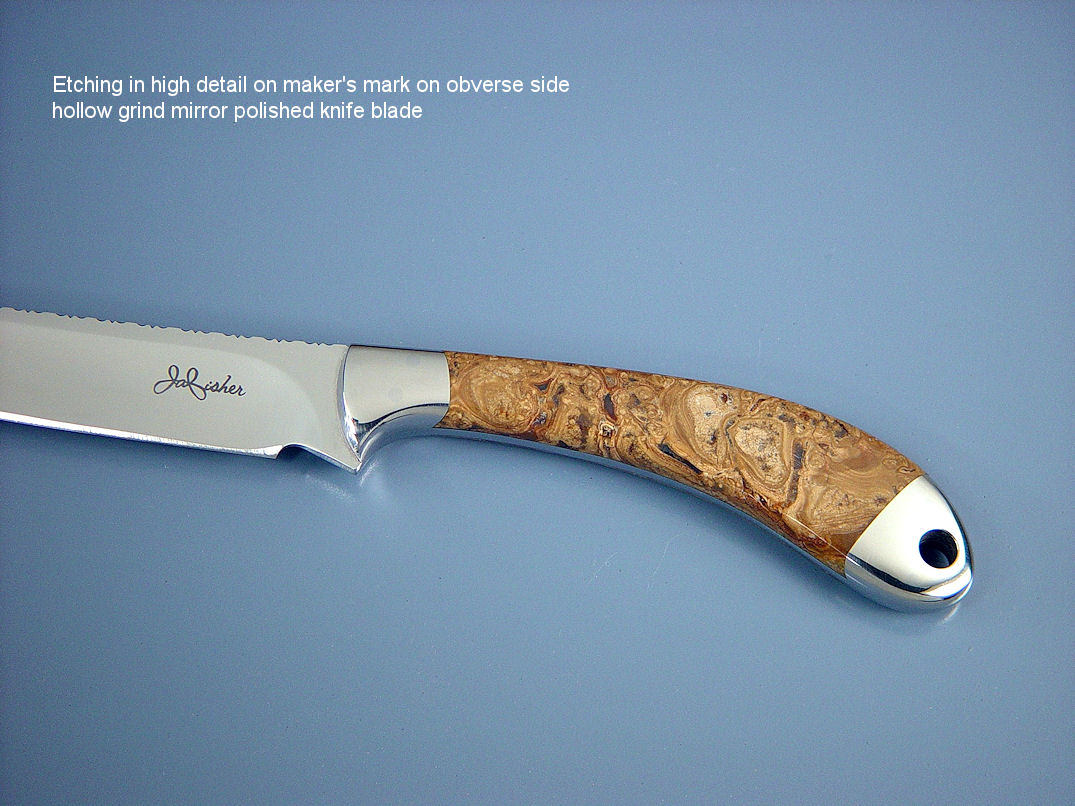
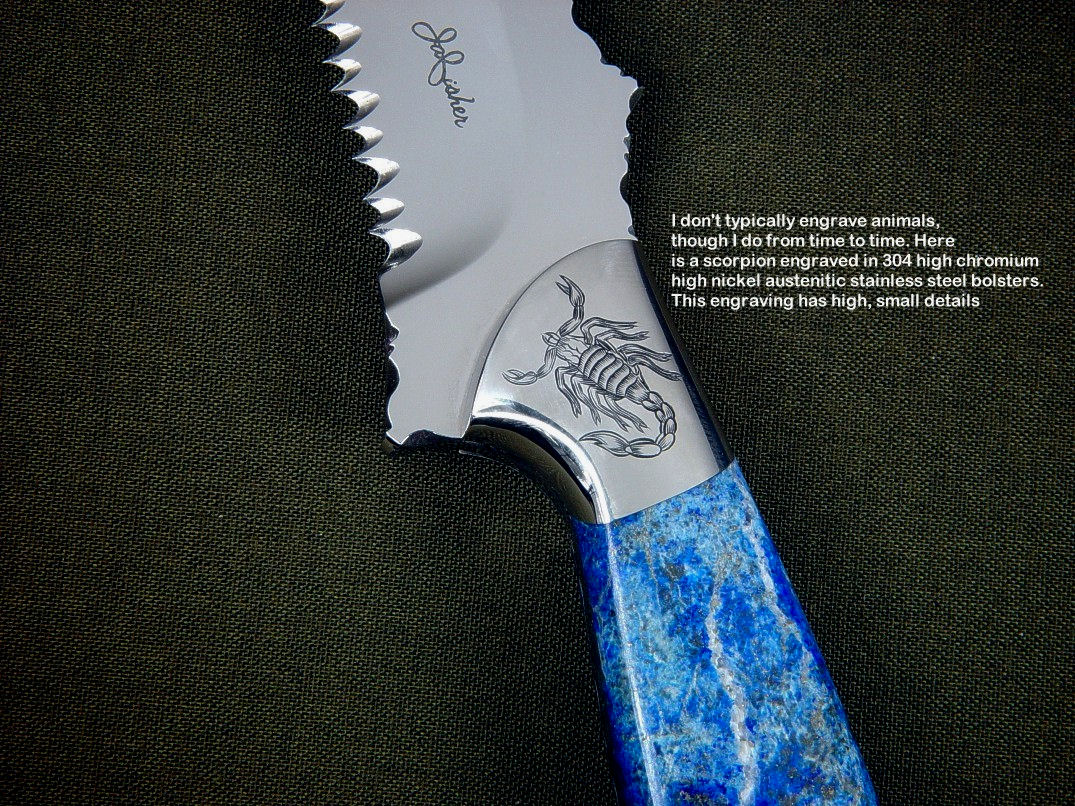
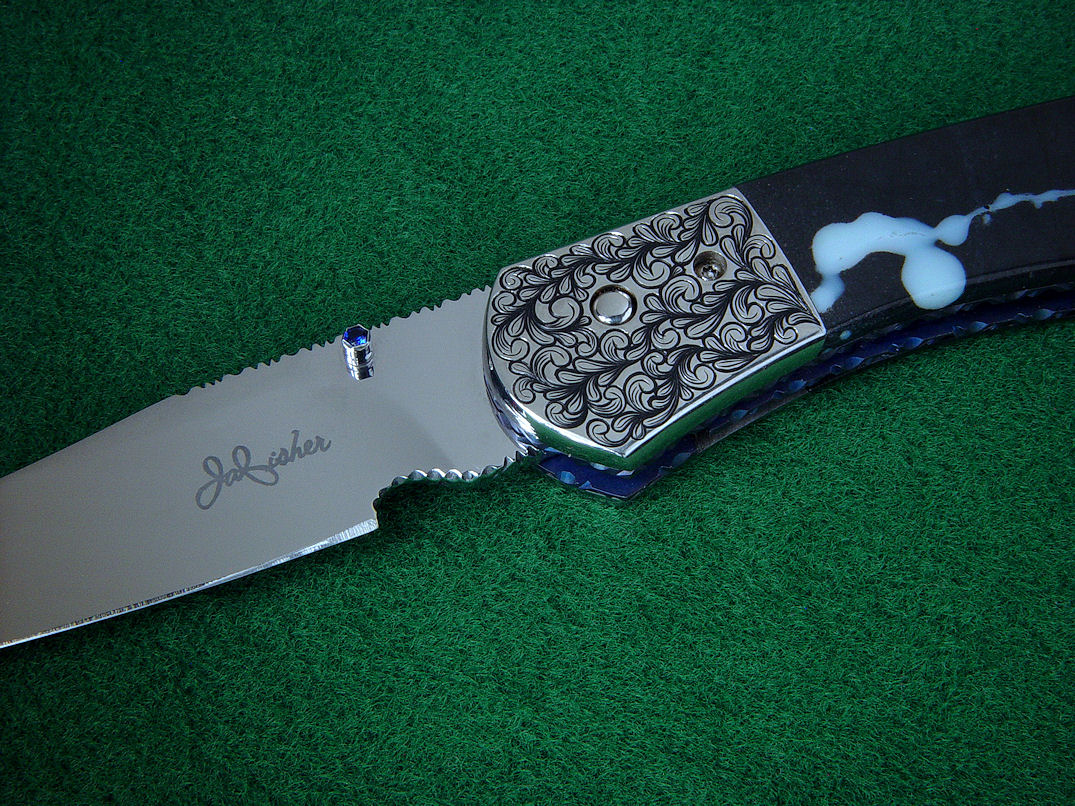
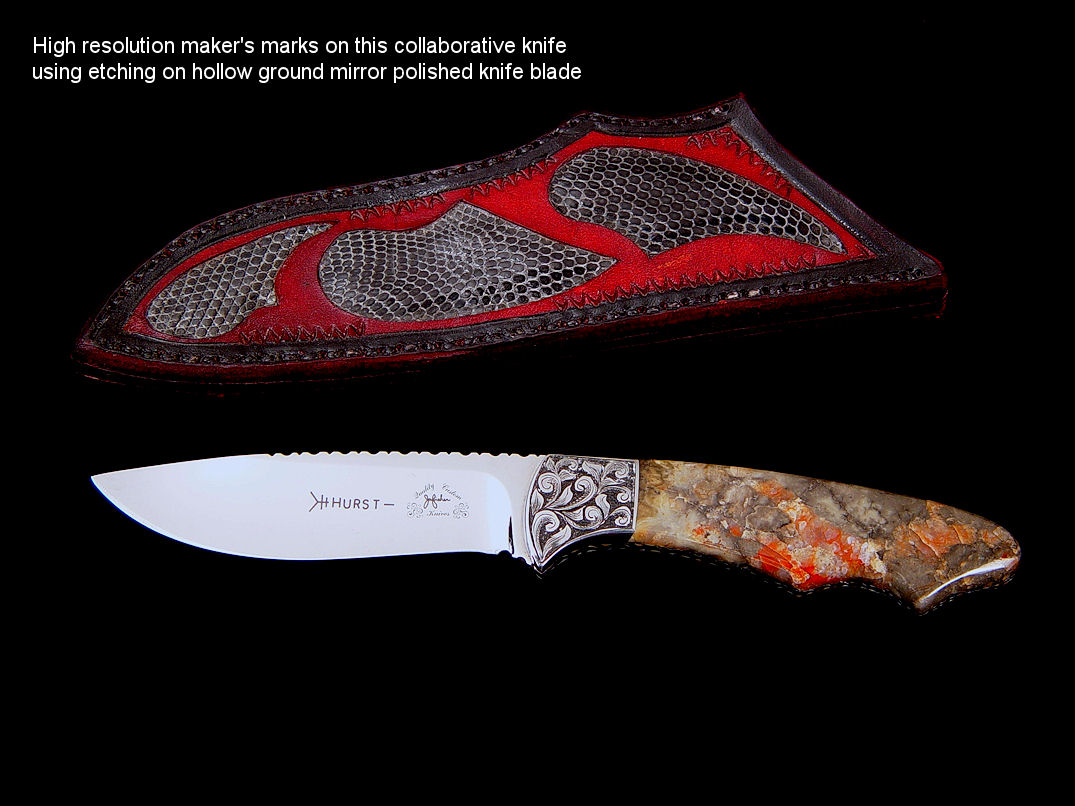
You've probably noticed that nearly all custom knifemakers etch their name or maker's mark into their blades. They use a well-known process sold by a company that advertises in knifemaker magazines, catalogs, and publications. The process is simple: a tiny sponge is soaked in an acidic solution, it's applied over a small plastic mask to the blade, a weak electrical current is applied to accelerate the cutting by the acid. The image is dark, low resolution, very fuzzy around the edge, and not very deep. My makers mark is different. It's extremely small and resolute, with very high detail and deep penetration. Most people need a magnifier to read it. My mark from 1988 to 2006 was "JaFisher Quality Custom Knives" in script, with two flourishes filling out the logo. The "JaF" is in a butterfly form. My earliest knives just had the butterfly "JaF." The entire logo is .530" wide on most knives, and I've even used a smaller one where space is limited that is .300" wide! Since 2007, my maker's mark is simply my "JaFisher" signature, but the quality has not changed. It's clear, sharp, and well etched. Read more about my own maker's mark on a dedicated page here.
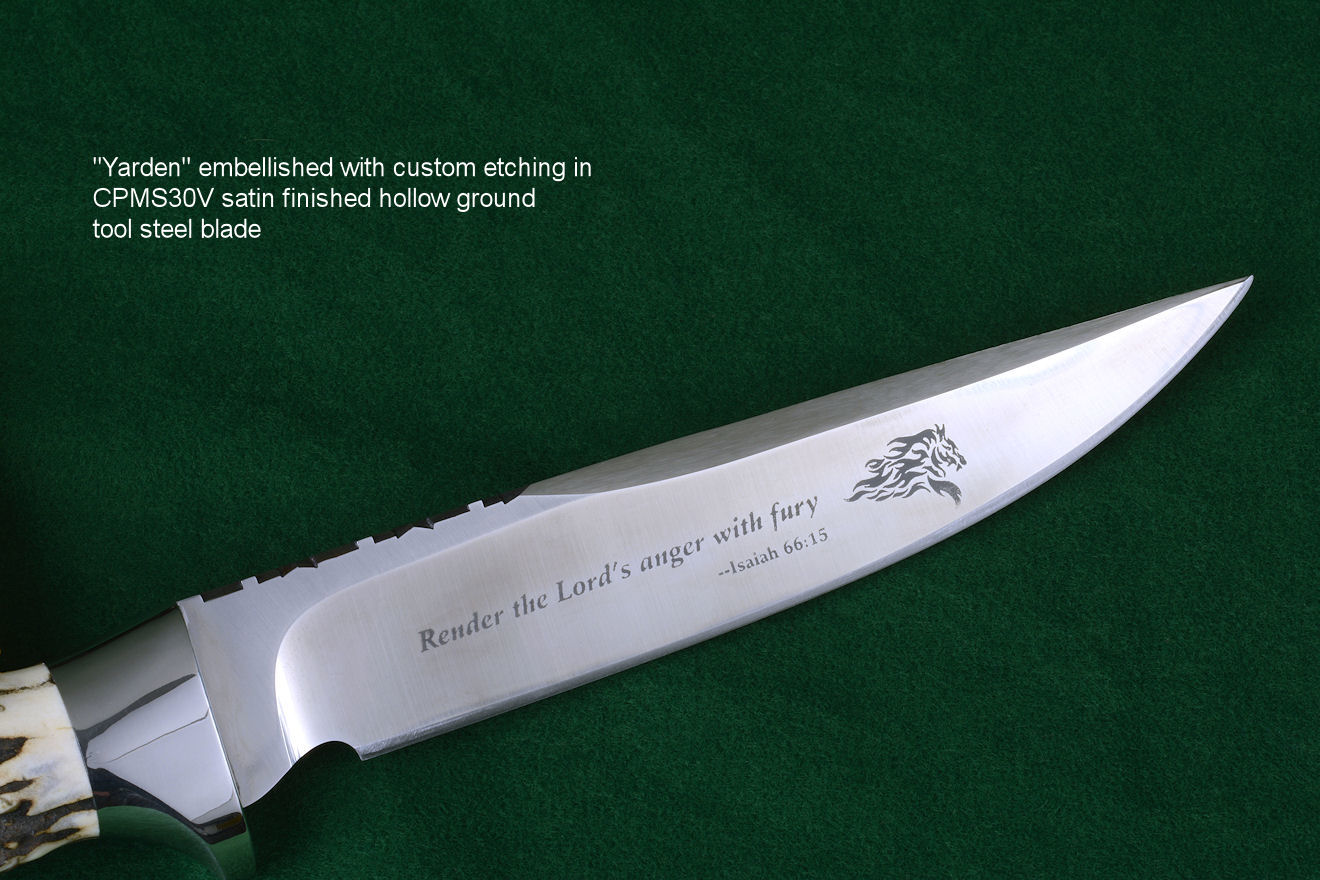
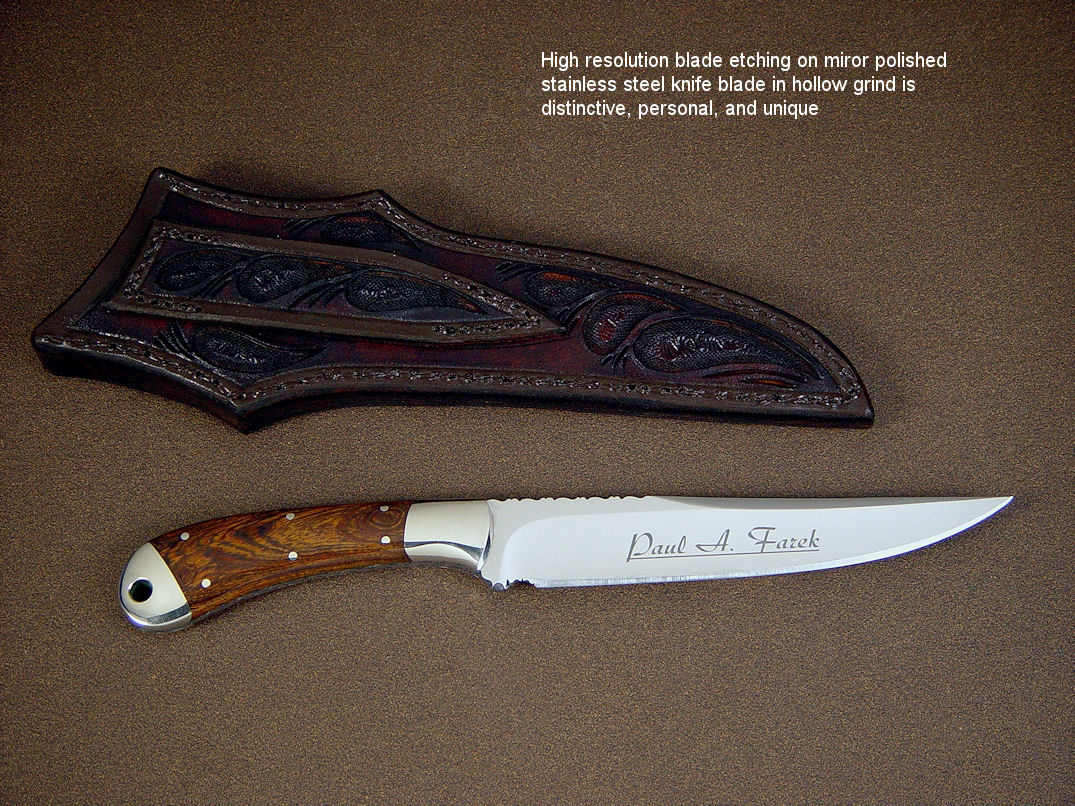
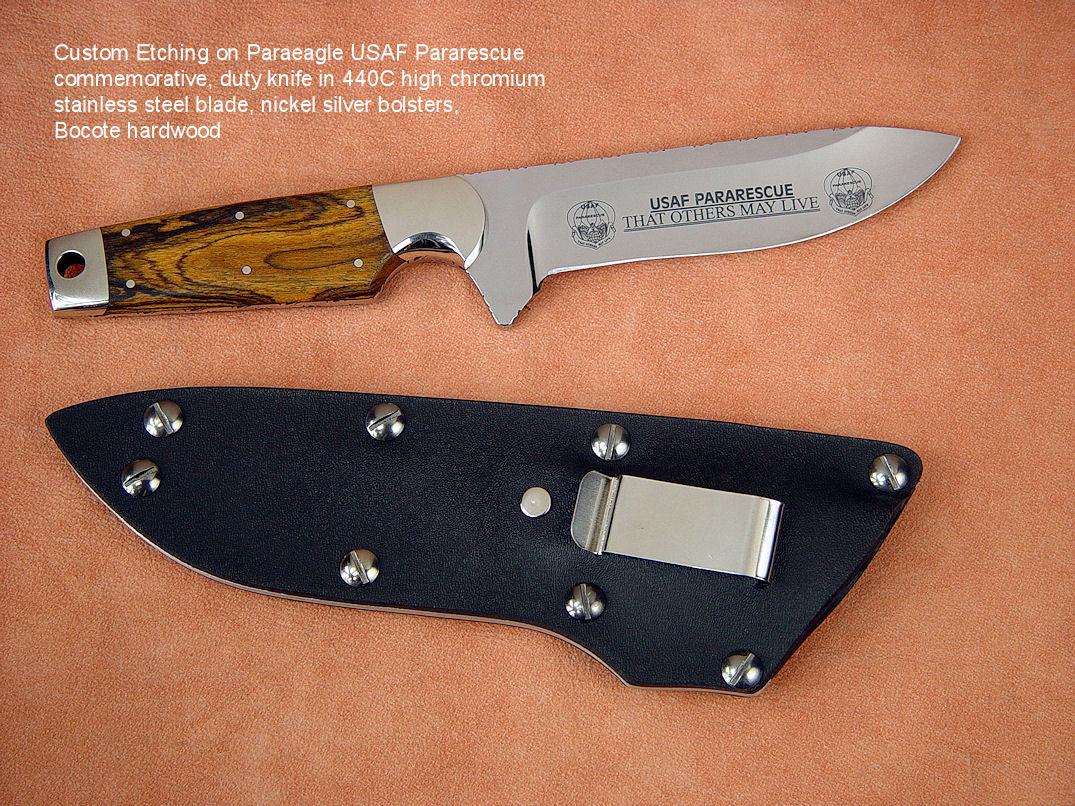
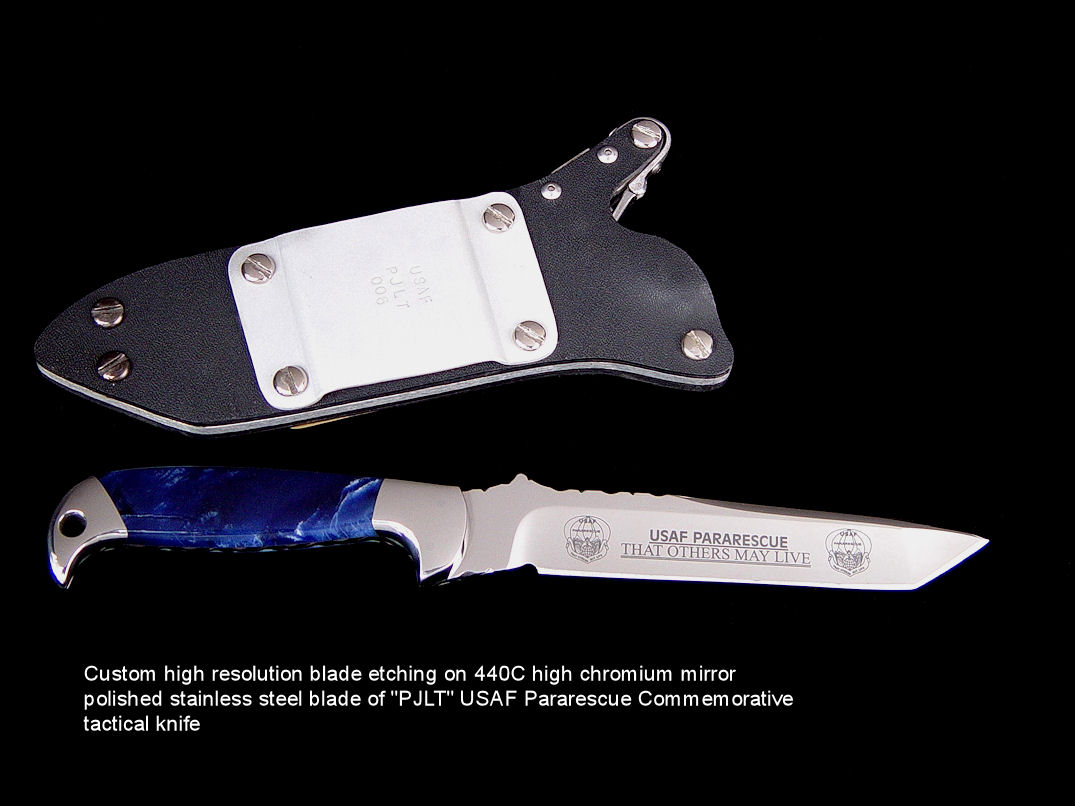
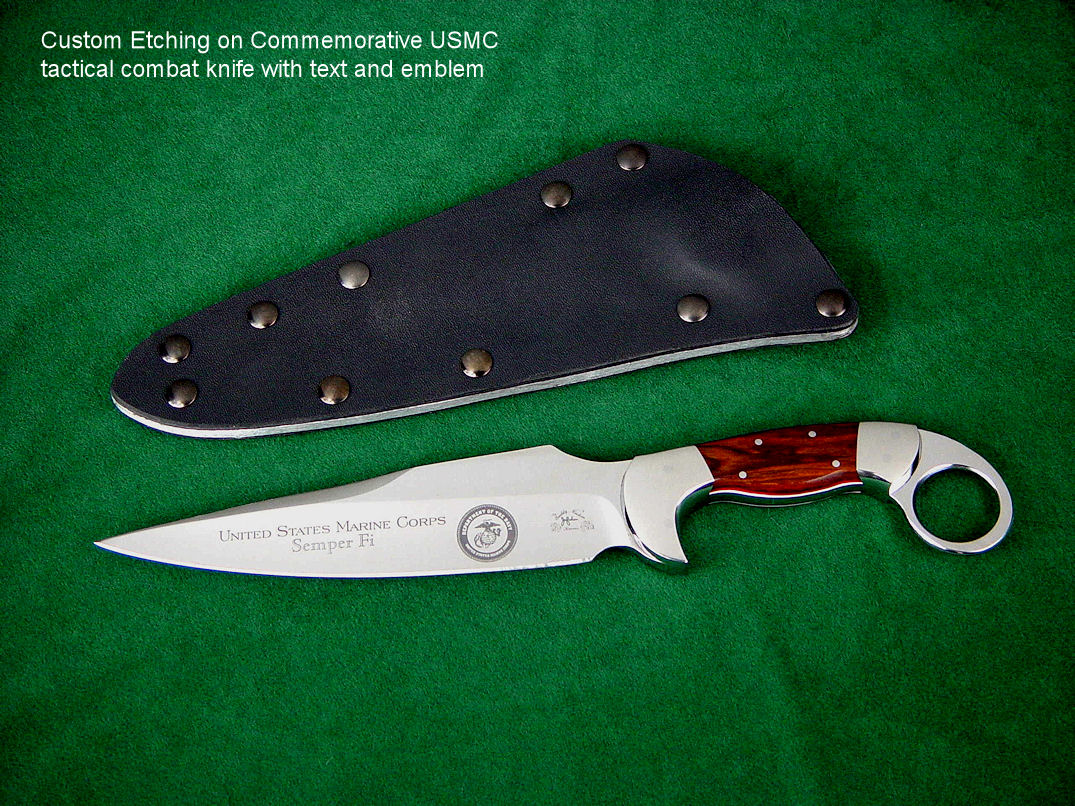
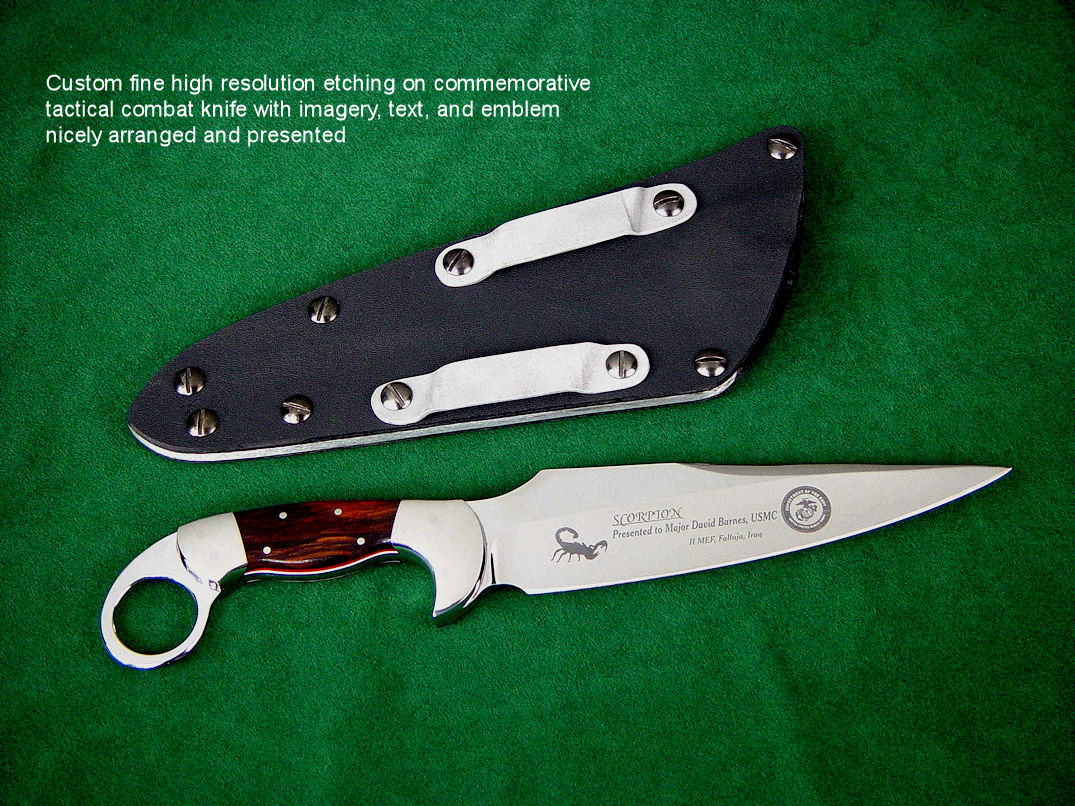
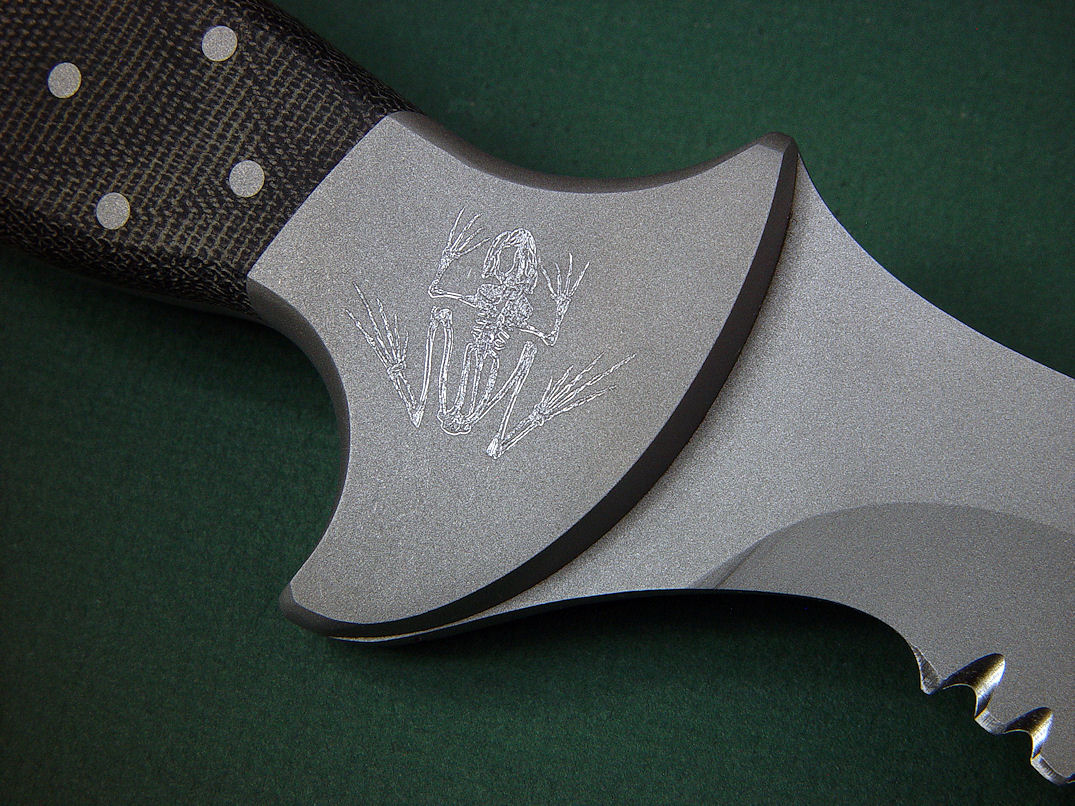
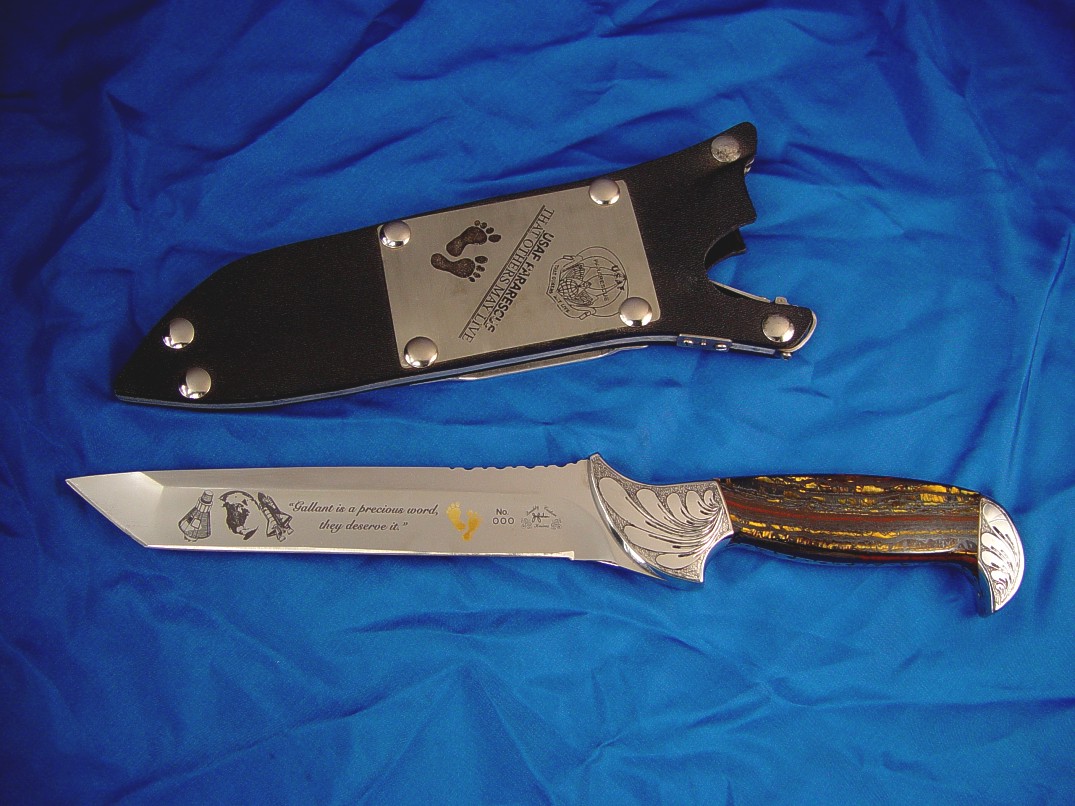
Beyond the maker's mark, I can etch just about anything in a blade like military logos, emblems, text detailing names, service dates, and important events. I've etched animals, flourishes, faces, foreign language characters. Just about anything you can imagine can be etched permanently into the blade, bolsters, or metal components of the knife or sheath. I even etched gemstone handles.
What I charge for custom etching depends on the image. Obviously, high detail graphics will cost more than text. Sometimes, it is more effort to custom design the artwork than to execute the etching. Each etching is quoted on an individual basis.
Is my etching deep? You won't live long enough to hand-polish the deep cuts out of the metal. The only way to remove it is to regrind the blade starting at 40 micron (about 360 grit) and sand the blade back to high polish.
In the past, I've etched bead-blasted blades. I wasn't happy with the fogging and fuzzy quality of the etching, so I now only etch finely sanded or mirror polished blades. This takes advantage of the fine resolution, high detail, and stark contrast of the etching cut.
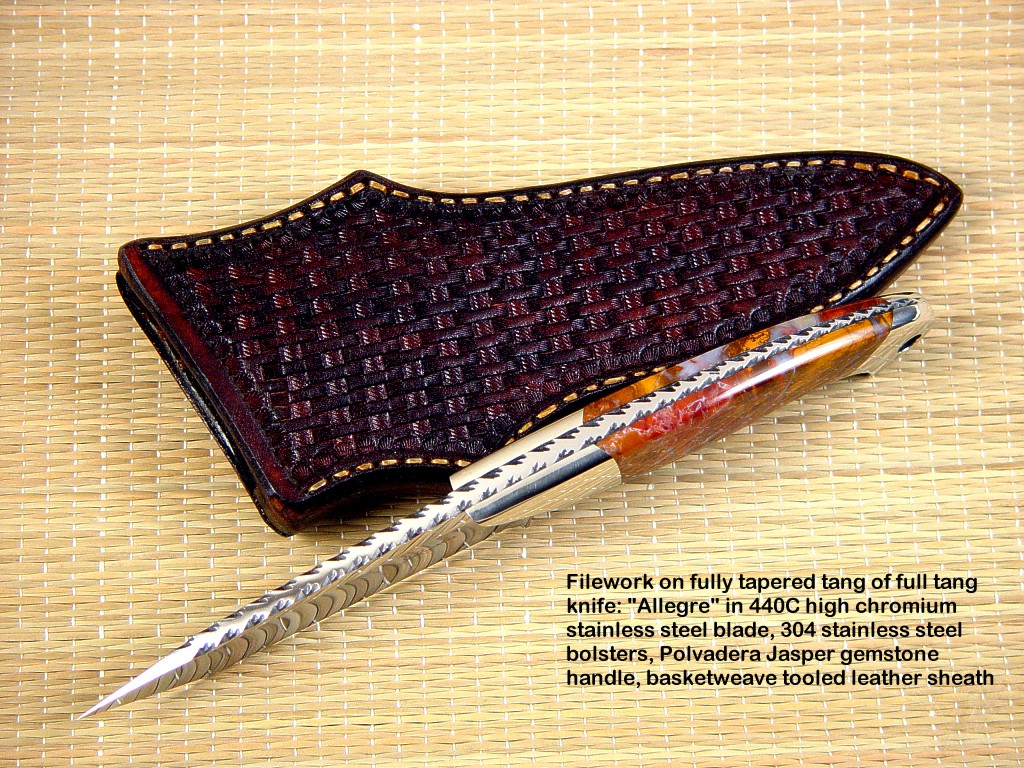
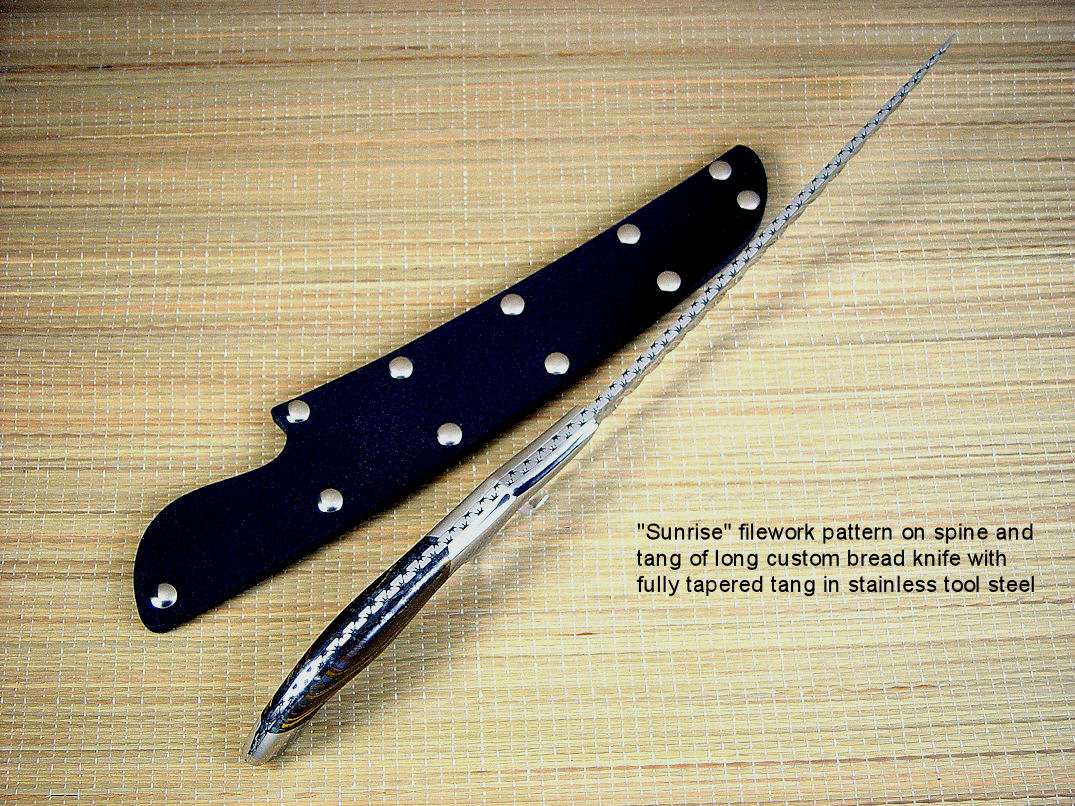
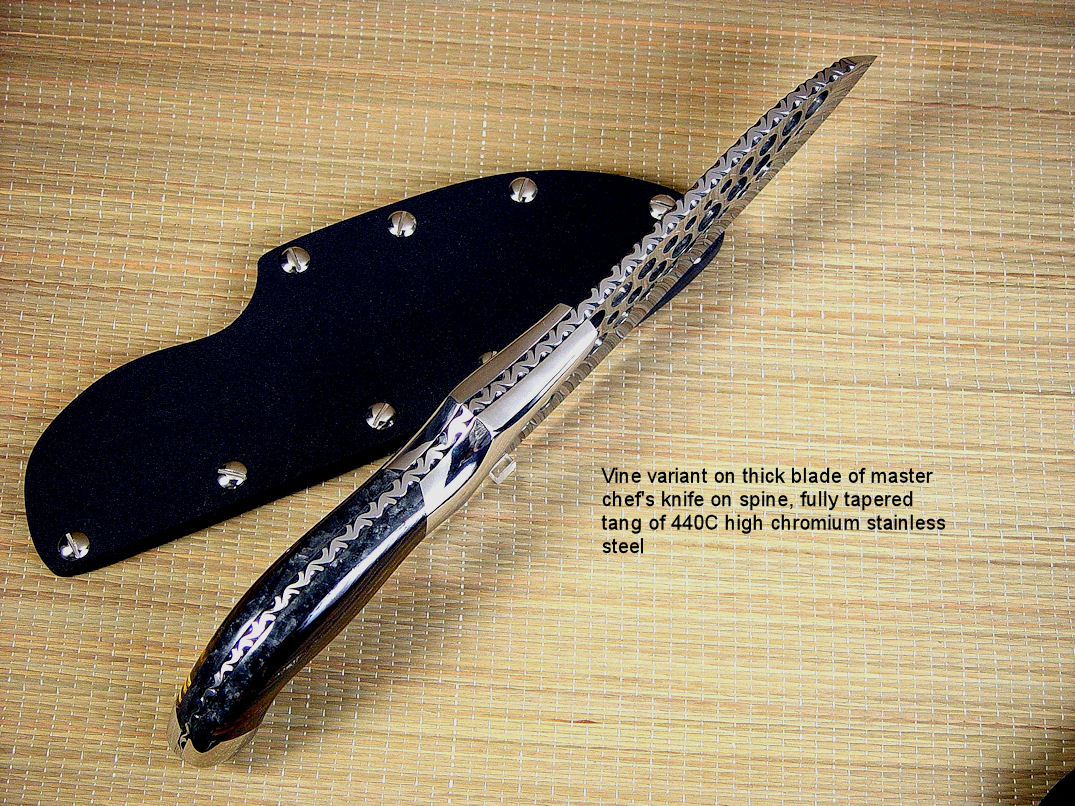
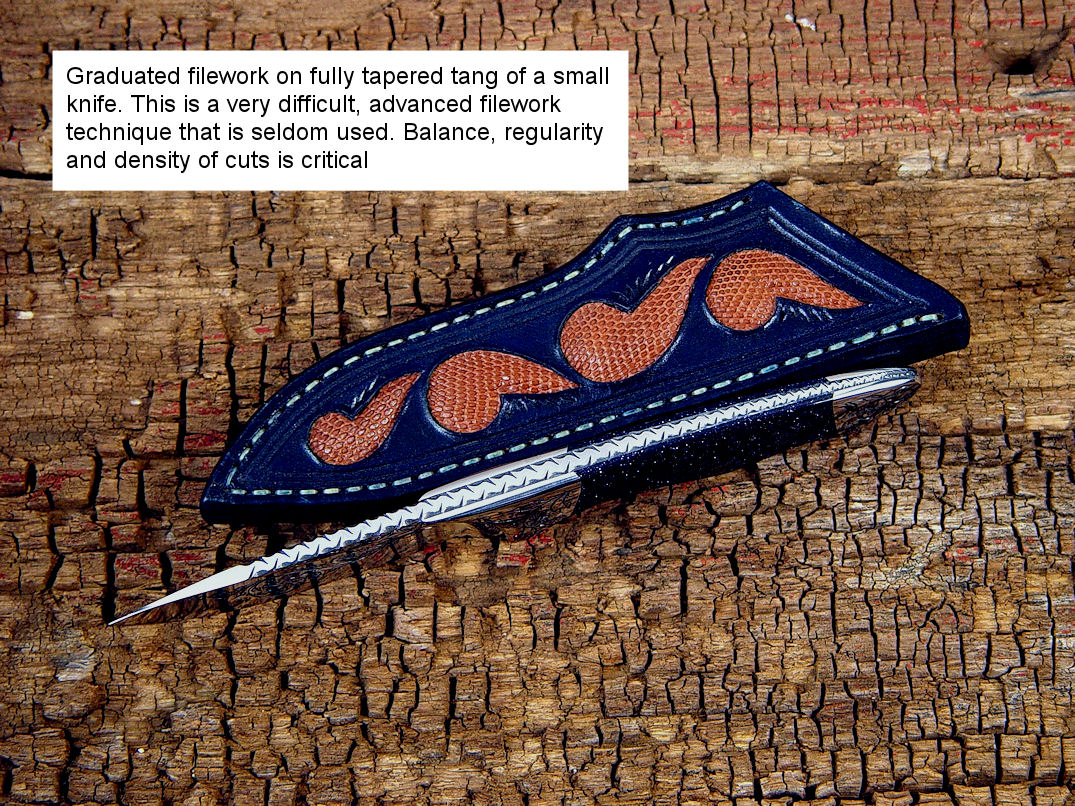
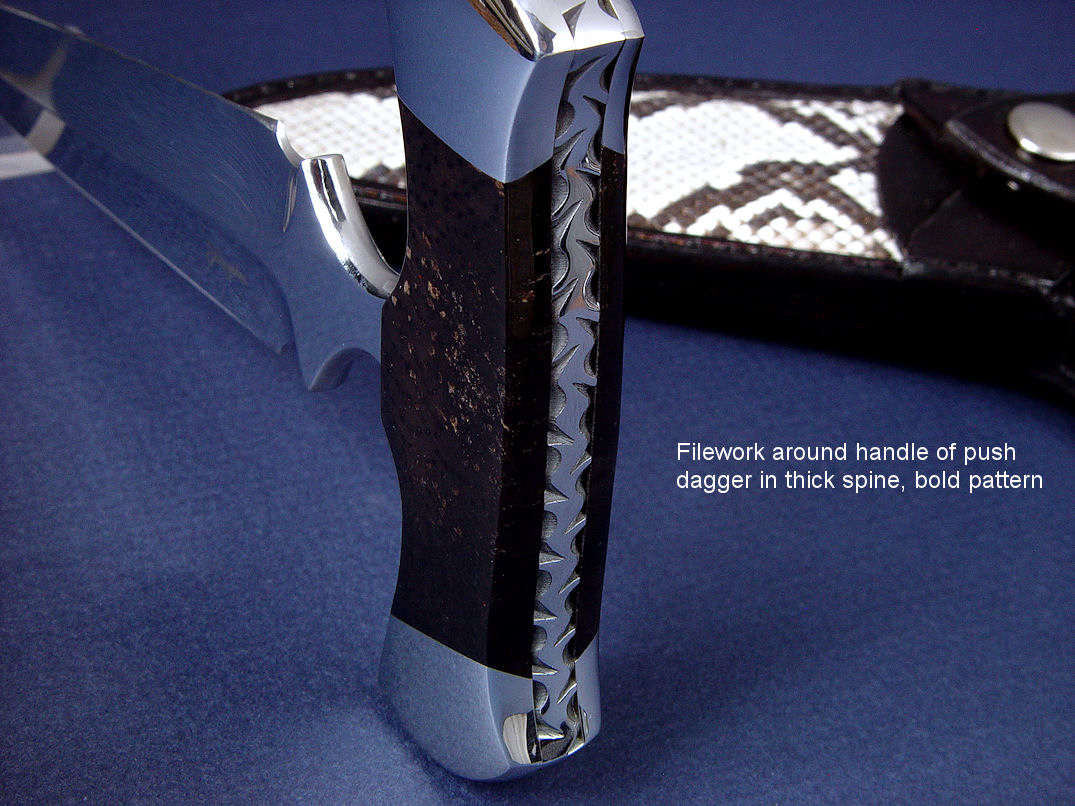
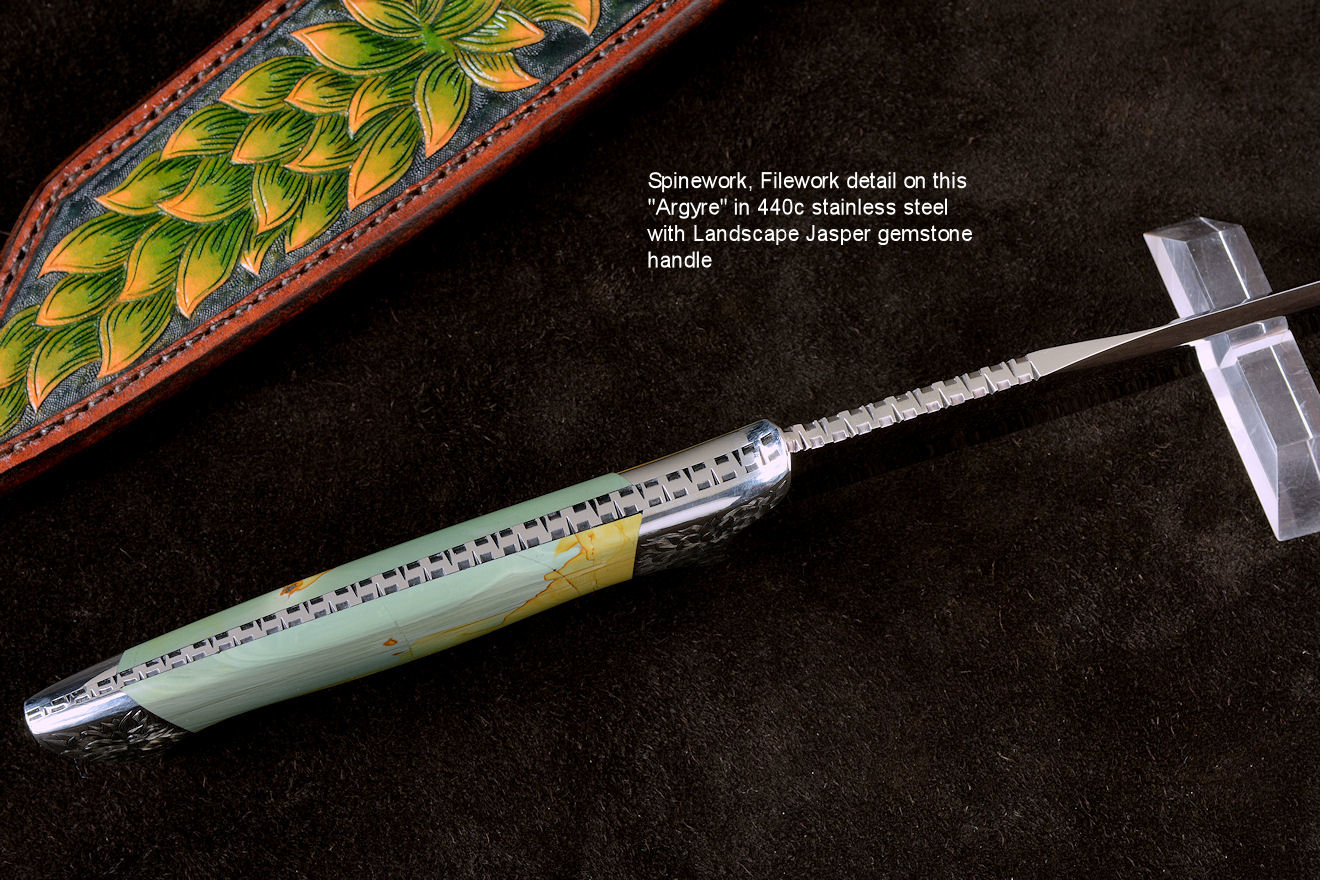
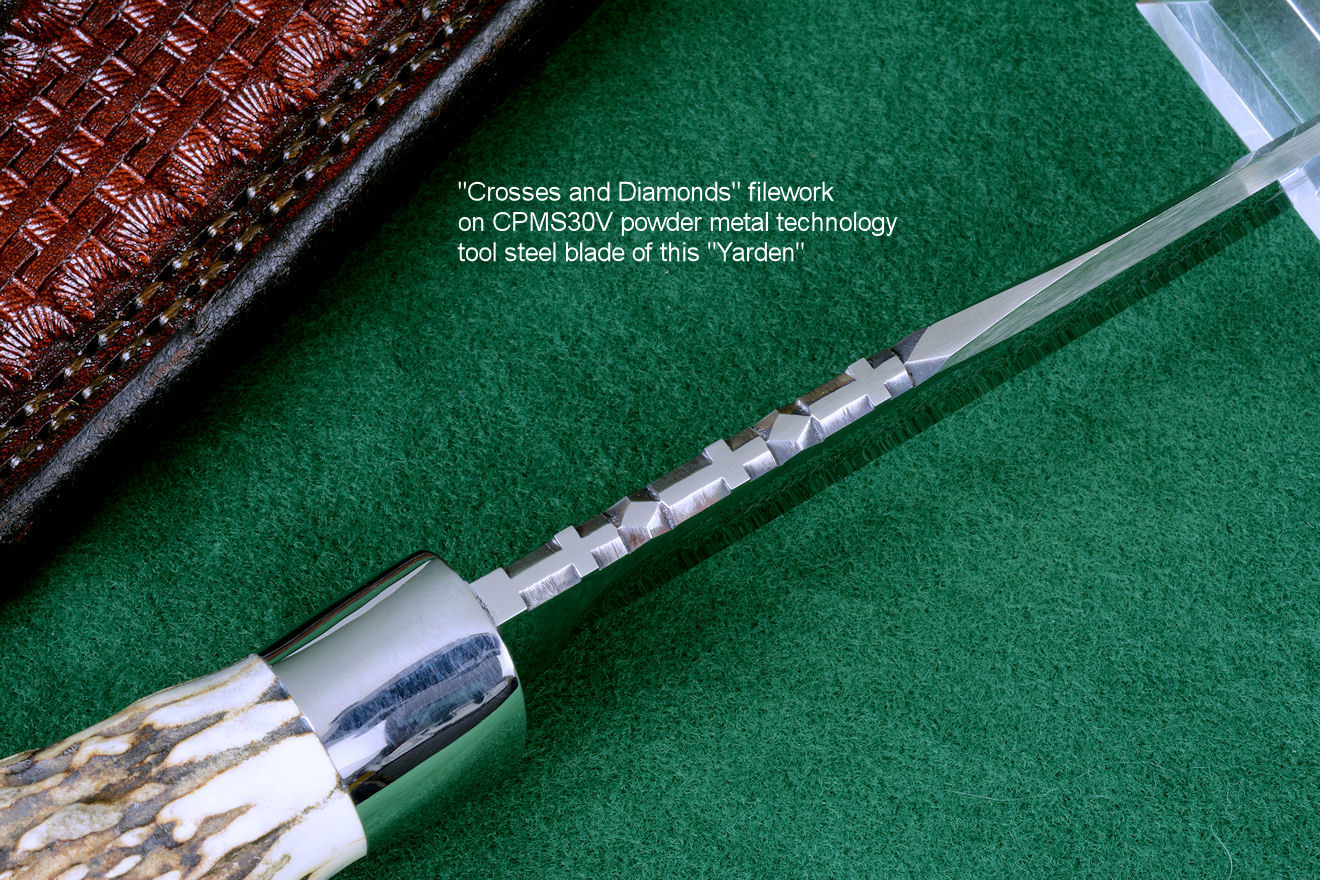
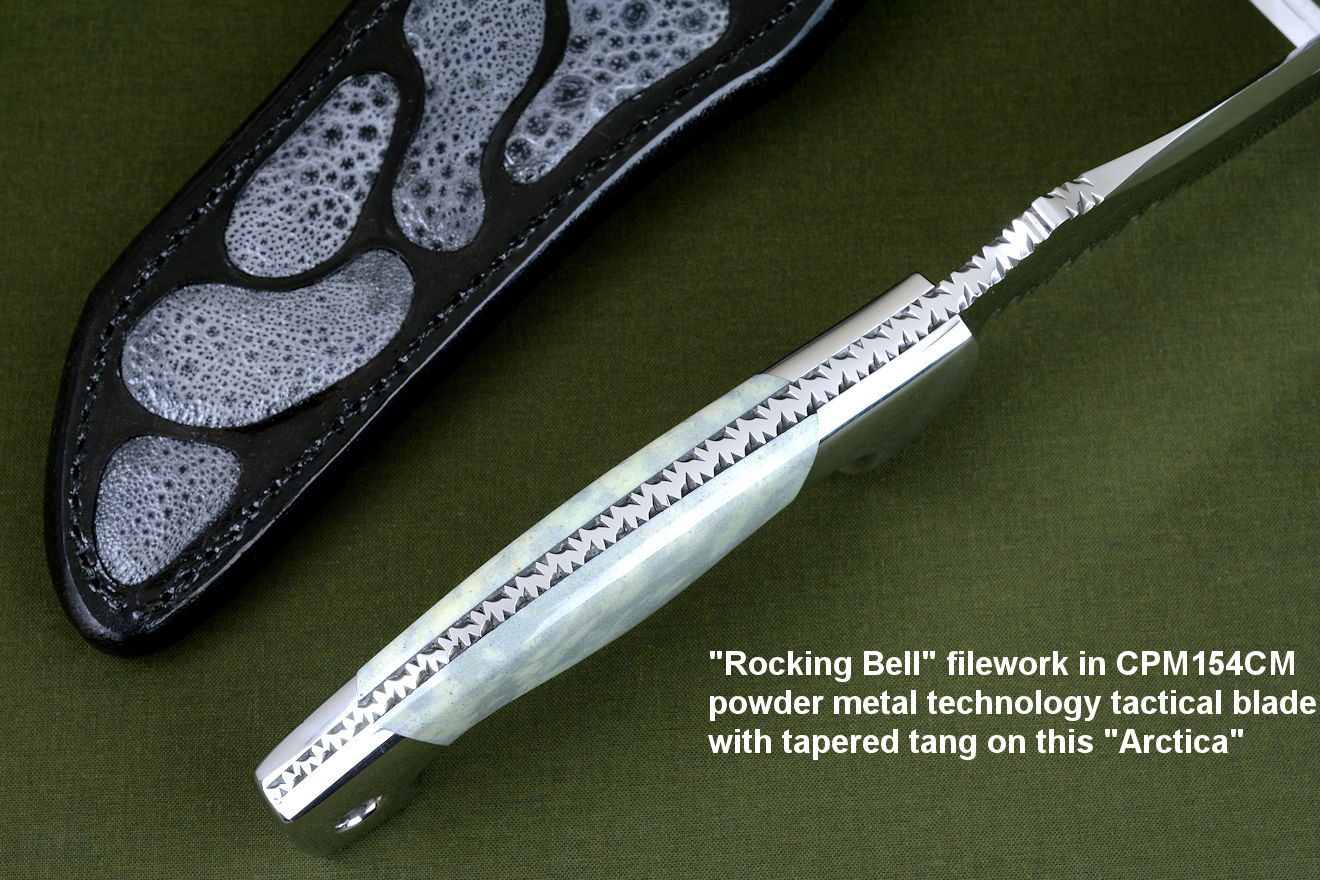
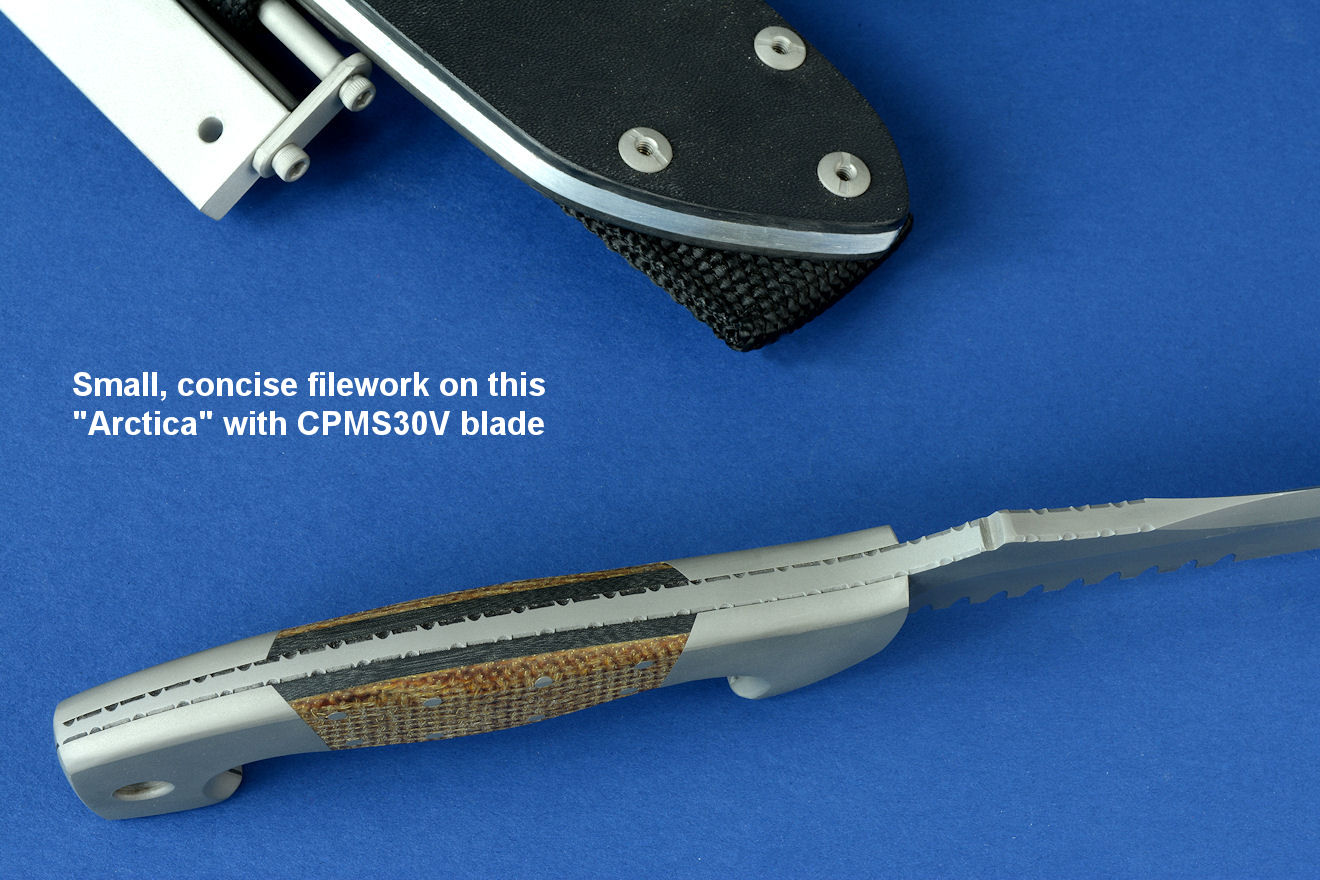
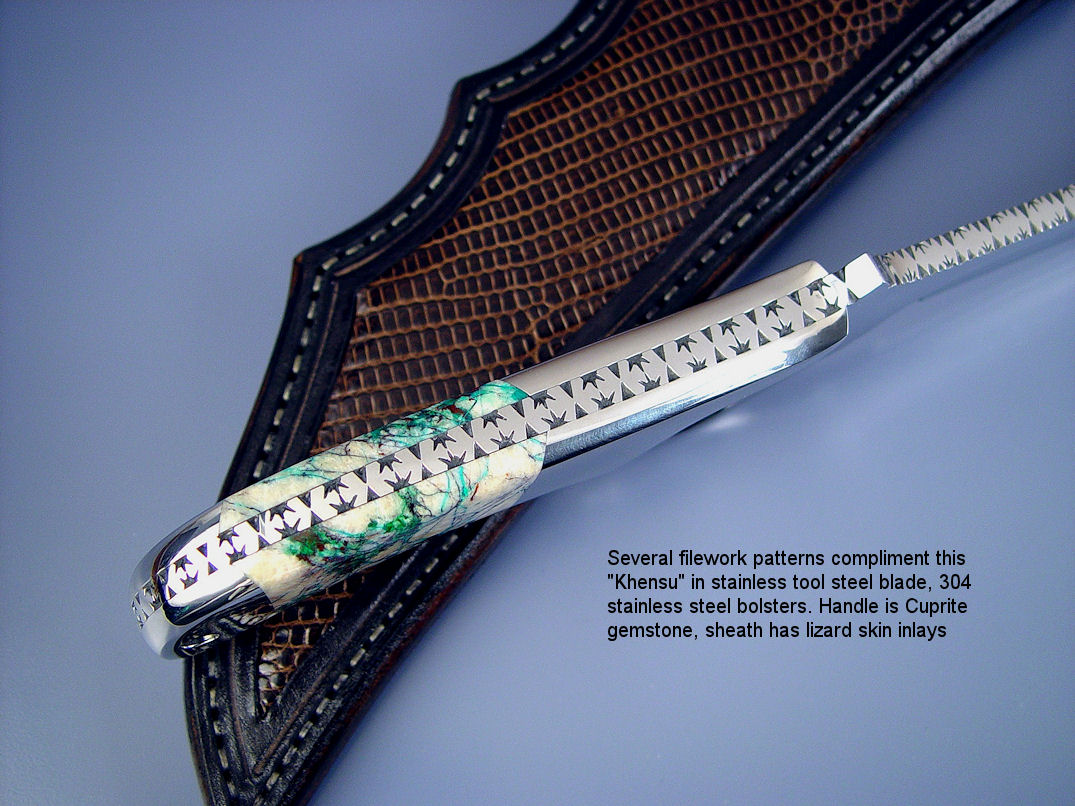
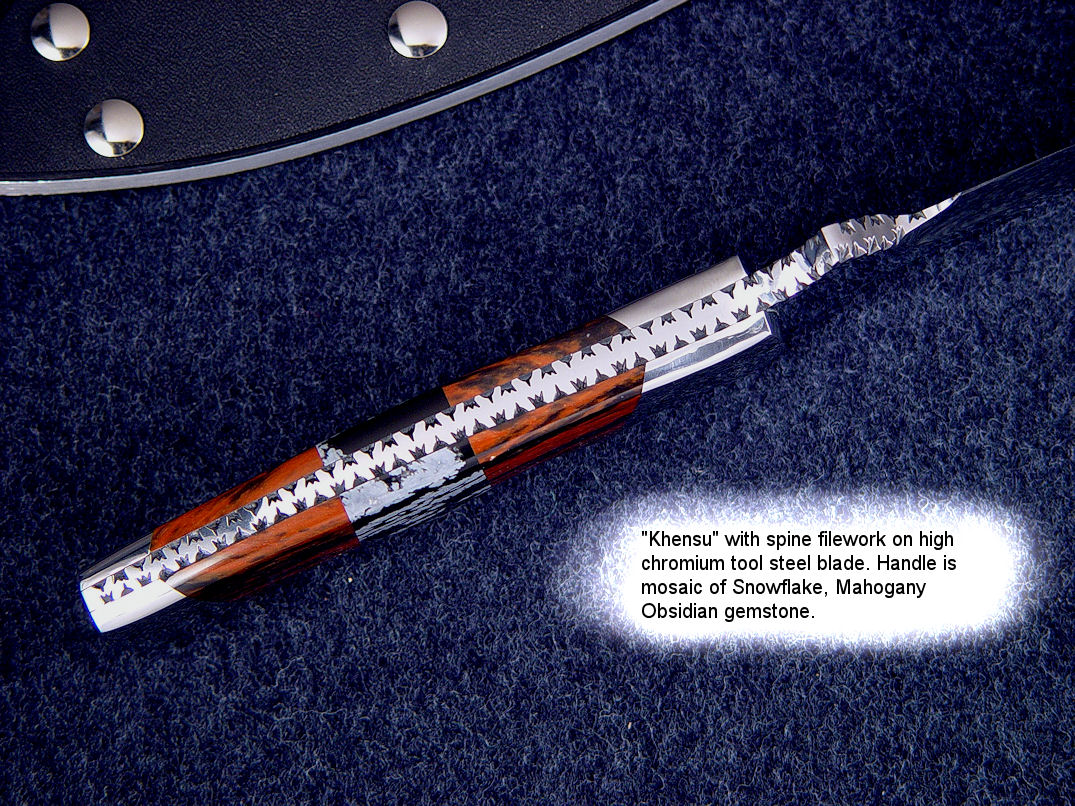
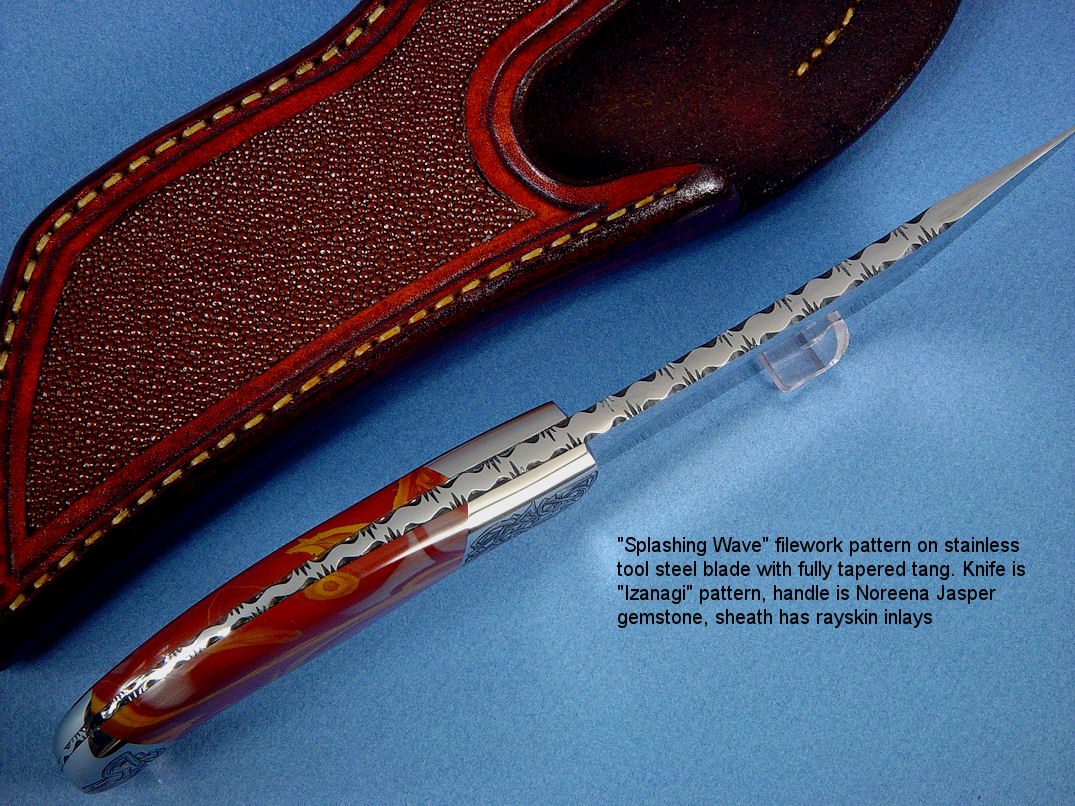
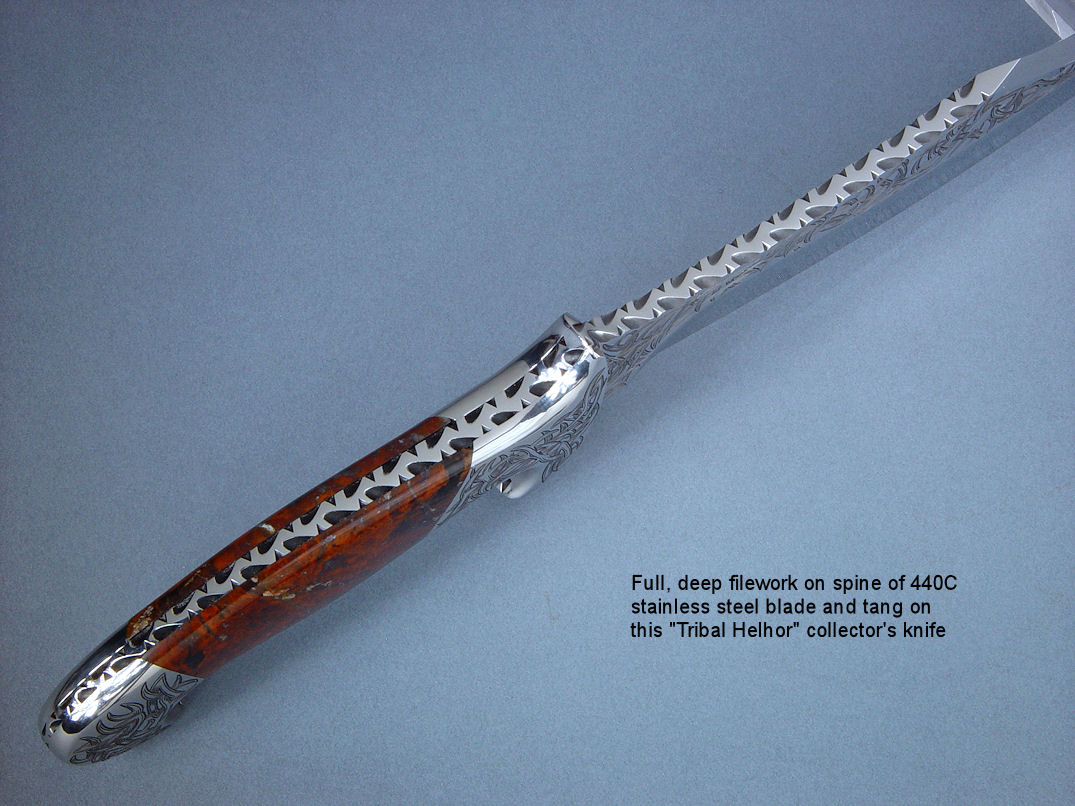
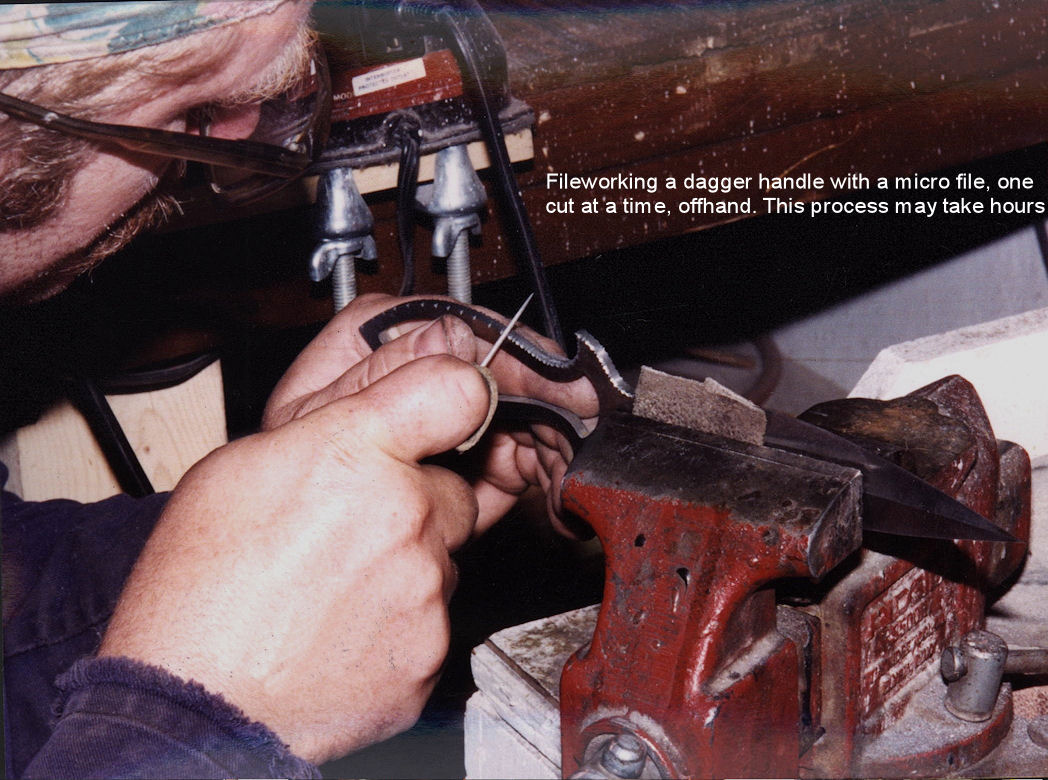
Once upon a time there was an old word, "jimp" that came from North England and Scotland, meaning neat, handsome, and slender in form. The early knife industry designated these machined cuts or cross-hatched patterns on the back of the spine of the knife to improve traction of the fingertips "jimping." They still call those regular spaced machine made cuts jimping, but the in the custom and handmade knife world artistic filework is the dominant version and king of technique. Jimping may be machine cut by automated slitters, mills, or blades, but filework must be hand-cut.
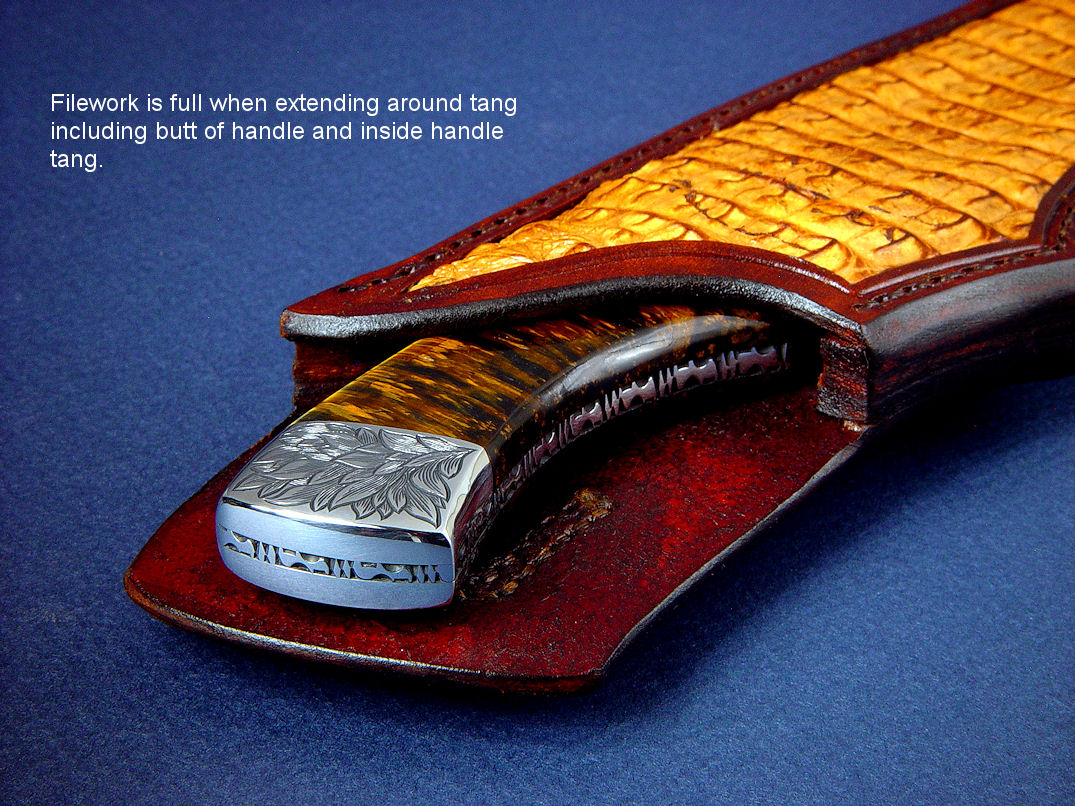
The word filework is a neologism, a compound noun of file and work. More about this interesting word on my Knife Anatomy page at this link. Some antiquities scholars call the process and result of filework "a worked back," or "backwork," referring to the back of the knife blade, but this is not specific, accurate, or clear, as filework may extend throughout the tang, butt, inside of the handle and even in liners, spacers and accessory parts of modern knives. It seems that filework is uncommon prior to the 19th century, however, the Italians and the Scotts have a history of fileworking blades dating back to the 1600s.
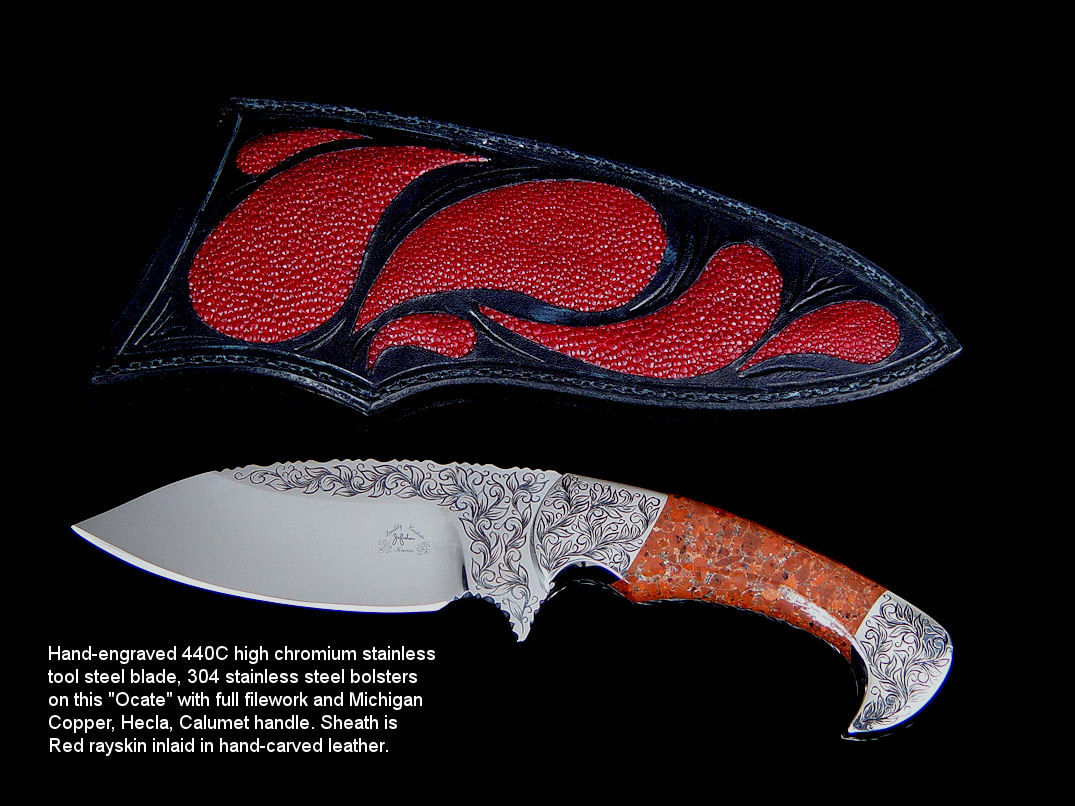
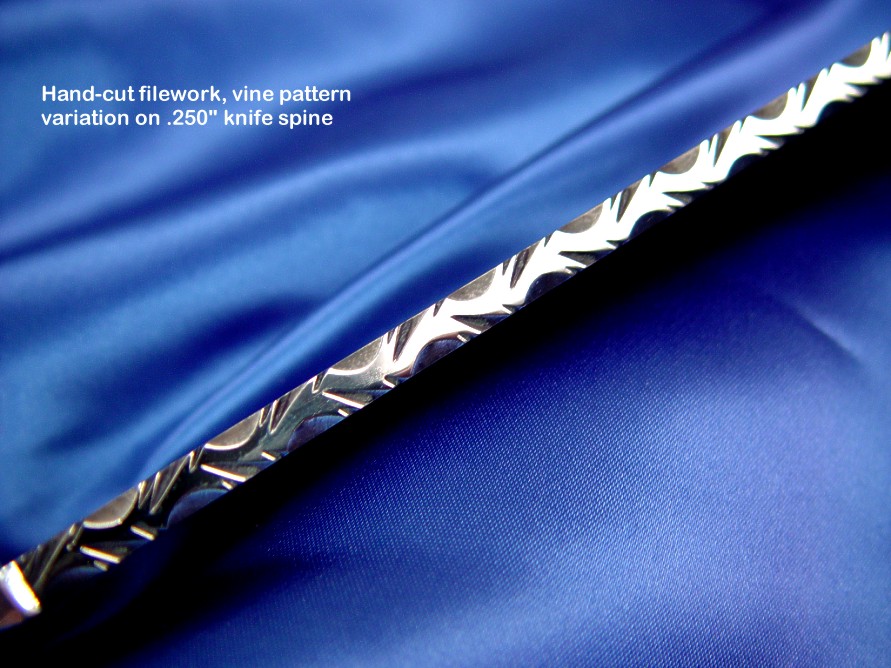
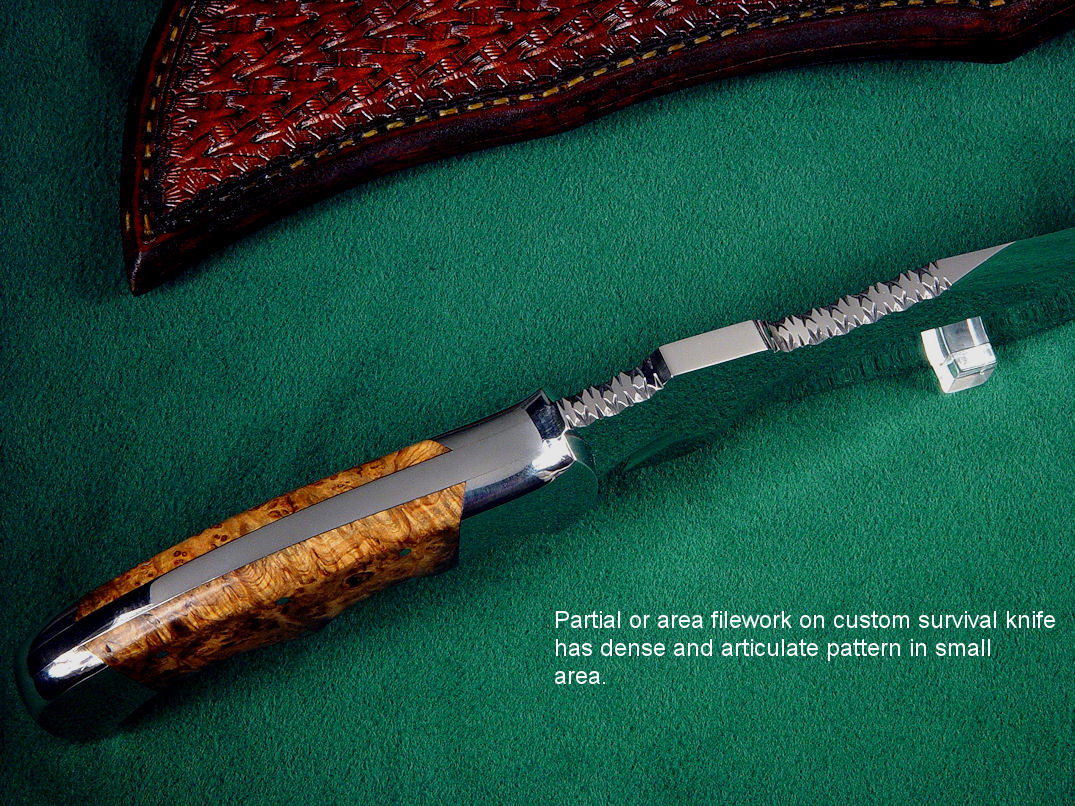
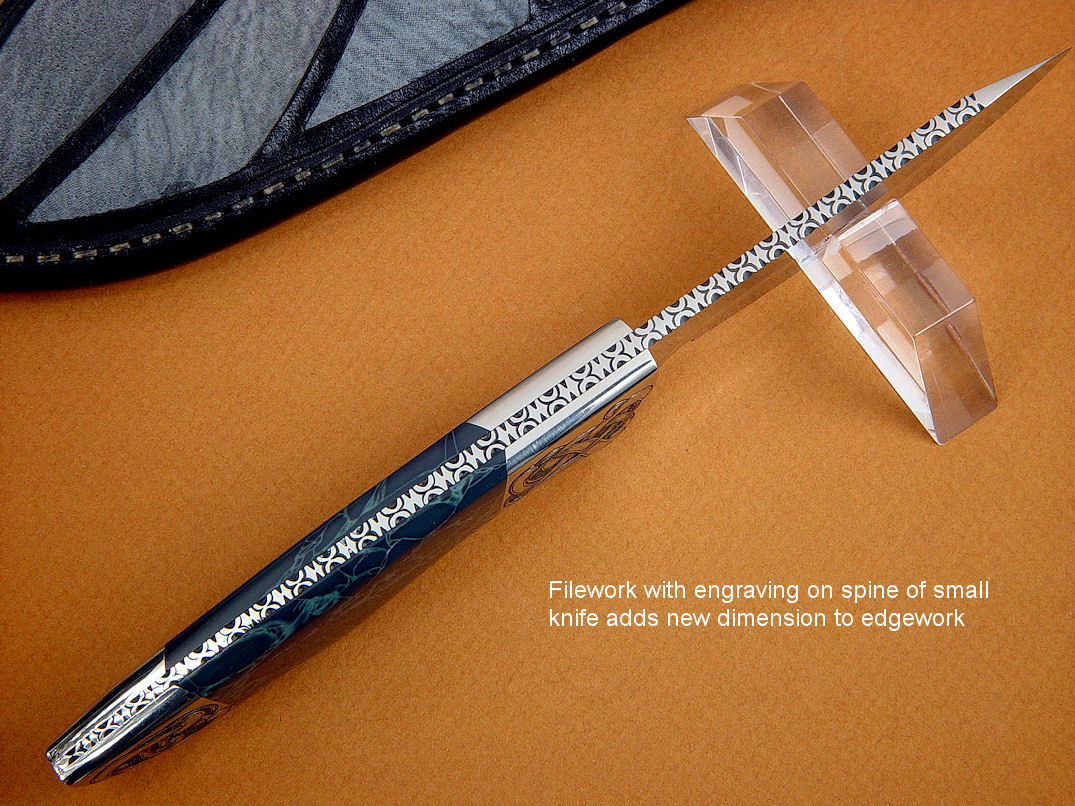
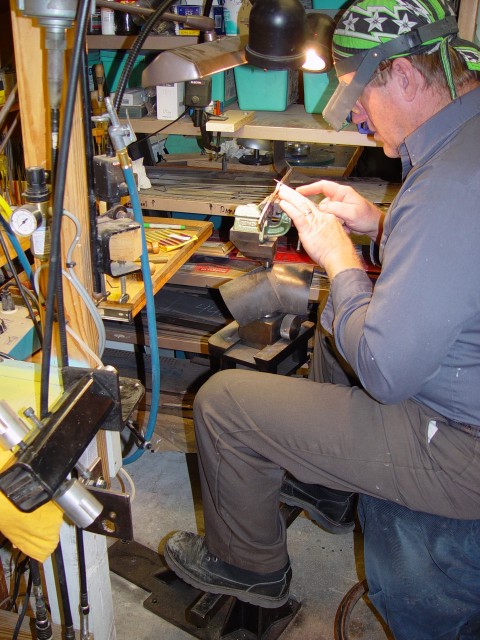
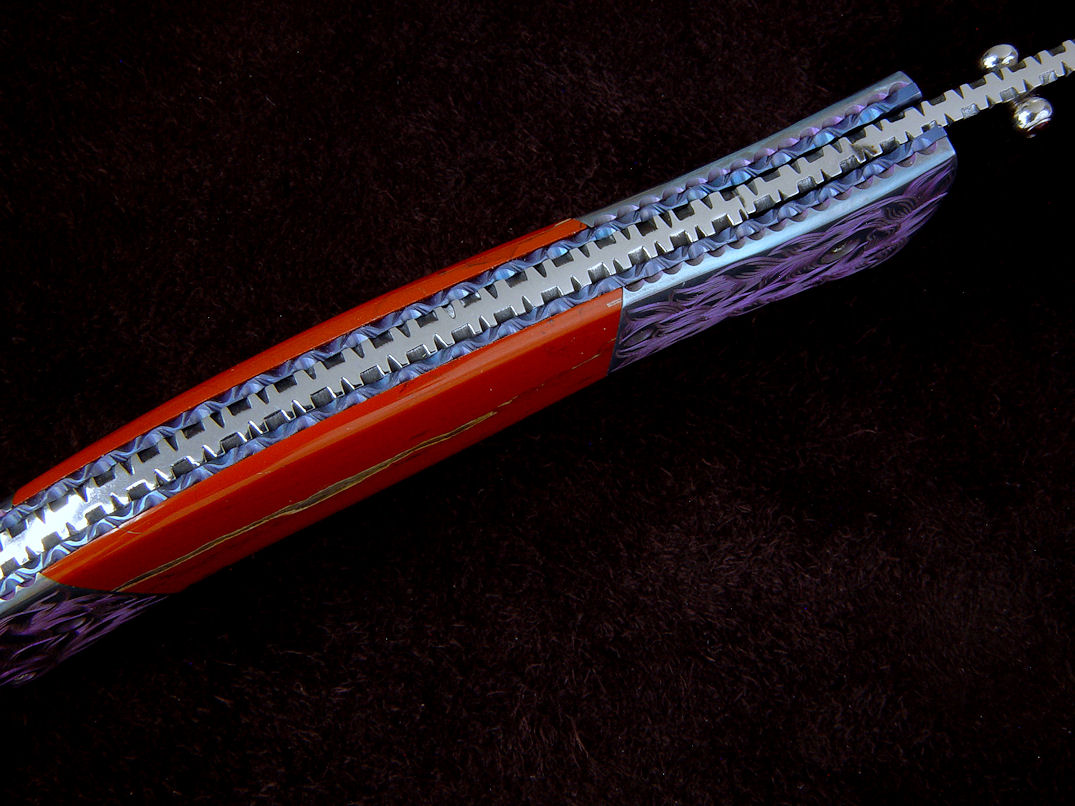
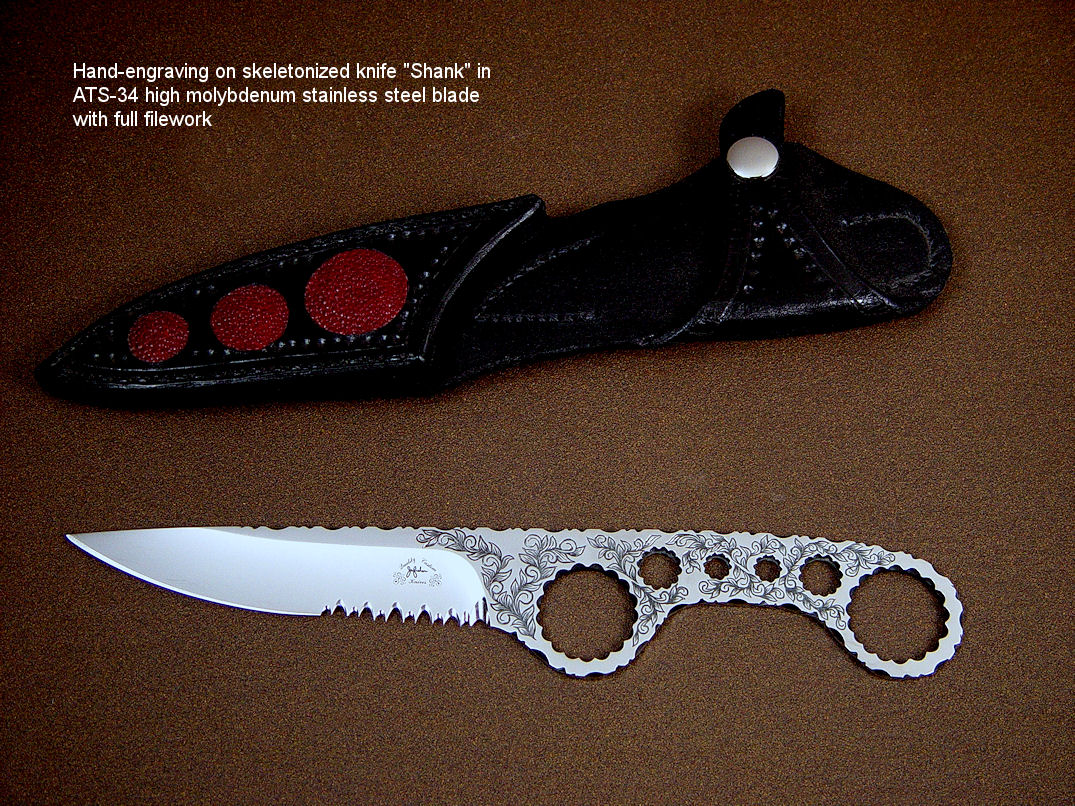
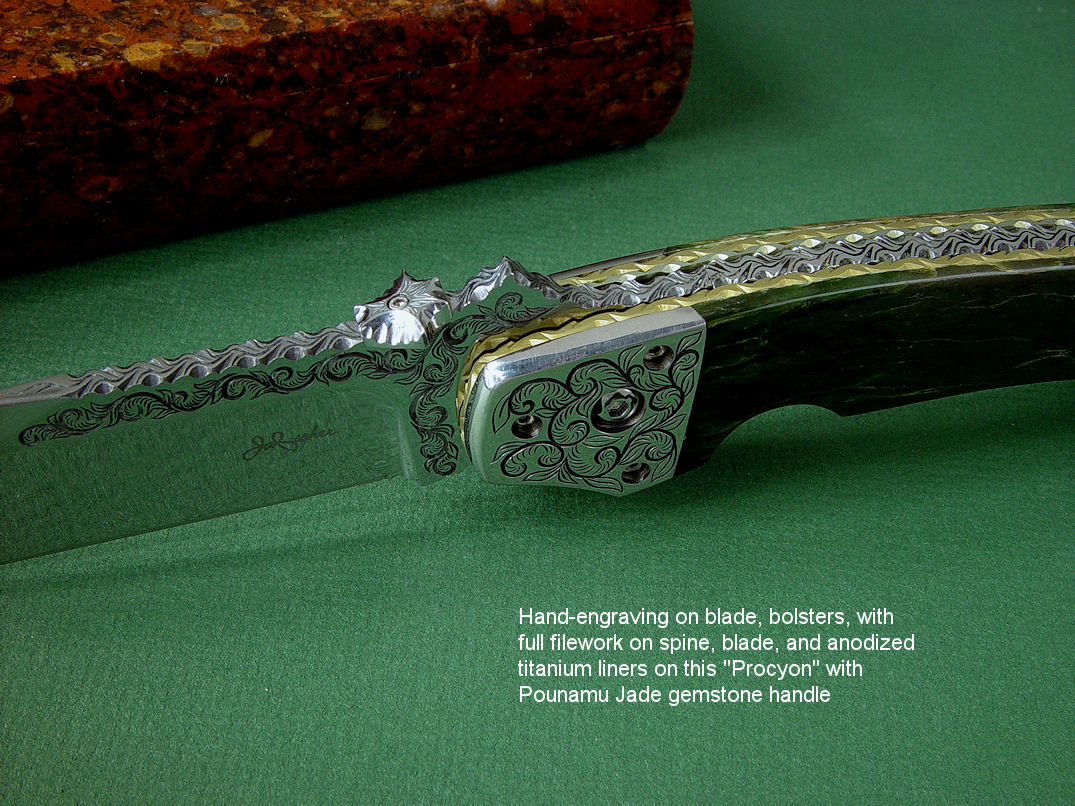
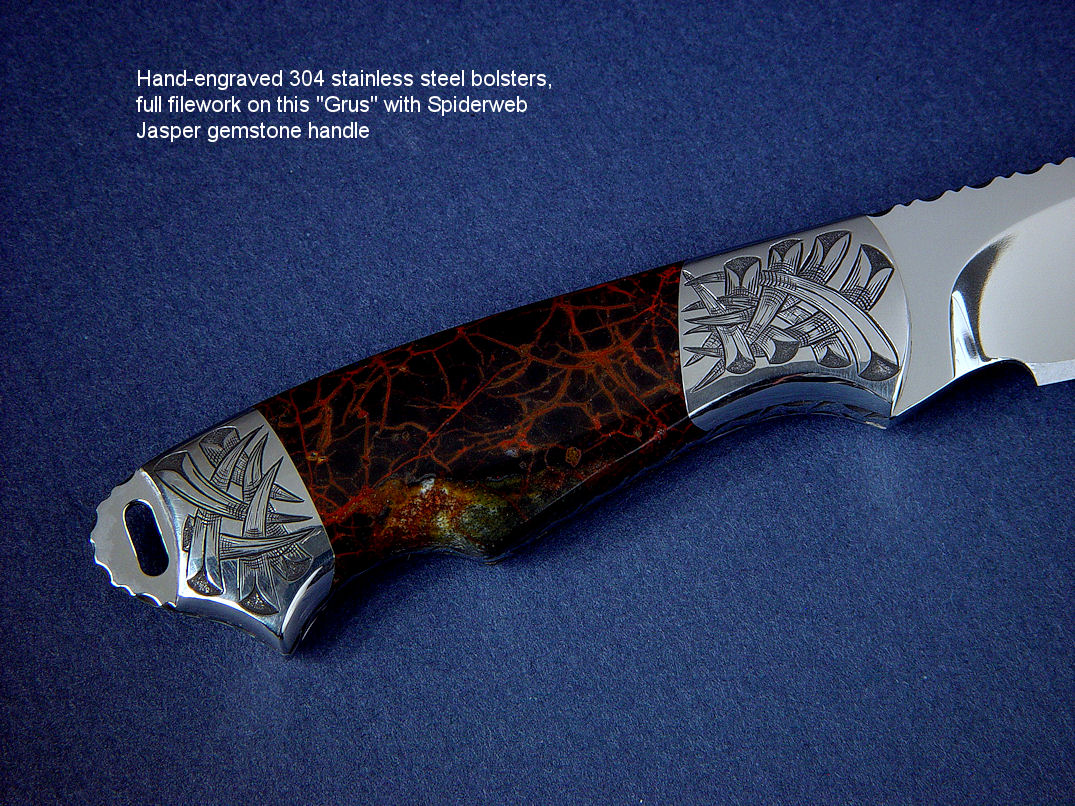
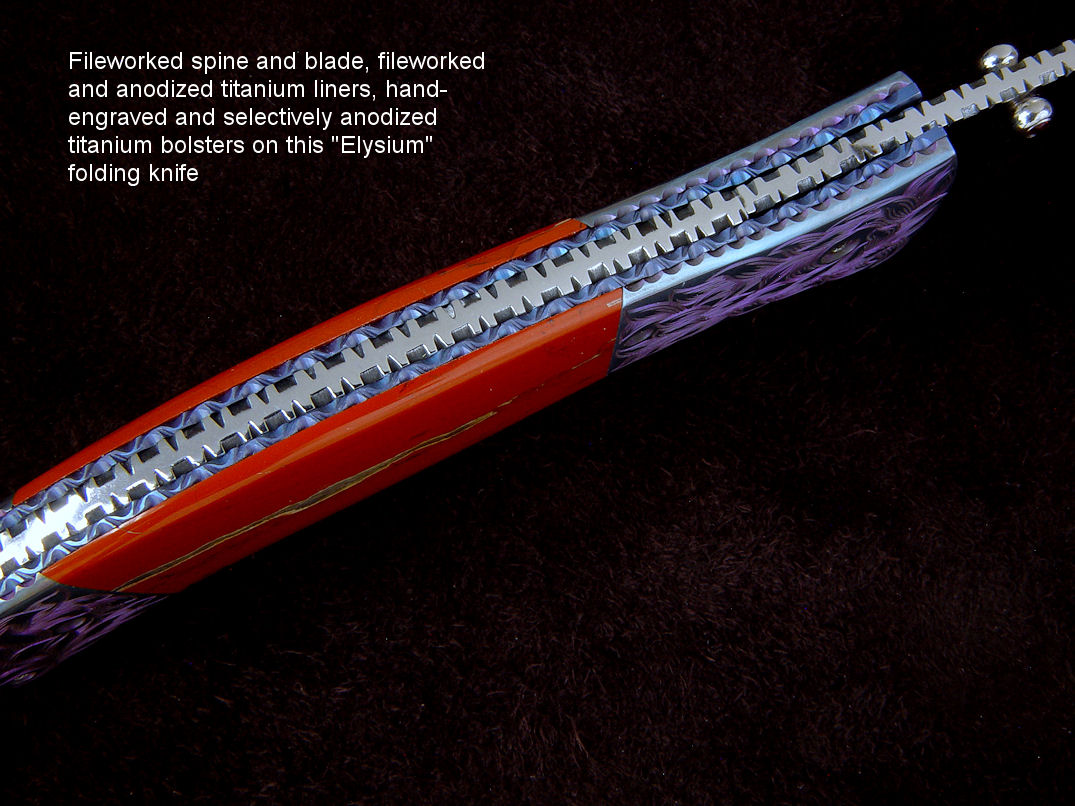
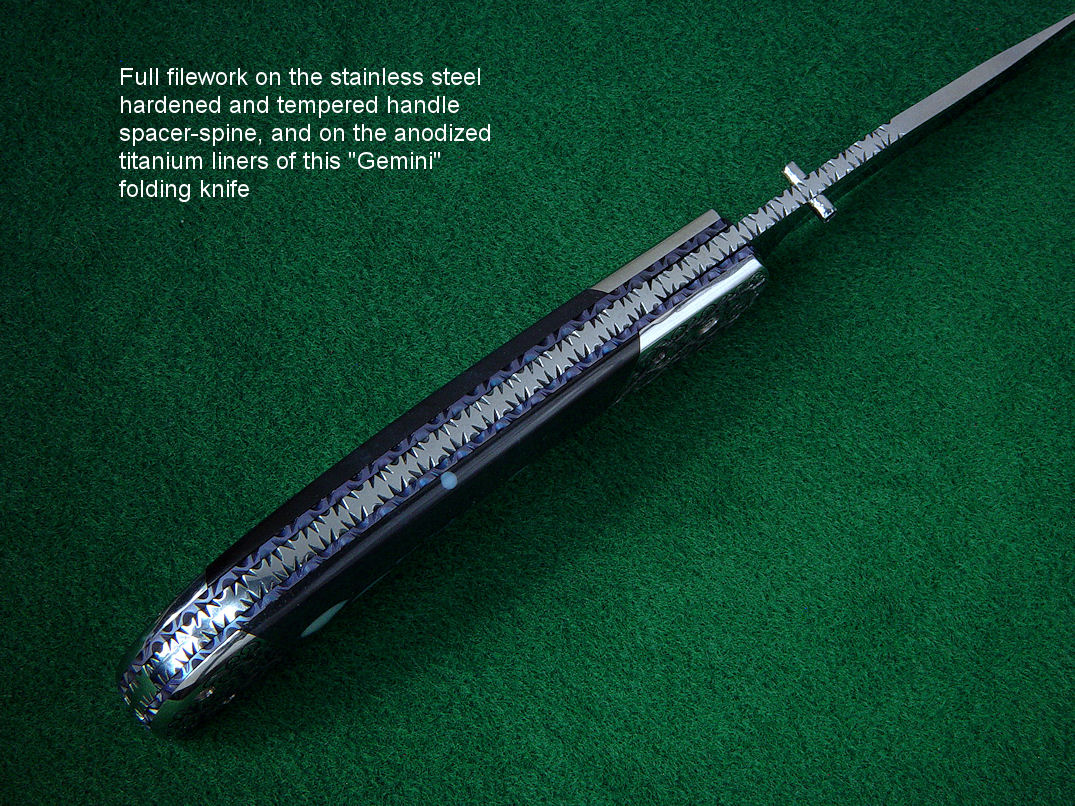
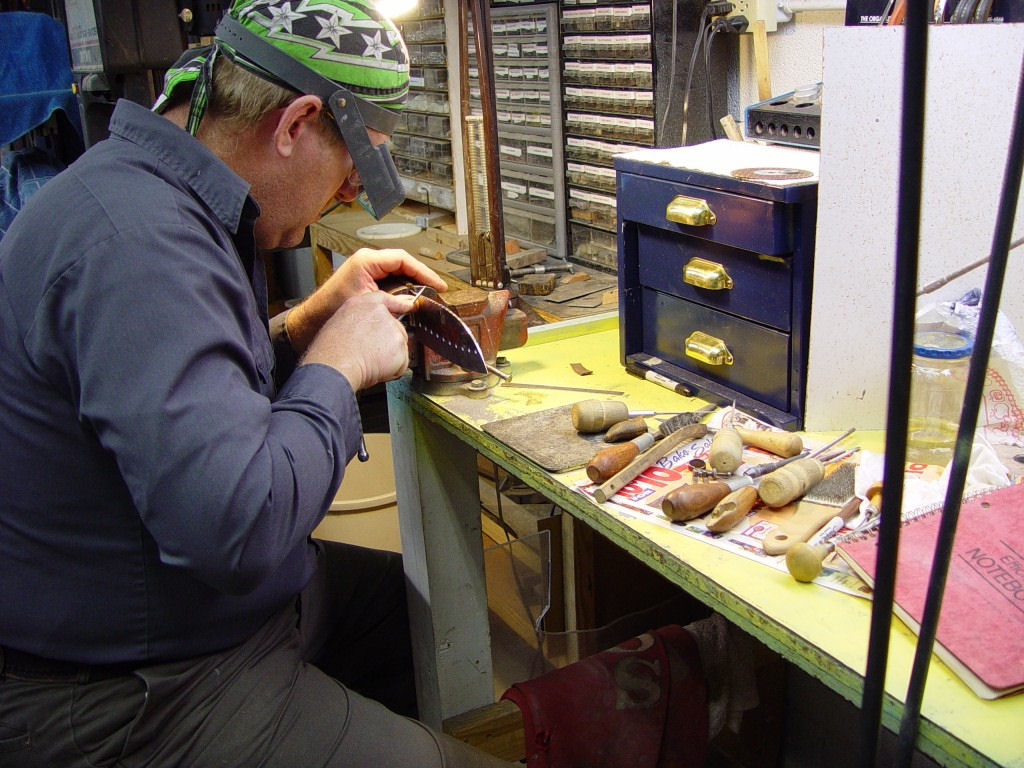
Filework has evolved into a highly decorative art form, sometimes even accented with engraving and precious metal inlays, differential anodizing, finishing, and bluing. The edge of the spine is its own canvas, and it seems every knife begs for its own style or pattern. My filework on one blade may take from one to eight hours to complete, each cut performed while bent over a filework vise with proper magnifier. I use all hand files, needle files and micro files (they're the size of a toothpick) and special layout tools and protractors. Large or deep cuts may be initiated by hand-controlled air, rotary, or power assisted tools, but the final form is always worked by the slow and careful technique of hand-cutting. The pattern is worked through a succession of cuts, then worked over for accuracy and uniformity. File cuts do not need to be smoothed or sanded, and sometimes a rough surface is better because it causes a visual contrast with the polished blade. Filework and edgework personalizes a knife, and is an absolute indicator that the knife is uniquely hand made, and still functions to stop the hand or fingers from slipping on a slick spine. Artistically, the filework, like engraving, distinguishes the skill and style of the artist who is, in this fashion, hand-carving the metal blade.
No factory made knife will ever have or imitate fine filework. This particular skill, working on a curved surface down a tapered, narrowing tang can only be achieved by a skilled hand. This makes a well-made, fileworked knife unique and increases its long term value. The quality of the filework is a direct indicator of the significance of a custom knife, and you don't have to be a trained appraiser to see this worth. The human eye is drawn to arrangements and regularity in repeating patterns, balance, and style motifs. Take a good, close, hard look at the filework, and you'll know the quality and thus the value of the knife.
"Mr. Fisher,
some of the first file-work I ever saw was in a Blade Magazine (if memory
serves), and the name attached to the knife photo was yours (that I remember)...Since then,
I have sought to breathe that extra bit of life into a knife as you have, and I've been
getting some high praise from folks 'round here when they see what I do. I am quick to
steer them to the real pros when they exclaim over my handy-work, and more than once
I've spoken your name as one of the key motivators for my endeavors. I happened
across you today while researching something, and wanted to stop by and thank you for being one of
the catalysts that occasioned me to become an embellisher of people's steel companions. If you
are so inclined, I have an account where I keep pictures of my efforts, and I would be honored if
you were to stop by and offer your critique....Thank You Mr. Fisher, for providing the
light that I'm sure has been a guiding beacon to others than just myself.
Peace to you and yours, J."
Hi J. Thanks for writing, and thanks for your encouragement. I did look over
your picture album, and it looks like your work is improving as it goes along. The only reasonable advice I can offer is
to keep at it, keep practicing, and take plenty of time on your projects. If you're like me, you can't stop making even
if you wanted to!
Thanks, Jay
Thank you, Mr. Fisher, for your quick response. I am teaching myself how to
build knives and the filework is my favorite part. I always look to your website for inspiration
and I hope to be half as good as you one day. Thanks again!
--G. L.
On one knife maker's web site, I read an amusing (and astounding) comment. He claimed that filework does not have to be symmetrical or balanced, and sometimes it looks better when it's not. What? Okay, maybe I'm not understanding his idea here. If a knife has good filework, you know it. Irregular, out of balance, and non-accurate filework does NOT look good, and trying to tell people it does is just a way to cover for bad craftsmanship. Because filework is done by human hand, of course it cannot be perfect. But if you're going to pay hundreds (or thousands) of dollars for a custom or handmade knife, it better be very, very good!
I keep a pattern book of my most favorite designs, and I offer three lengths of filework:
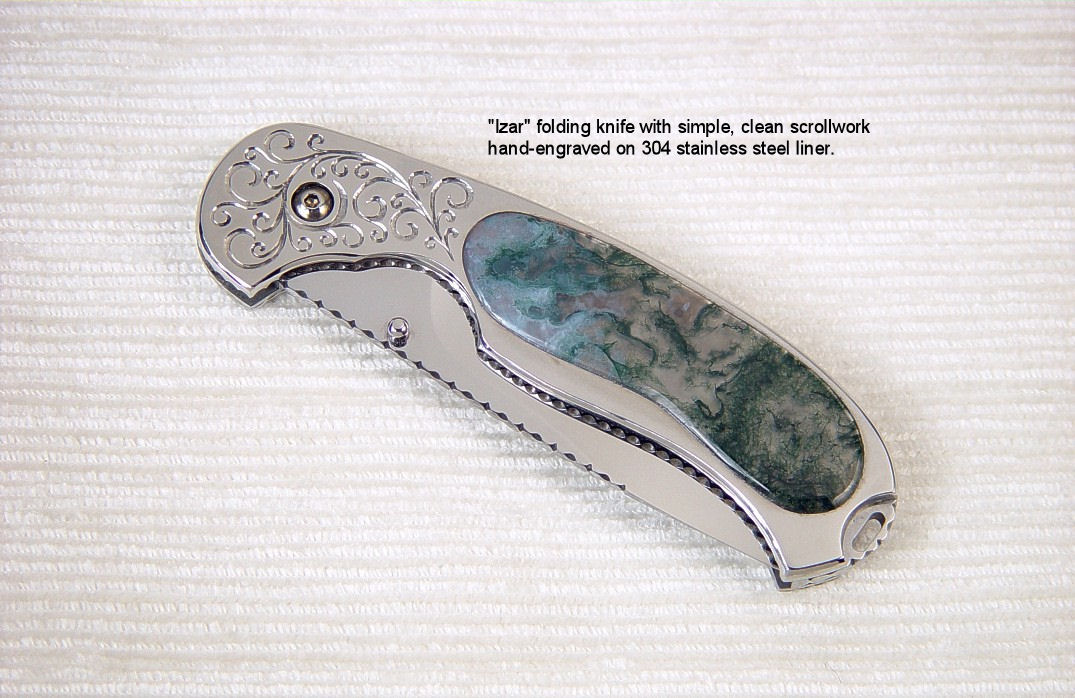
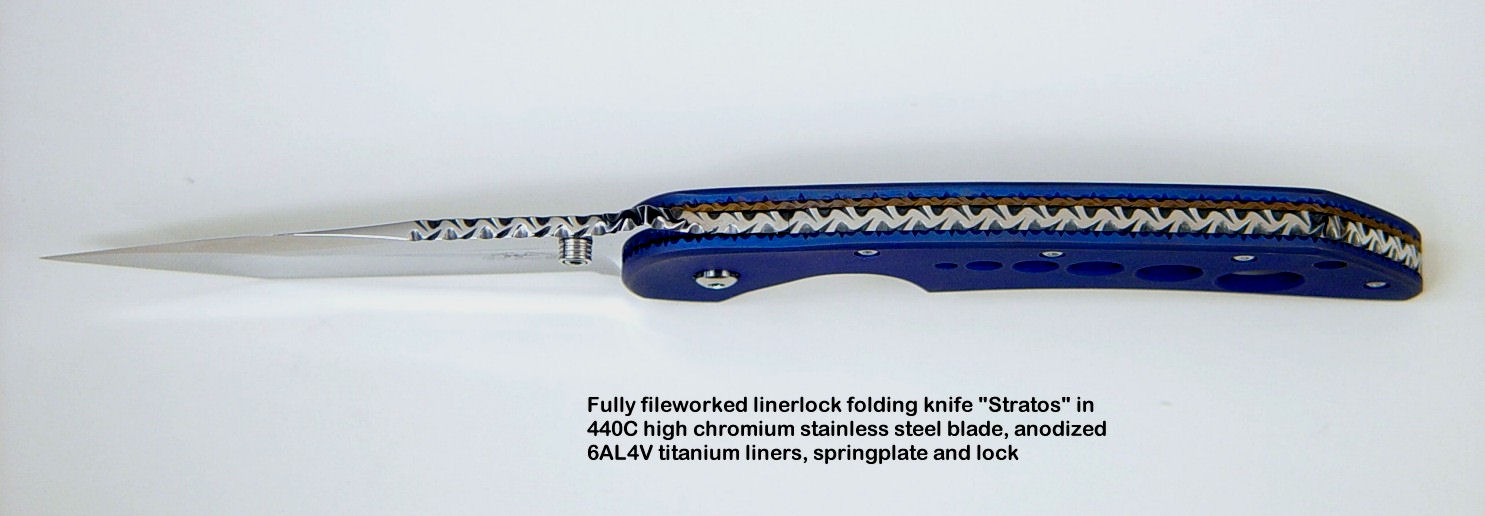
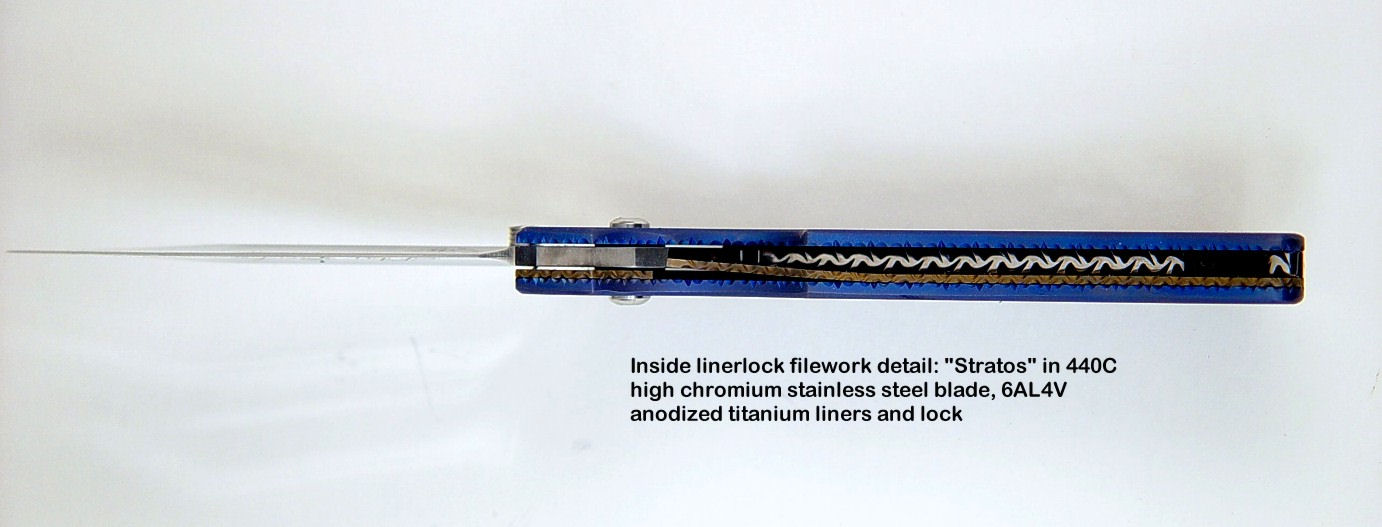
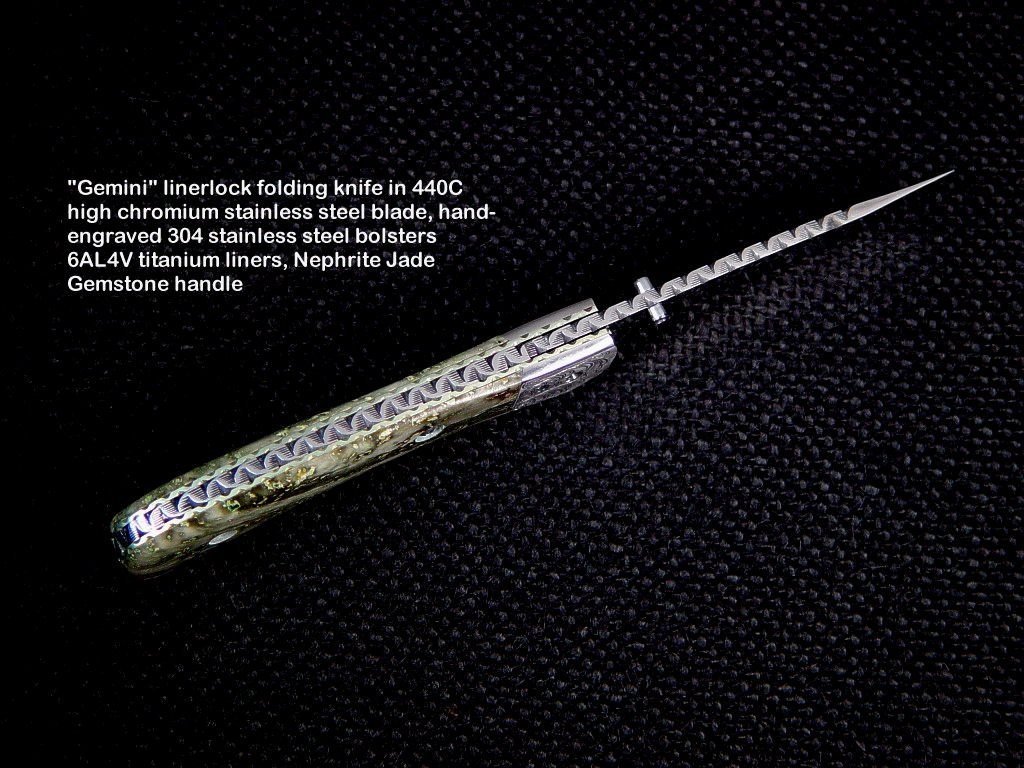
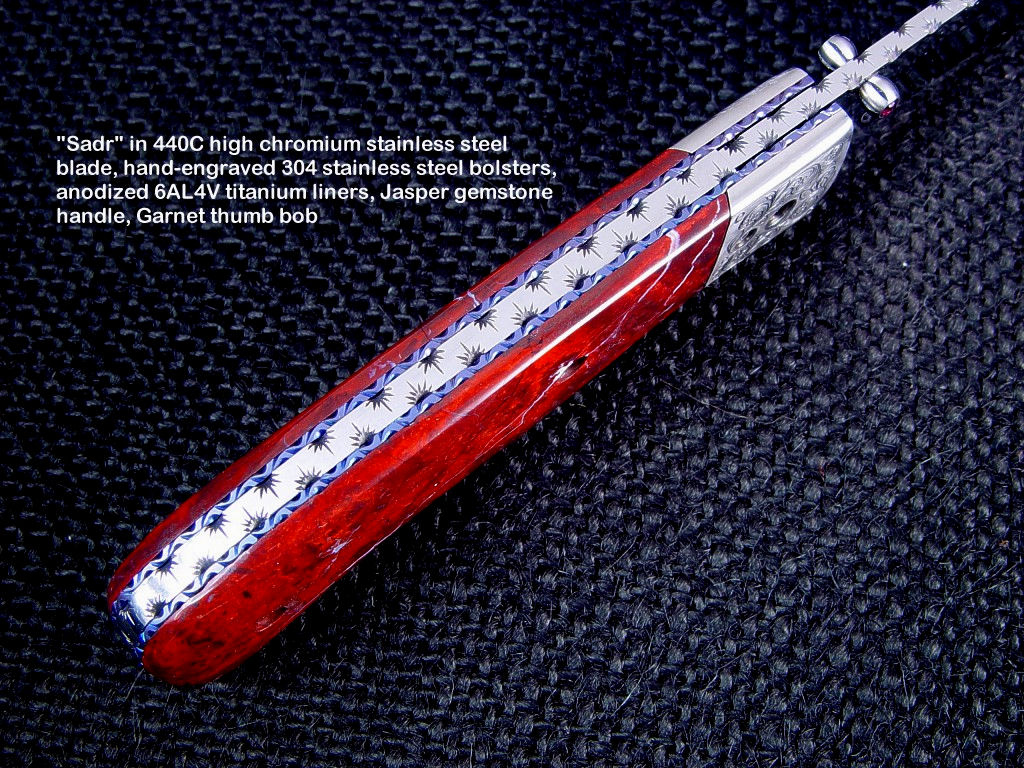
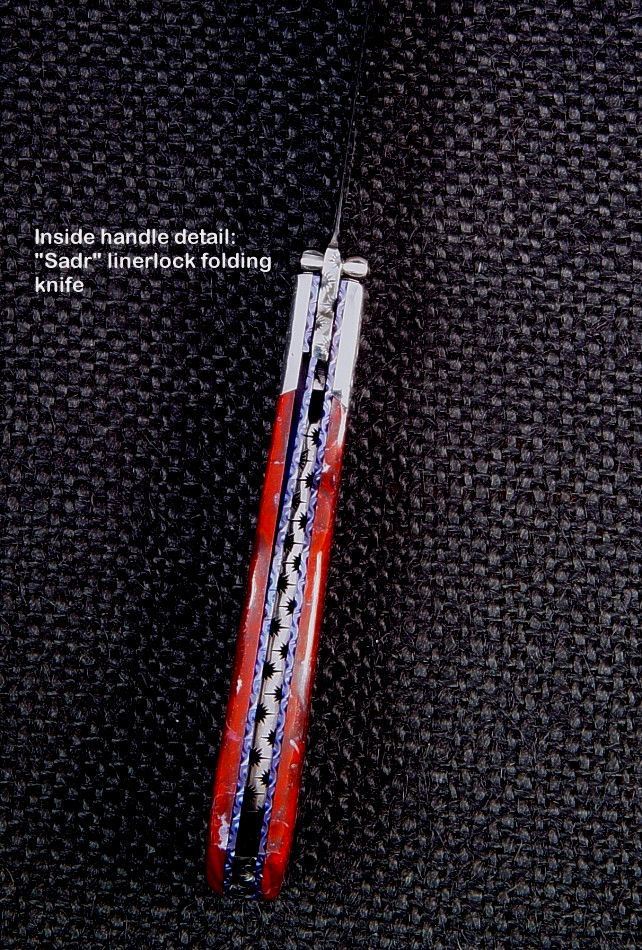
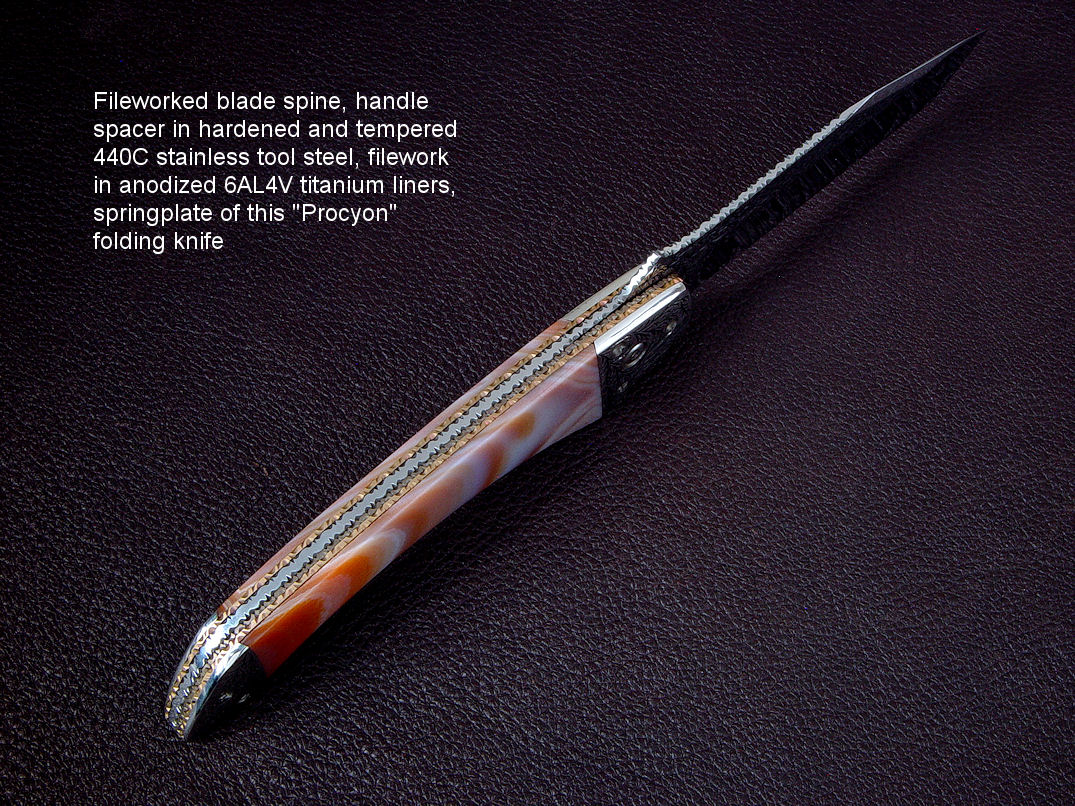
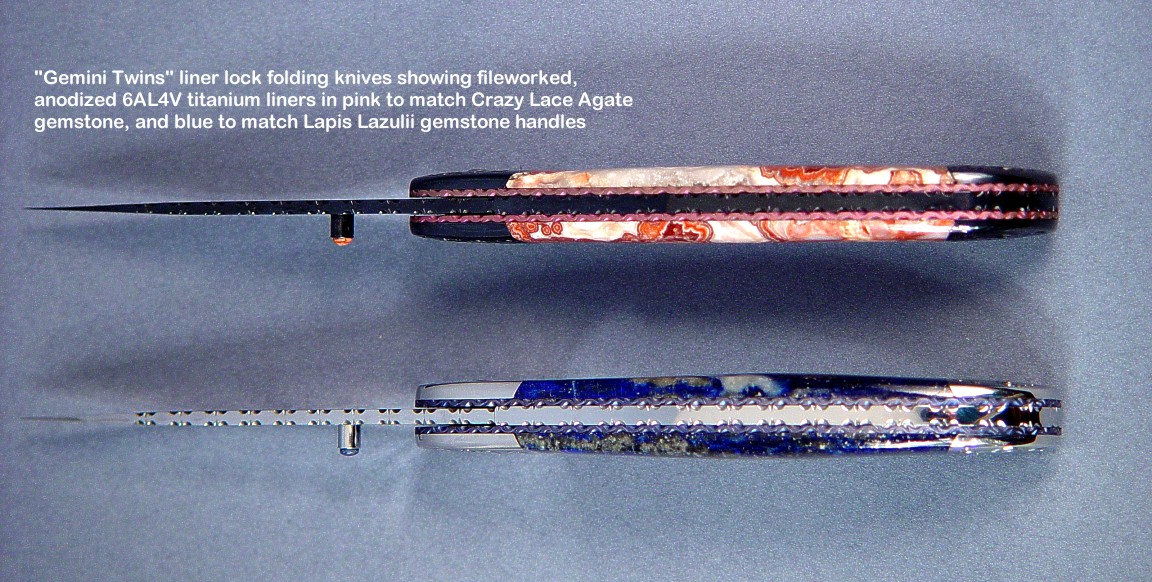
Filework and edgework for folding knives is a bit different. Good filework extends from the blade all around the spacer/spine, and usually includes the liners. Anodized titanium liners and lock spring plates can be fileworked as well as the blade and spacer/spine. The inside of the knife should also be finished, and the junction of the blade to stop on the spacer/spine should be seamless.
There are two types of engraving I'll address: hand engraving and machine engraving.
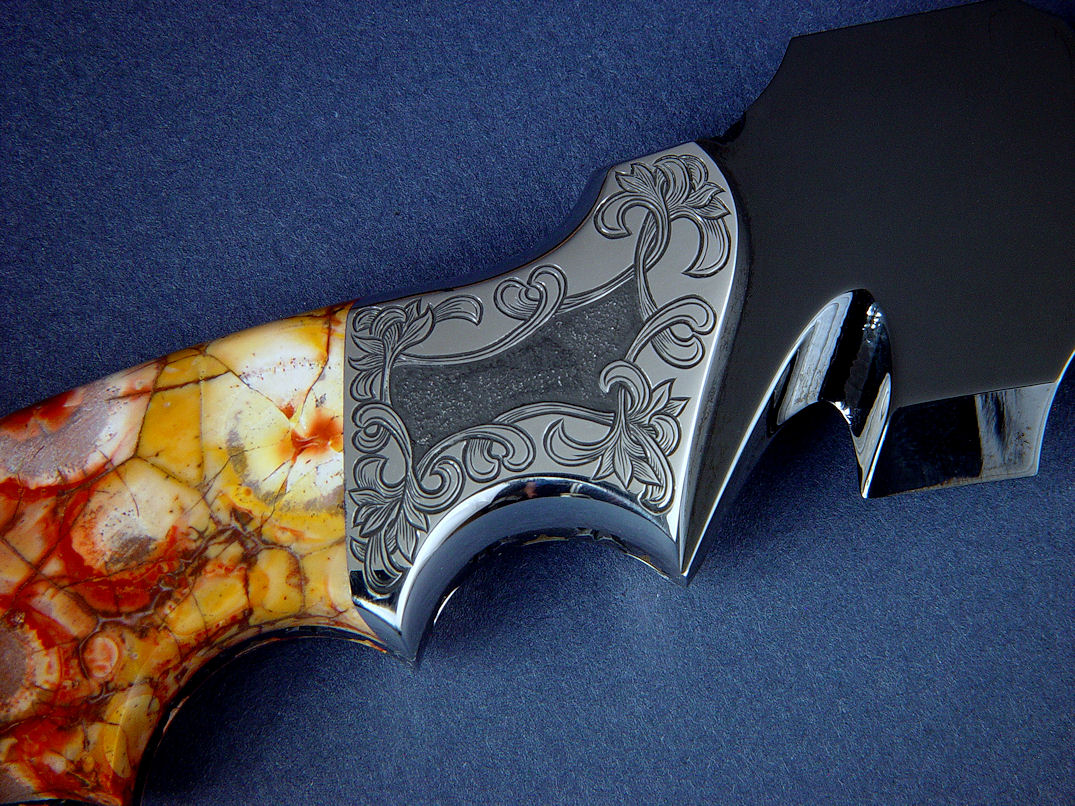
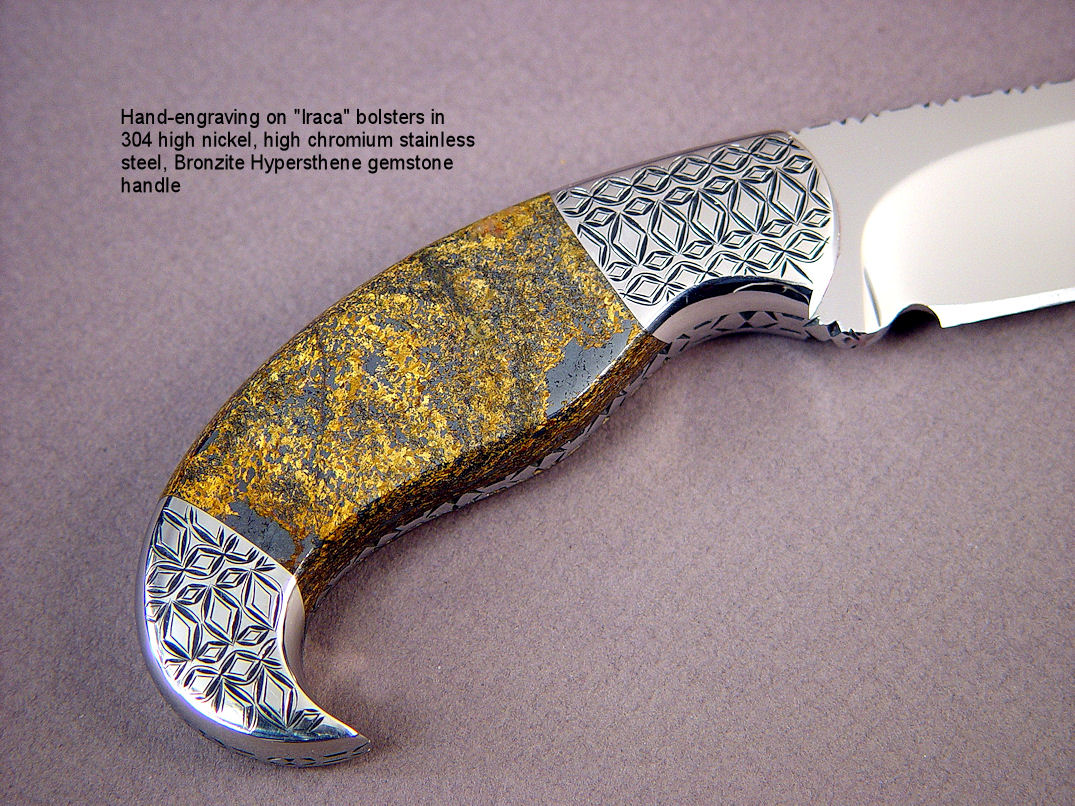
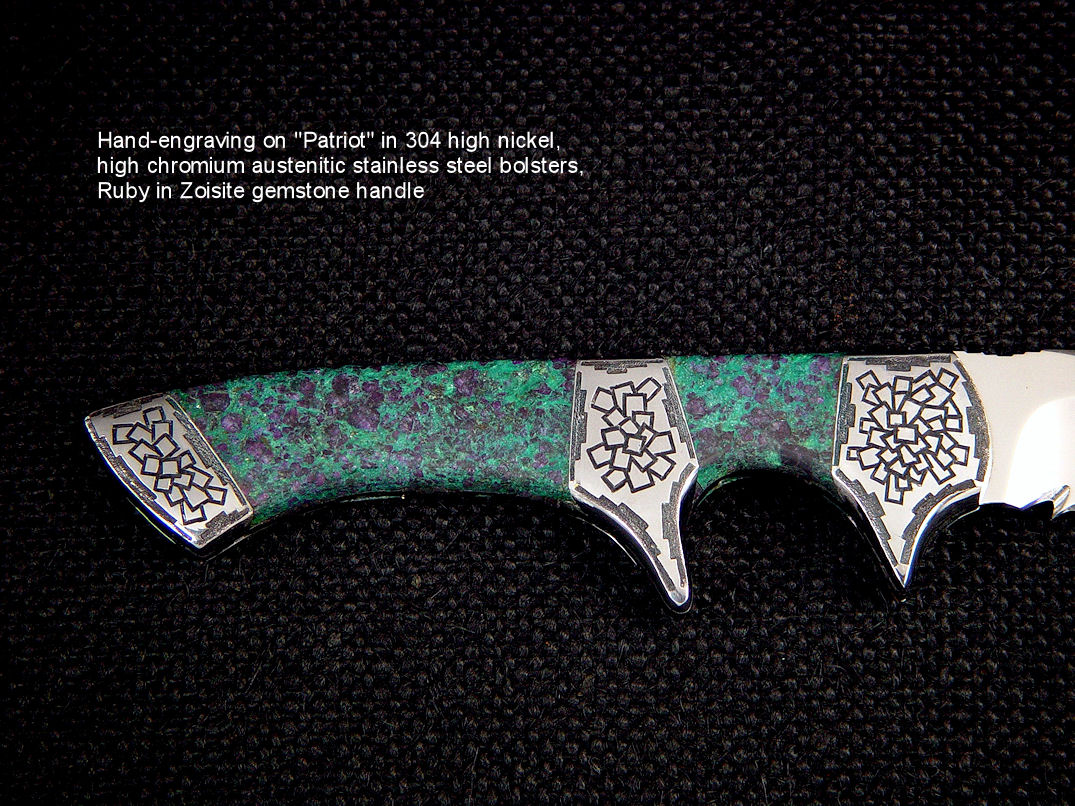
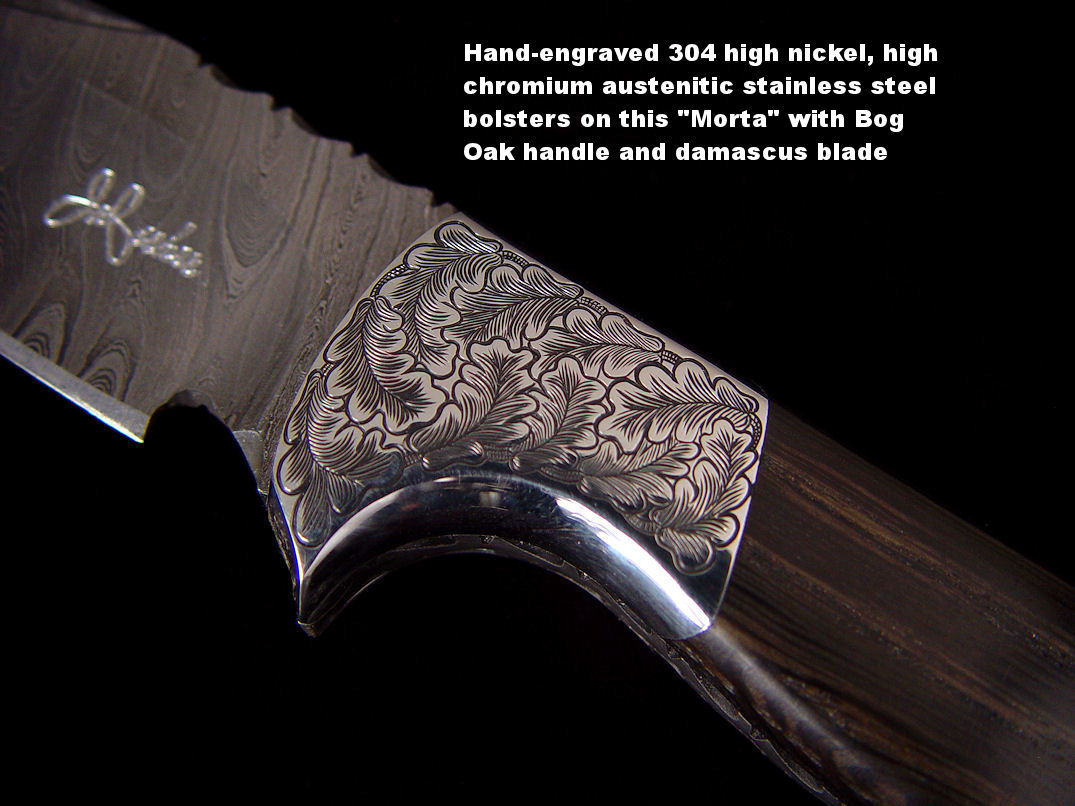
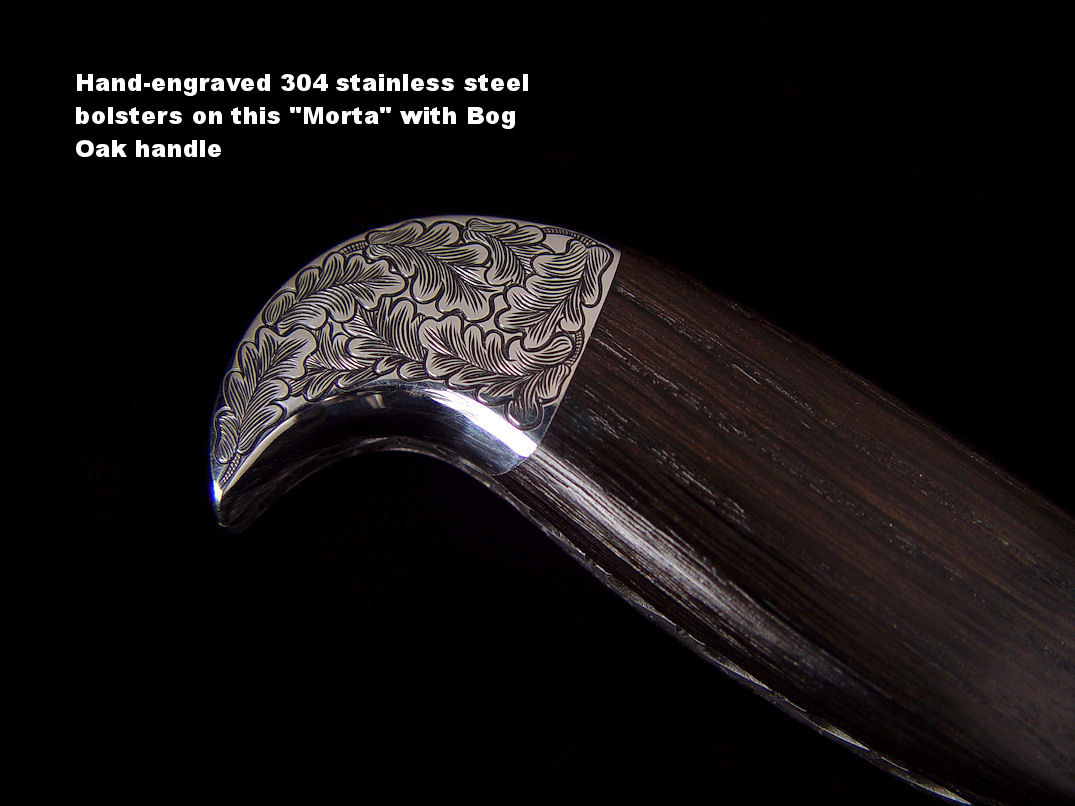
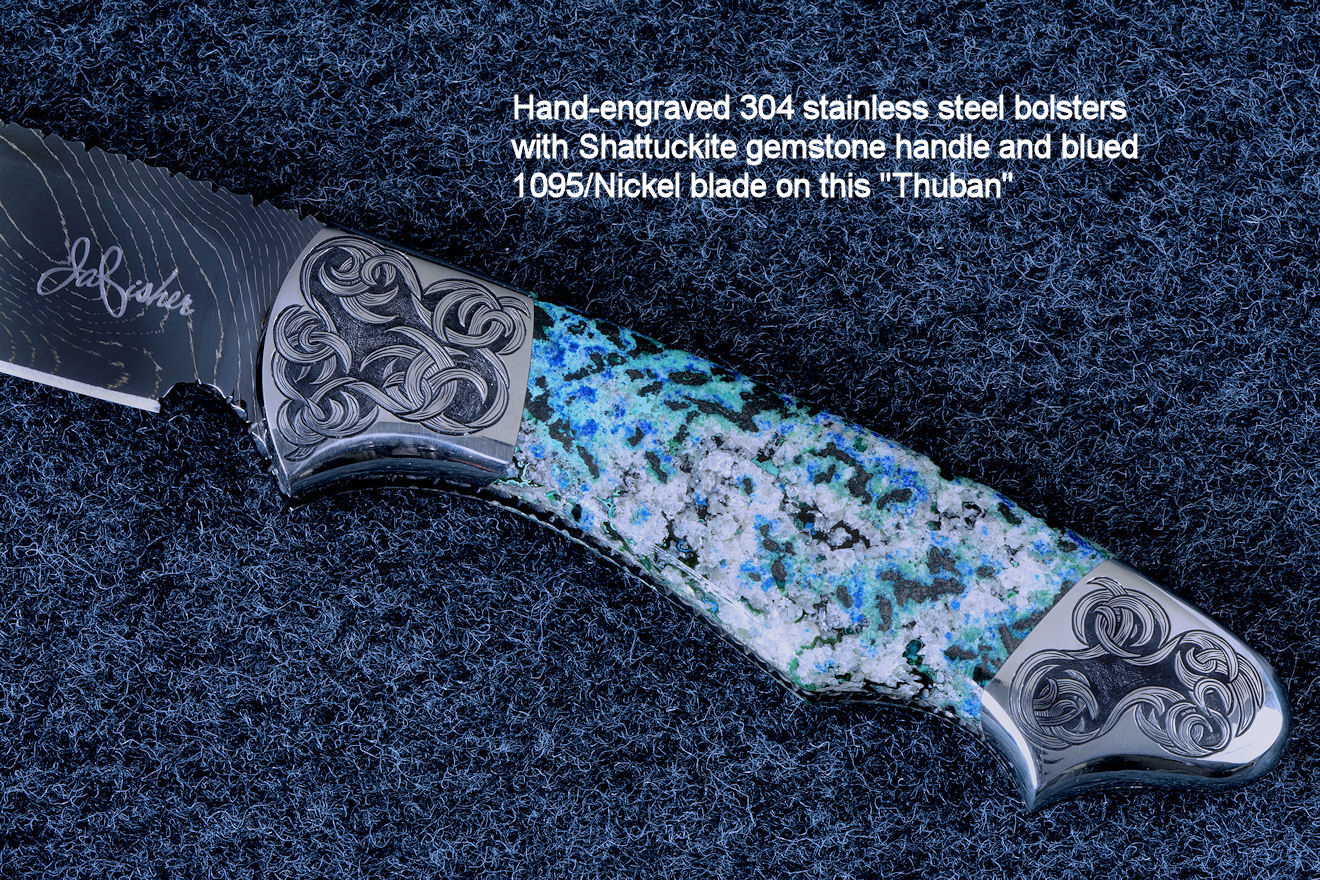
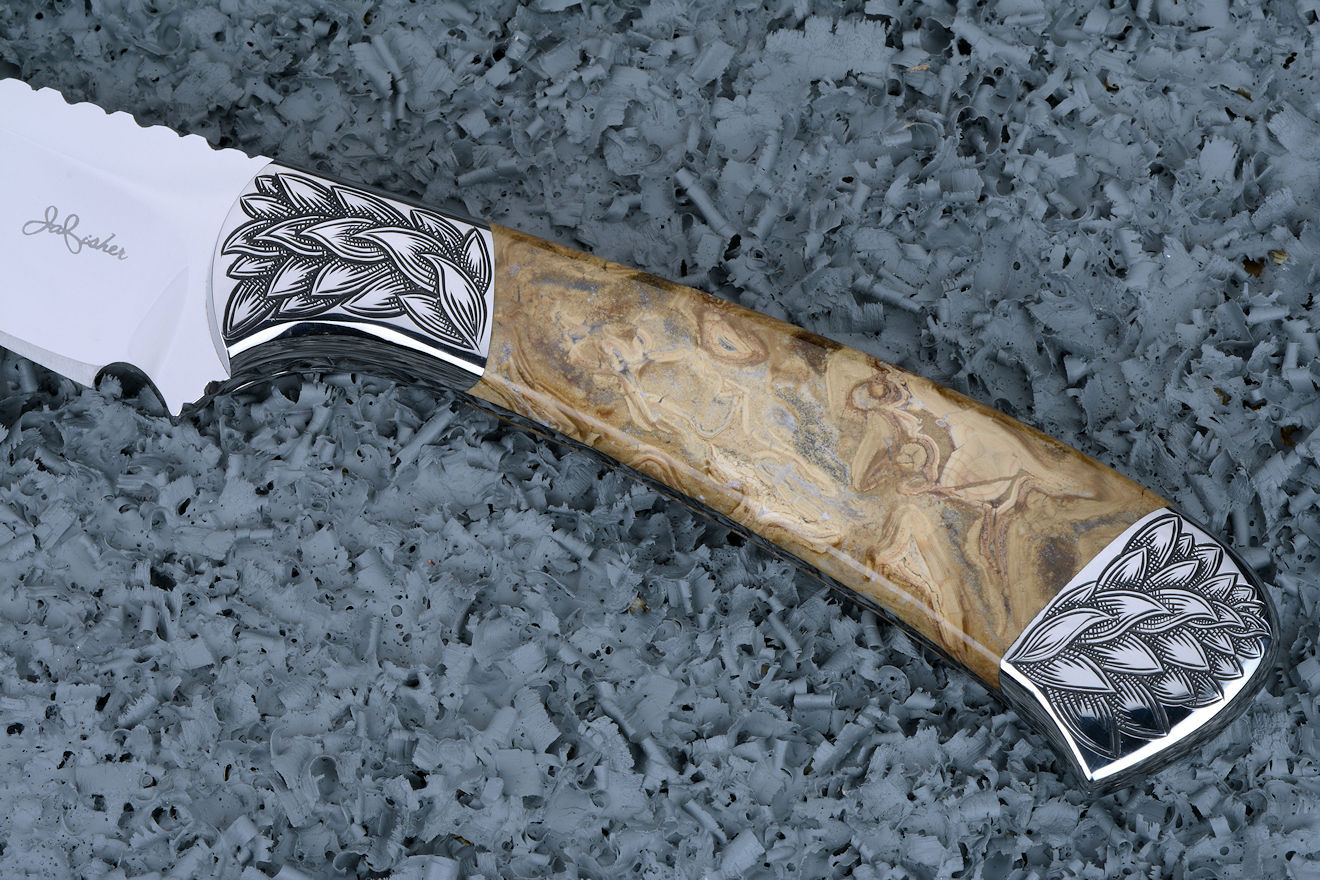
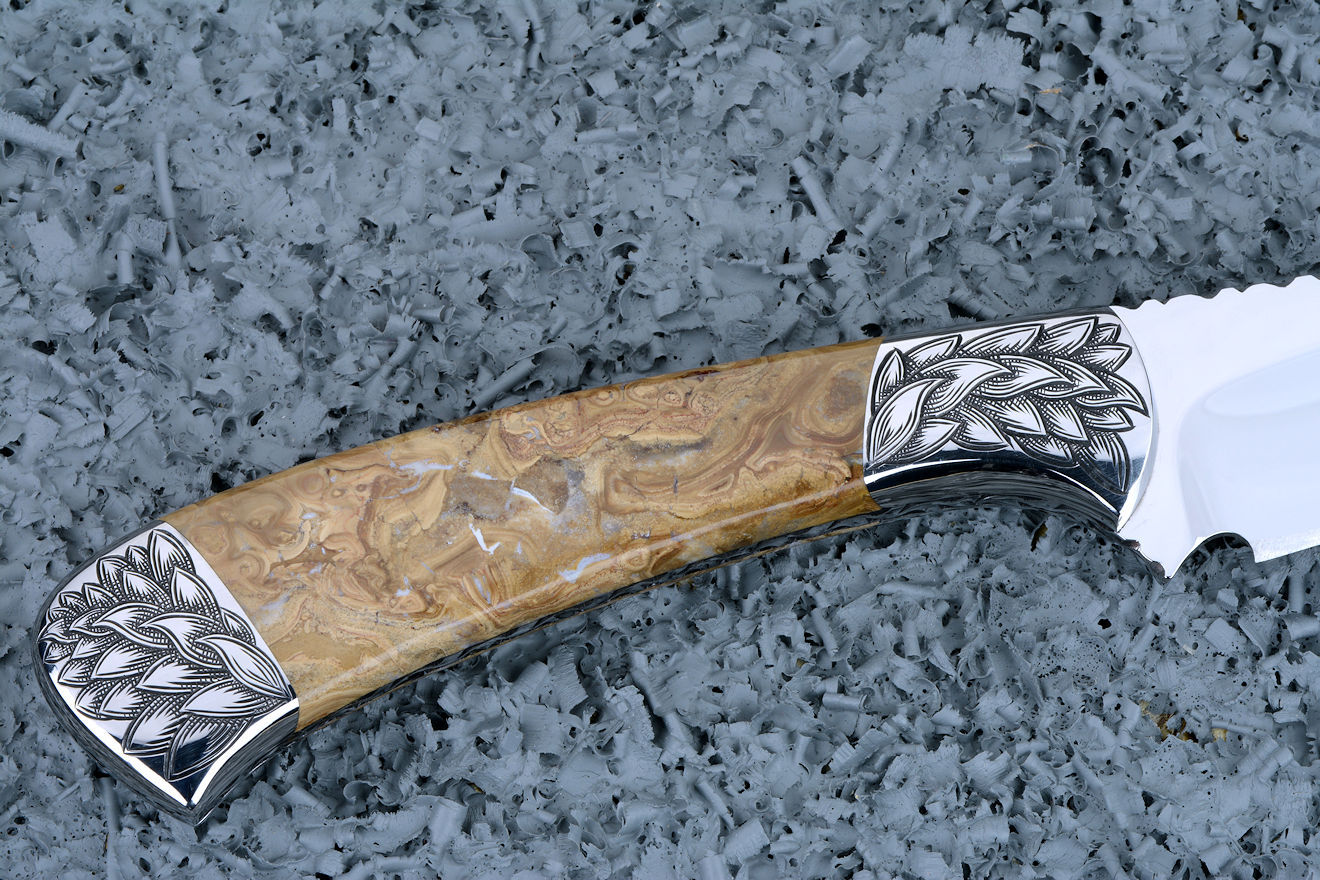
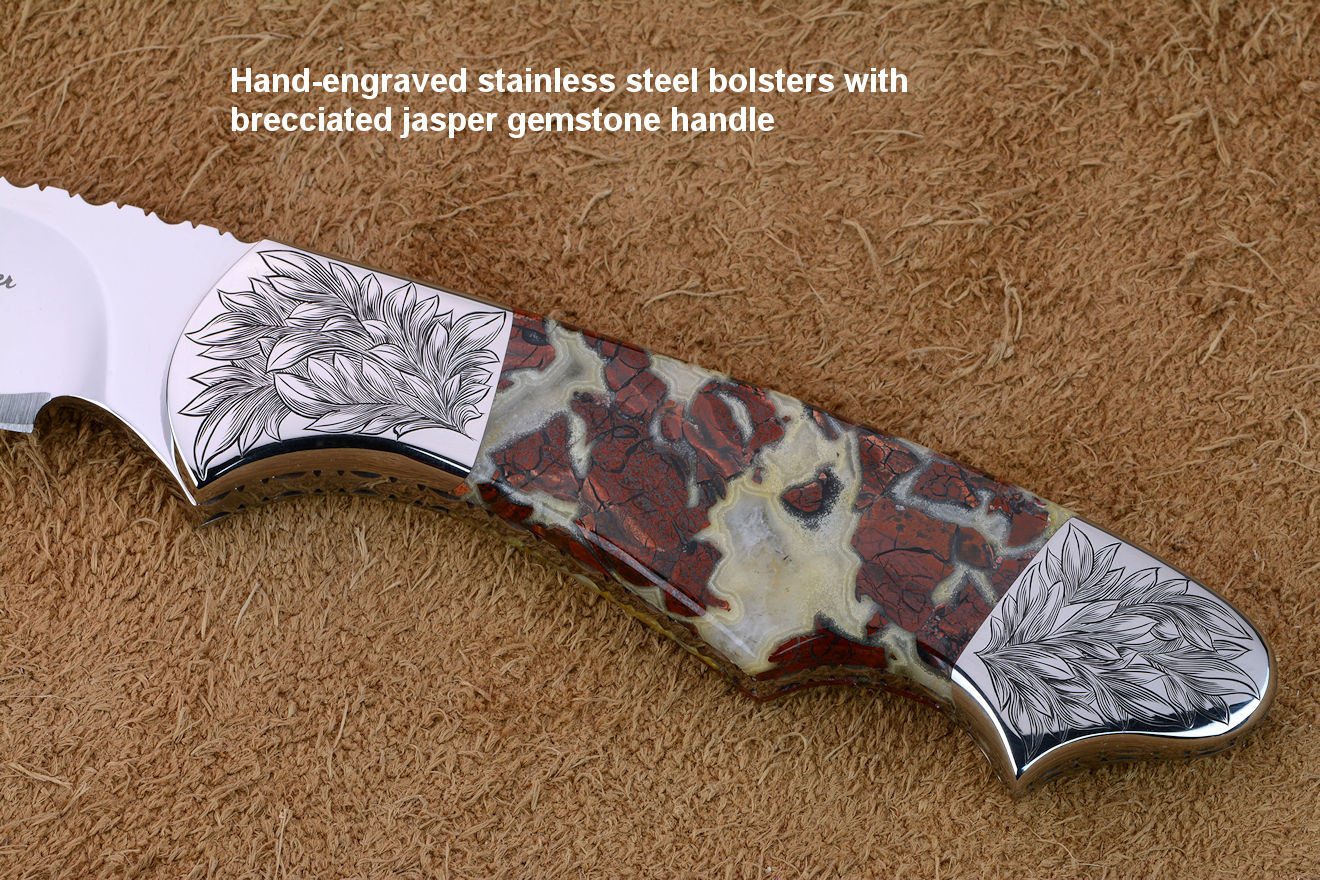
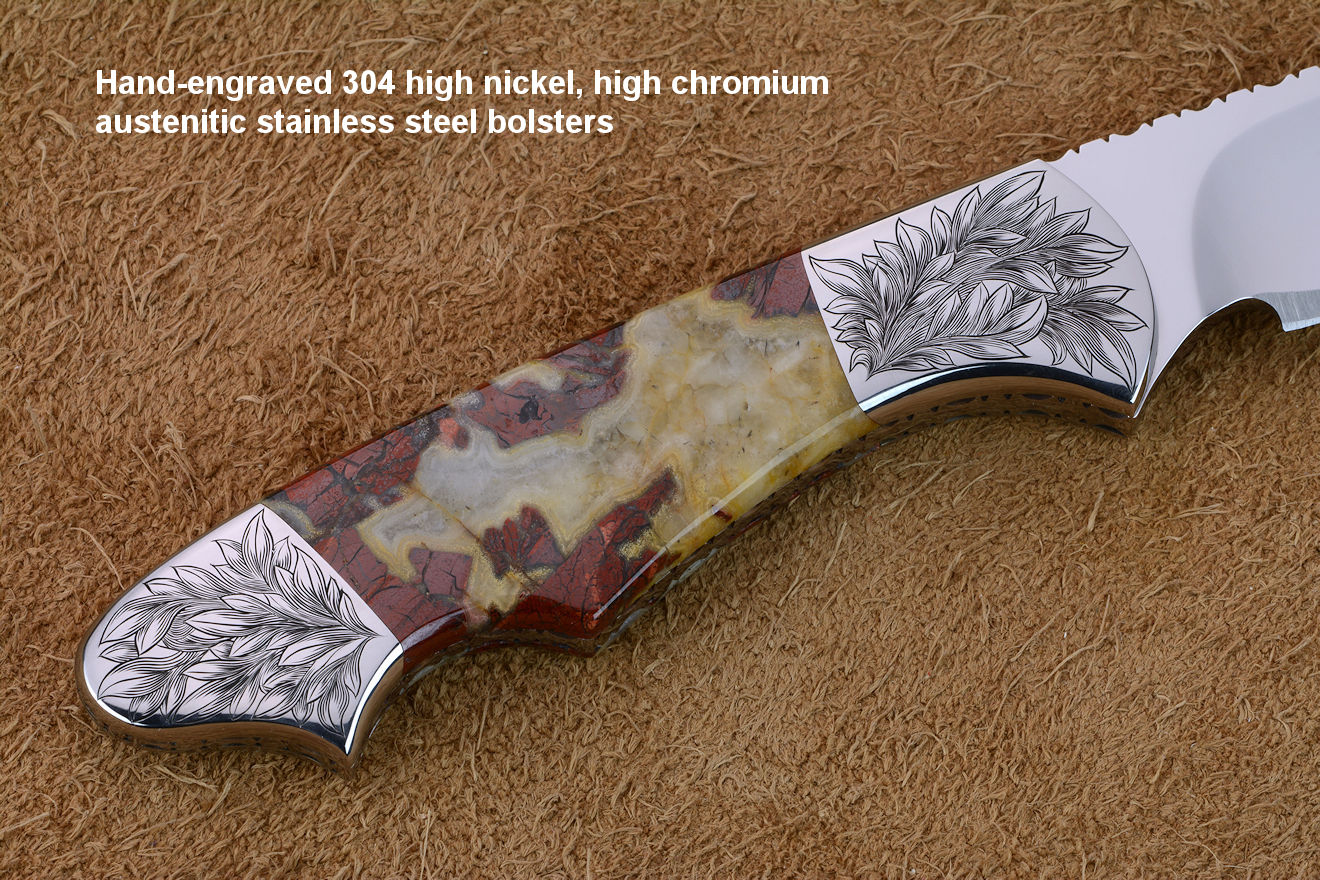
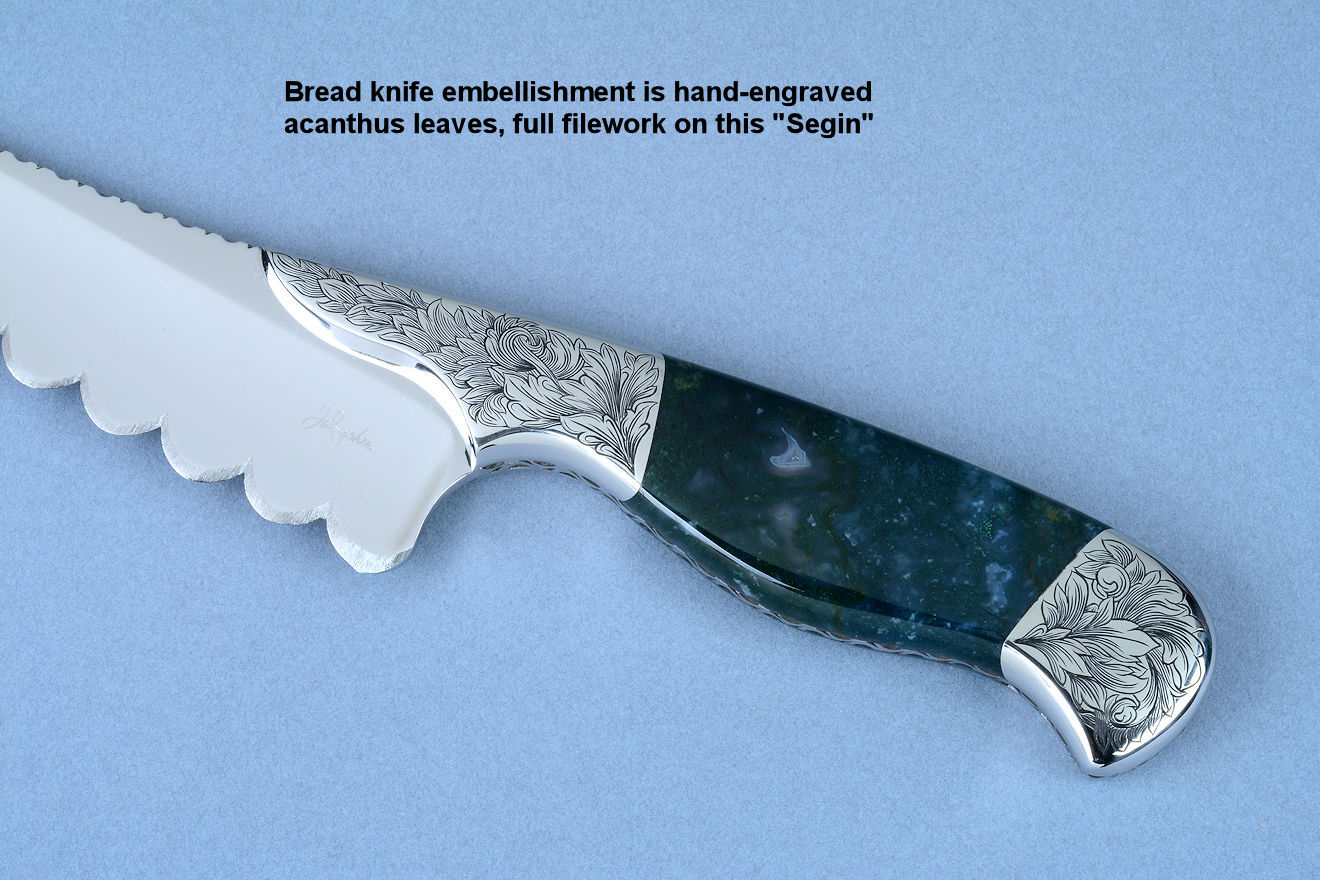
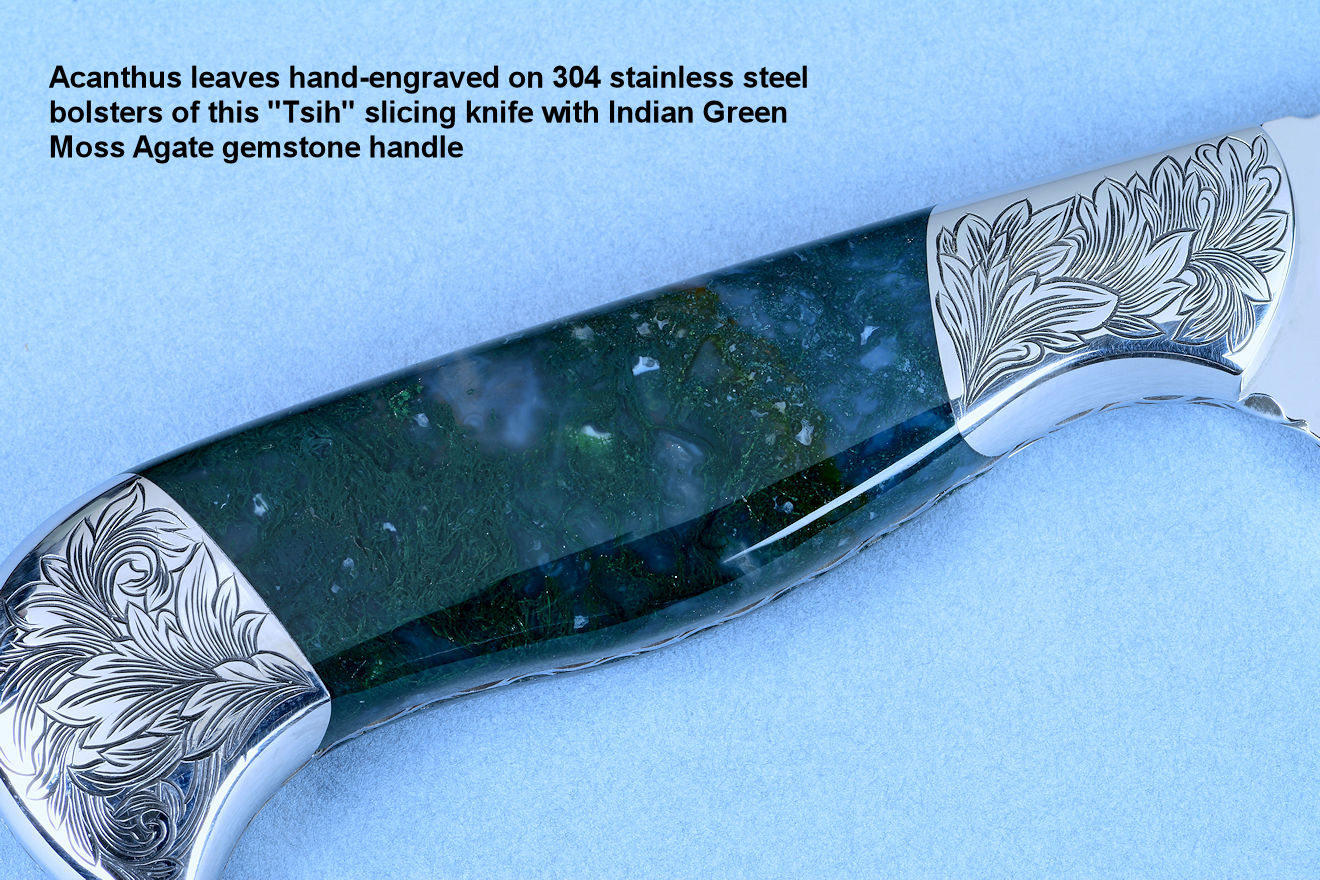
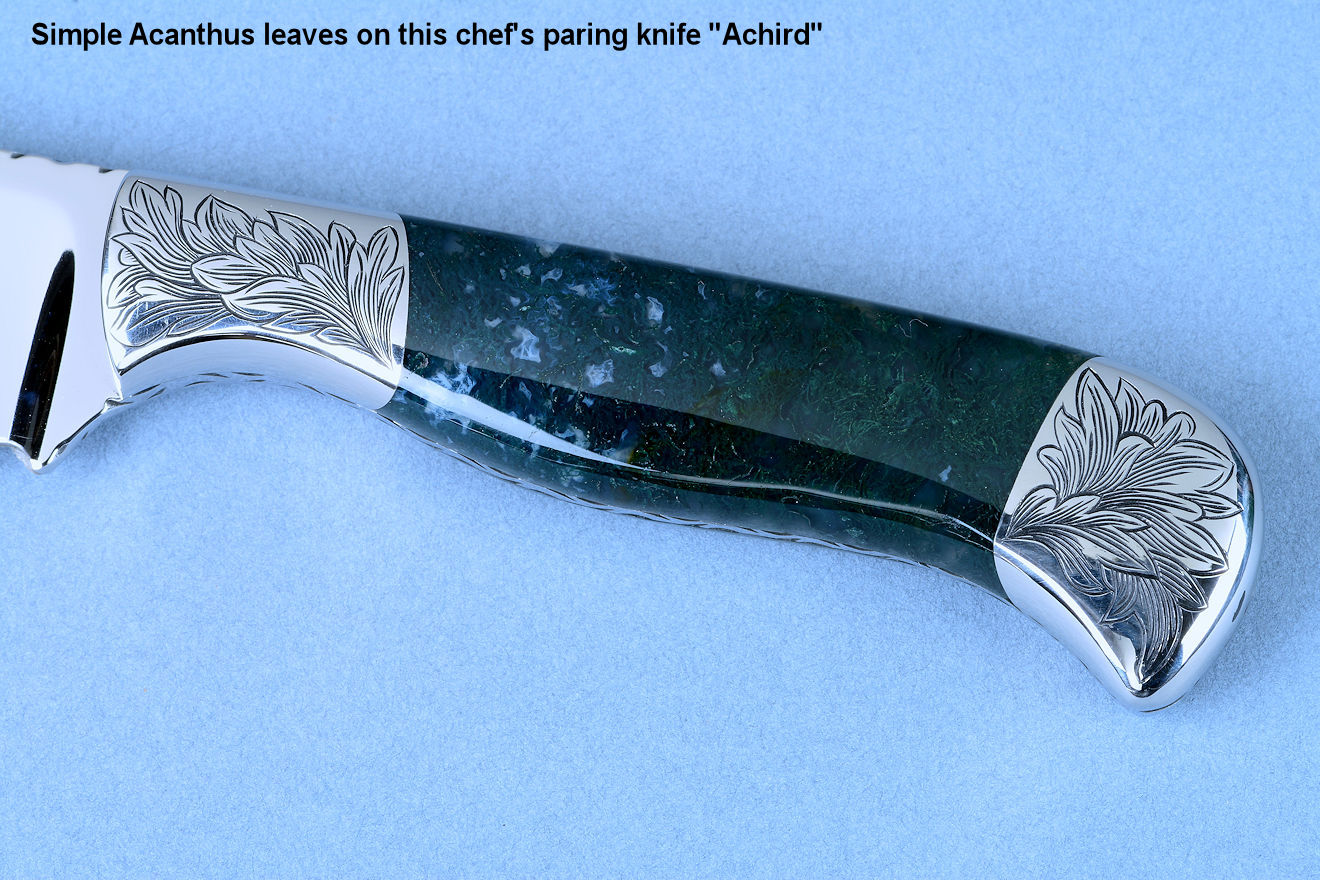
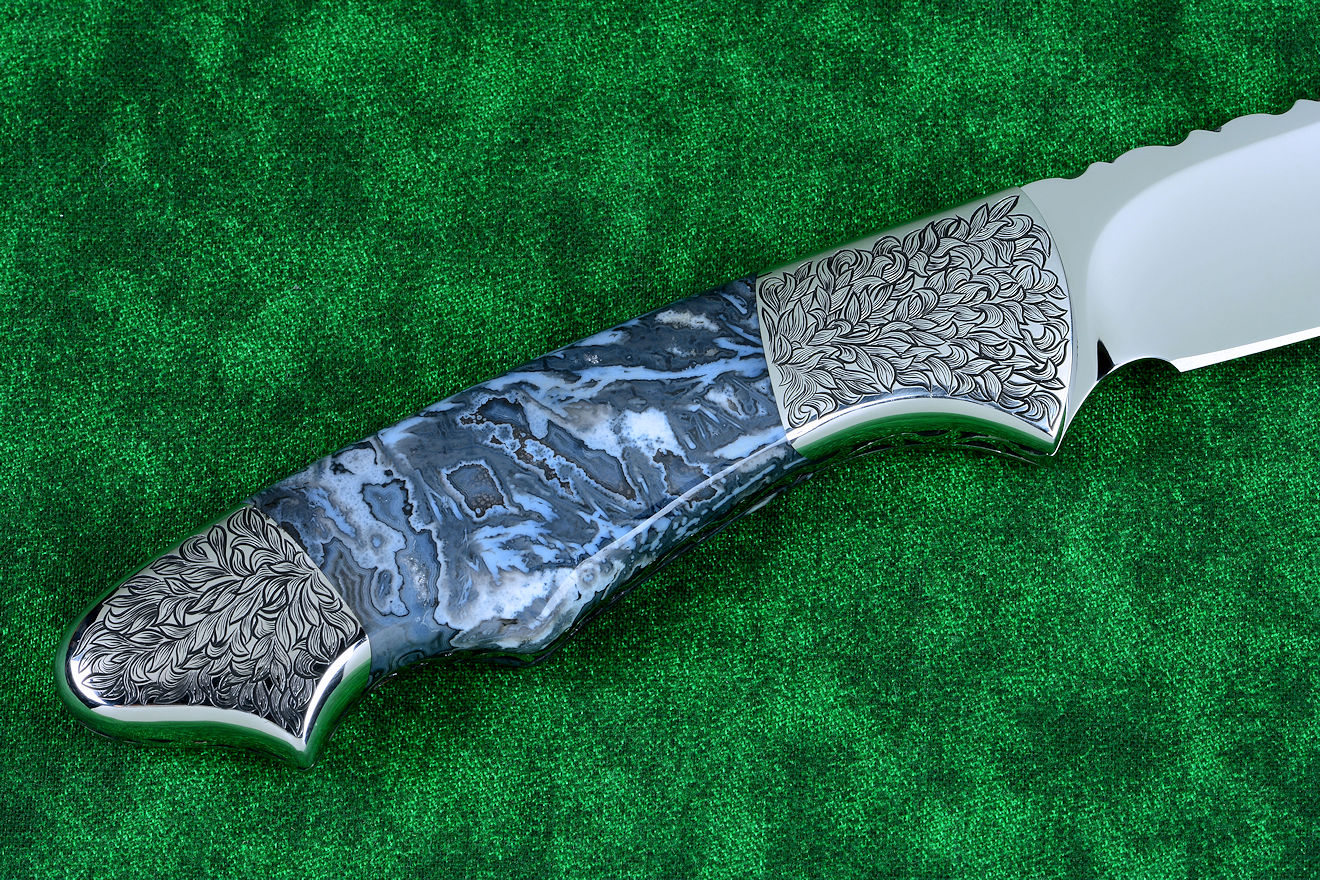
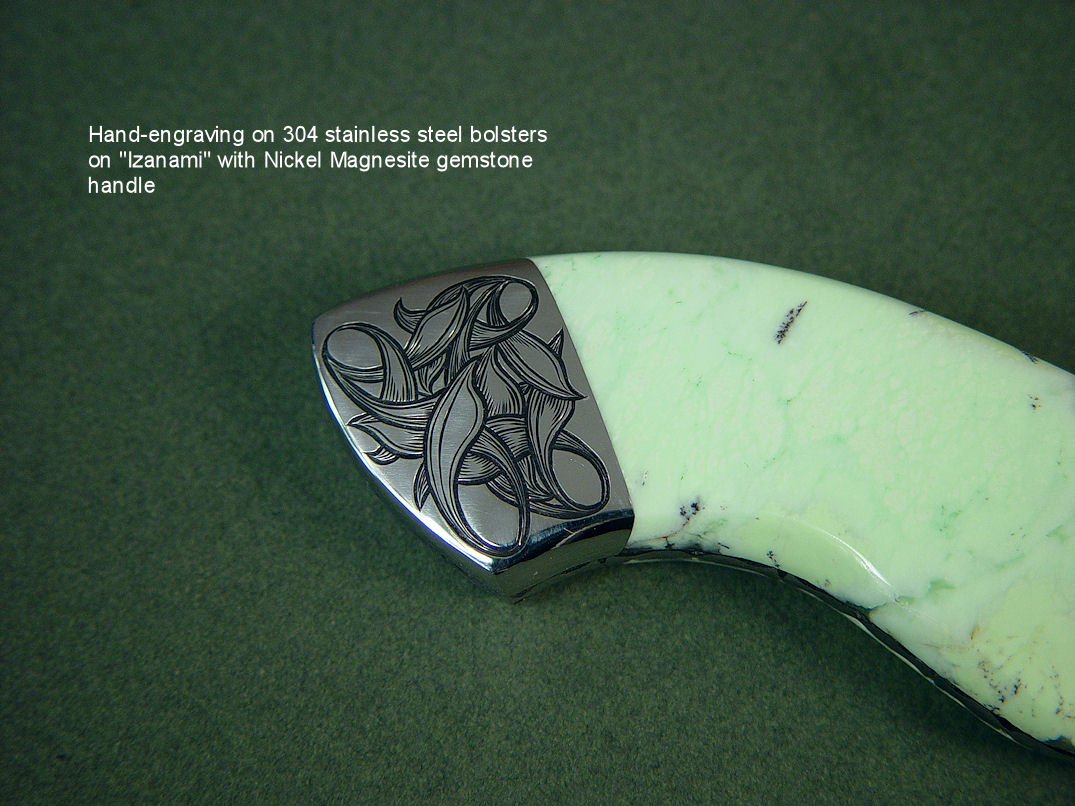
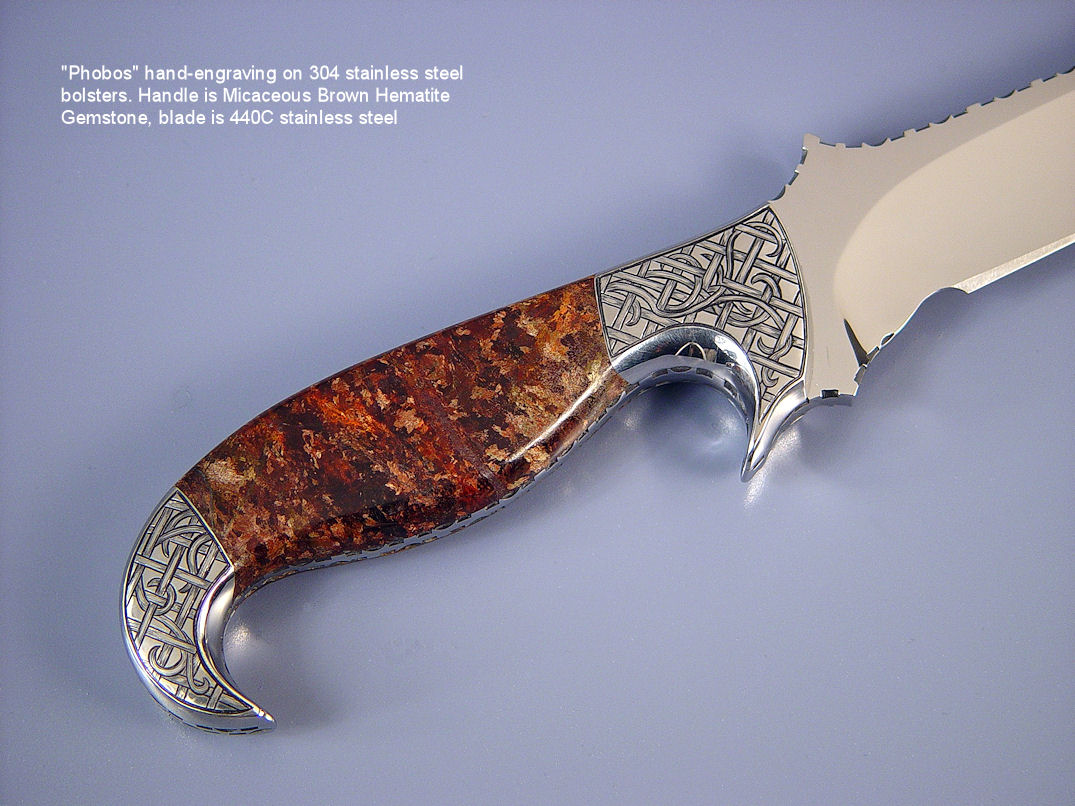
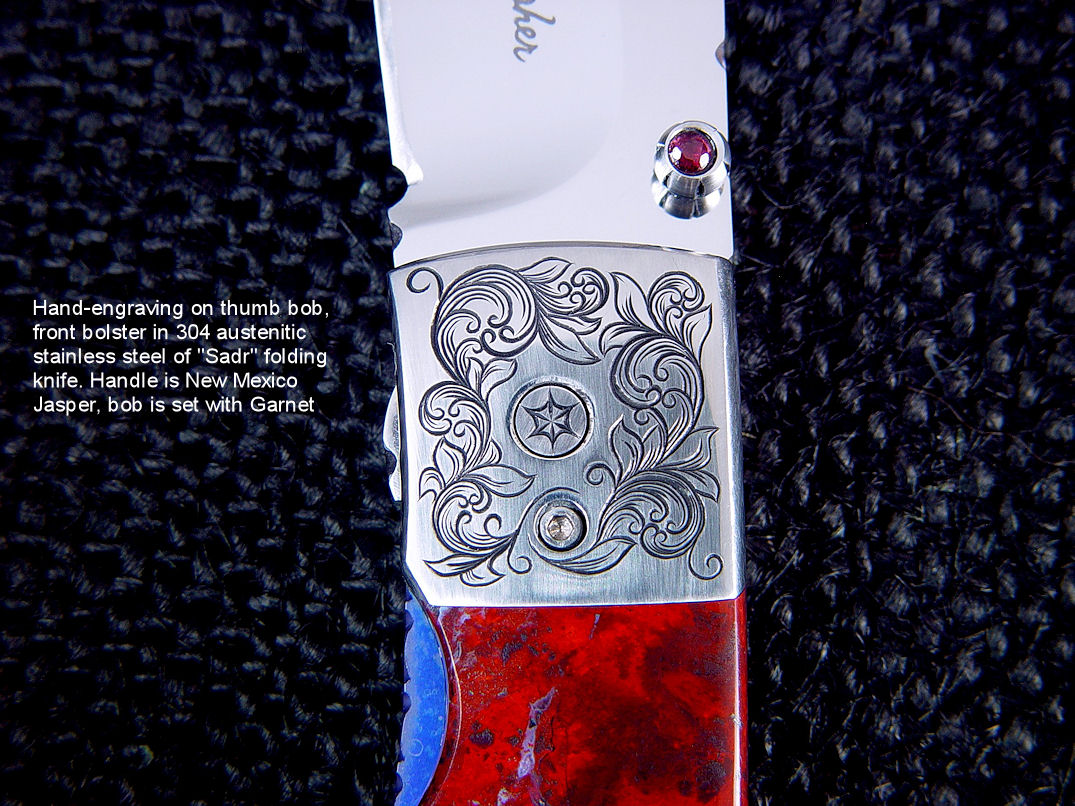
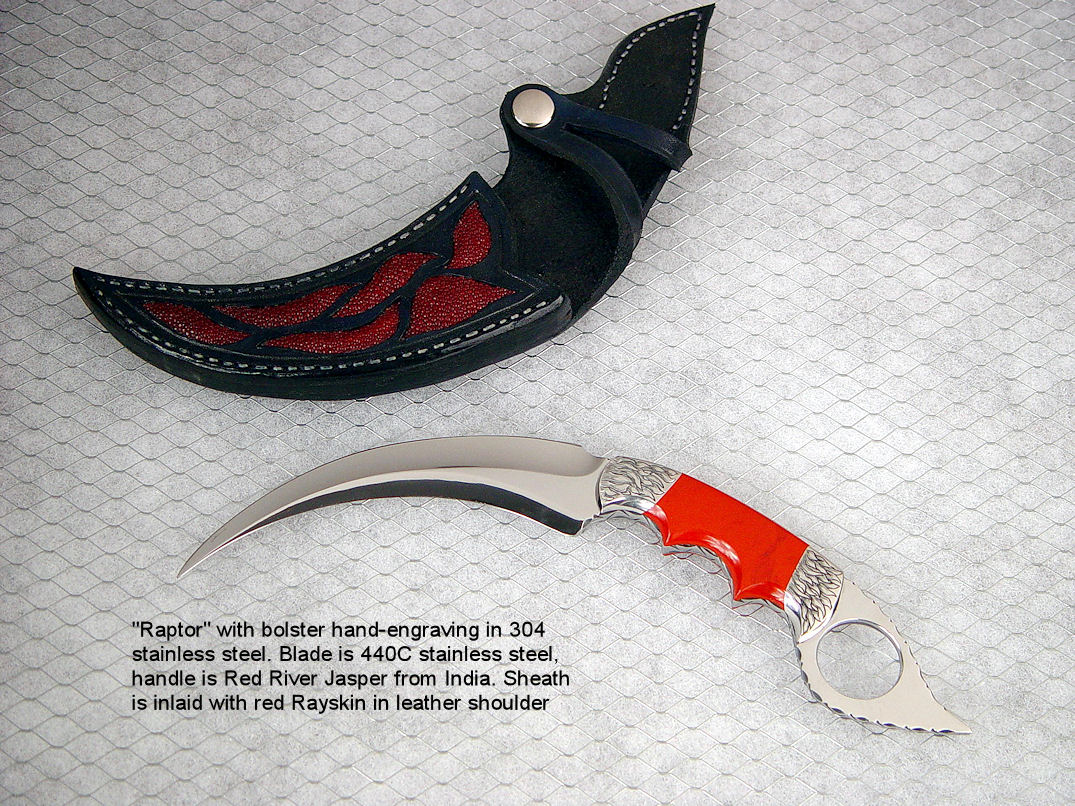
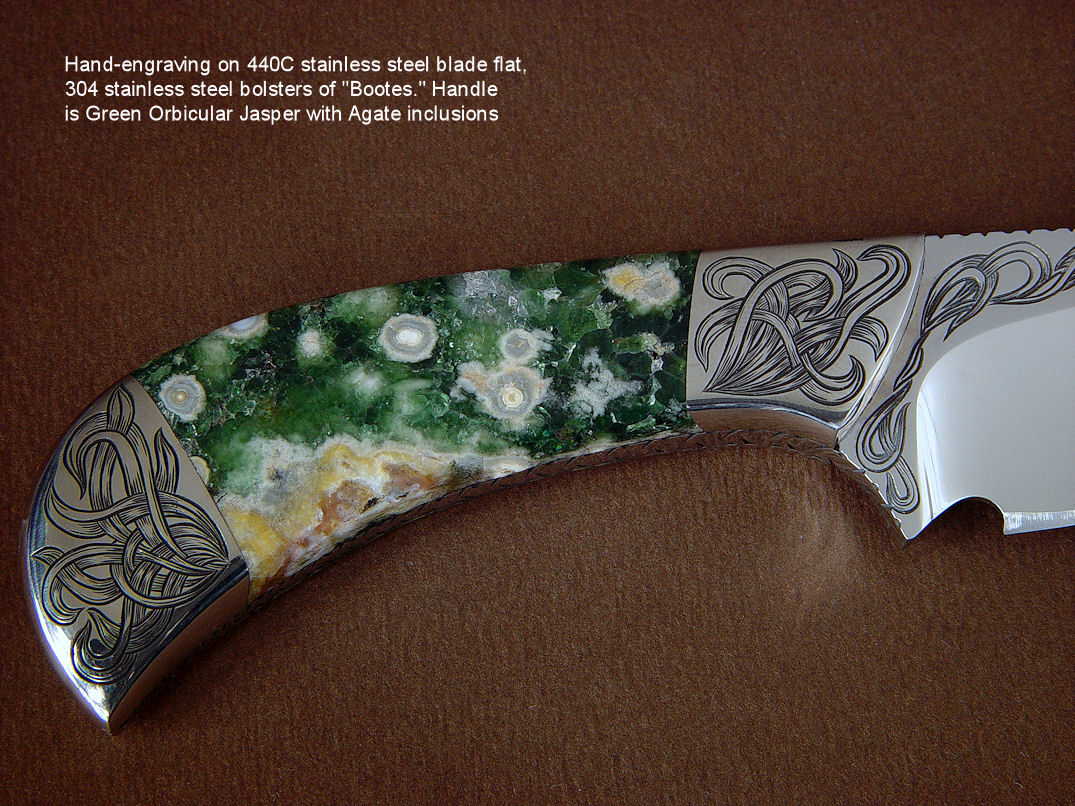
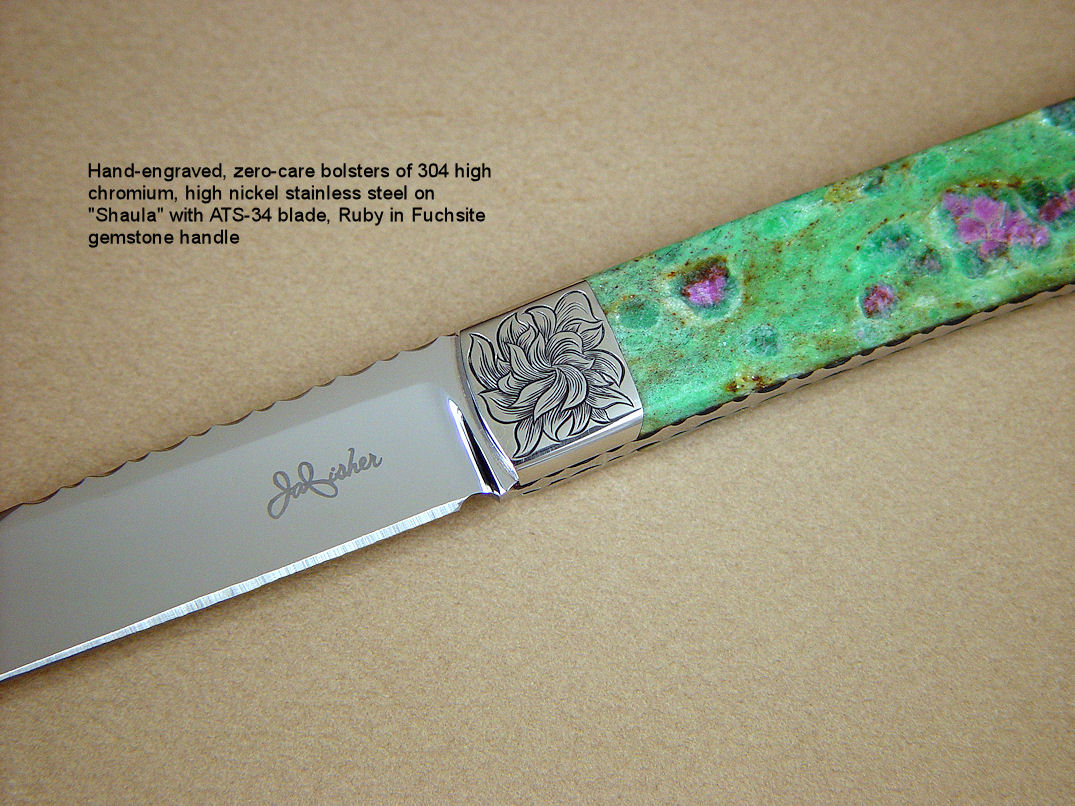
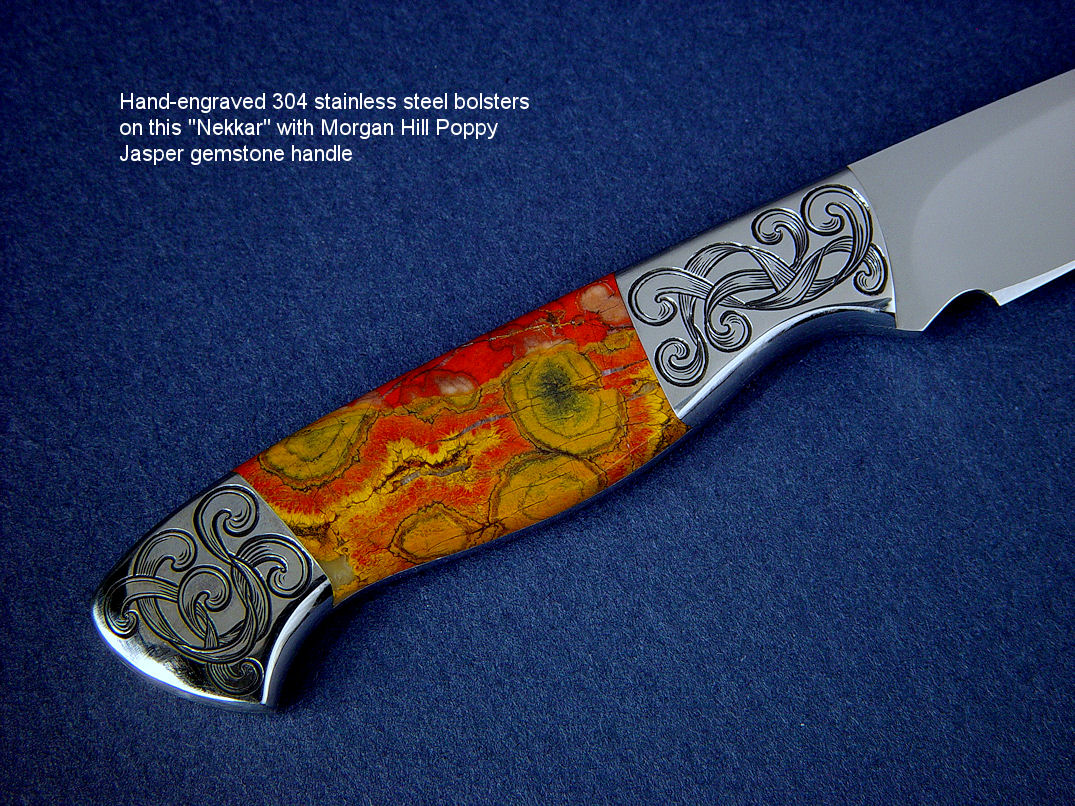
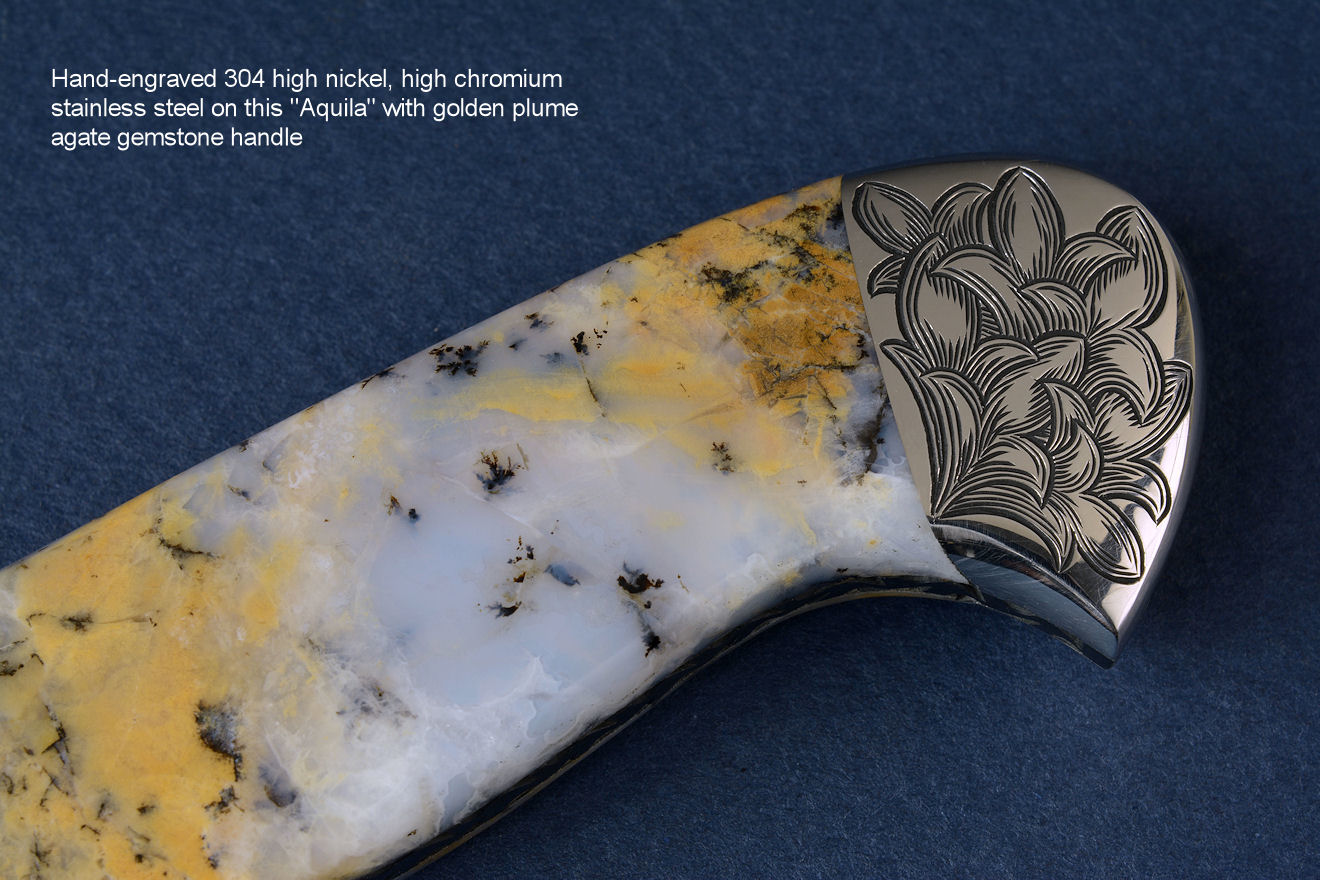
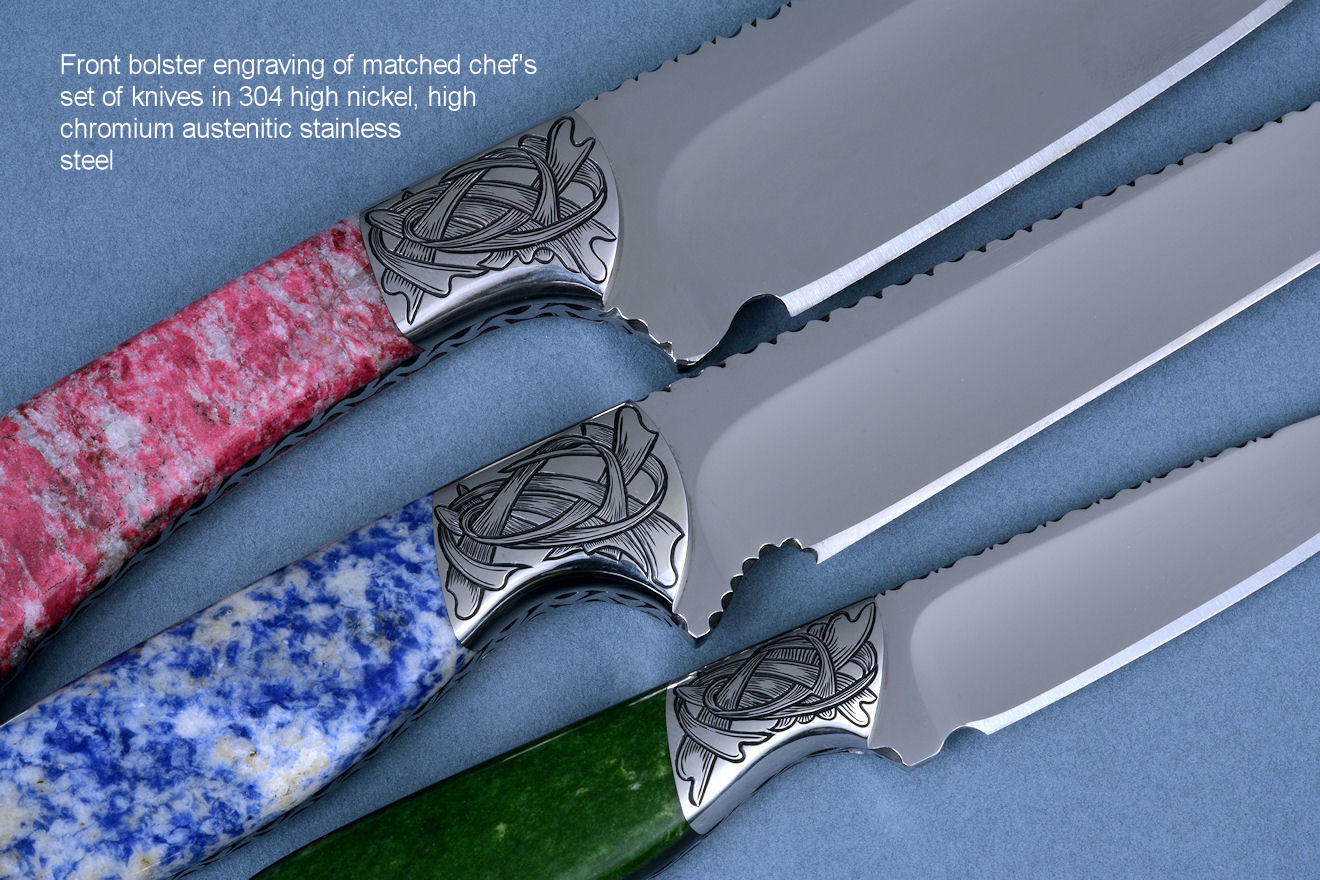
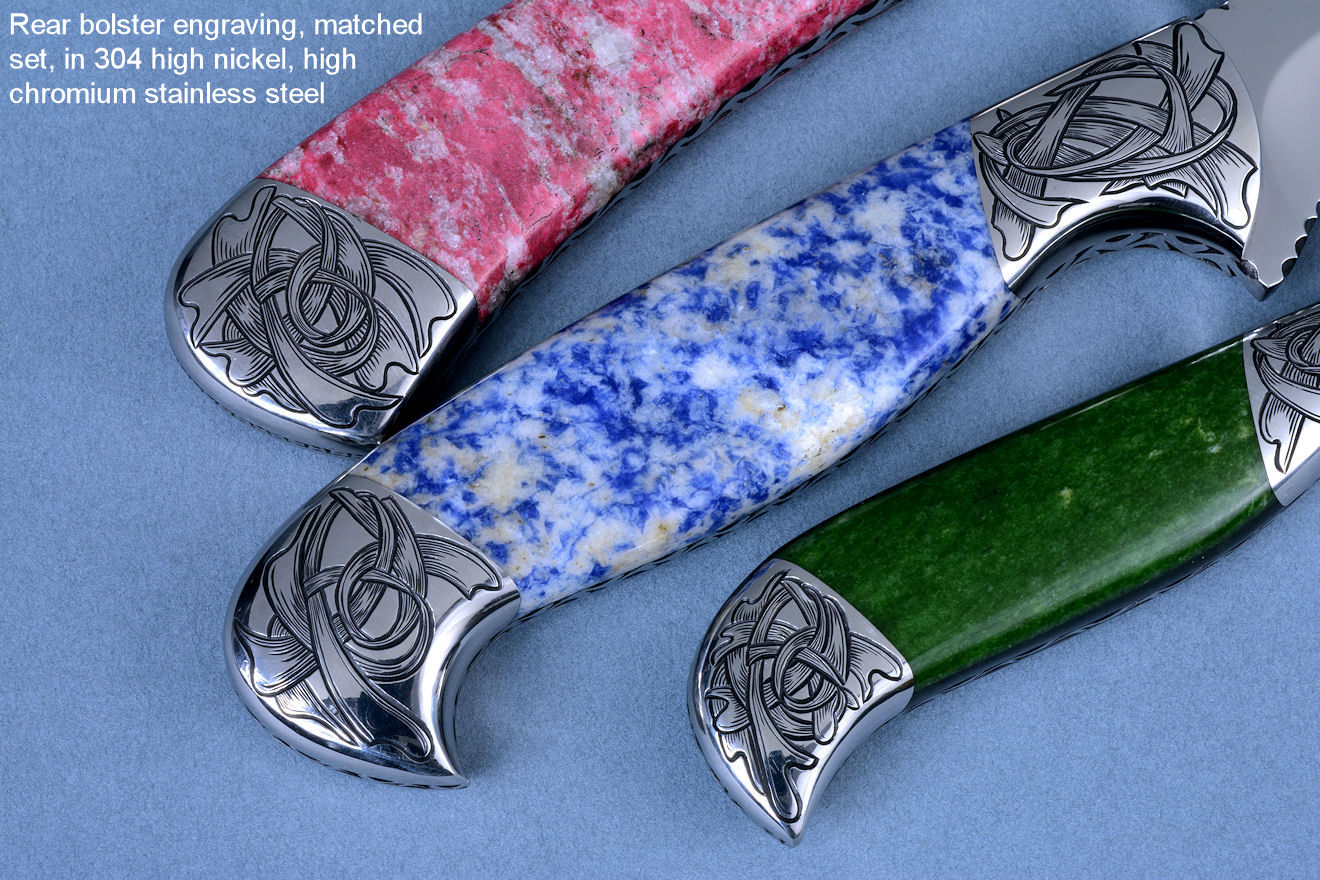
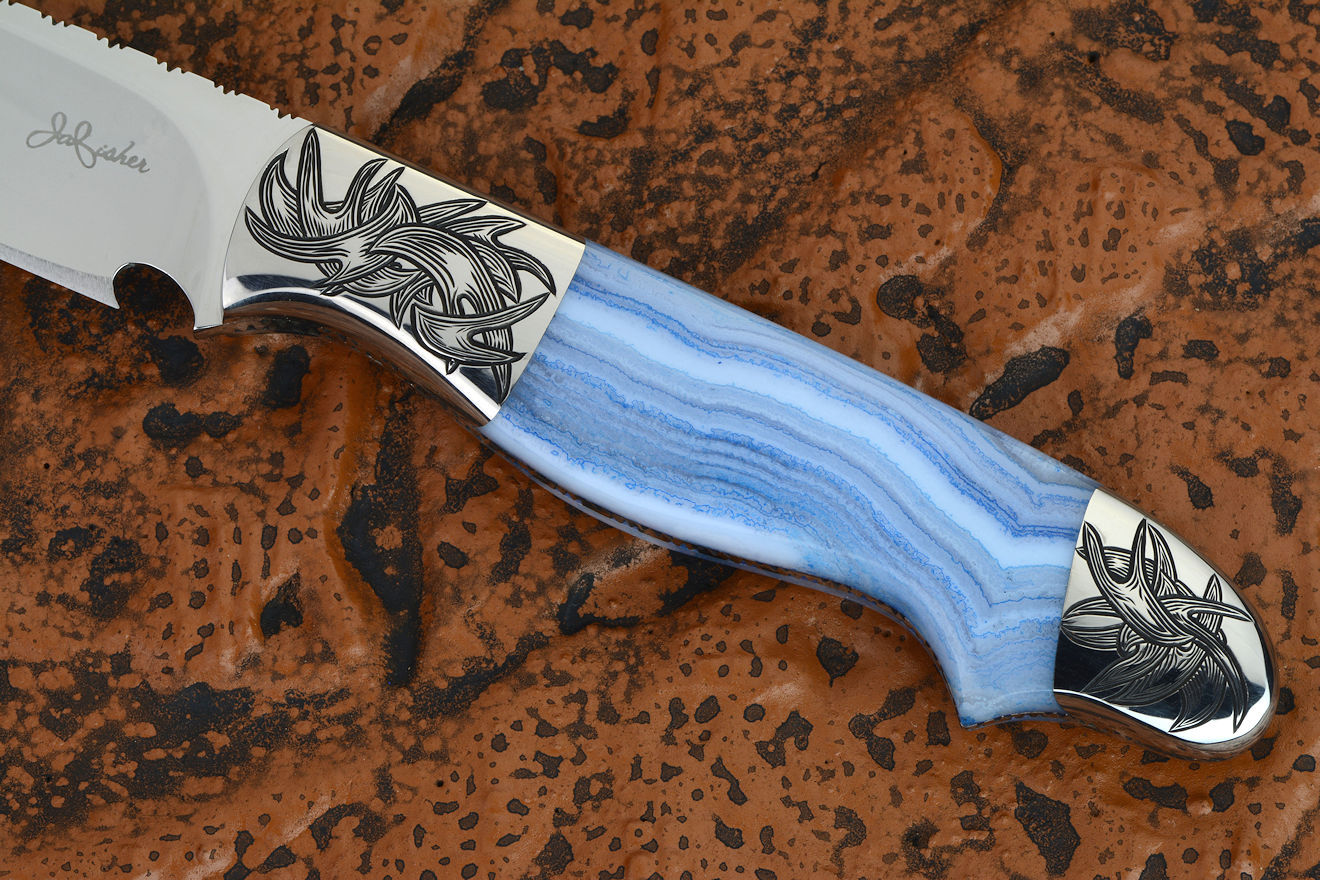
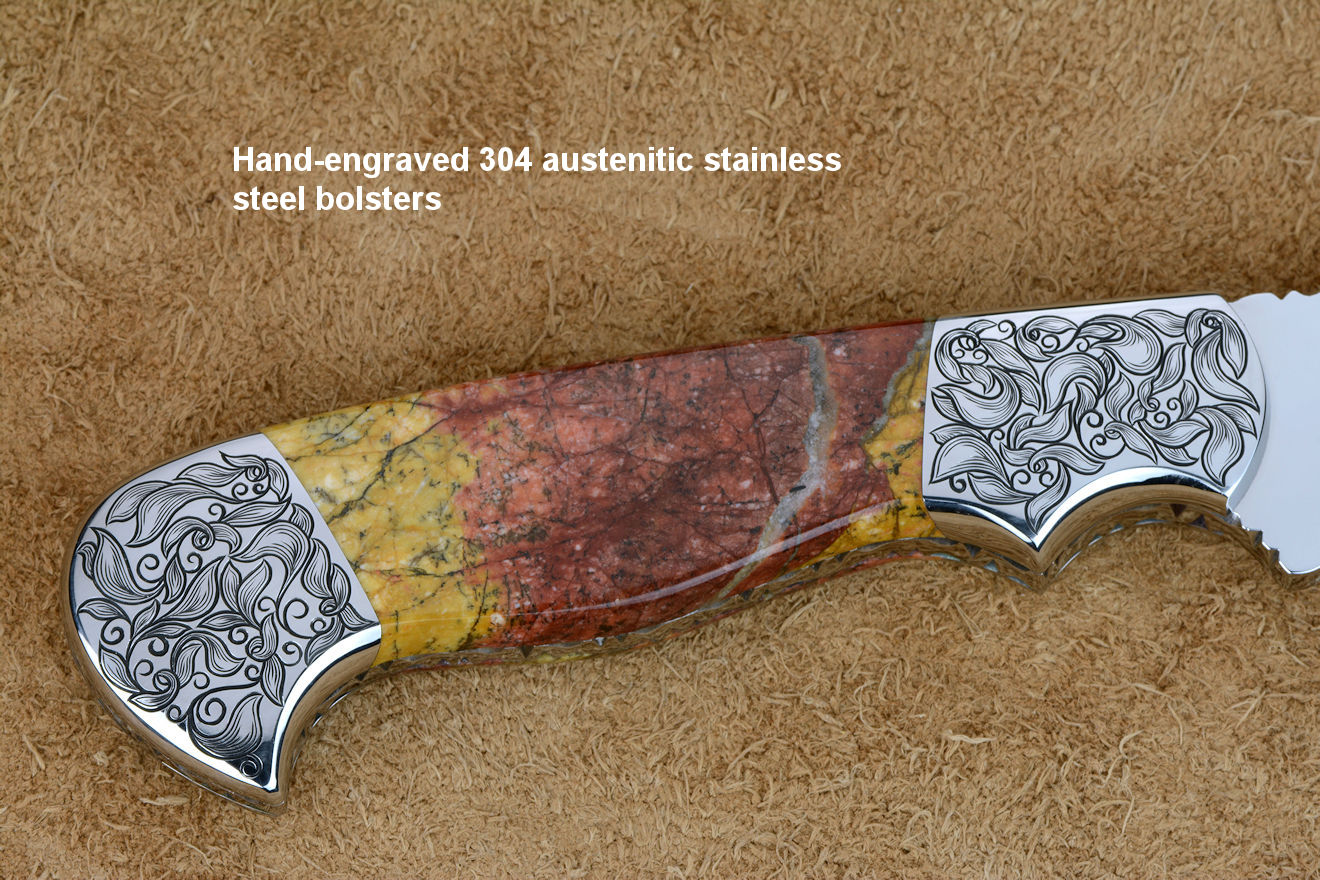
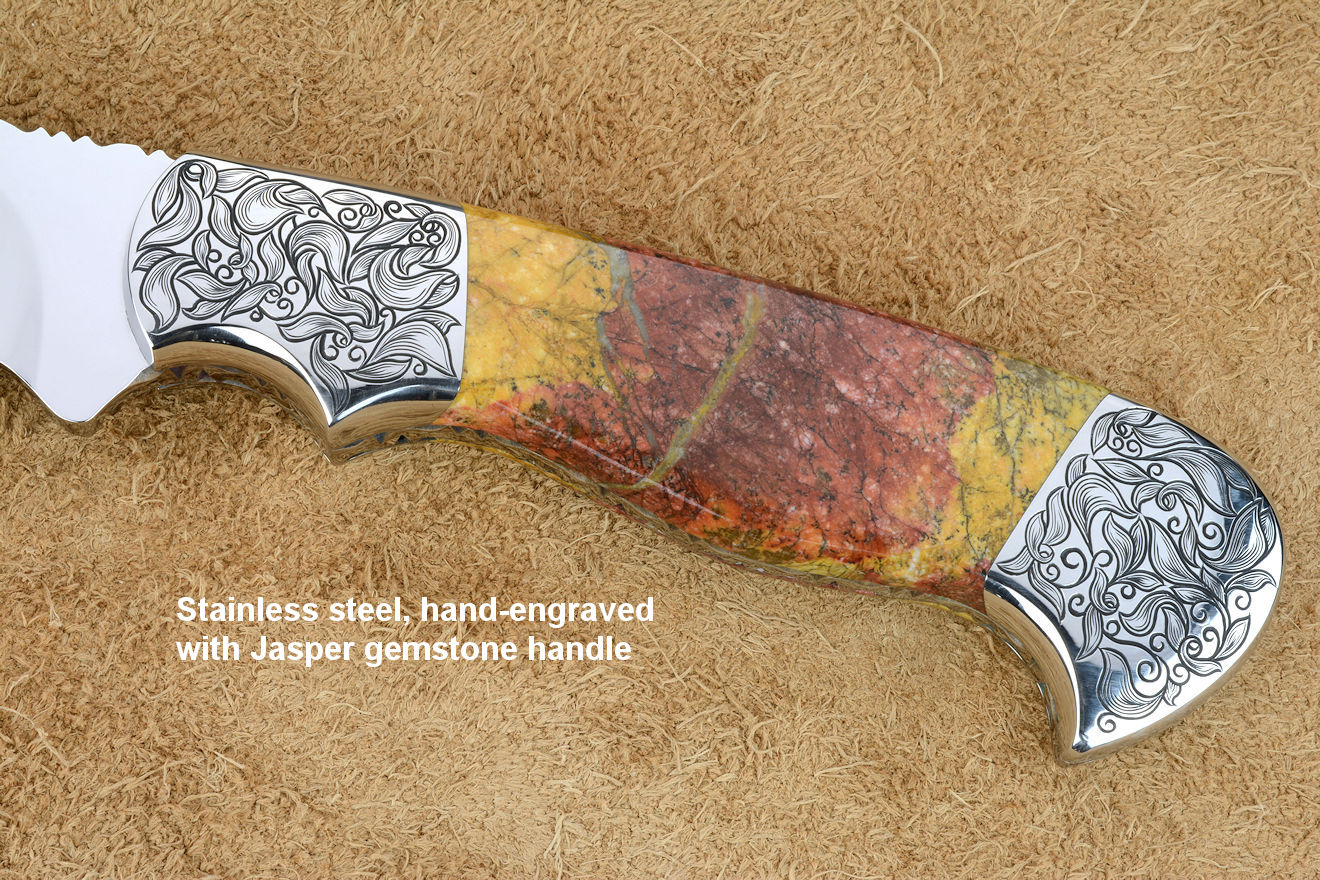
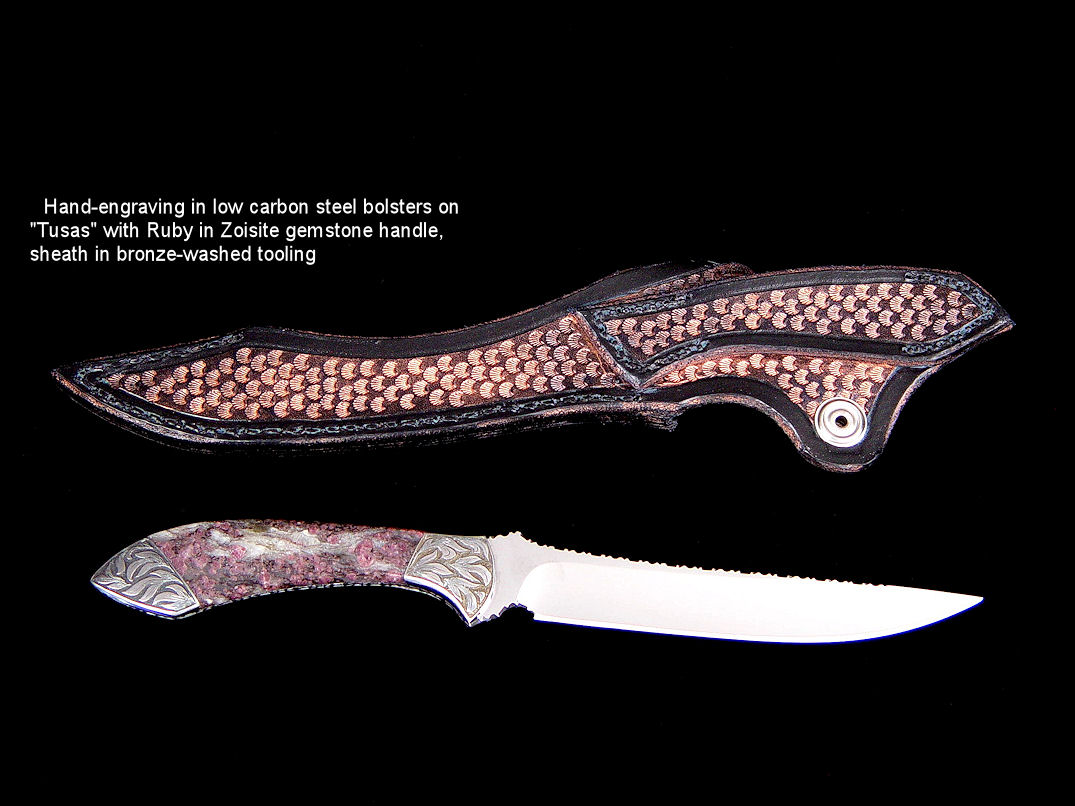
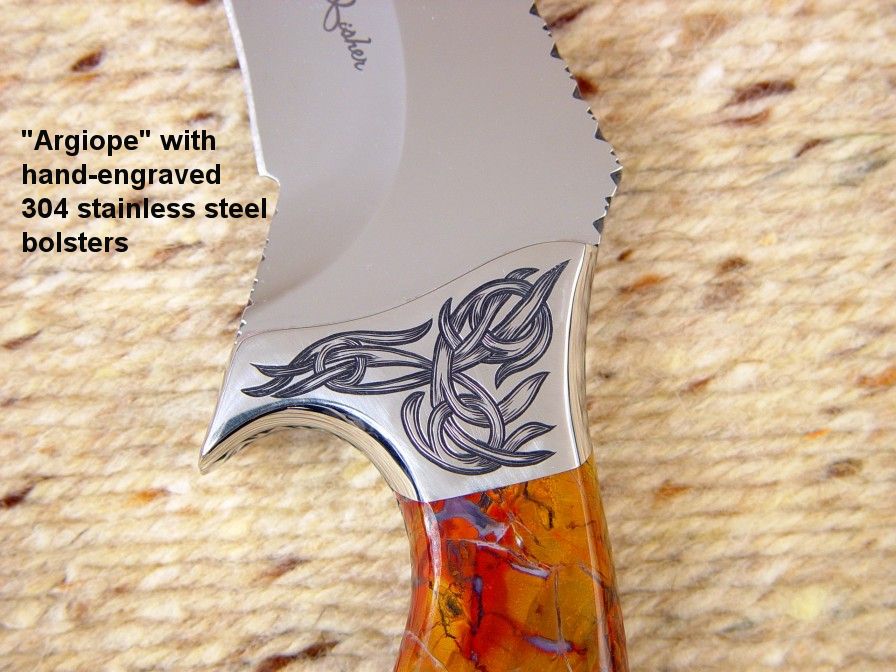
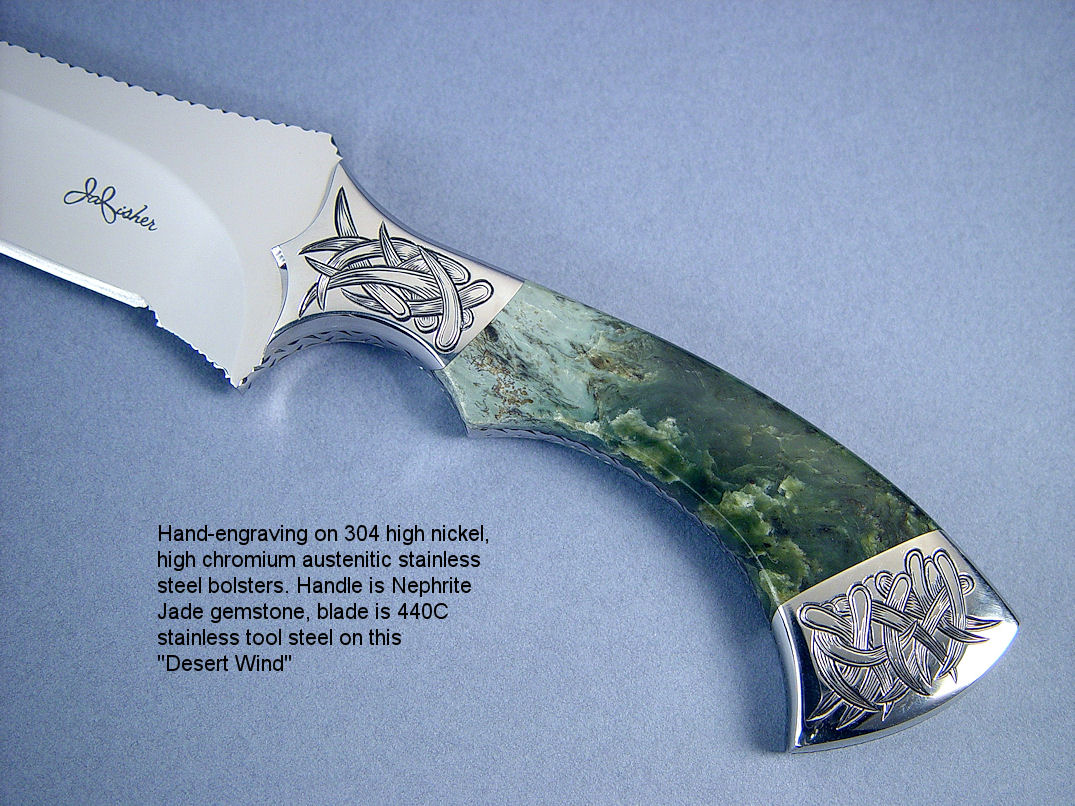
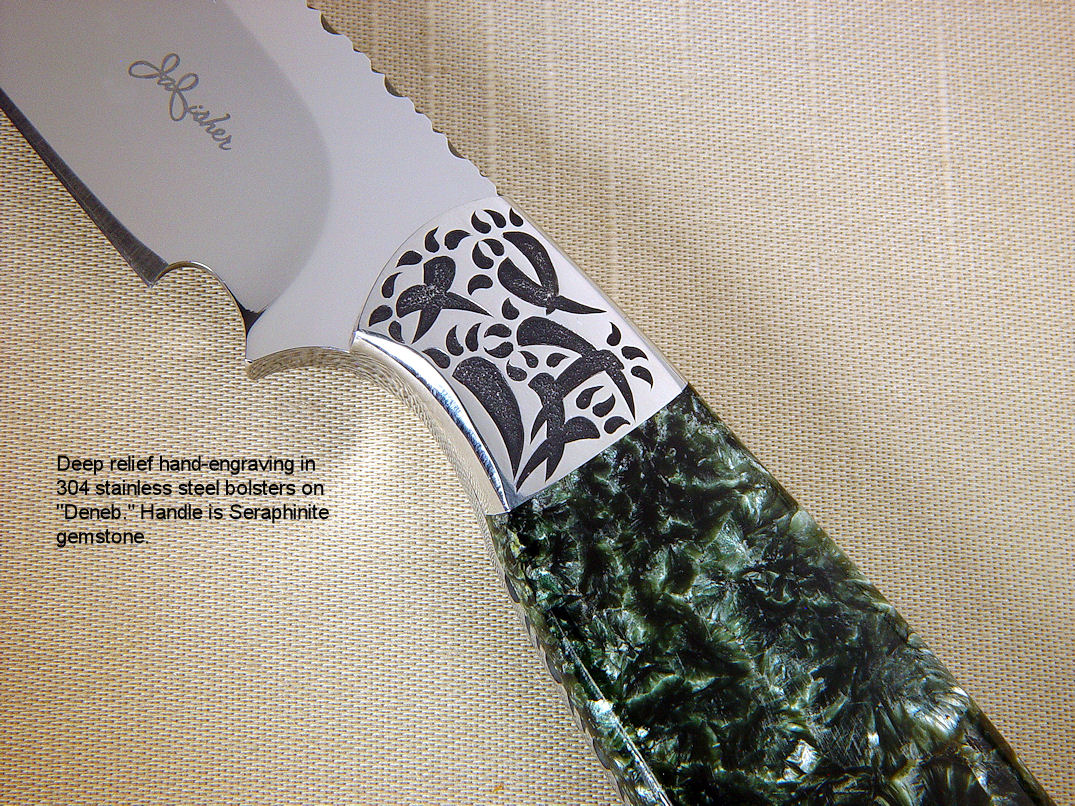
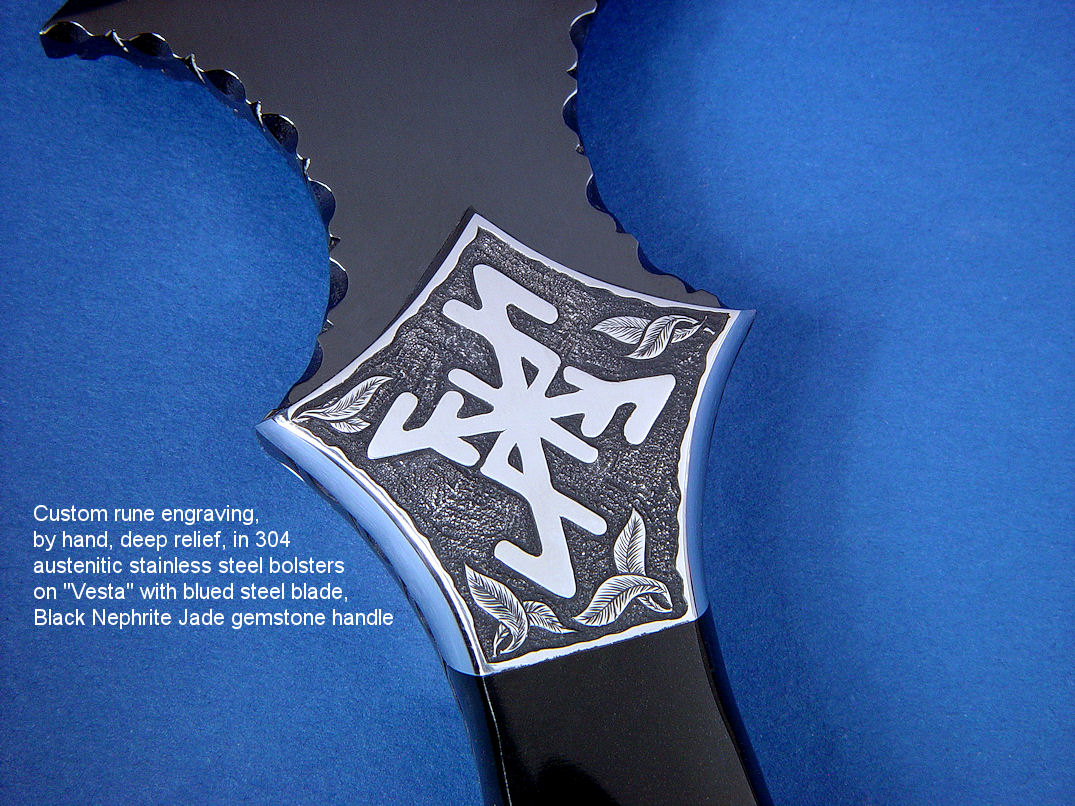
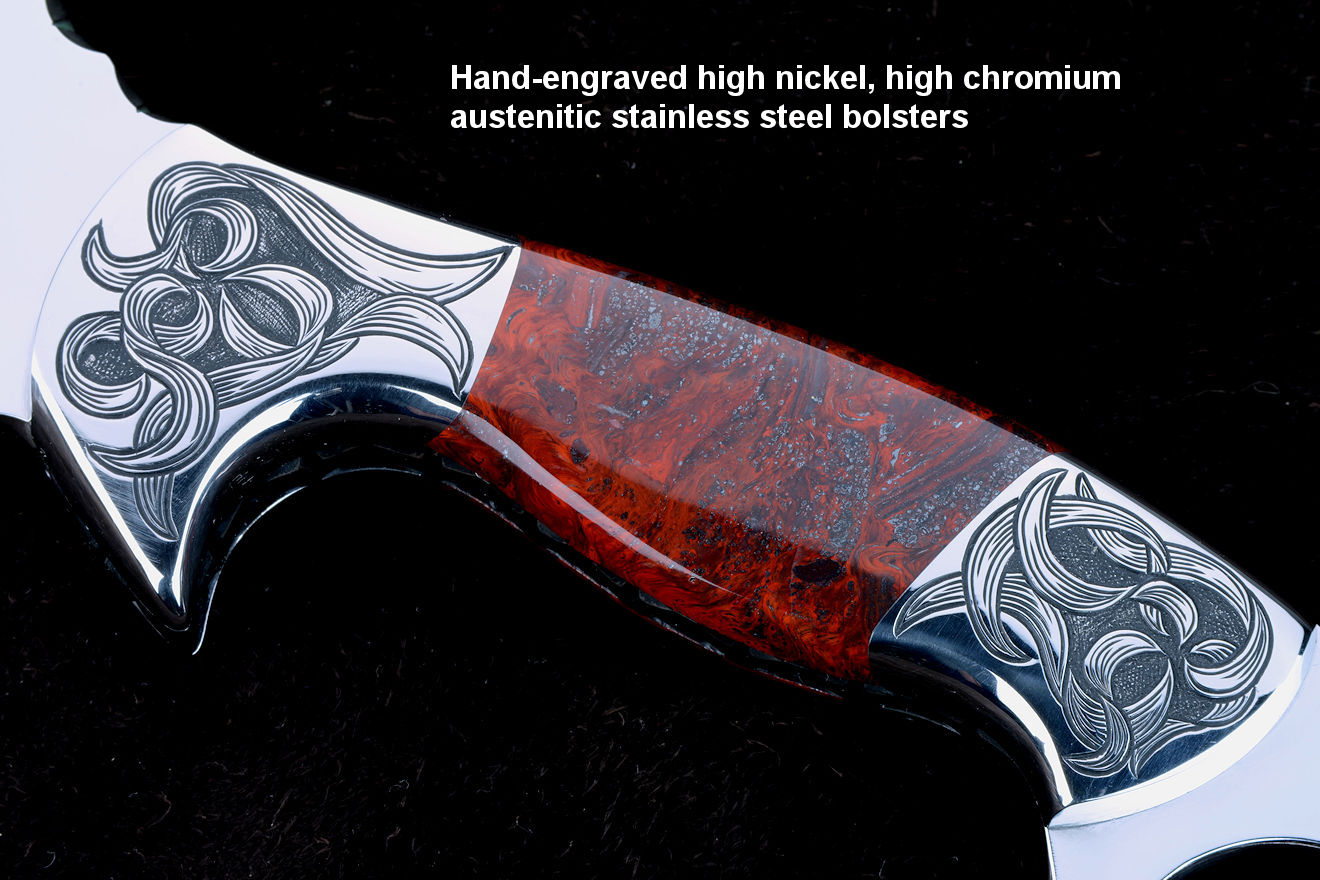
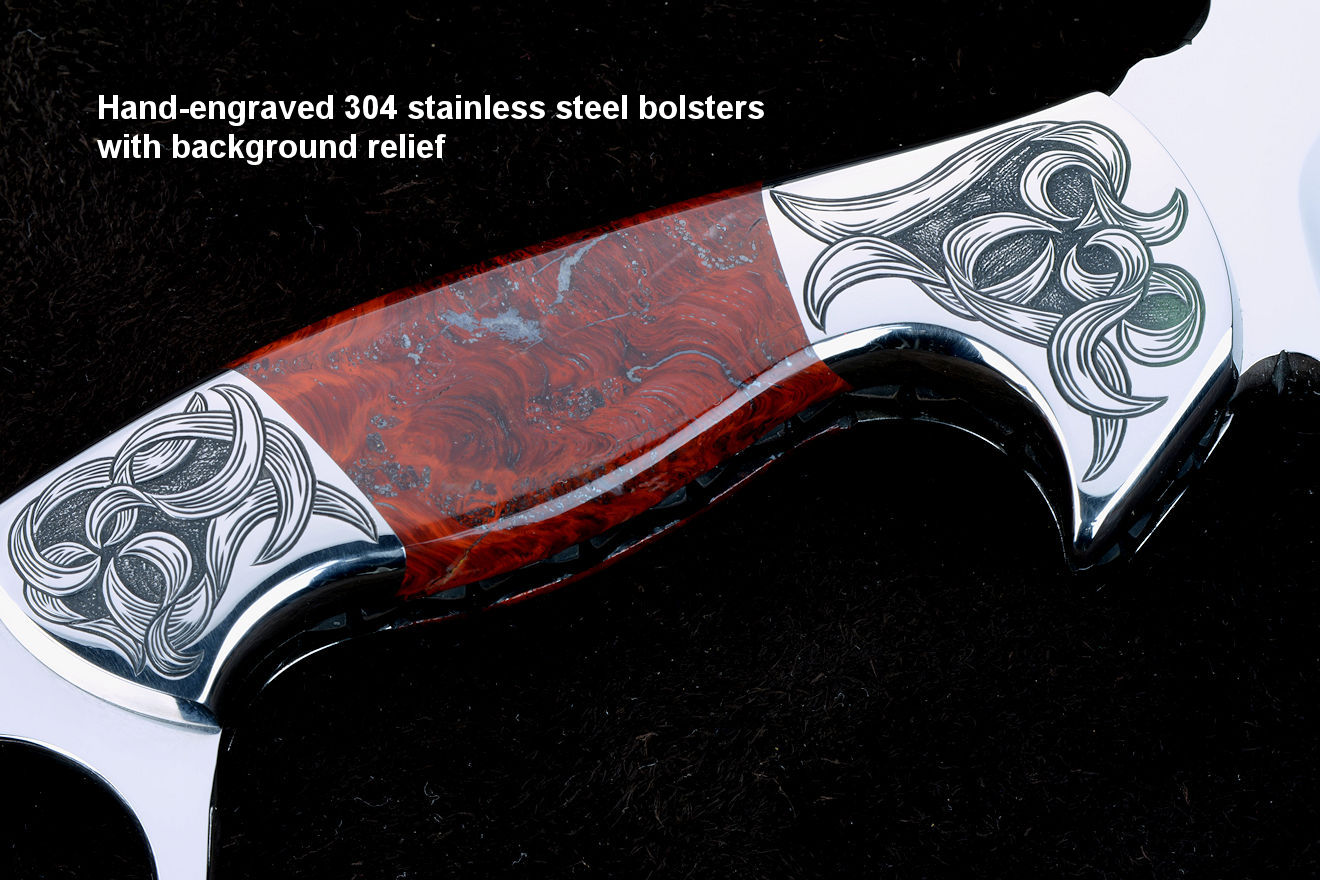
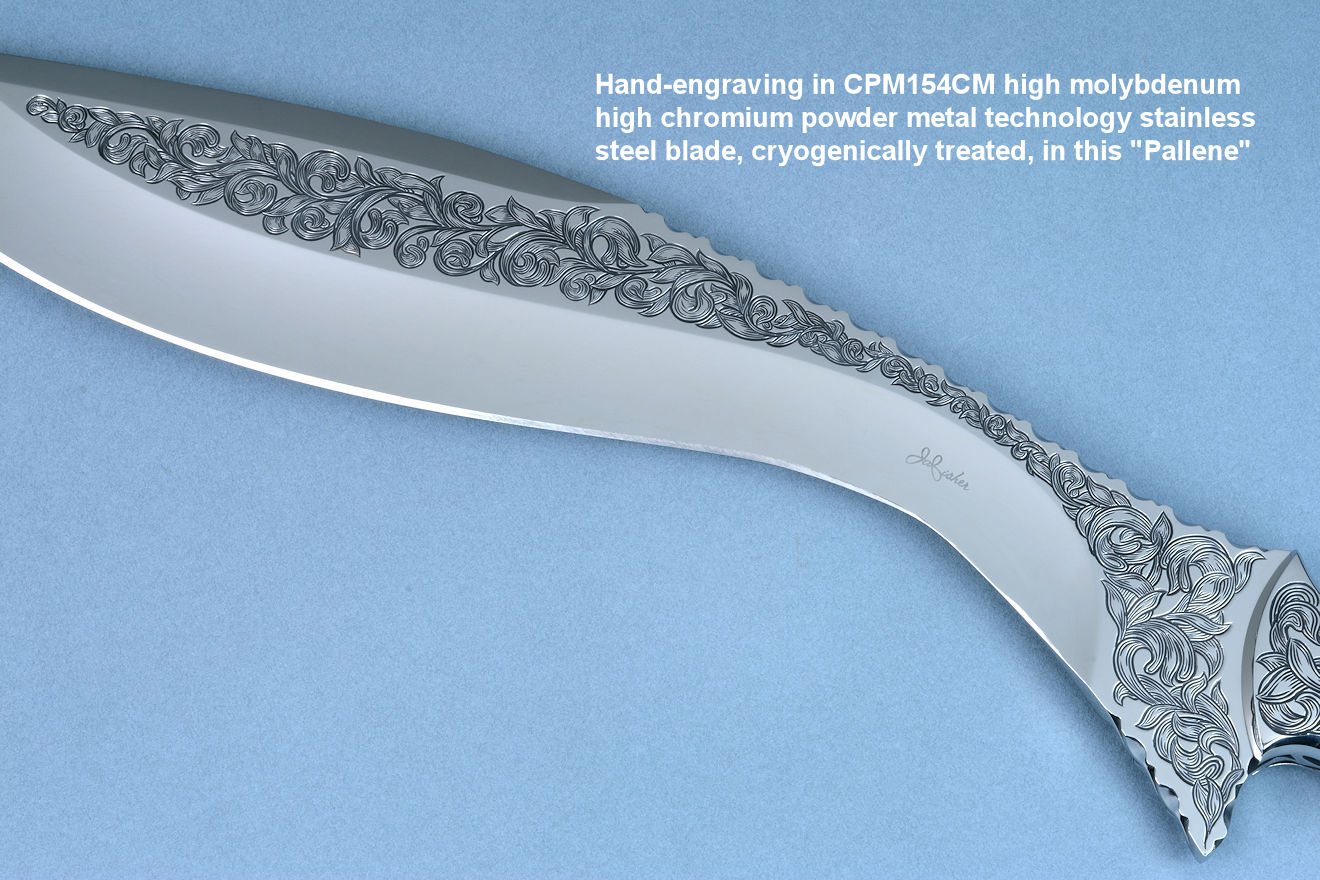
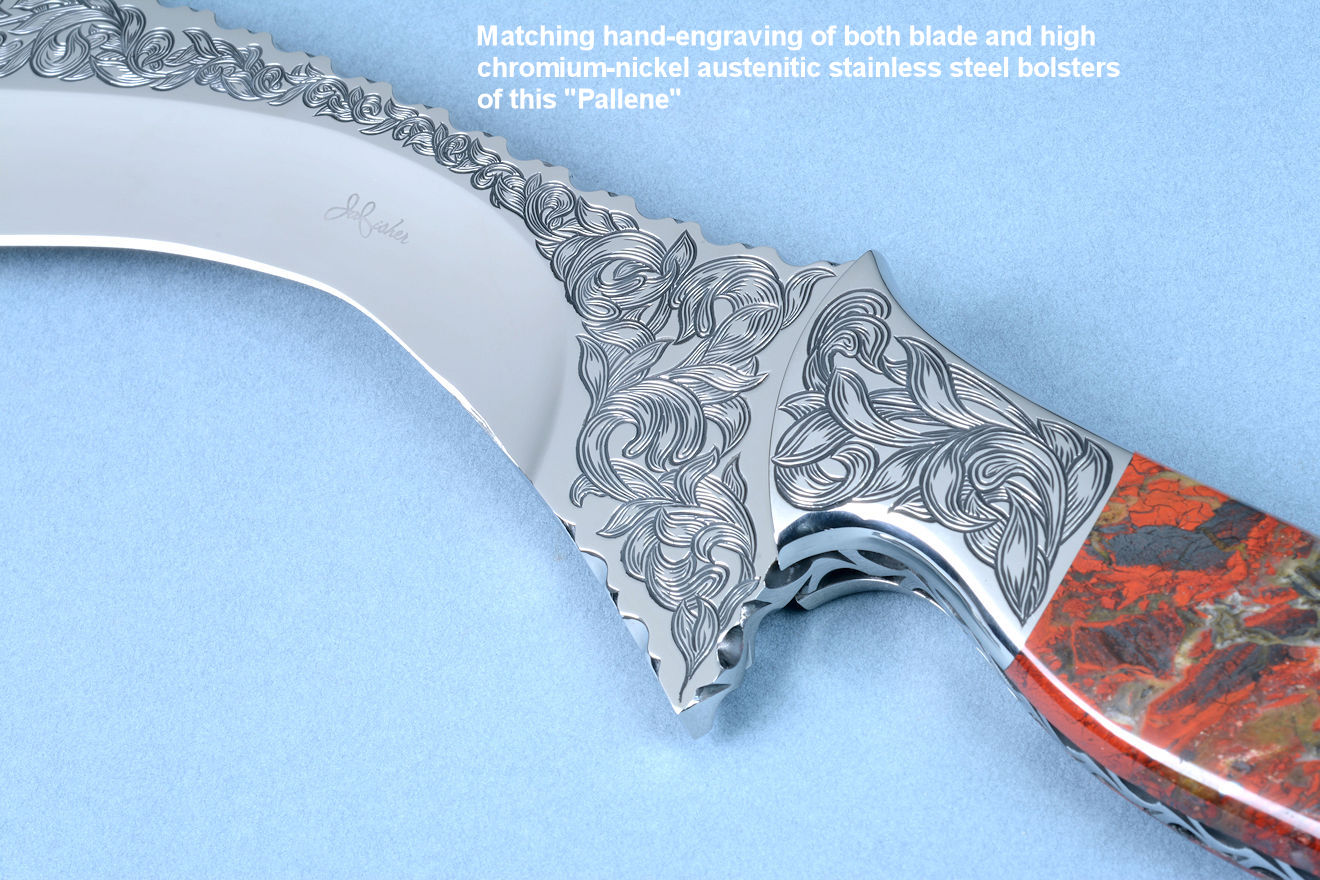
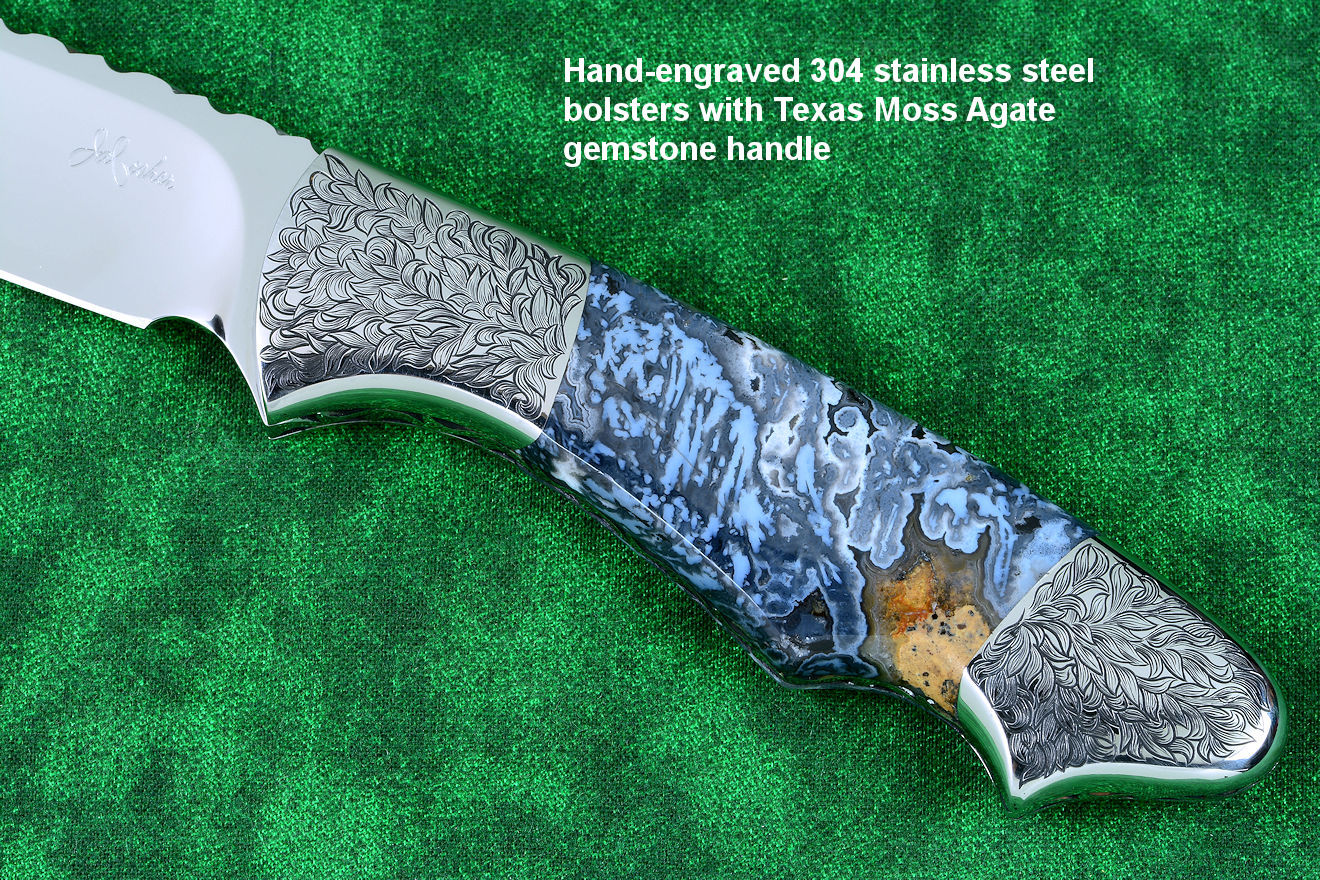
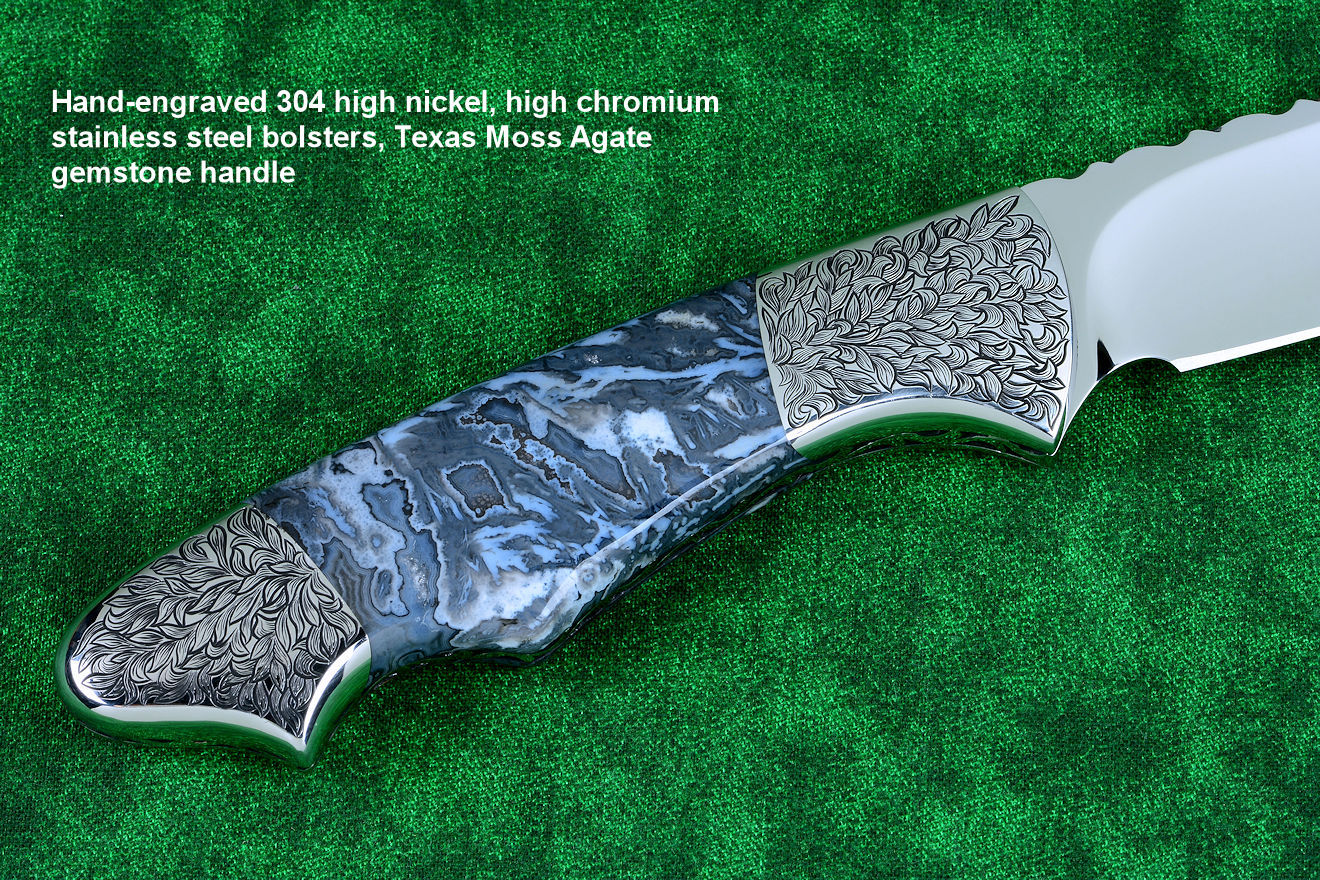
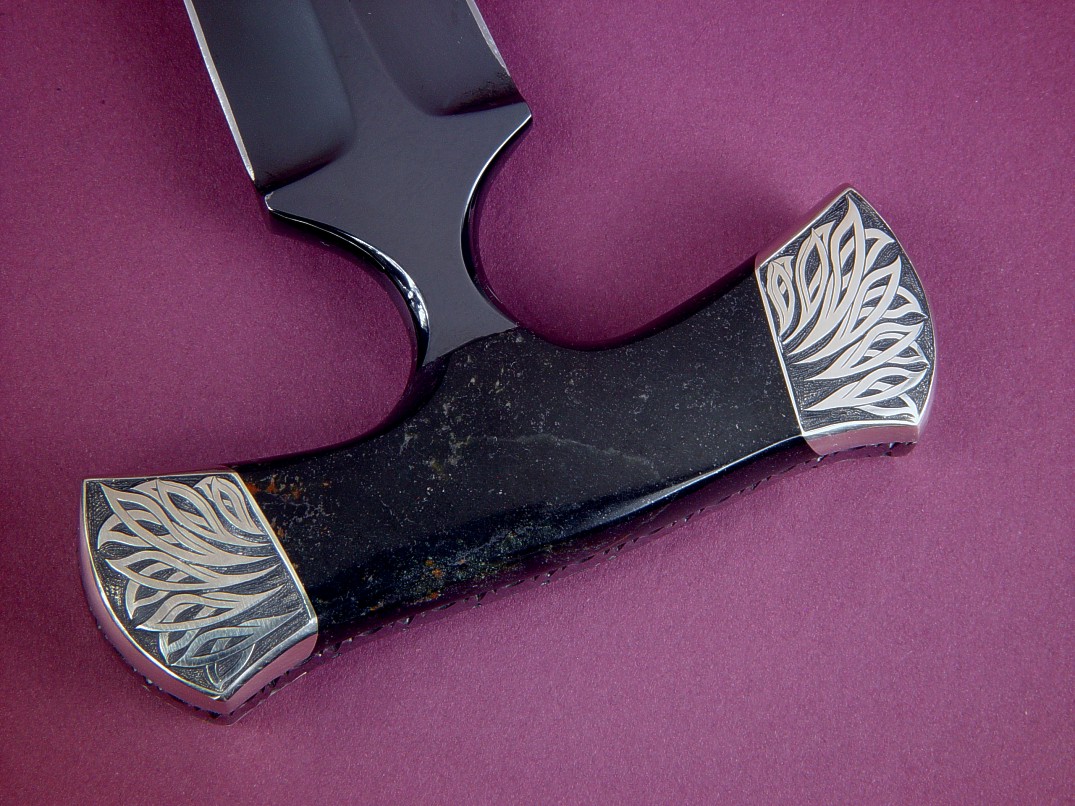
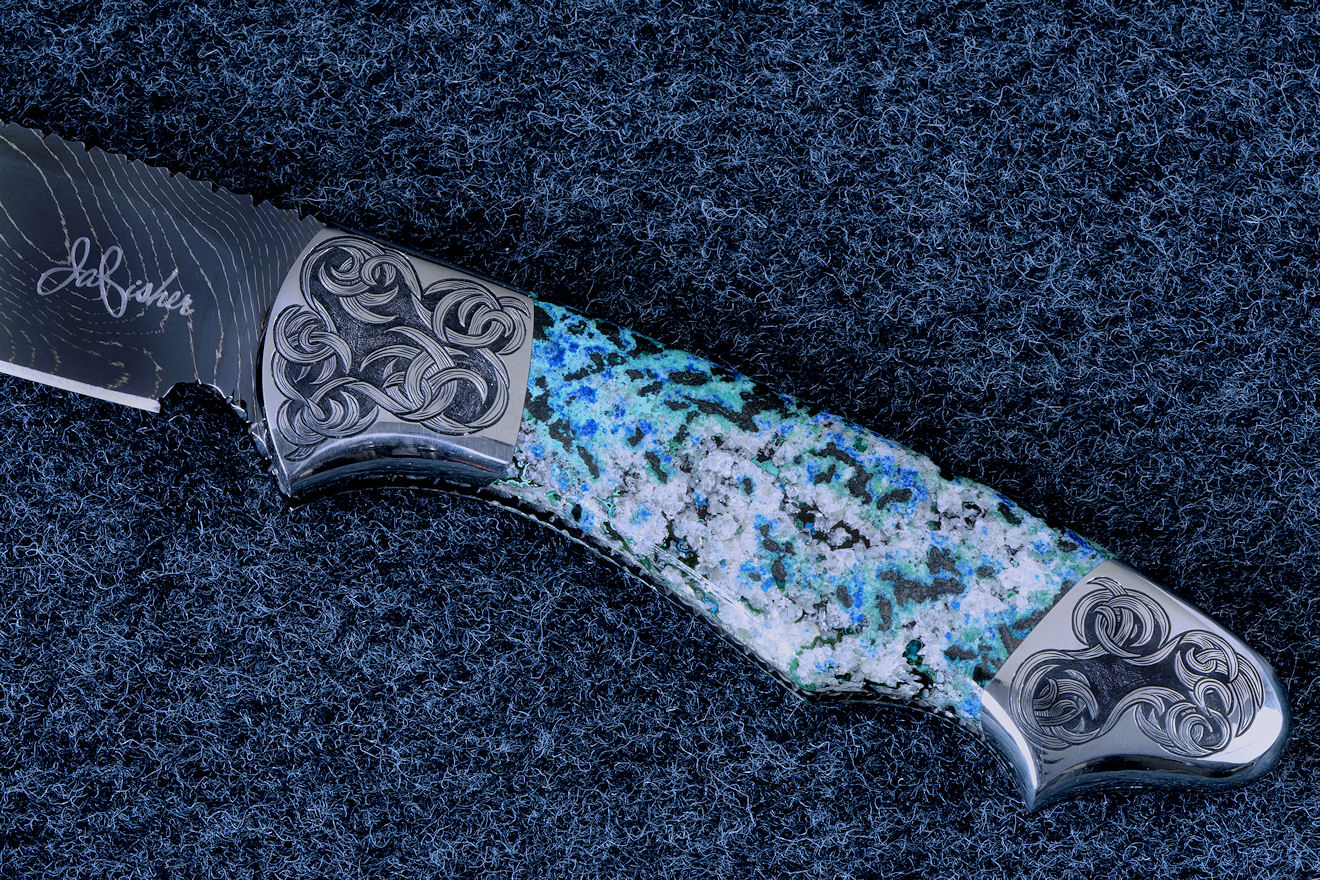
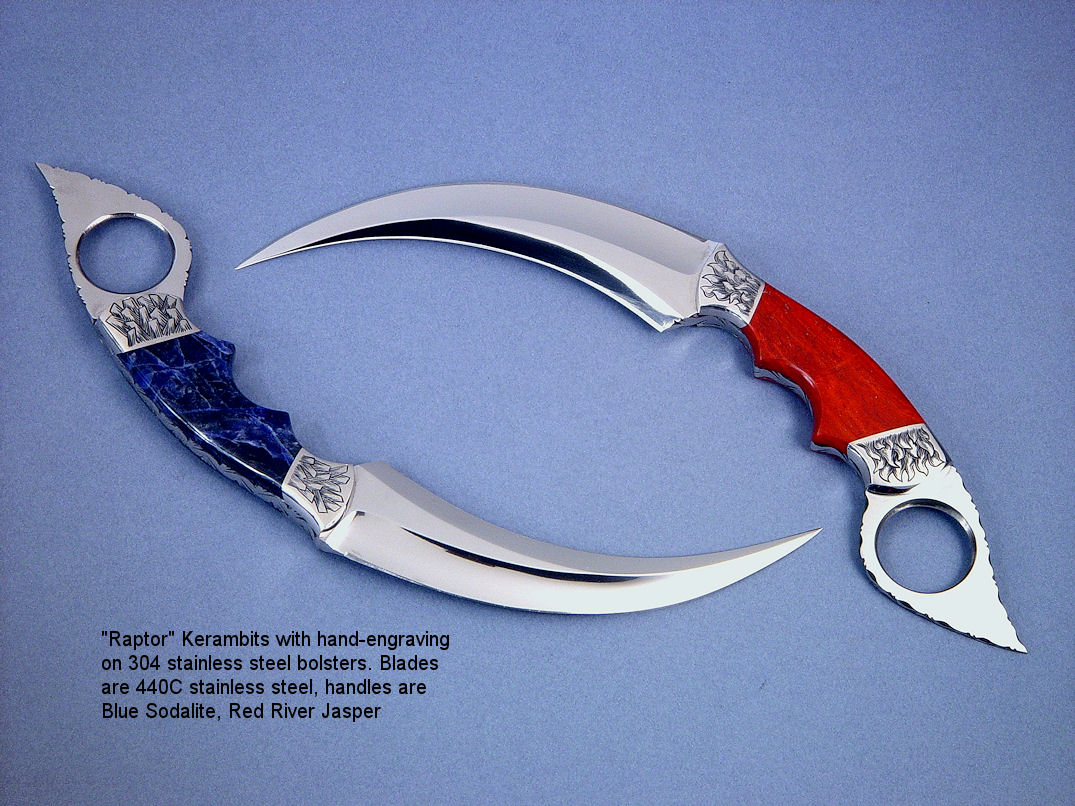
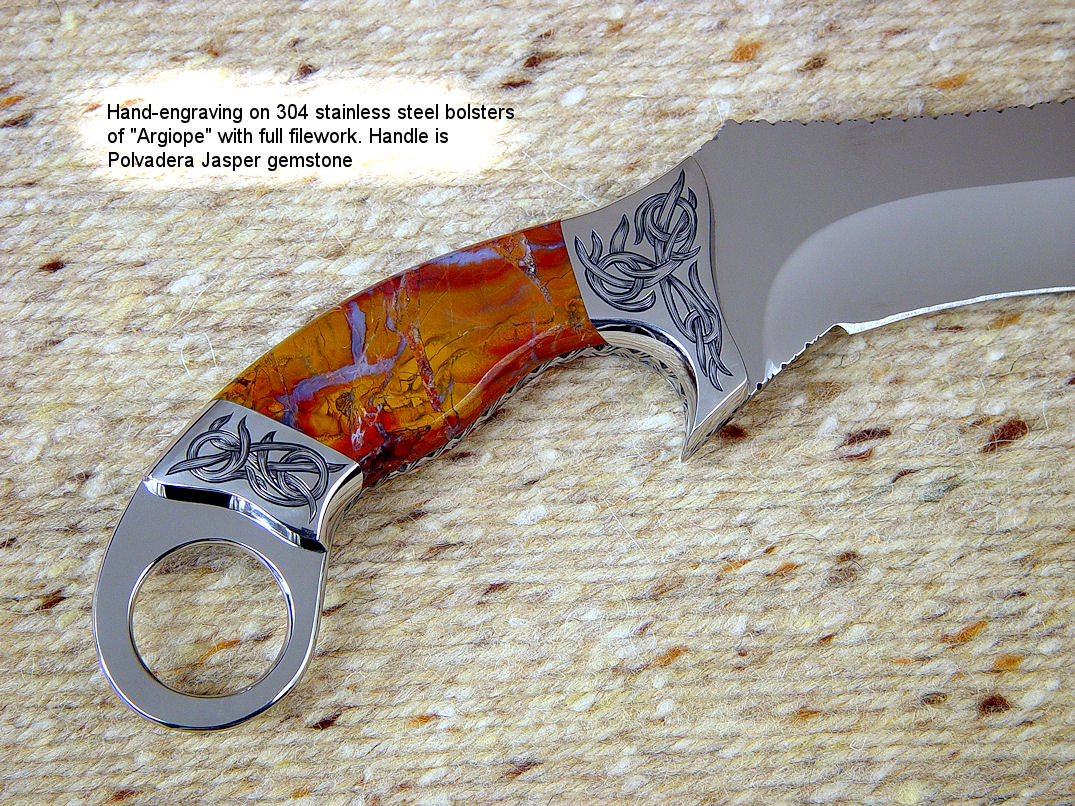
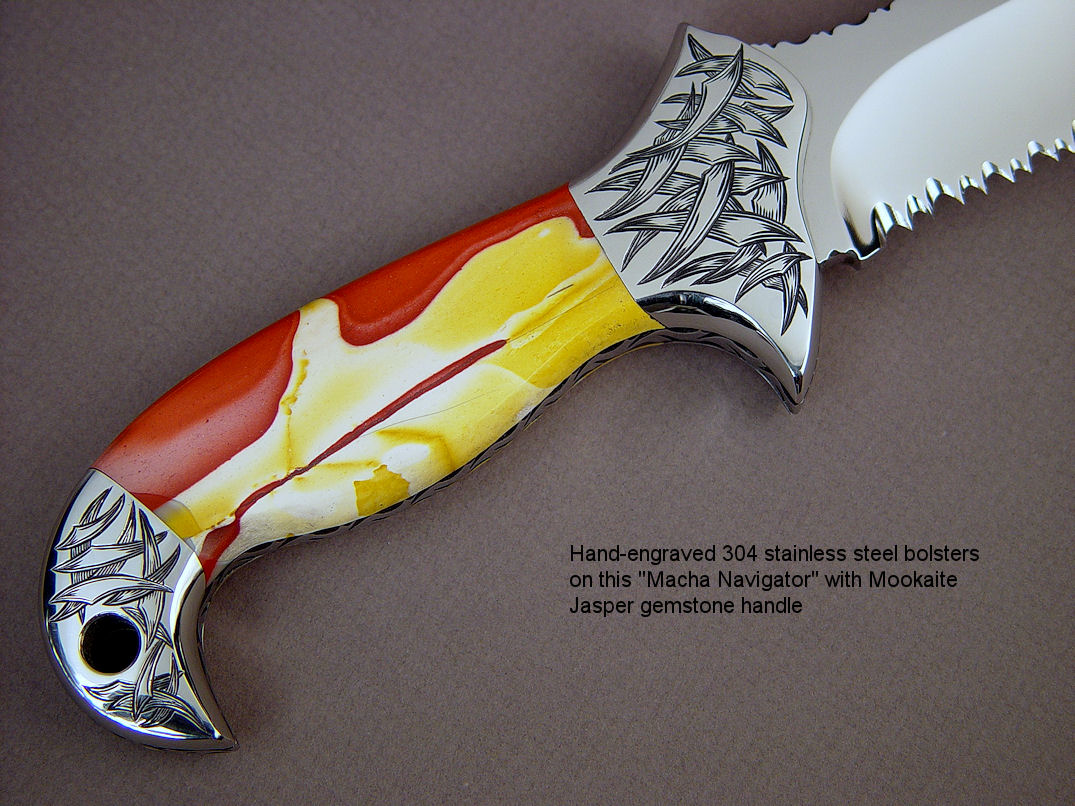
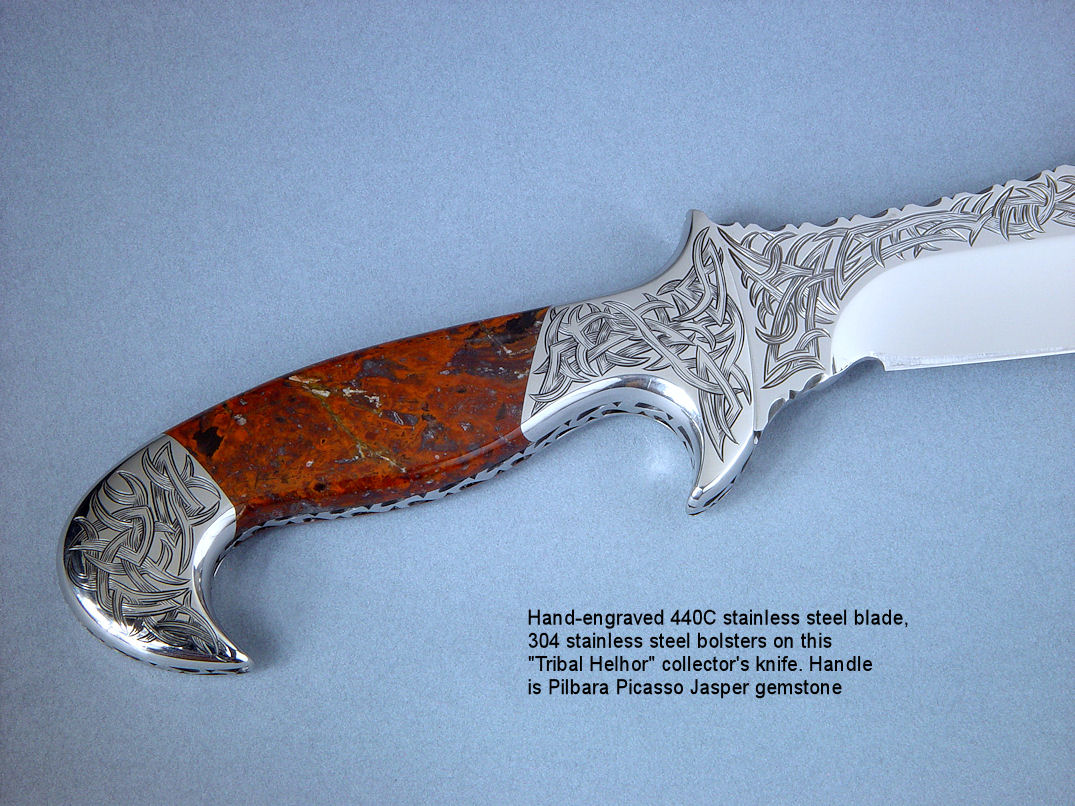
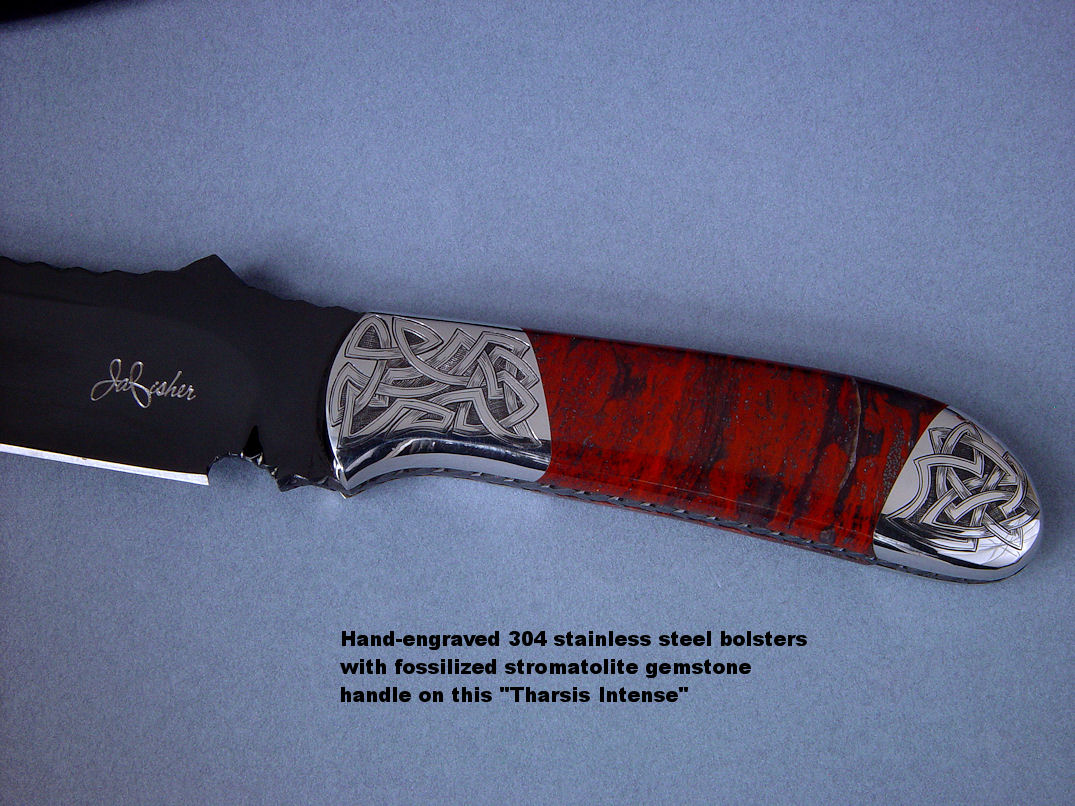
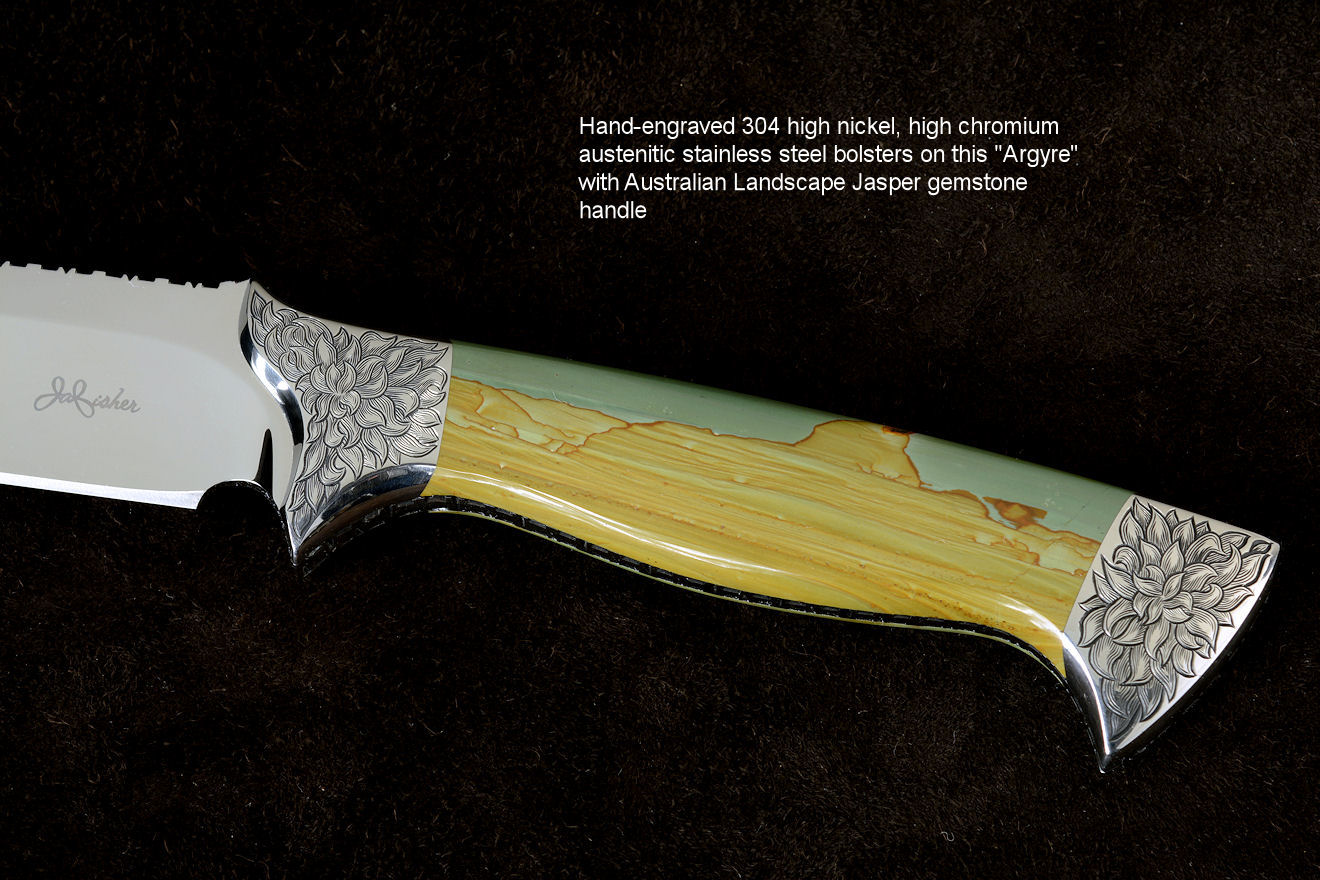
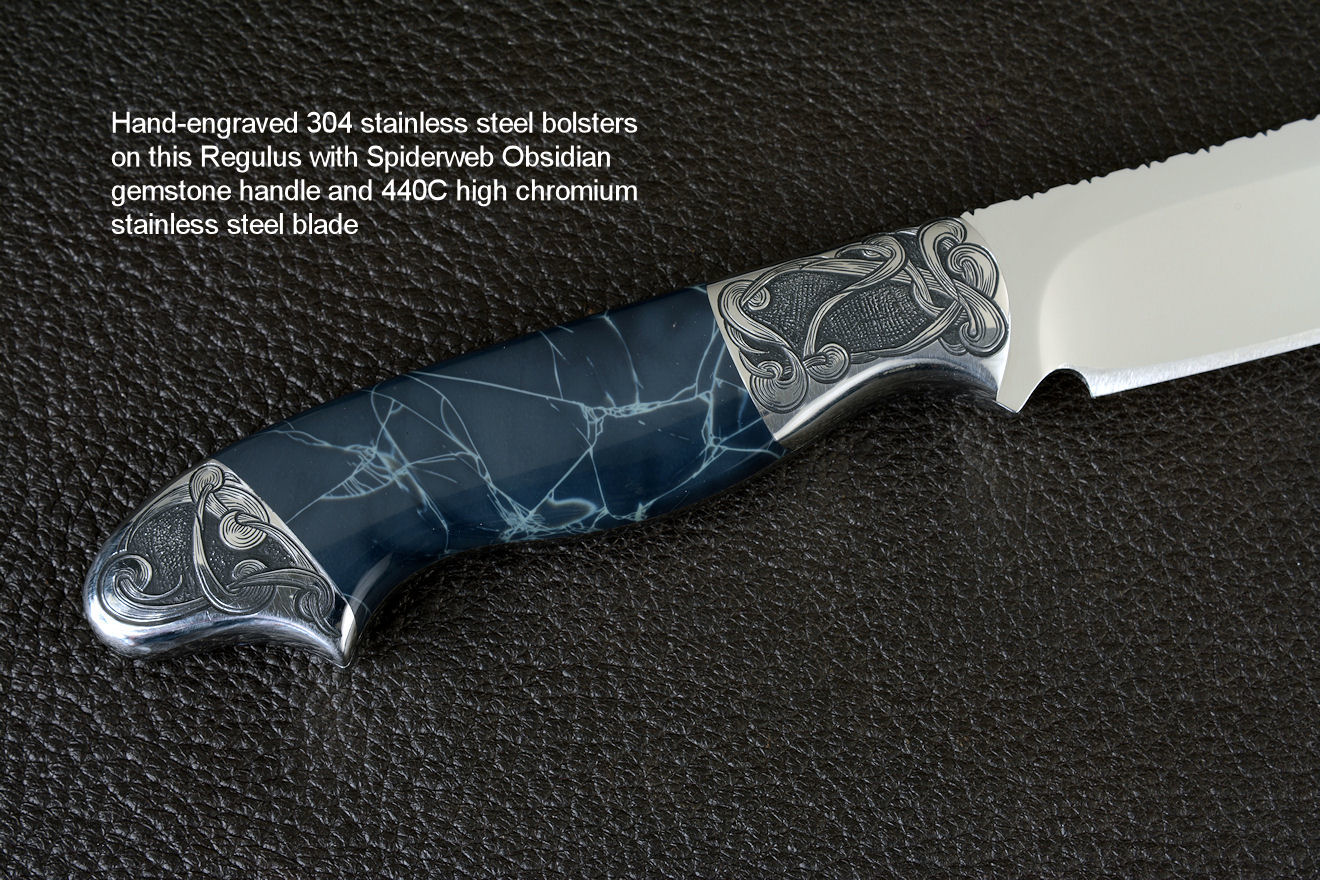
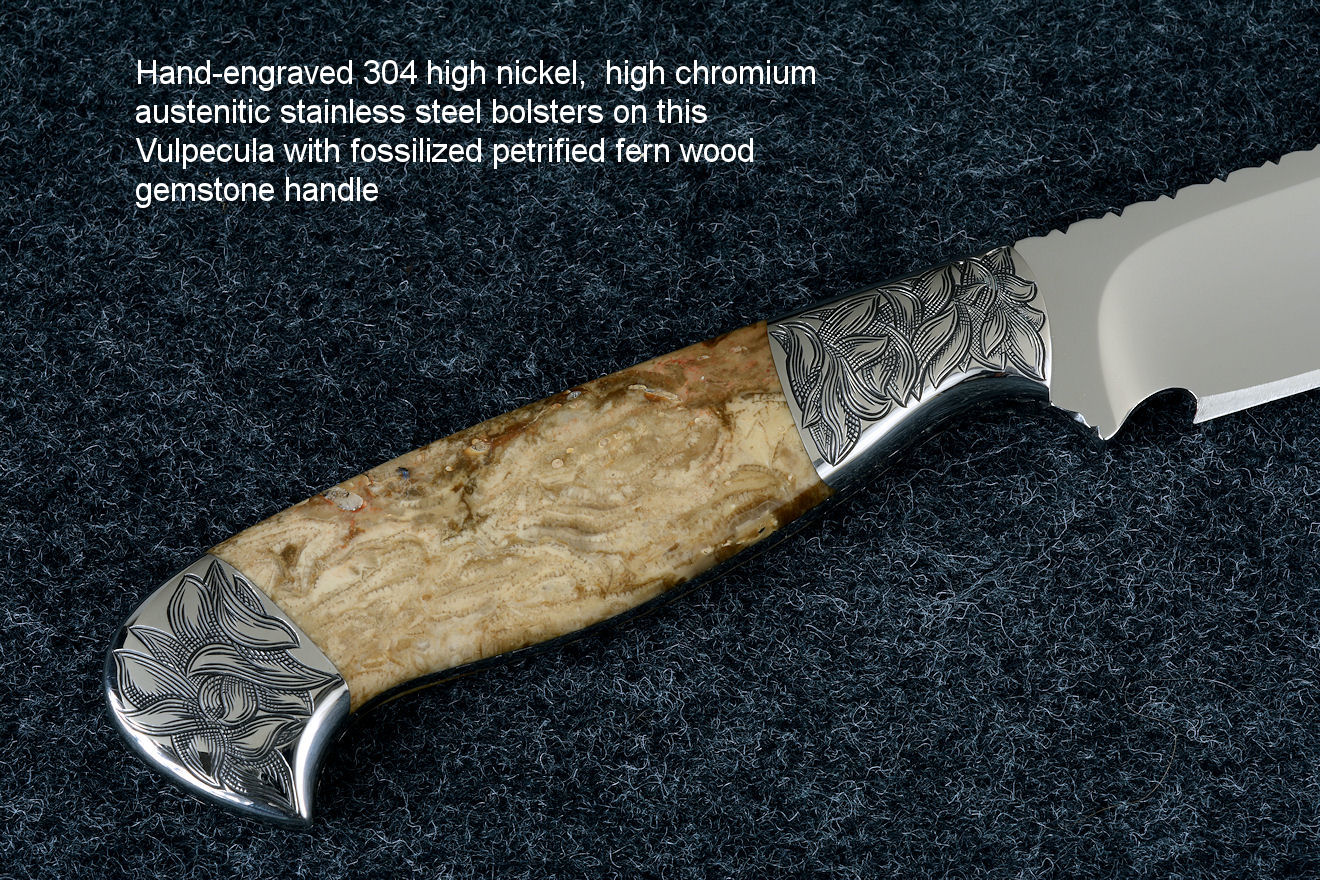
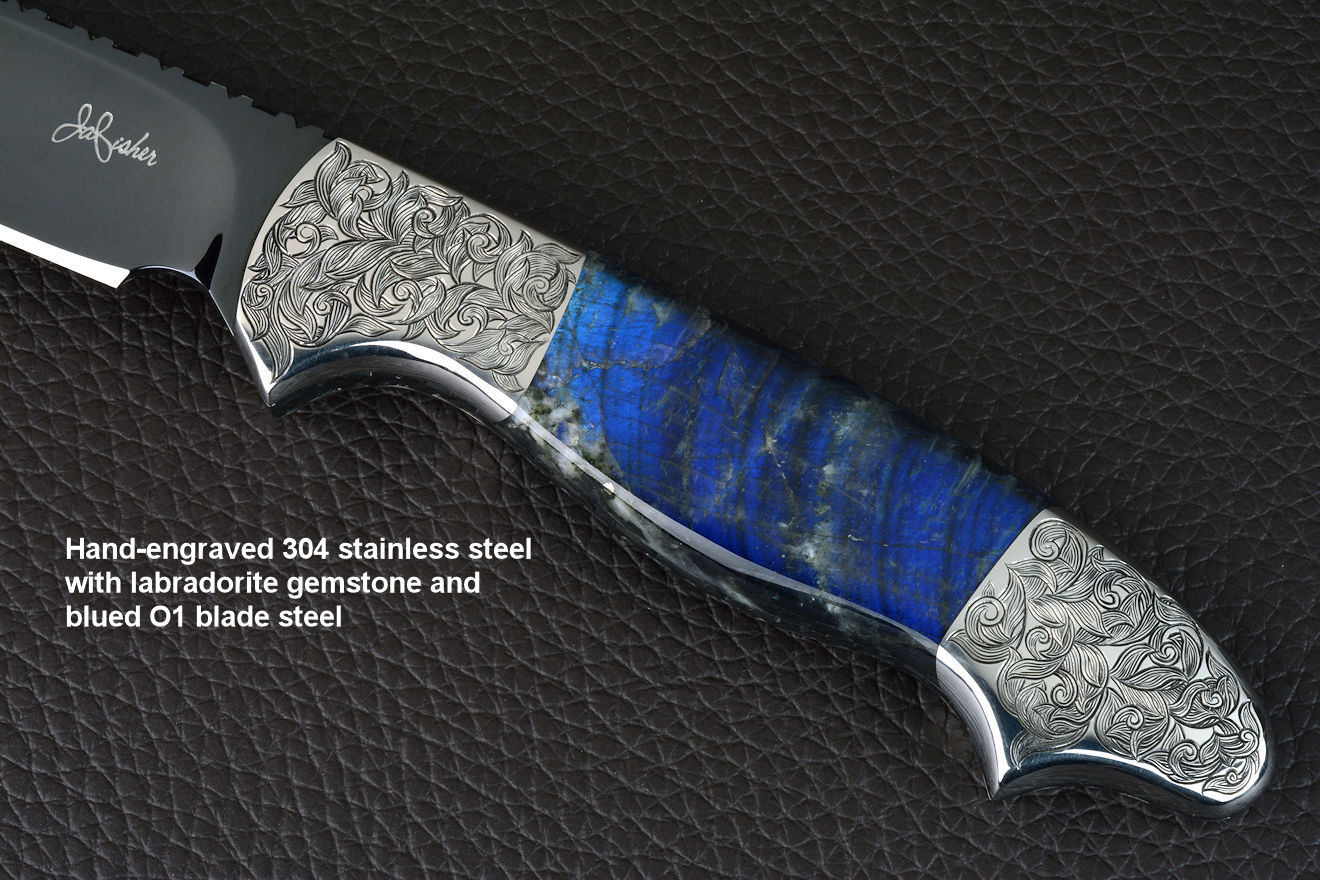
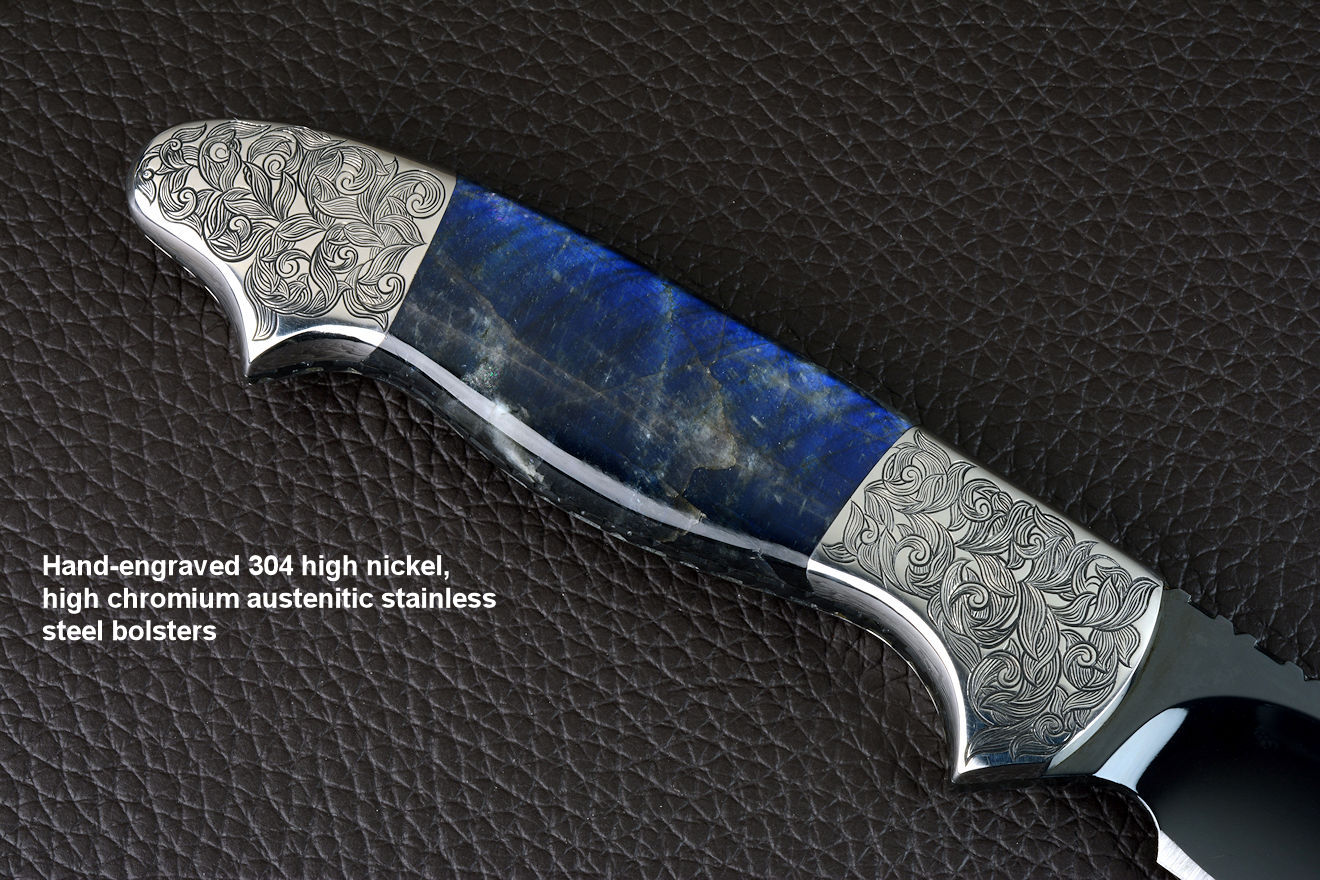
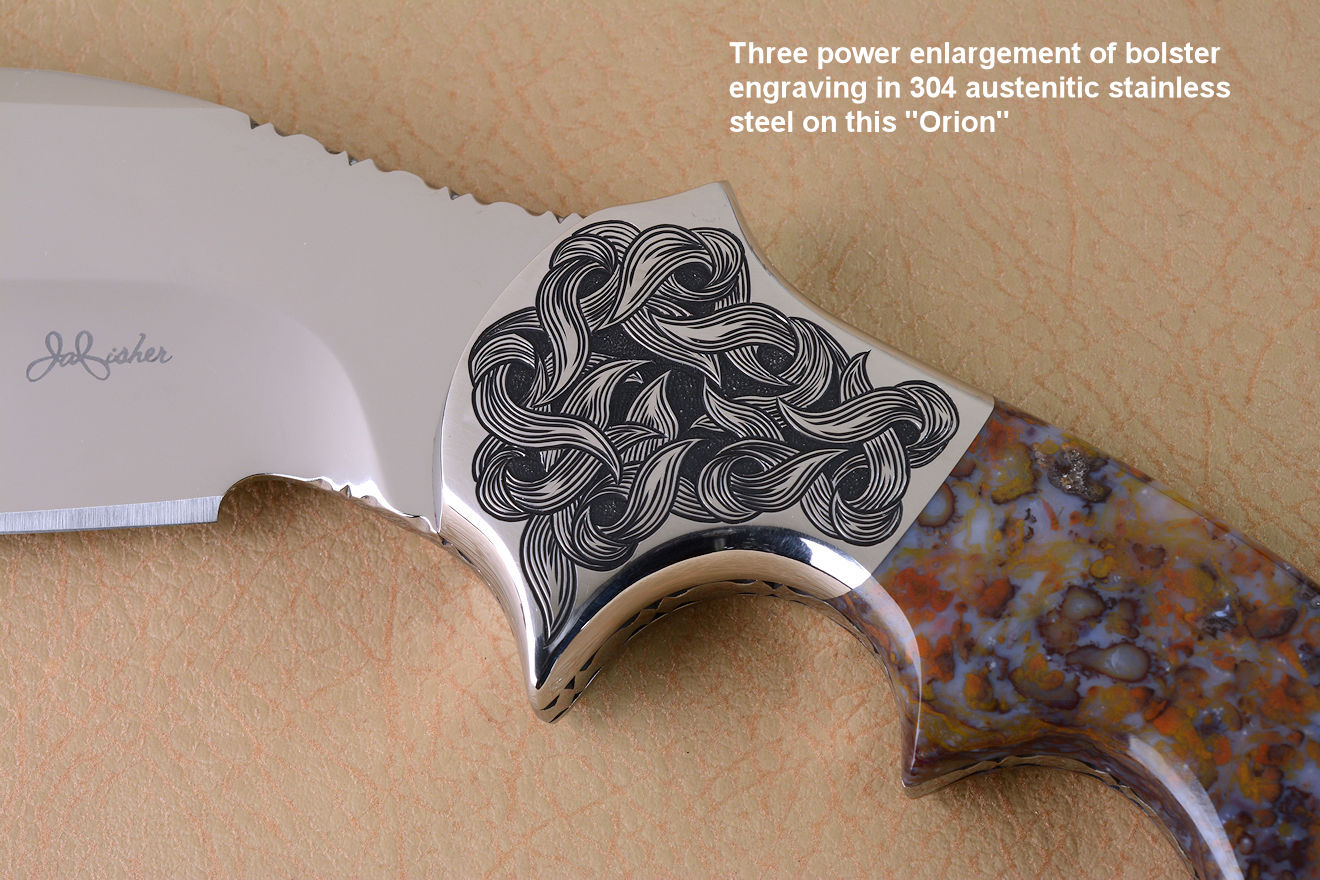
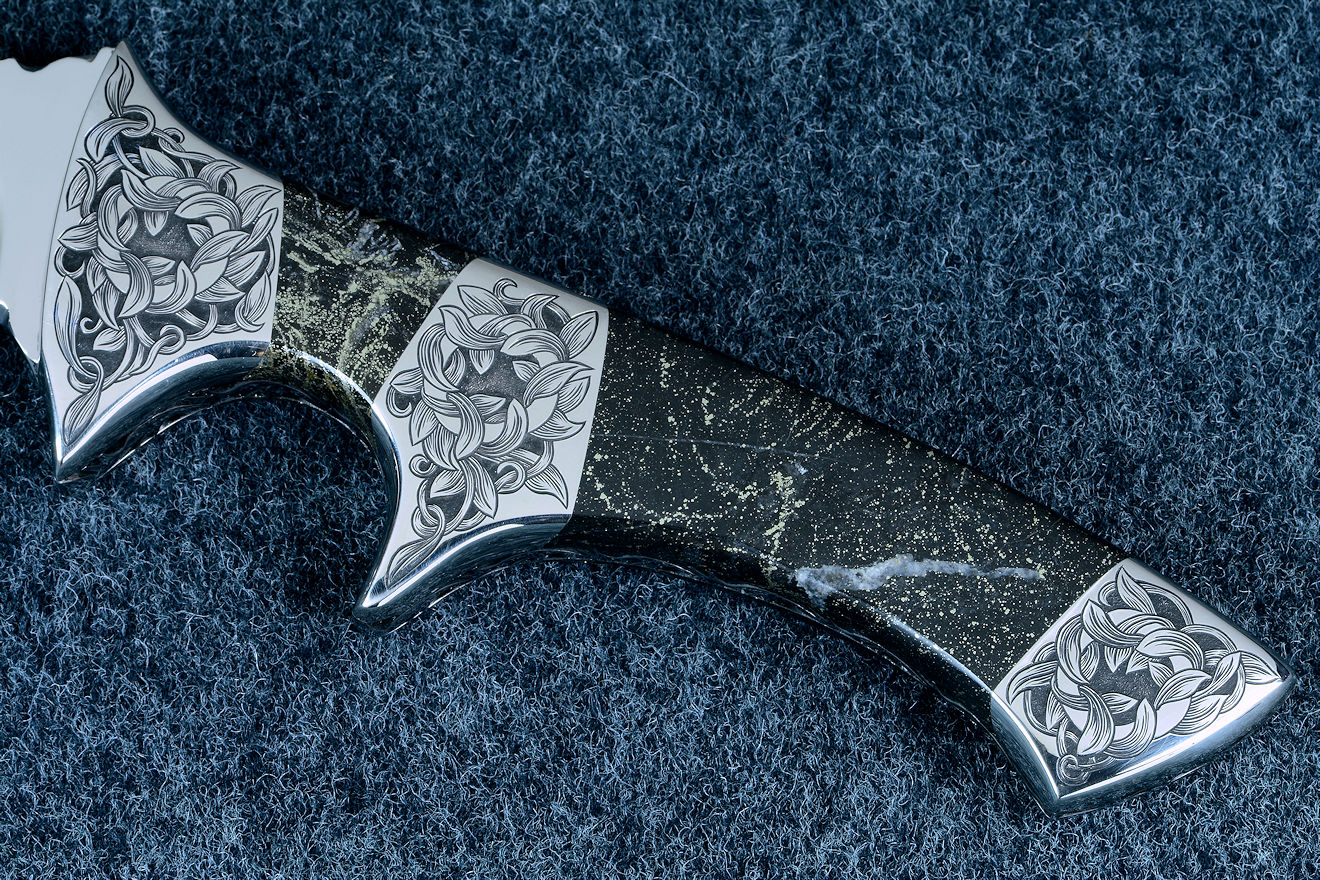
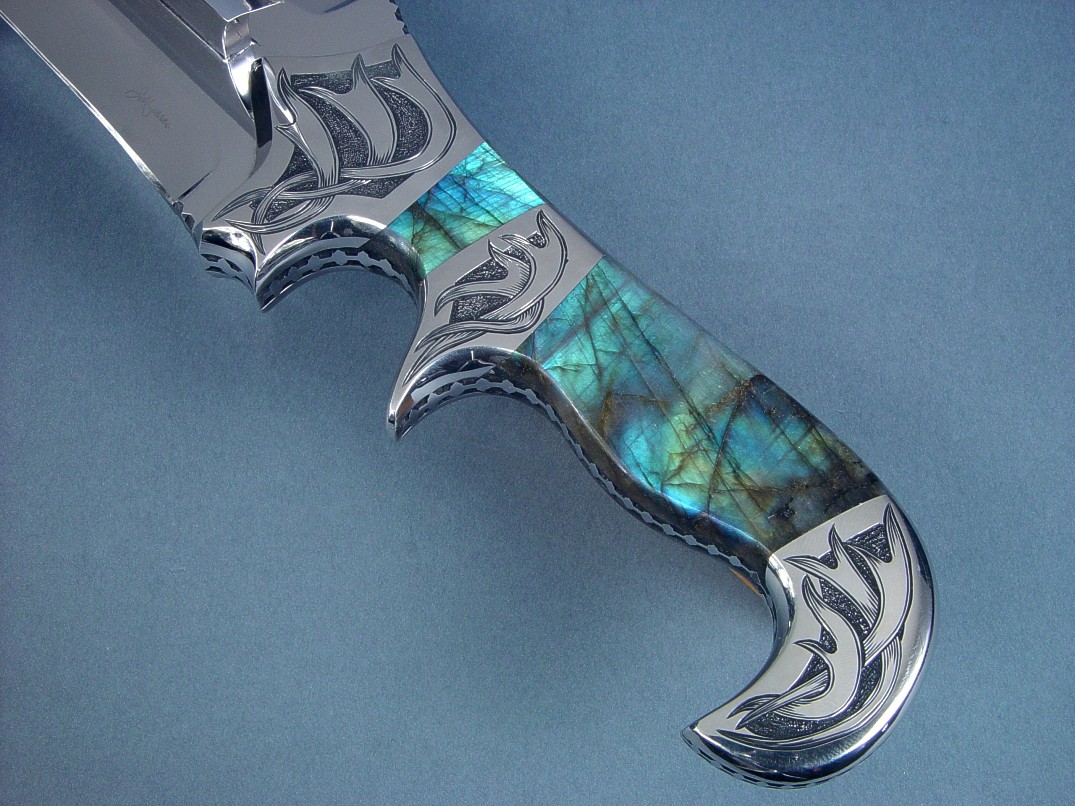
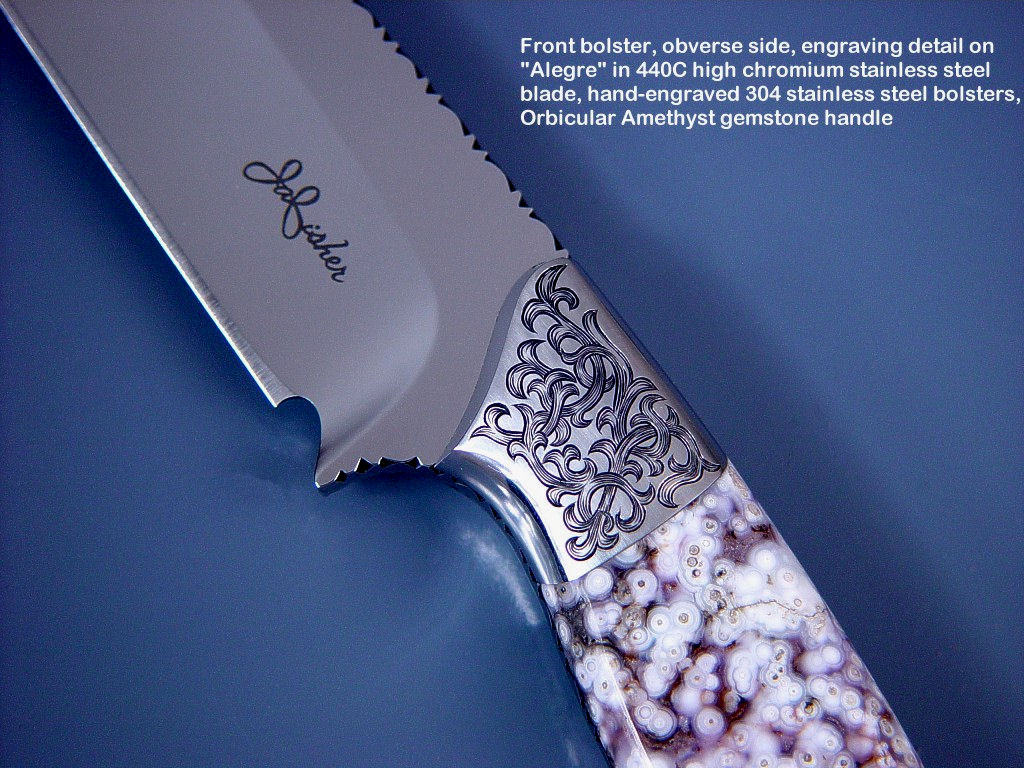
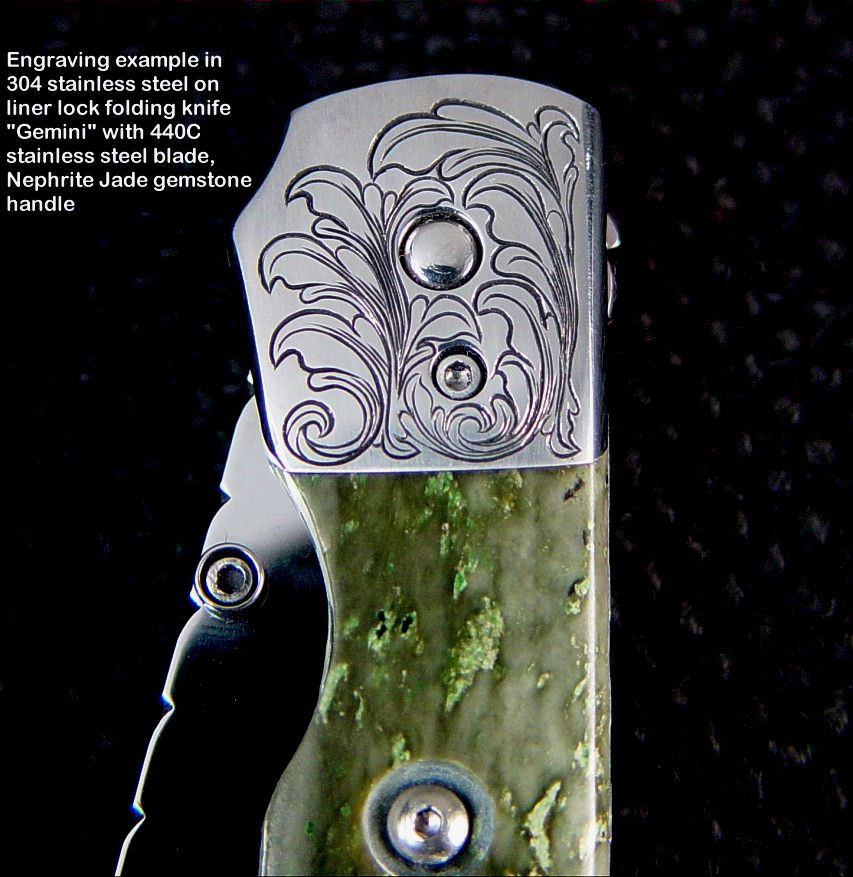
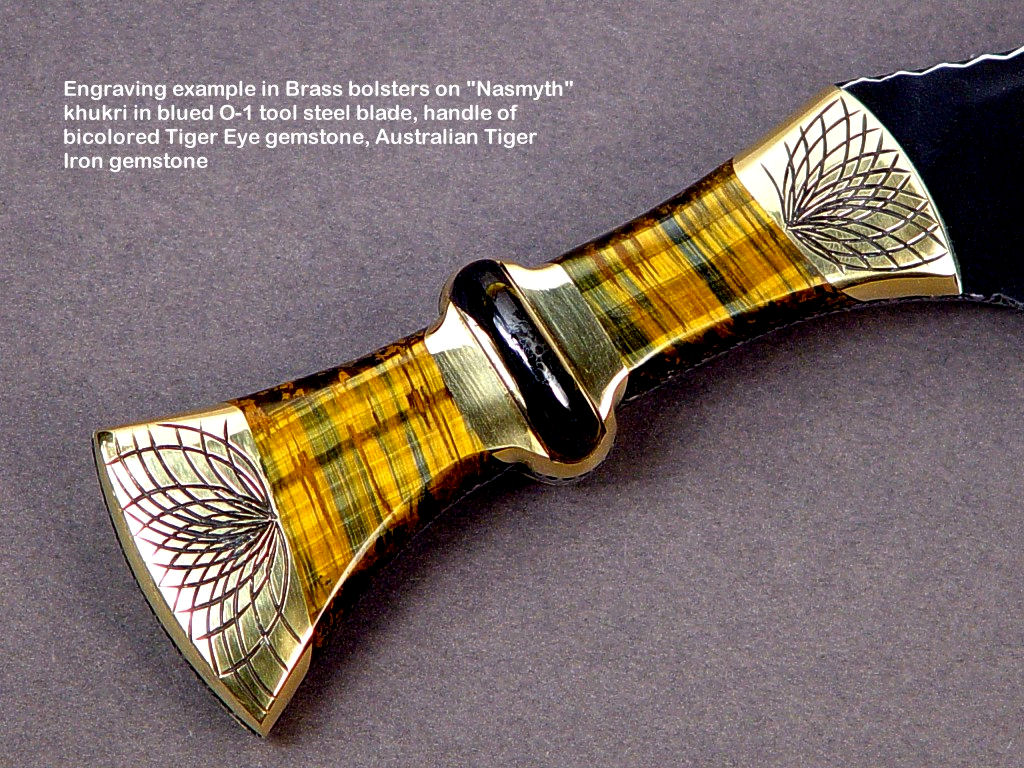
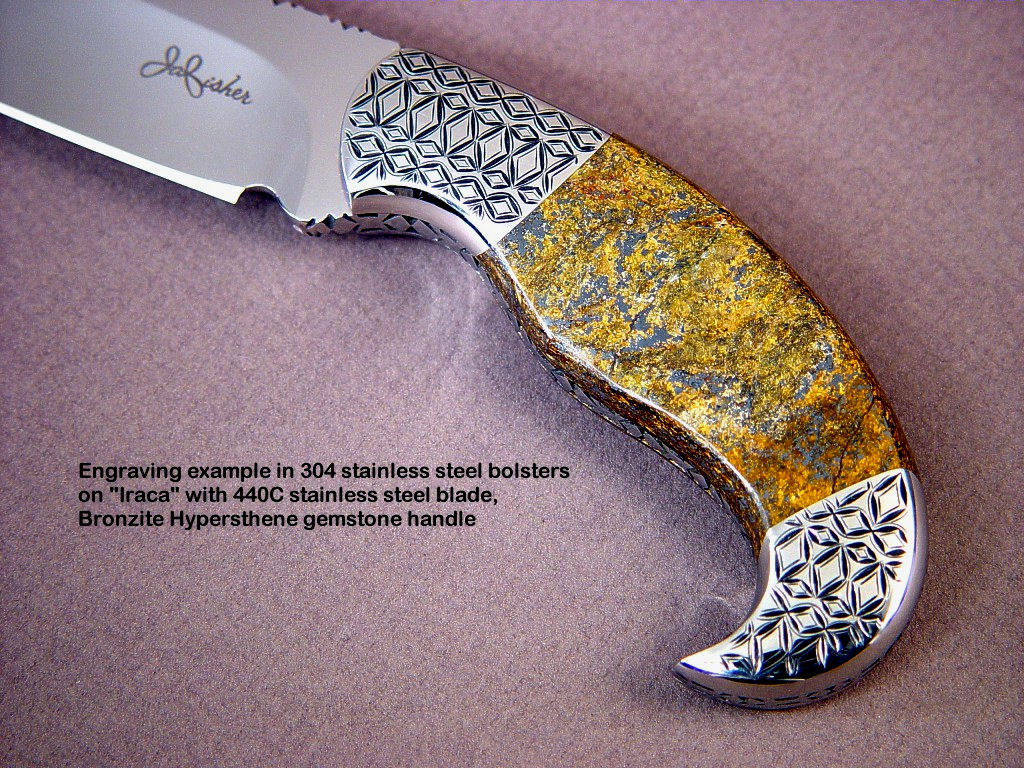
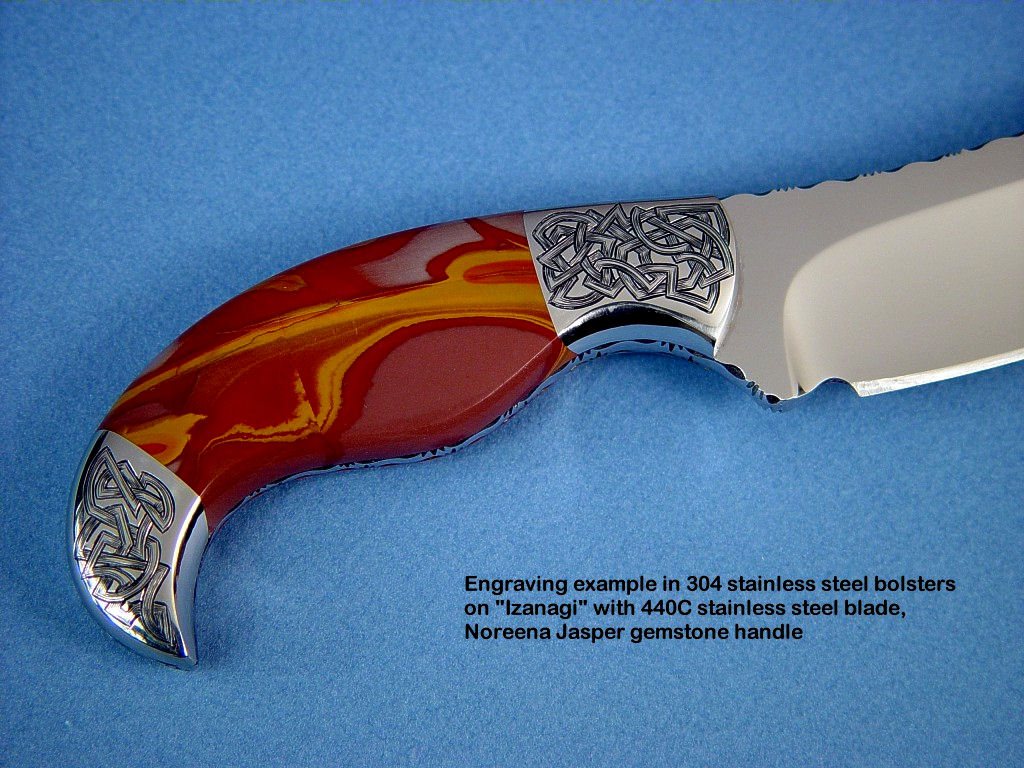
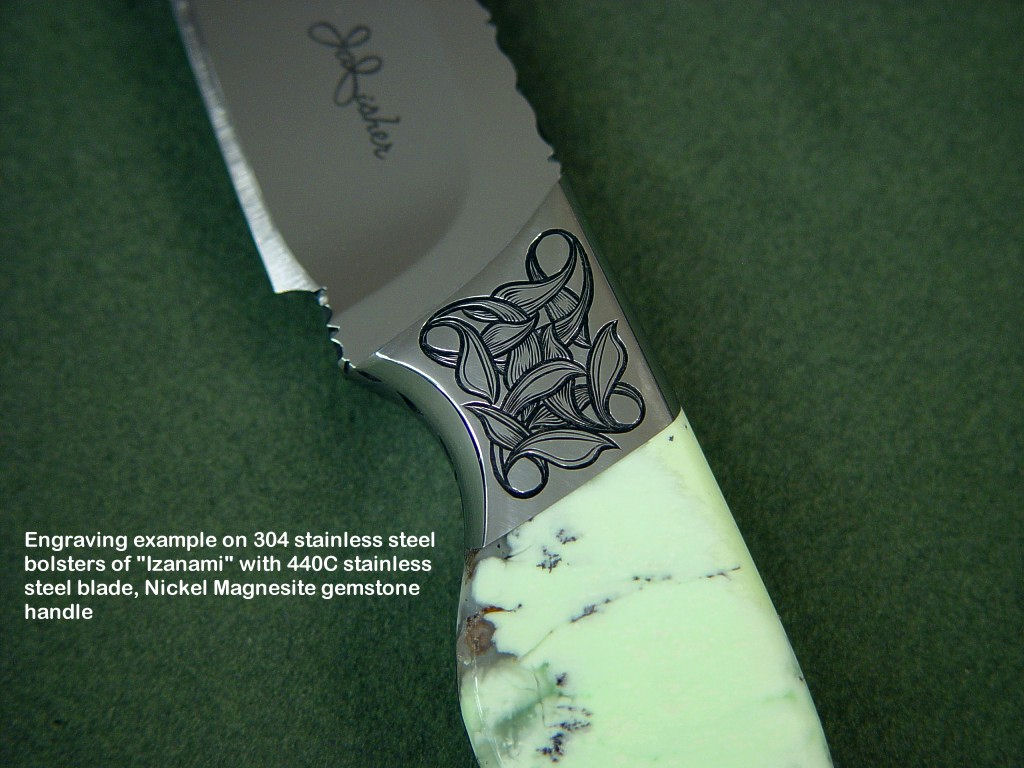
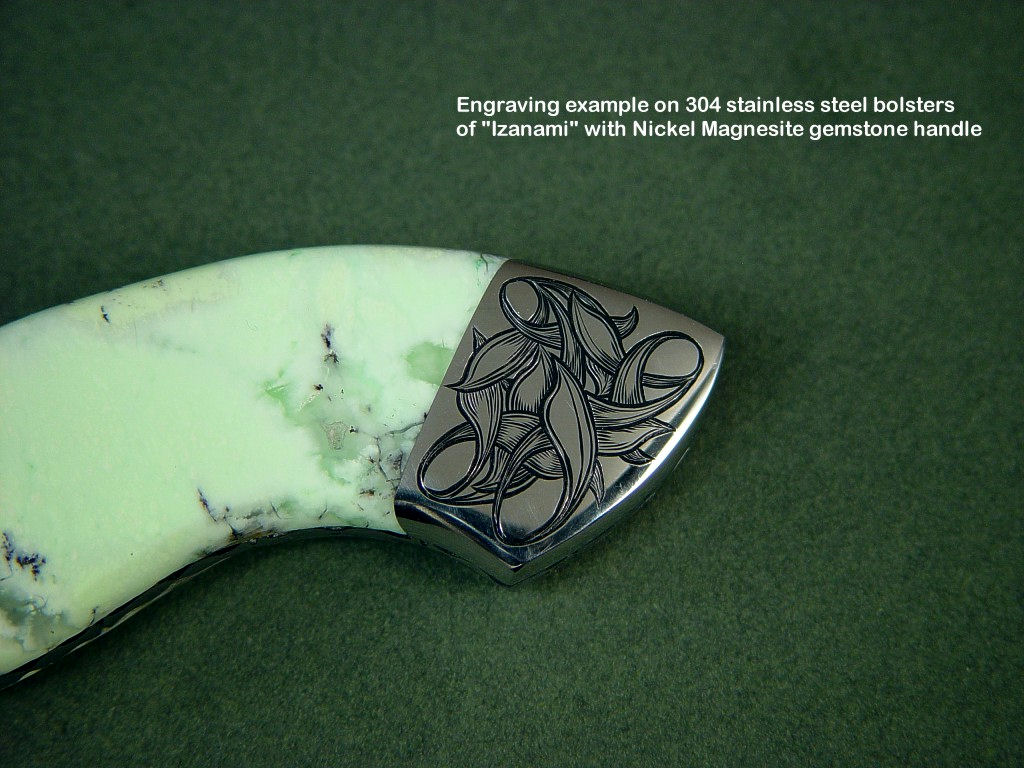
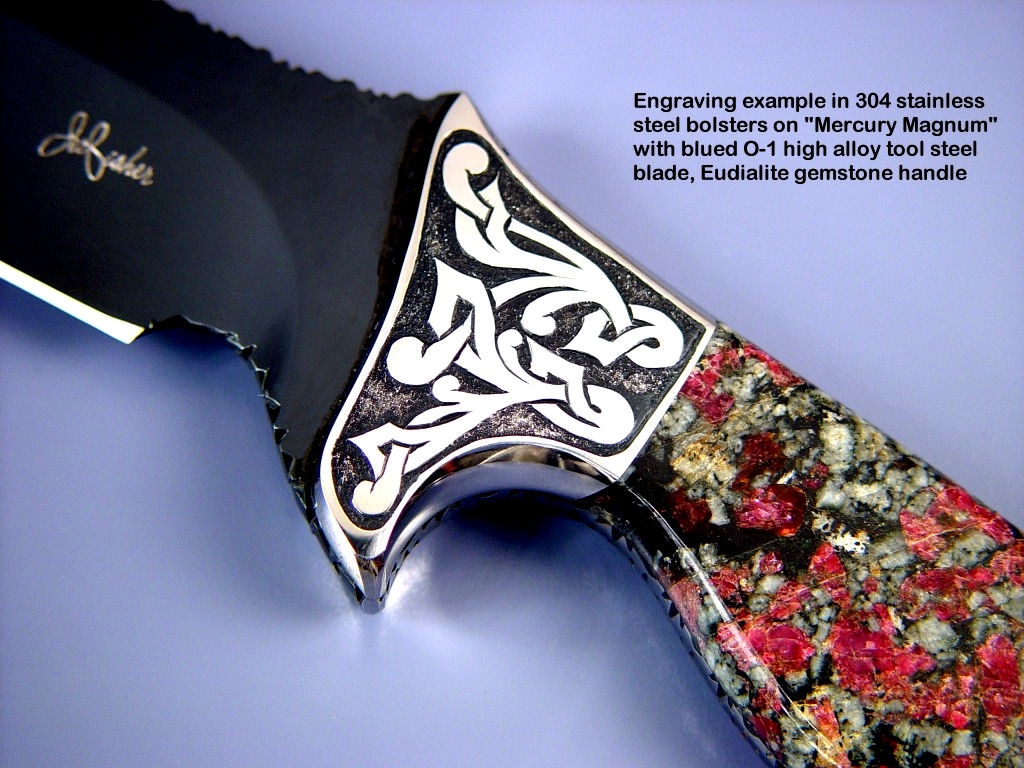
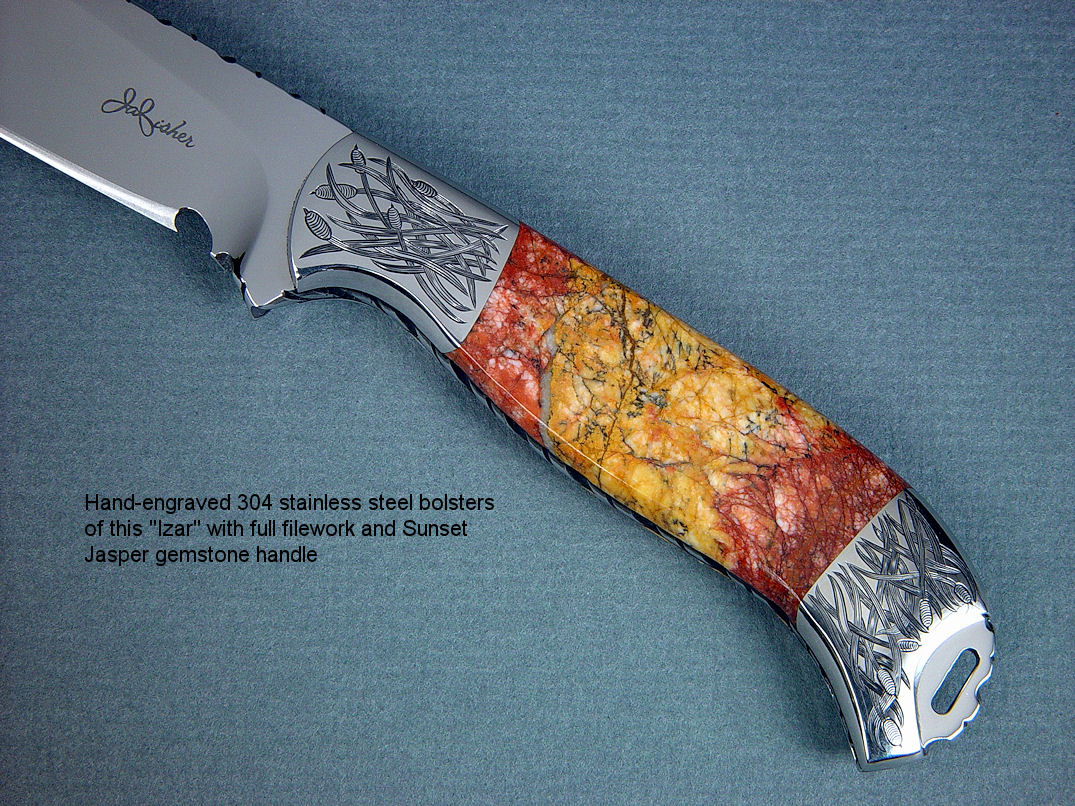
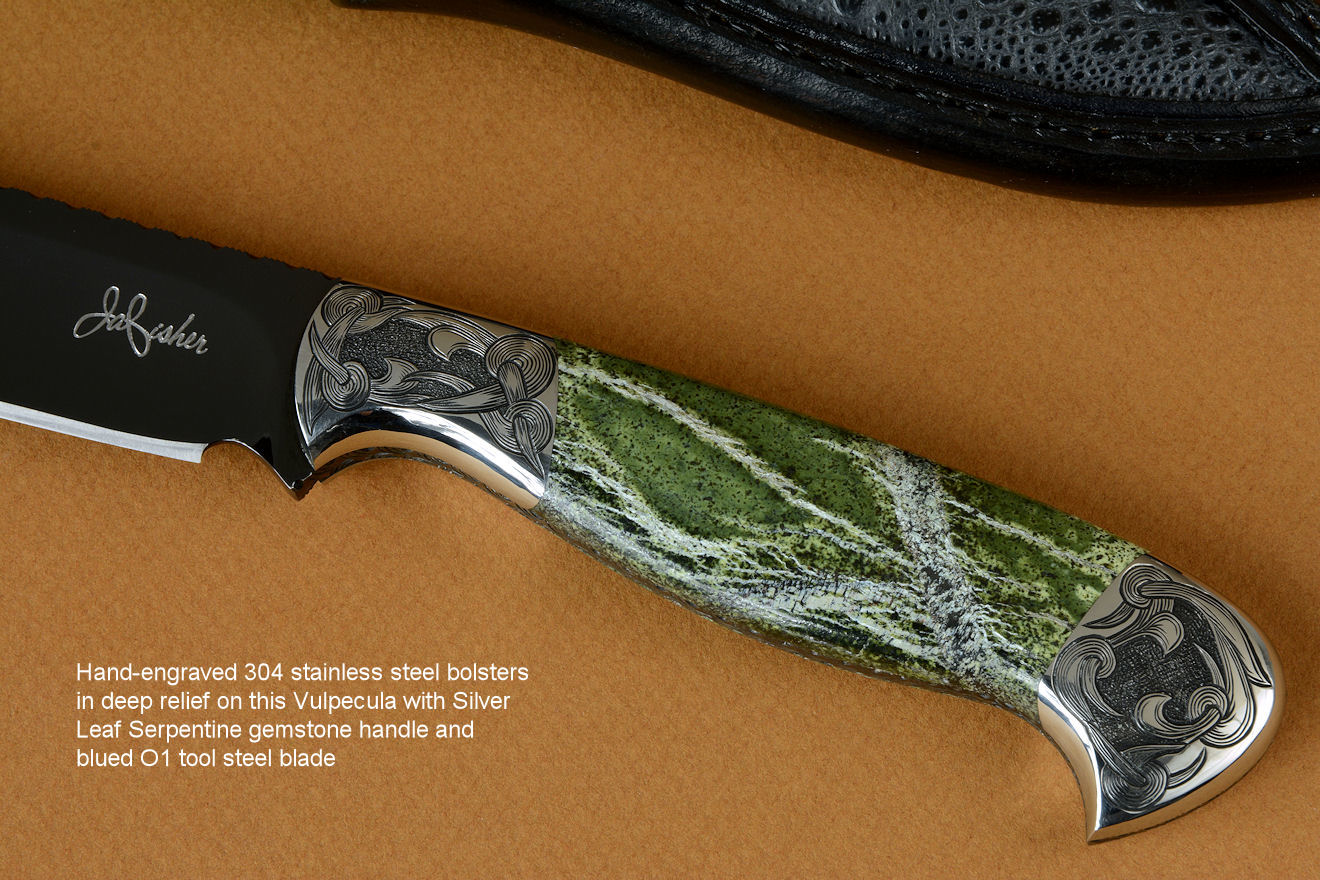
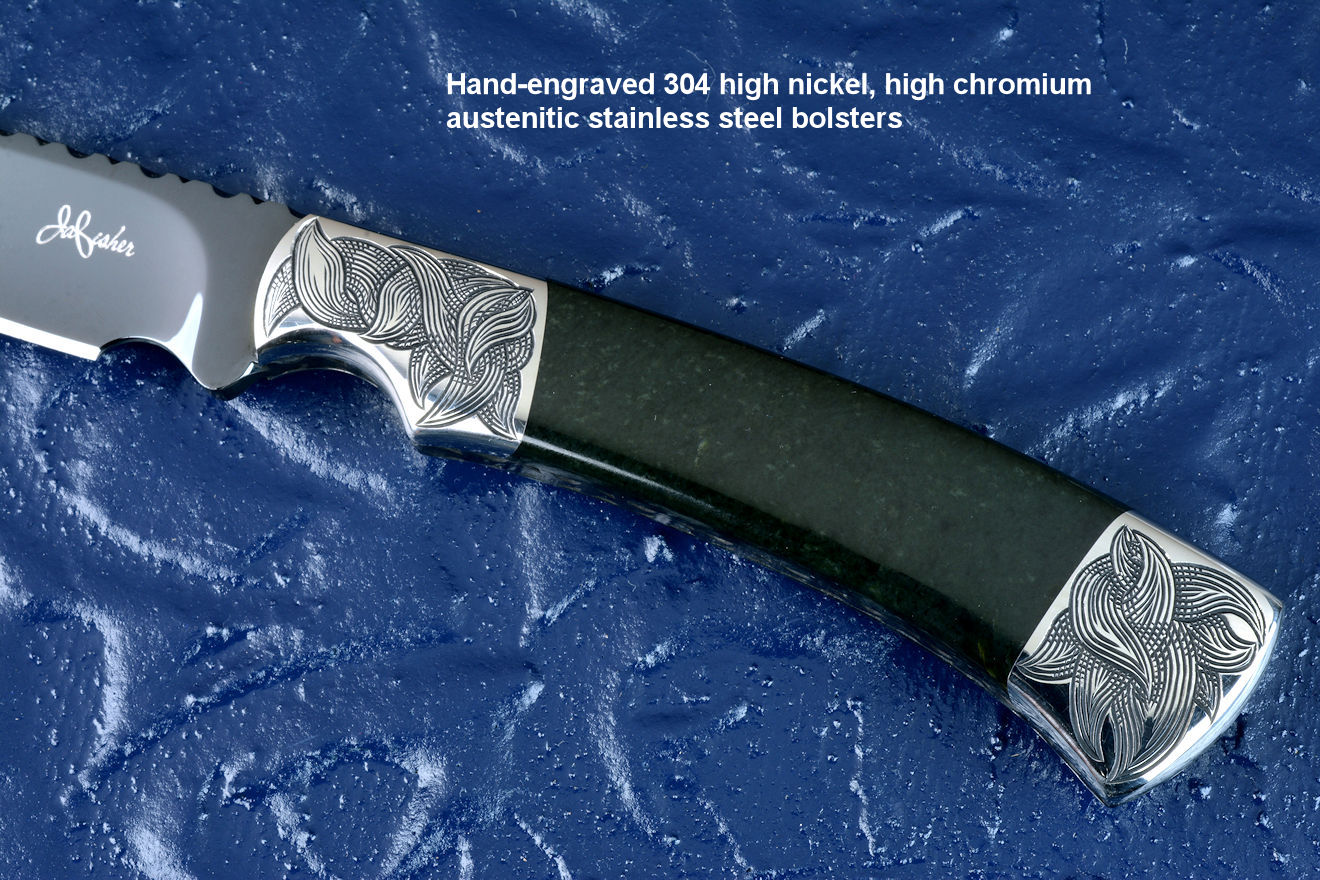
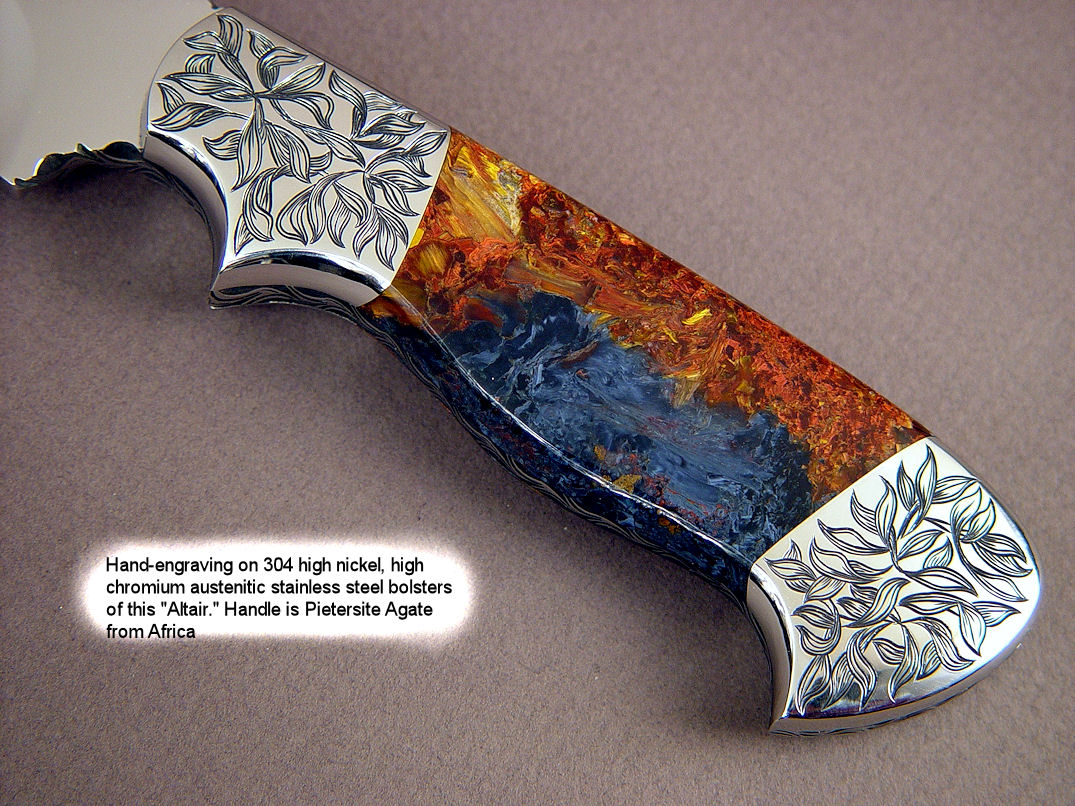
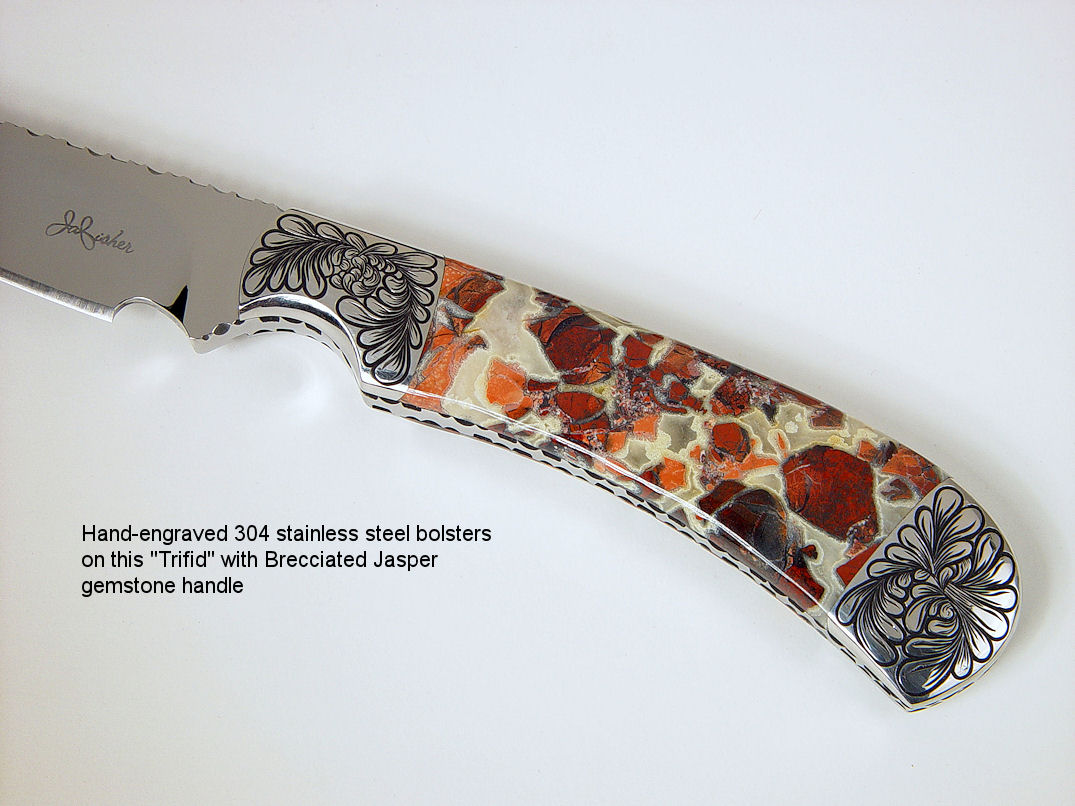
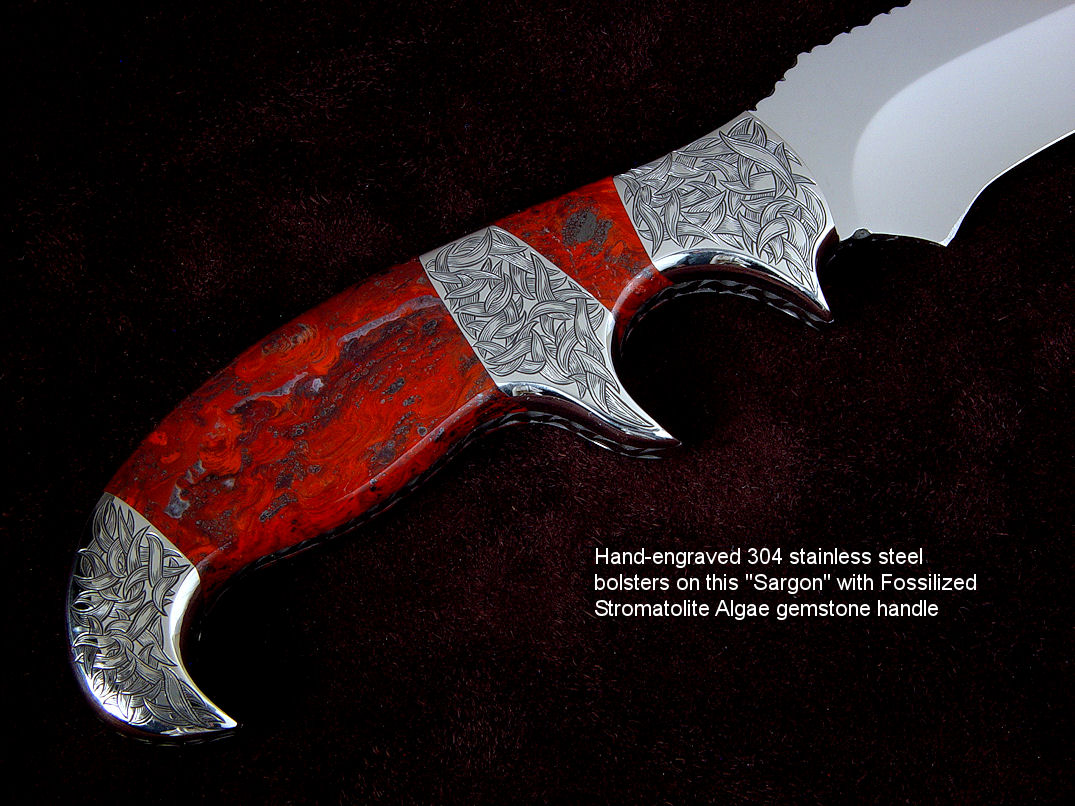
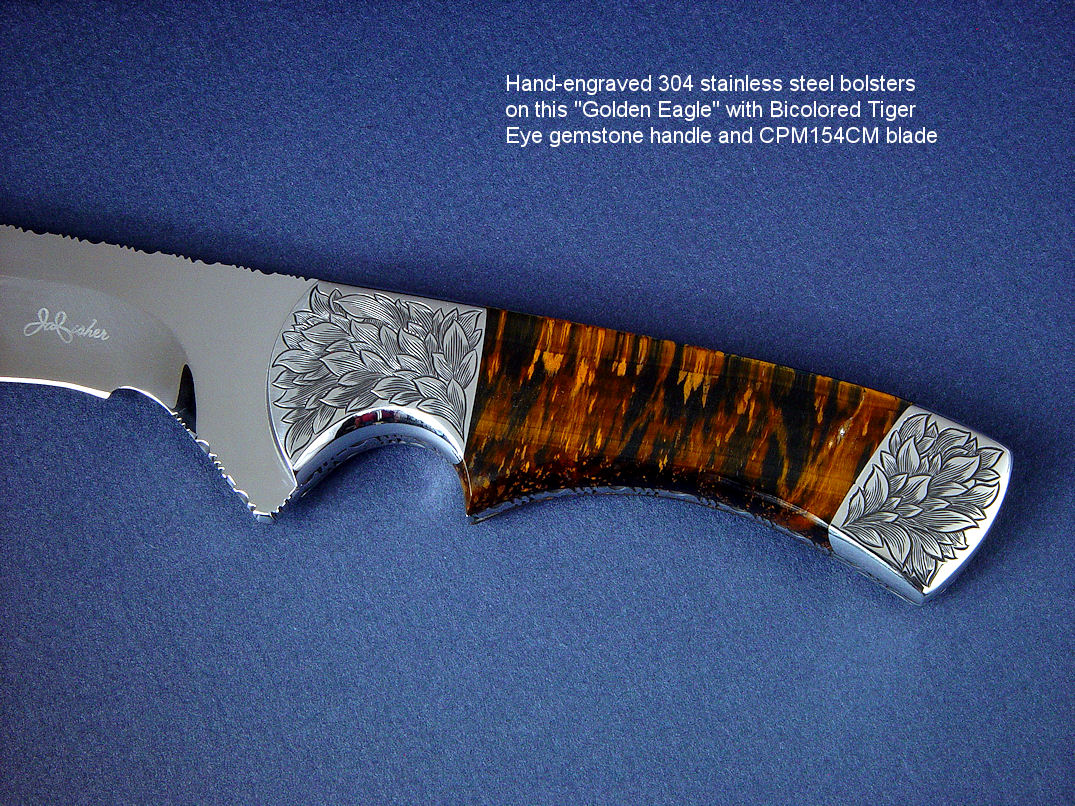
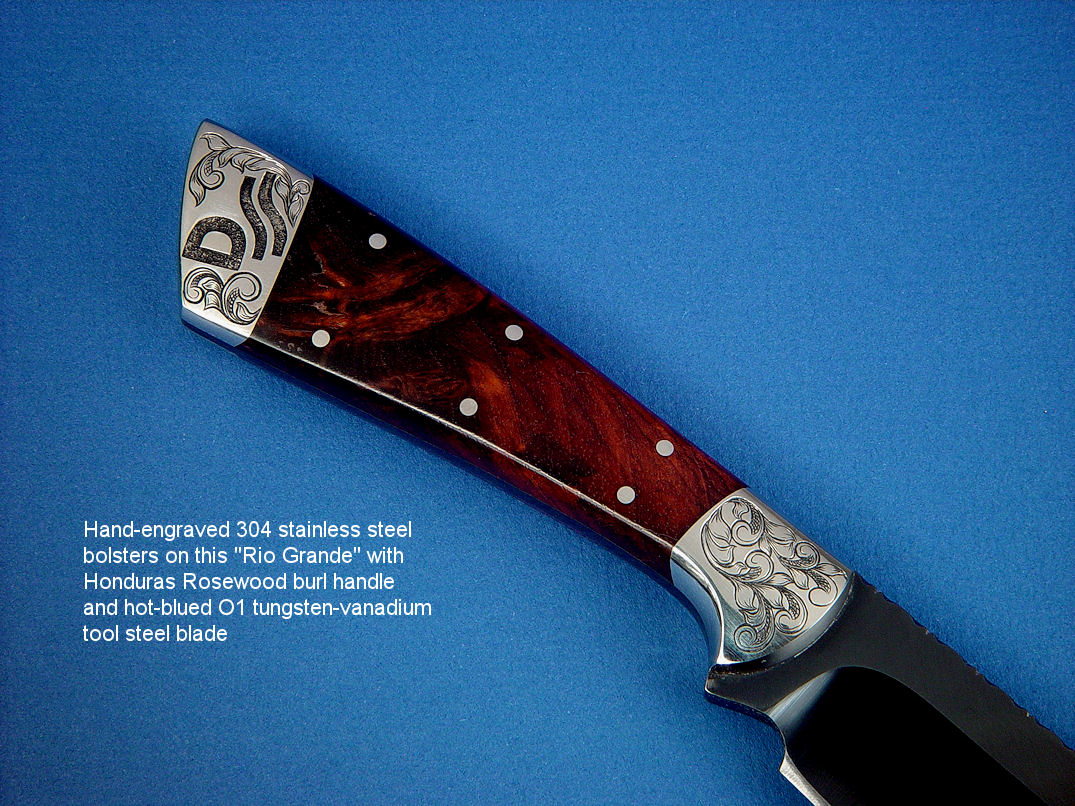
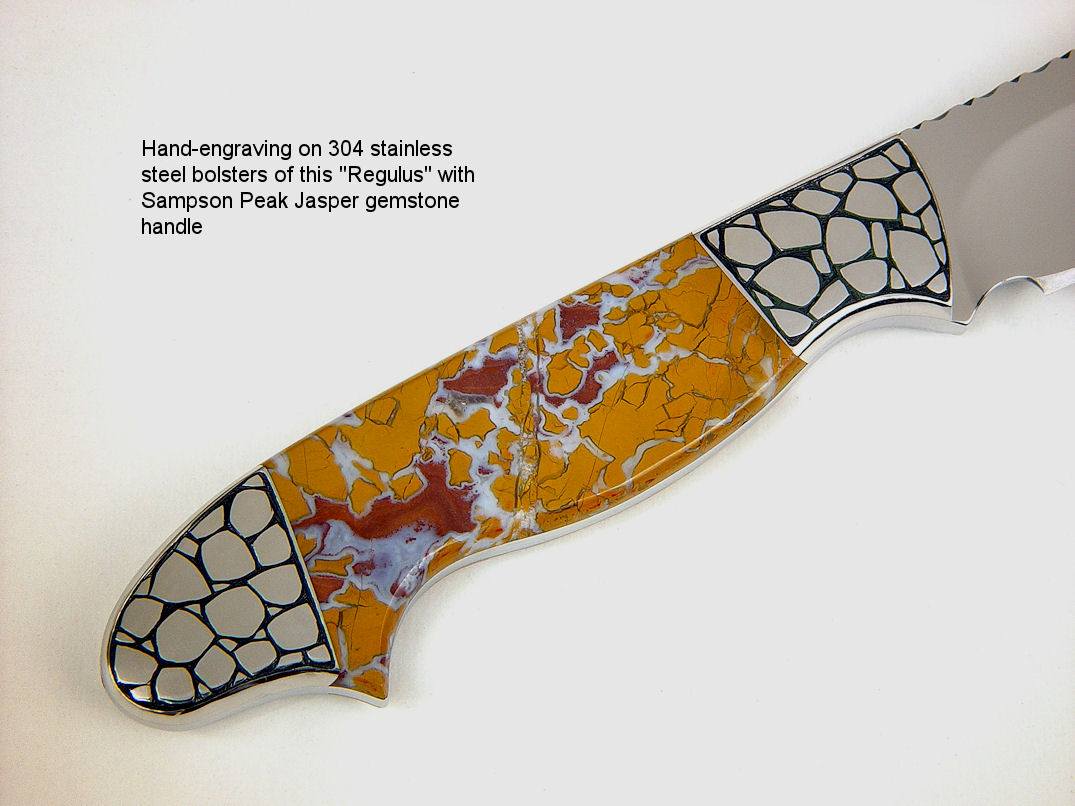
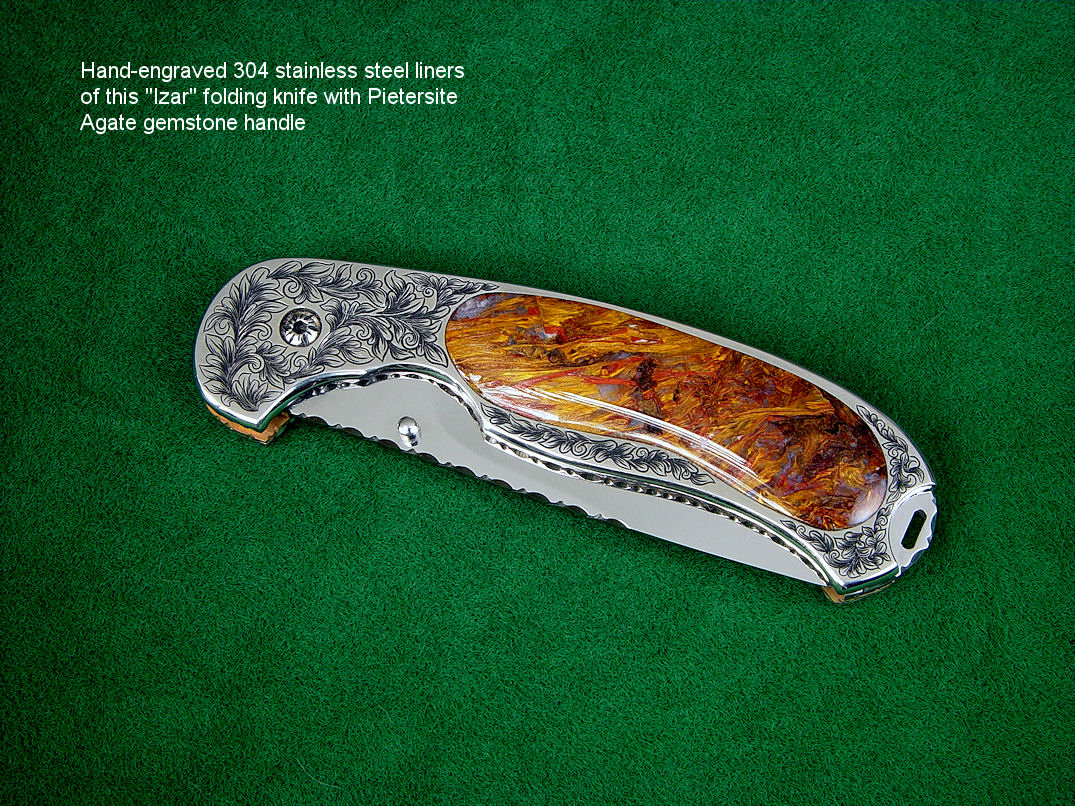
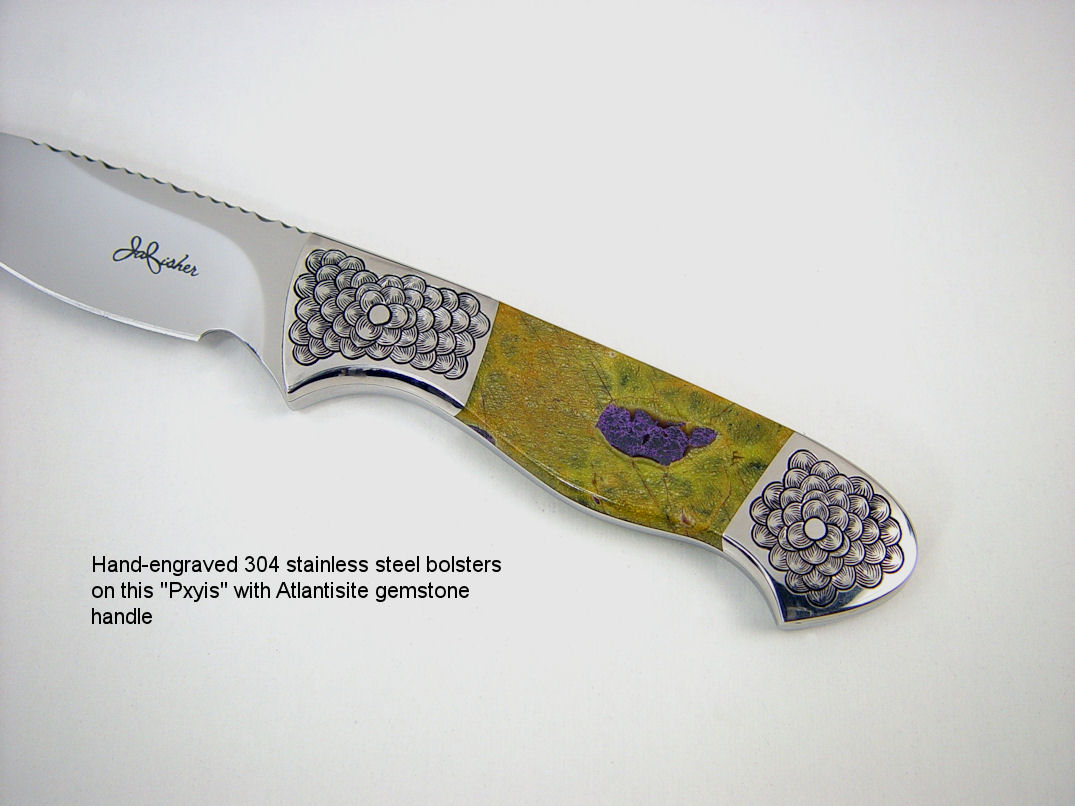
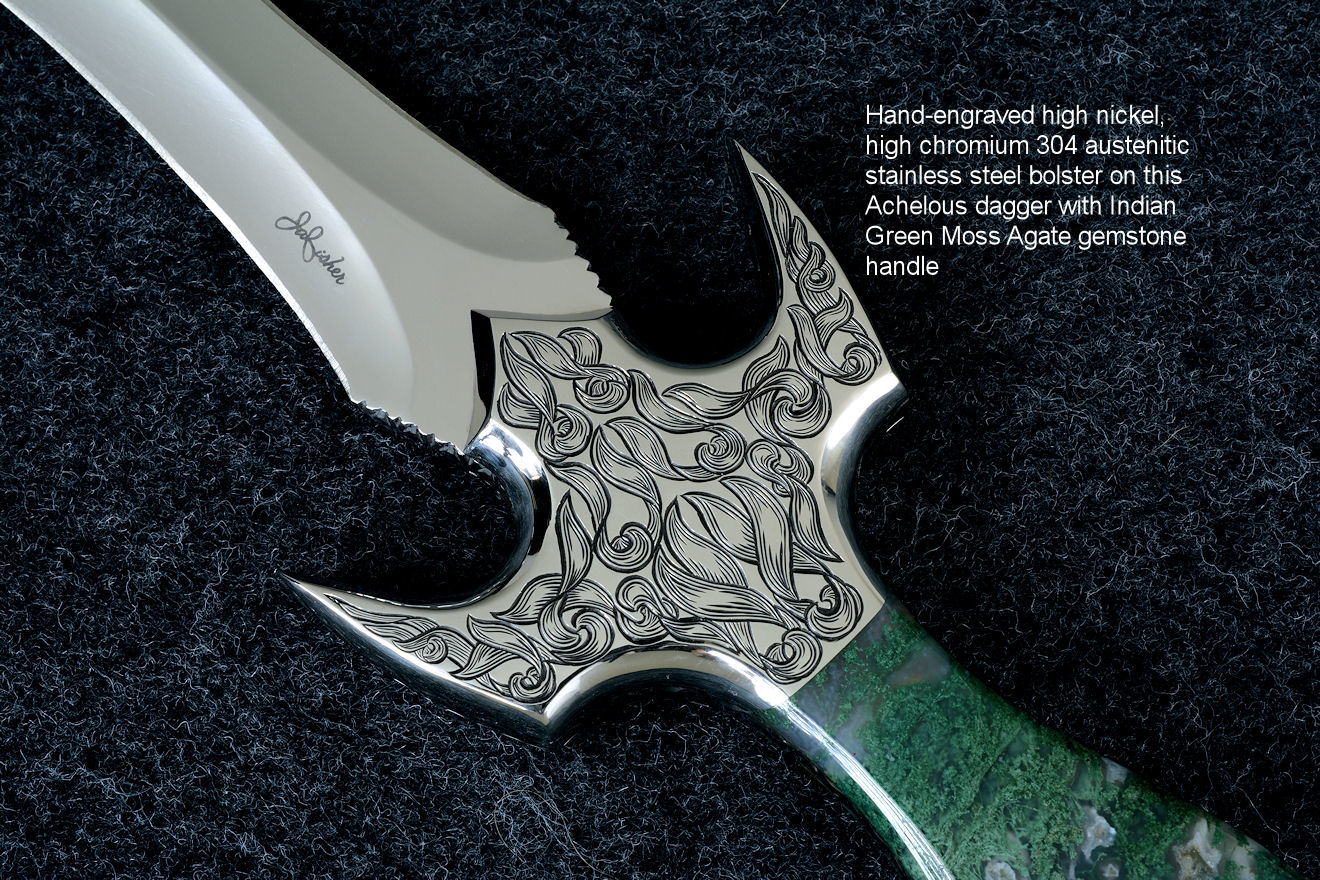
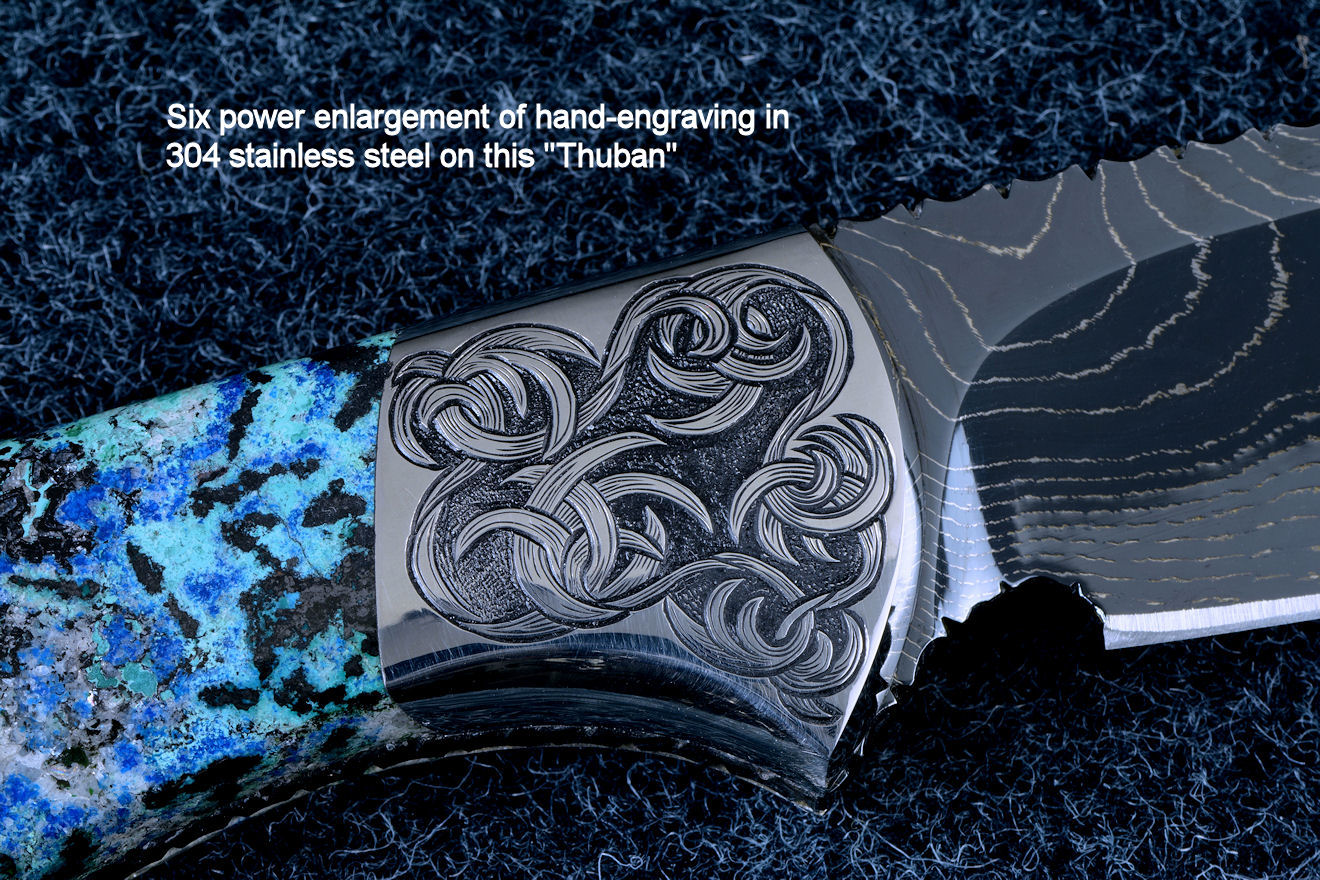
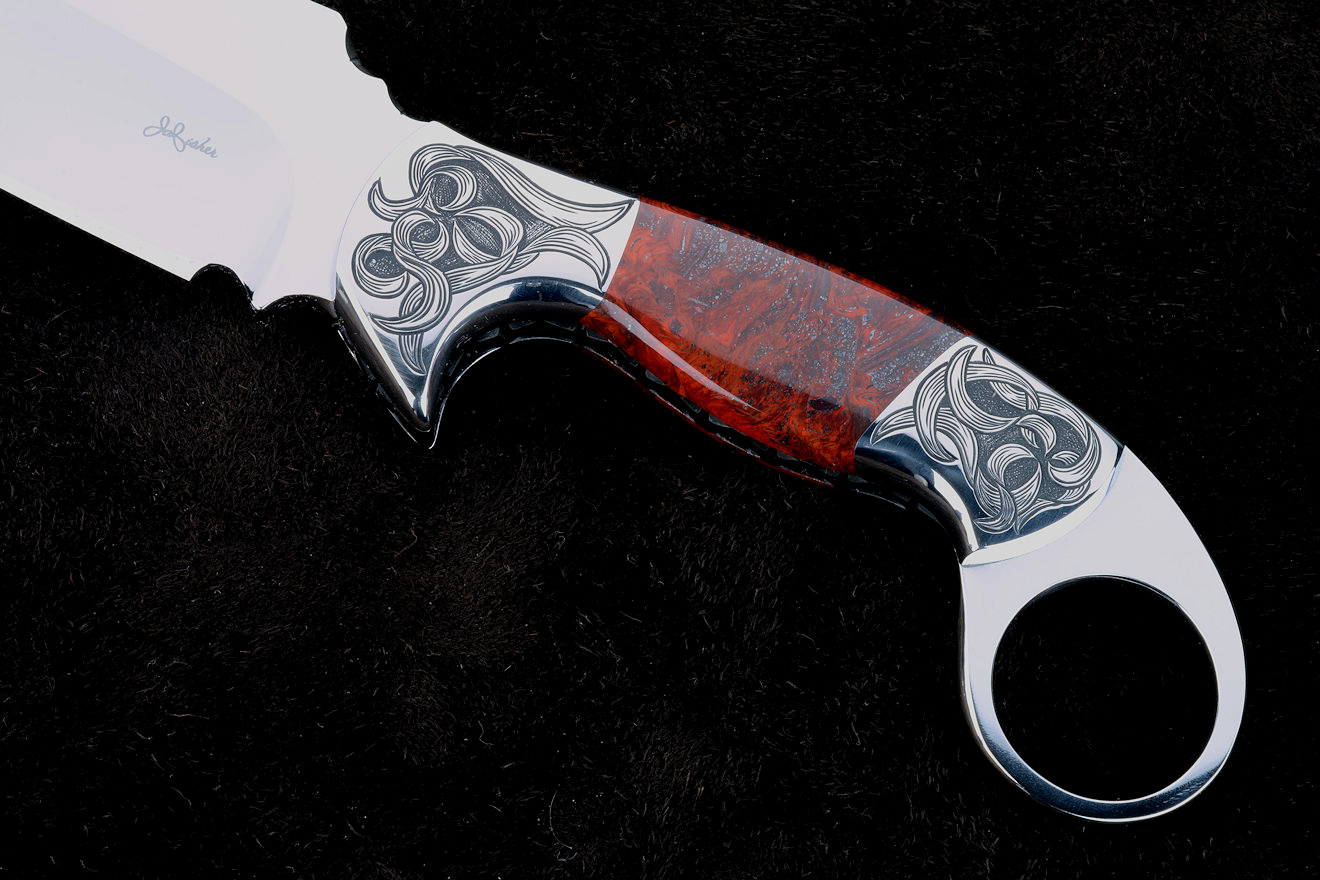
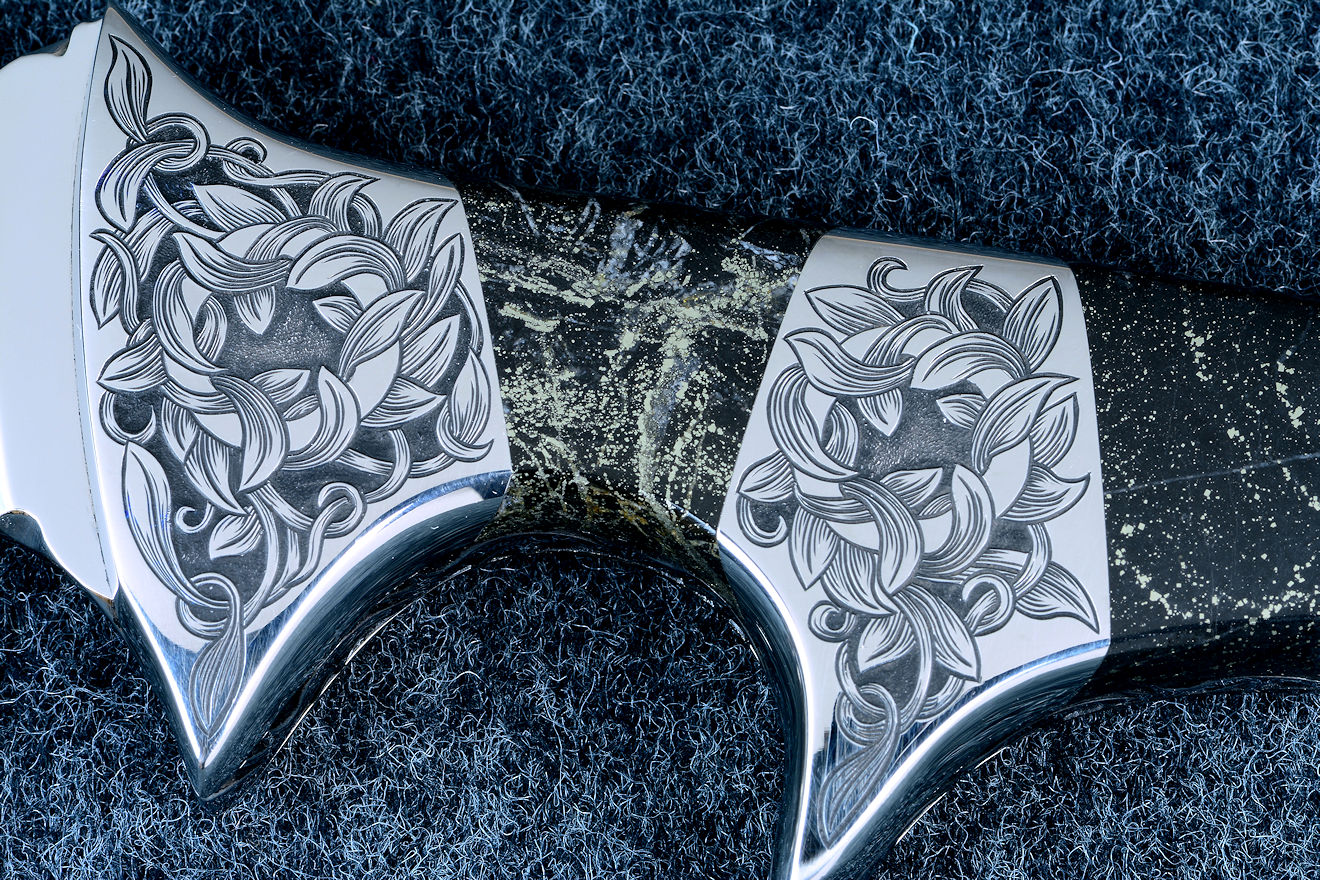
Hand engraving is the cutting away of metal with a small tool called a graver, chasing tool, or chisel. It's done by hand, sometimes with the assist of a hammer, tool, or vacuum/pressure hand piece. No matter the device or assist, it is all controlled by hand. One could write a book on engraving (there are many), and hand engraving is one of the highest value additions to fine custom knives. It has a deep history and kinship with fine weaponry, and there were (and still are) people who spend their full-time work lives only hand-engraving metal, usually jewelry, firearms, and knives. The wide variety of cuts available through a skilled engraver is astounding, ranging from almost imperceptible fine scratches on the surface, to deep, dark background relief, and even penetrating holes through the metal. Hand engraving has character, the style of the engraver is apparent on every surface.
The greatest value brought to already complete custom knives is usually through hand engraving. A good engraver will often charge $150-$300 a square inch (that's one half inch by one half inch, right?). So to engrave one set (that's both sides of one bolster pair), the engraving alone will cost $200-$800, depending on the size of the bolsters, the material, the engraving design, and the engraver himself. Often, an attempt is made to improve the value of a fine custom knife by sending it out to an engraver. This usually works, but the engraver often has his own ideas about the artistic style of the piece, and he imparts that flavor to the engraving. So many knives look "gussied up" instead of completed with a singular, uniform design idea. Then if the knife maker or owner sends it to a scrimshander for scrimshaw, and then a leather worker for a fine sheath, eventually the whole design idea looks broken up and in the worst case, schizophrenic. Now don't get me wrong; there are some fantastic engravers out there that can add thousands of dollars of value to a fine custom knife. The knife owner or maker must determine whether that value is well applied.
I've seen many knives that look like this and the first impression is a "busy" overall appearance. When you look at the components, each one has it's own merit, but together can be overwhelming. How to rectify this: one artist, a singular idea or concept, executing all aspects of the piece, blended into a solid, interesting, and beautiful idea. The added benefit of this is that the sole artist is also responsible for the entire work, therefore accountable. If anything goes wrong, or is substandard, or is questionable, the maker is the source for rectification.
Ultimately, when the individual maker creates all parts of a custom knife and its accoutrements, he then learns and grows at an increased rate, as consideration is given to specific construction techniques that will be important for those later applied embellishments. And that greater rate of growth, accomplishment, and skill leads not only to a better knife, but a better overall investment for collectors. Remember, the value of a custom knife and collection is directly attributable to the maker, his skill, history, and longevity making knives. Read more about that on my FAQ page, "What is the value of investment knives and why?" here.
I try to be the best engraver for my own work, and I strive to learn and improve on every knife or project. It is a lifelong pursuit, continually changing and growing until I stand at the feet of God and my lessons here are finished! Thankfully, He has given me room and time to learn.
For many years (perhaps 10), I've left the square inch calculation comment in the section above, on purpose. My inner mathematician knows it's incorrect, and I do this because I'm curious to see how many people comment on the figure. Plenty do, and rightly so! Here are a small part of the emails and comments where astute people have noticed this strange discrepancy so that you may have an idea of the issue:
Jay,
Great work on your page - very interesting reading. I wanted to point out that on your embellishments page you
state that a square inch is 1/2" x 1/2"; this is actually 1/4 square inches. A square inch is 1" x 1".
You have some beautiful work and great tips and facts. Thanks.
Scott. T.
Hi, Scott. Thanks for the kind comments.
Actually, ½ x ½ would not be ¼” square inches, it
would be (or could be) 1 square inch! This one might blow your mind, but
when you put together square roots of fractions, it doesn’t take long to fry some brain cells in the process!
Sure, mathematically, it might work out per your suggestion in a simple calculation, but in reality, how could
the multiplication by another dimension actually reduce the area? If you multiply .5 x .5, it would equal .25,
hence your supposition. But if you multiply 5 x 5, you’ll get 25, which is the square of 5 and five times larger
than you started with! So what gives?
Practical areas must be calculated with geometry, not simple mathematics. This is a problem anywhere the number
“1” occurs, particularly with the use of fractional square roots. The prevalent way to calculate the area is the
Greek geometrical method. Here’s how it’s done (draw this simple diagram on a sheet of paper and it will be
crystal clear).Take a small square (perhaps the size of a bolster face) that has the external dimensions of ½”
by ½”. Bisect that square into four equal parts, and you have four parts that are .25 inches by .25 inches each.
Each one of those is a quarter of an inch square. Add those four together and you have one square inch!
The problem here is that we are often not taught practical math, only math by calculation. In the real world,
these “word problems” often occur. Now this won’t always work in a classroom, but this is how area is calculated
when figuring engraving rates on bolster faces.
Thanks!
Jay
Just an FYI, you mention on your engraving page that:
"A good engraver will often charge $150-$300 a square inch (that's one half inch by one half inch)"
One square inch is one inch by one inch.
One half inch by one half inch is one quarter of a square inch.
-Mike F.
Hi, Mike.
Thanks for pointing out the comment.
I put it there on purpose, to see if anyone caught it.
It’s mentioned because of the square area conundrum. Assume you have a square, and its sides are ½” long. Of course, that’s one-half square inch (as you suggest).
But then draw lines bisecting this square into four equal portions. Each portion is equal to ¼ of a square inch, right?
Add those four together and you get one square inch.
Just a curiosity in the way it’s presented. Engravers can calculate in a variety of ways, and this was done historically,
perhaps, to help their earnings, and it’s a bit humorous.
Thanks again, Merry Christmas and happy ponderings!
Jay
Hi Jay,
Very impressed with your work - knives and website and everything, I was just visiting your
website for the first time in my live and wow! I felt like I was visiting a museum of art. Very beautiful things, and
very nice of you to describe so many steps of your art.
I've just noticed the following sentence under your heading:
What is engraving?
"A good engraver will often charge $150-$300 a square inch (that's one half inch by one half inch)!"
which I believe is wrong. As much as I know, one square inch is one inch by one inch.
One half inch by one half inch is .5X.5 = .25 square inches - which is one quarter of a
square inch.
I think it is very hard to find the slightest imperfection in your work.
You may want to correct this one.
Keep up the good work!
Best regards,
Florin Chelaru
Toronto, Canada
Hi, Florin. Thanks for writing and thanks for your very kind comments about my work.
I’m glad you noticed my little trick. I’ve purposely left it in
there to see how many people will catch the unusual discrepancy. You
see, one square inch is thought of by a square, with one inch by one
inch sides. Yet if you numerically consider the size using decimal
numbers, it’s this: .5 x .5 = .25, which is one quarter of an inch,
and is actuality a half inch square! Add two of those half inch
squares together and you’ll get a total of one square inch, yet it
calculates to only one half of a square inch. Even if you use
fractions (½ x ½ = 1”), it still doesn’t work out right. I’ve left
this unusual consideration up there for years, and you wouldn’t
believe some of the comments I’ve received about it. I think on the
next update, I’ll write a little about it. The reason I think it’s
important is that engravers can be a bit cagey about how they
figure the cost of engraving, and there are ways to figure this that
appear correct, but are not. It’s an interesting consideration.
Thanks again,
Jay
Hi Jay,
Now I finally understand what you mean. :o))
This is where I believe the confusion is coming from:
You see, a square with the side of 0.5" does not have an area of half an inch square:
0.5 X 0.5 = 0.25 - the area is quarter of an inch square
The definition of the area of a square is: A = a x a
ex. 0.3 X 0.3 = 0.09 square
"the square of the side square" and not "the side square"
so we name the respective area by naming the result of the a x a
multiplication followed by the word square: "zero point zero nine square".
We don't call the area by using the dimension of the side
of the square followed by the word square: "zero point three square"
Only in the particular case where the side of the square is equal to
1 do we happen to call it "one (meter, inch, etc.) square", because - coincidentally - the
result of the multiplication of the sides of the square (1) is equal numerically with the side of the square (1)
In any other case, the result of the multiplication of the sides of the square is not equal numerically with the side of the square, regardless if the side of
the square is smaller or bigger than 1:
0.3 X 0.3 = 0.09 ("zero point zero nine square" and not "point three
square") or 4 X 4 = 16 ("sixteen square meters" and not "four square meters")
Indeed, you can trick somebody into believing that a square with a
half a unit side has an area of half a unit square. but than you will lose much
more if that person will pay you for 4 square inches of engraving instead of 16 square
inches. For, if you will call "a half an inch square" a square with the side
of half an inch, he will be stupid not to call "a four inch square" - a
square with the side of four inches.
In the end, it looks like the confusion is coming from the play of
words: When we talk about a square, we can call it "X inches square"
where X refers to the side of the square. When we talk about
the area of a square, we call it "Y square inches", where Y is the
area of the square. So the confusion is coming from the fact that
we use the same word: "square" both when we talk about the shape of a geometrical figure, and when we talk about its area.
We have to be careful though, for the only instance when X=Y
is when X = 1. In all other infinity of cases, X is not equal to Y.
LOL, this is indeed so funny, Jay
I hope I was able to express myself as clearly as I intended to.
Once again, thank you for giving your time and energy ... and sweat,
and - I'm sure - even a drop of blood from time to time ;o))) - to
delight the world with your beautiful art.
Best regards,
Florin Chelaru
Toronto, Canada
...and I think Florin summed it up quite nicely!
Here is the reason I've mentioned this:
Engravers can be good or bad, they can be trustworthy or crooked. How they quote prices depends on their style, popularity, and the overall size of the project. When they offer a calculation to the client based on the size of the area they are engraving, it would do the client well to carefully examine the engraver's technique of calculation. I first learned about this many years ago, and was a bit shocked to discover this strange method. Here's how it's supposed to work:
A square inch is technically and mathematically defined as a square area having two perpendicular sides each one inch long. 1" x 1" = 1 inch square. Sounds simple enough. Then it stands to reason that a square having 1/2" x 1/2" sides would be one half of a square inch. But since engravers figure stuff on the small, they can use decimal numbers to calculate this dimension. This is where it gets, frankly, screwy (.25" x .25" = .07"), so this doesn't work. The number that should be a quarter inch square calculates to be much smaller! How about using fractions? 1/4" x 1/4" = 1/16", so that doesn't work either. How about adding? 1/2" + 1/2" = 1", so a half inch square becomes one inch square!
These calculations don't work with partial numbers, or decimal numbers greater than an inch, either. Try this: An engraver is asked to engrave an area that is 2 inches long by 1.5 inches tall. If the area is simply multiplied (like it's mathematically represented) it calculates to be 3 square inches. But if you draw it out (and you may need to do this to understand what I mean) it's actually five square inches! This is why I left this unusual comment in the text for so many years, and now it's revealed. Sometimes, geometry and mathematics must be figured together. And I won't even go into figuring curved surface embellishment!
What to do? Don't rely upon the engraver to calculate area for his engraving job. He should quote not only on the size, but on the material, the type of engraving (deep or light) and the complexity or simplicity of the artwork. There are many considerations to engraving and embellishing, and each job may be different. It's not simply about the size.
Jay,
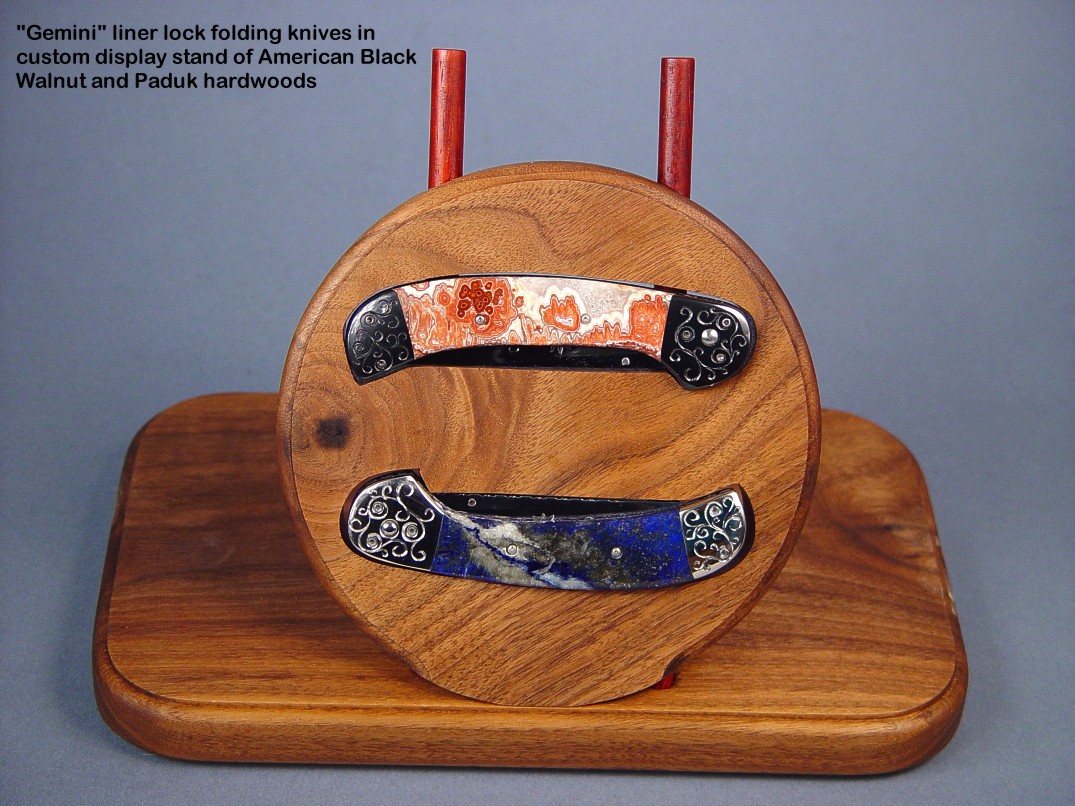 You have taken my breath away! They are absolutely beautiful, in fact I am lost for words, I am just
sitting here with a stupid grin on my face, never in my wildest dreams could I have imagined such beautiful
knives. The display stand is a masterpiece of functionality and elegance.
You have taken my breath away! They are absolutely beautiful, in fact I am lost for words, I am just
sitting here with a stupid grin on my face, never in my wildest dreams could I have imagined such beautiful
knives. The display stand is a masterpiece of functionality and elegance.
Can’t wait to get my hands on them!!!!!
Thank you so very much
--D A.
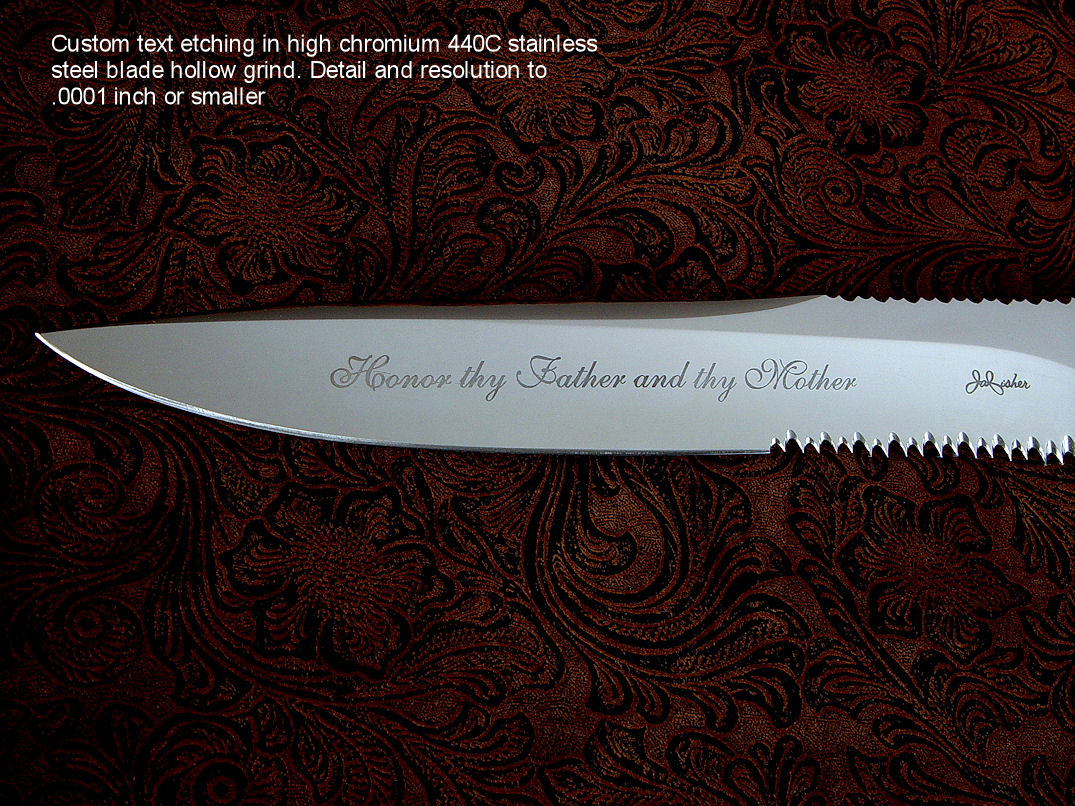
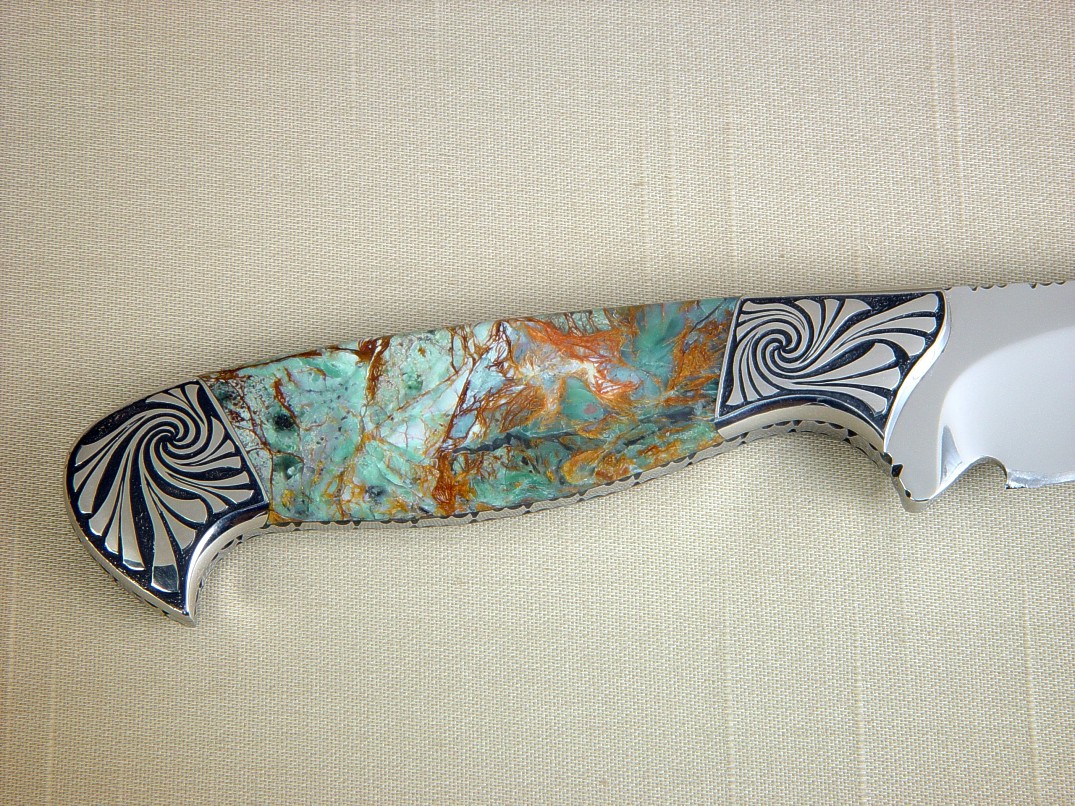
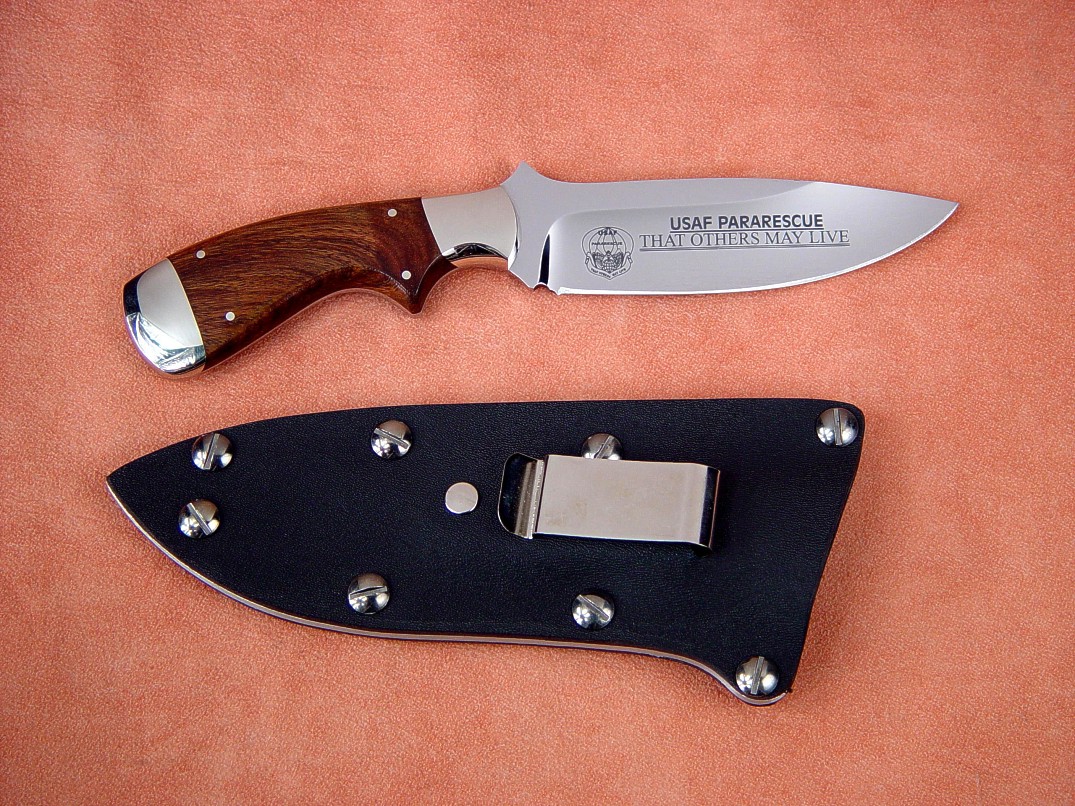
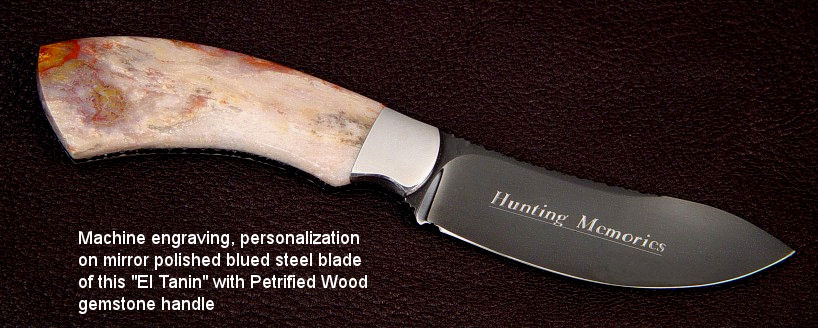
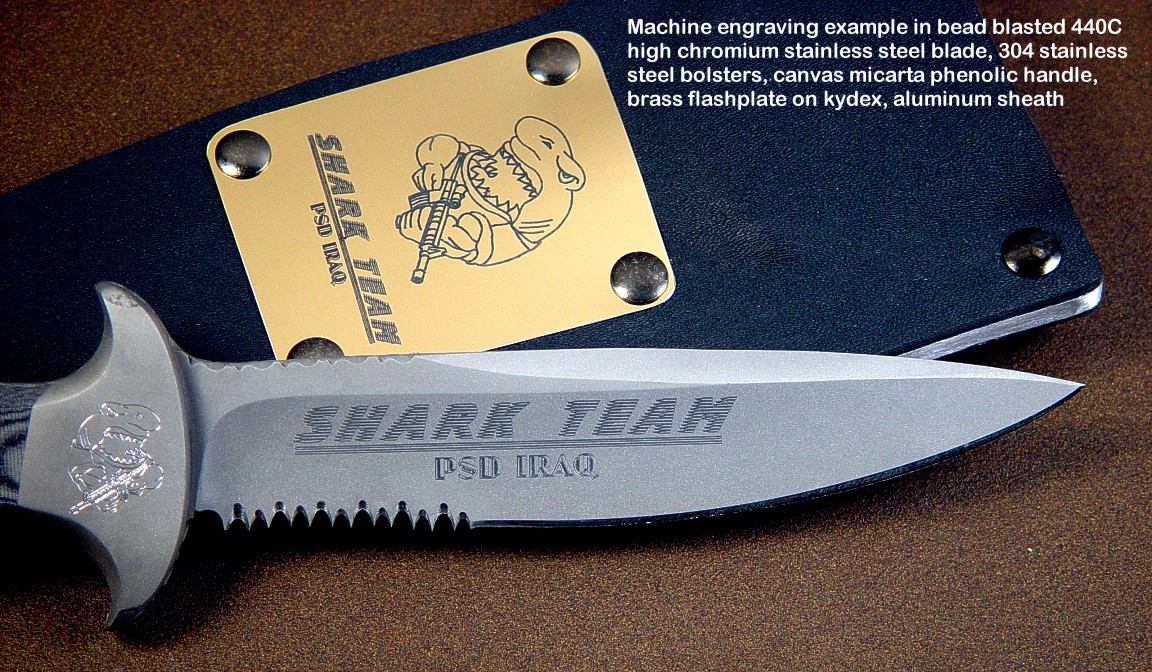
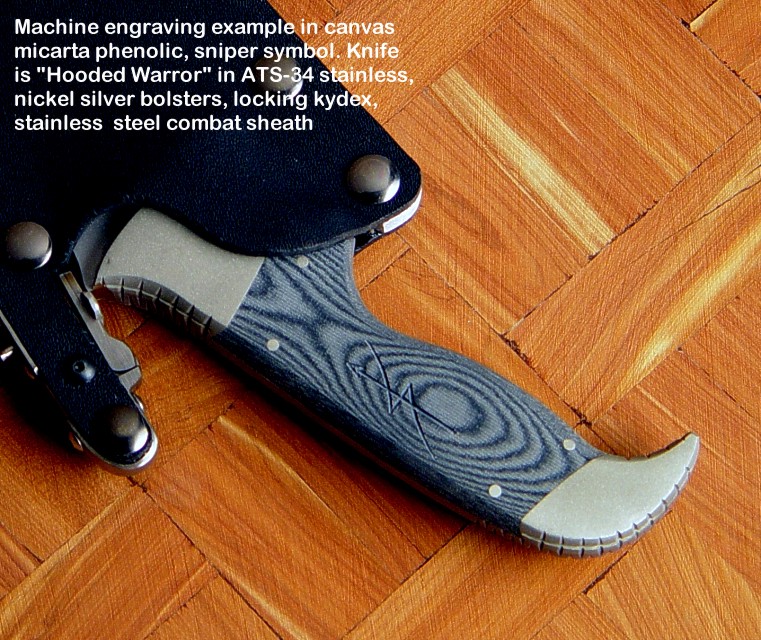
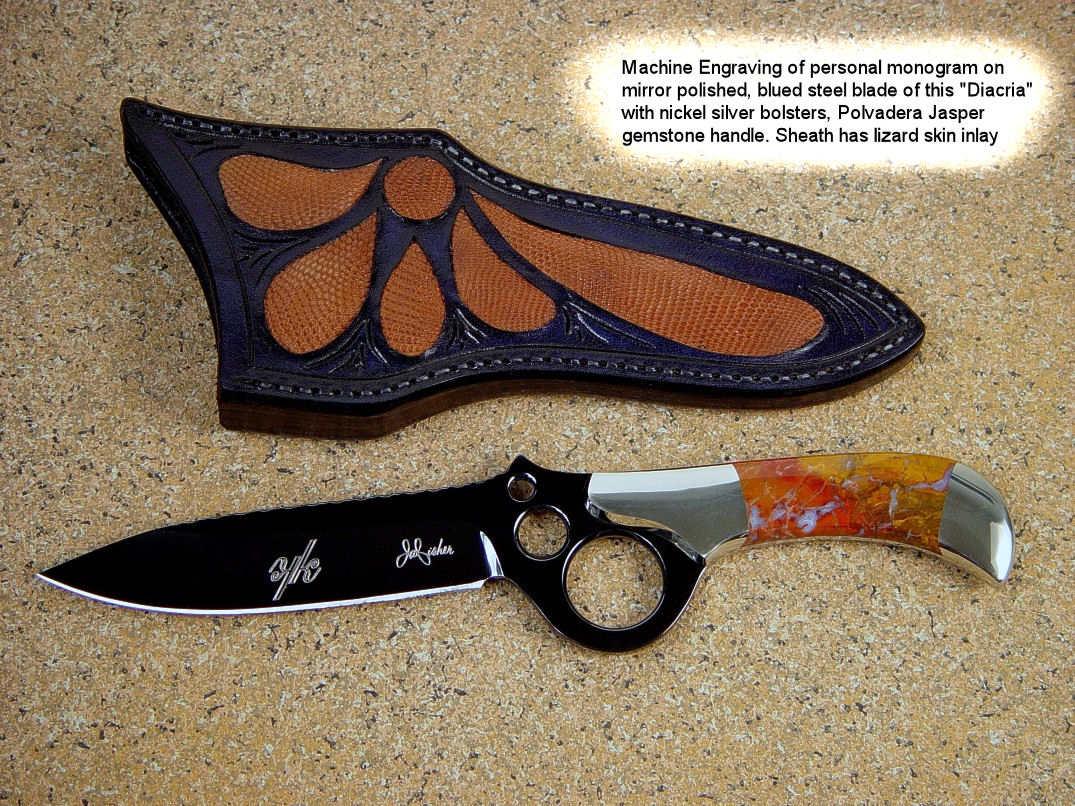
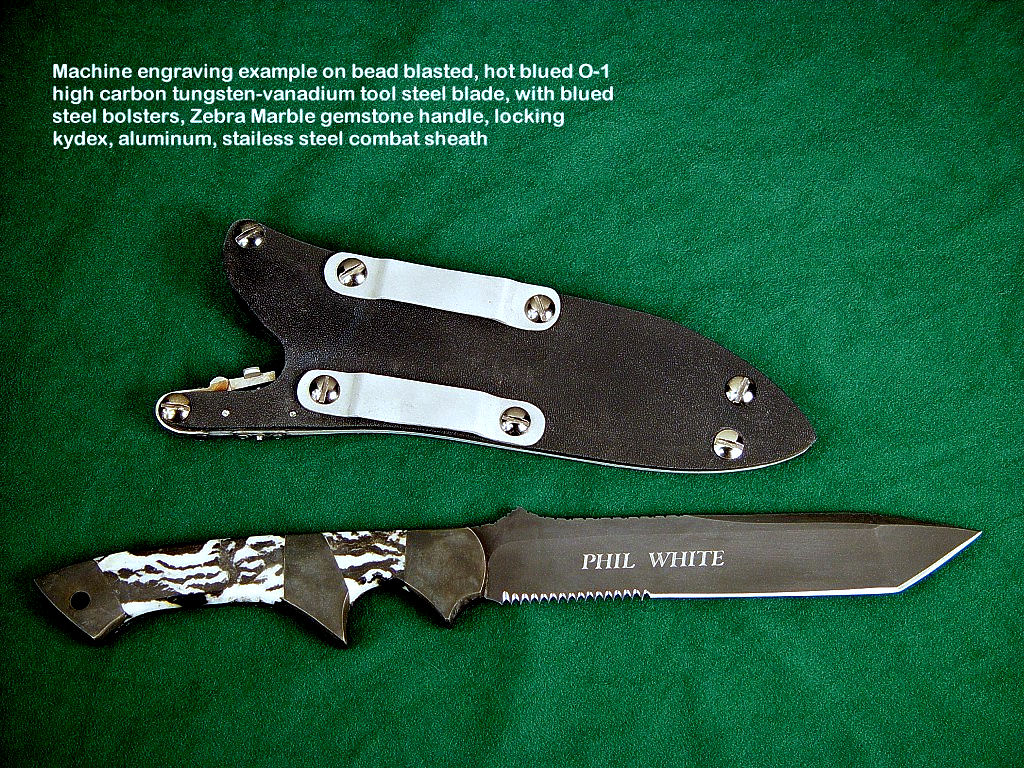
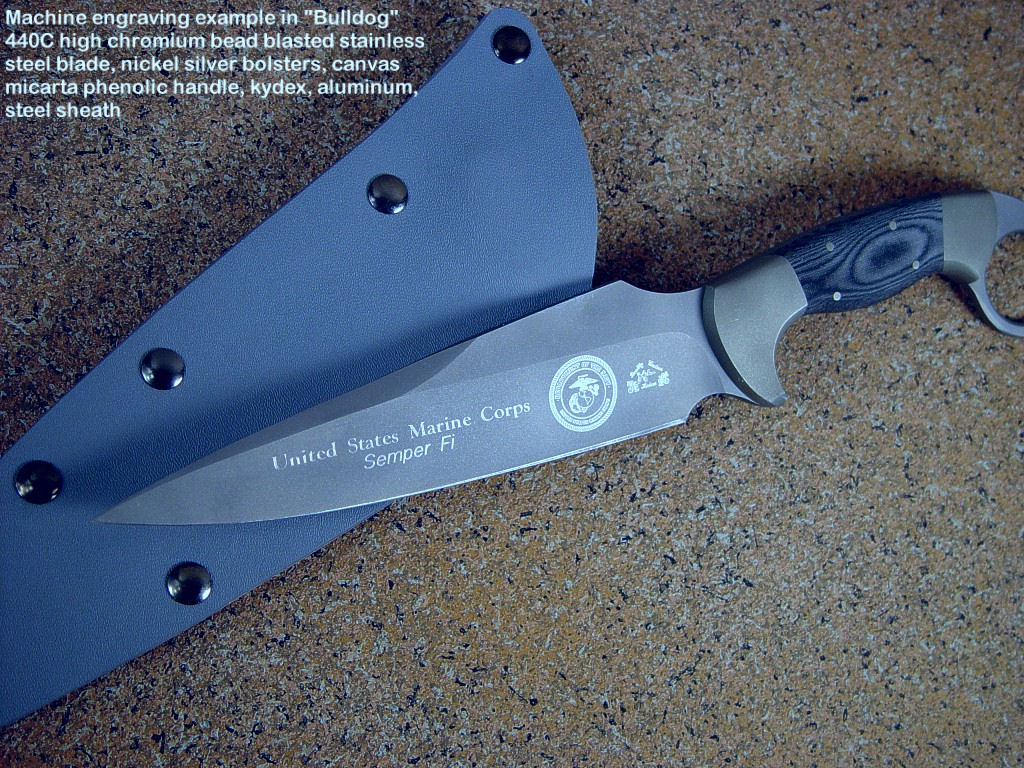
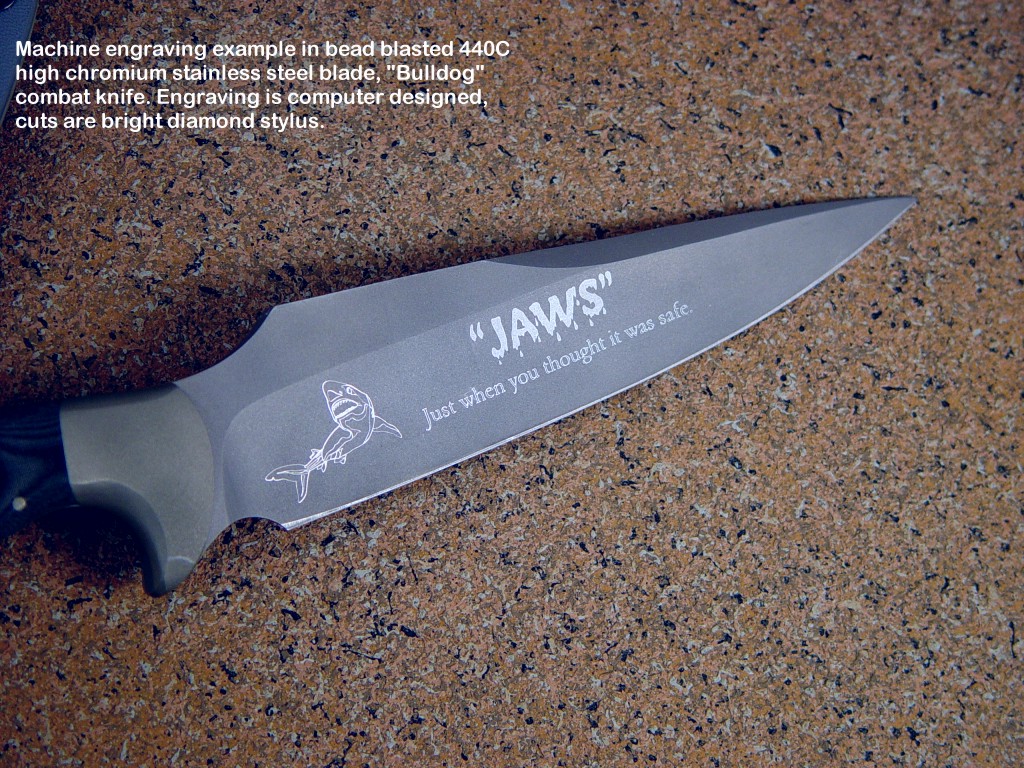
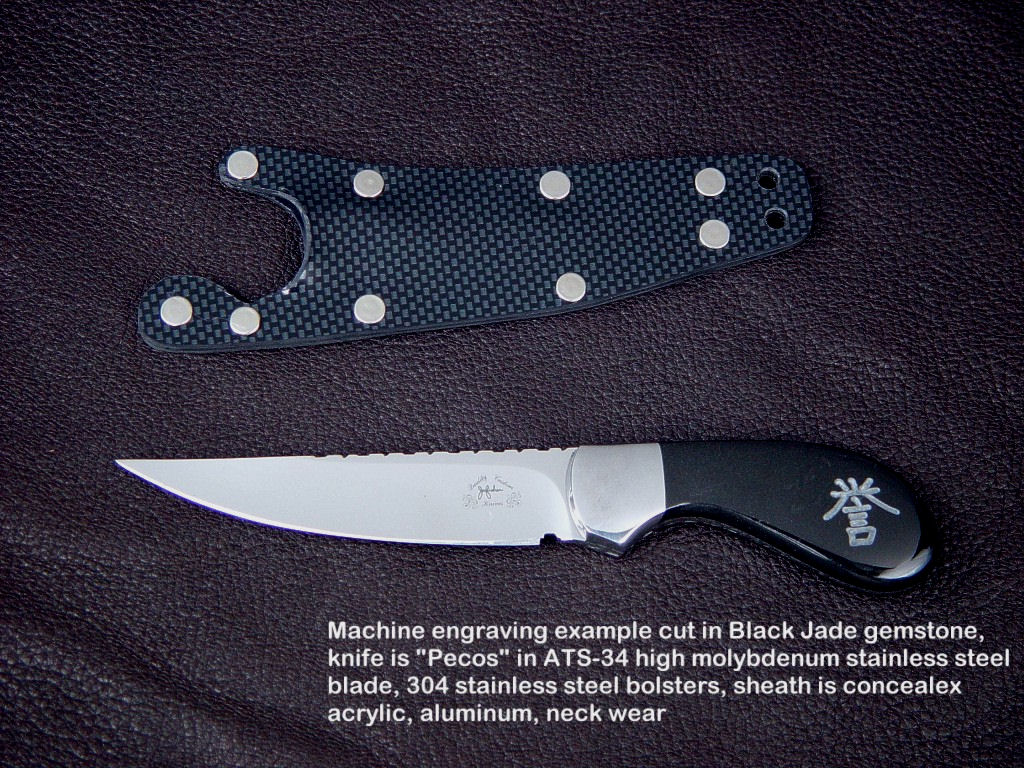
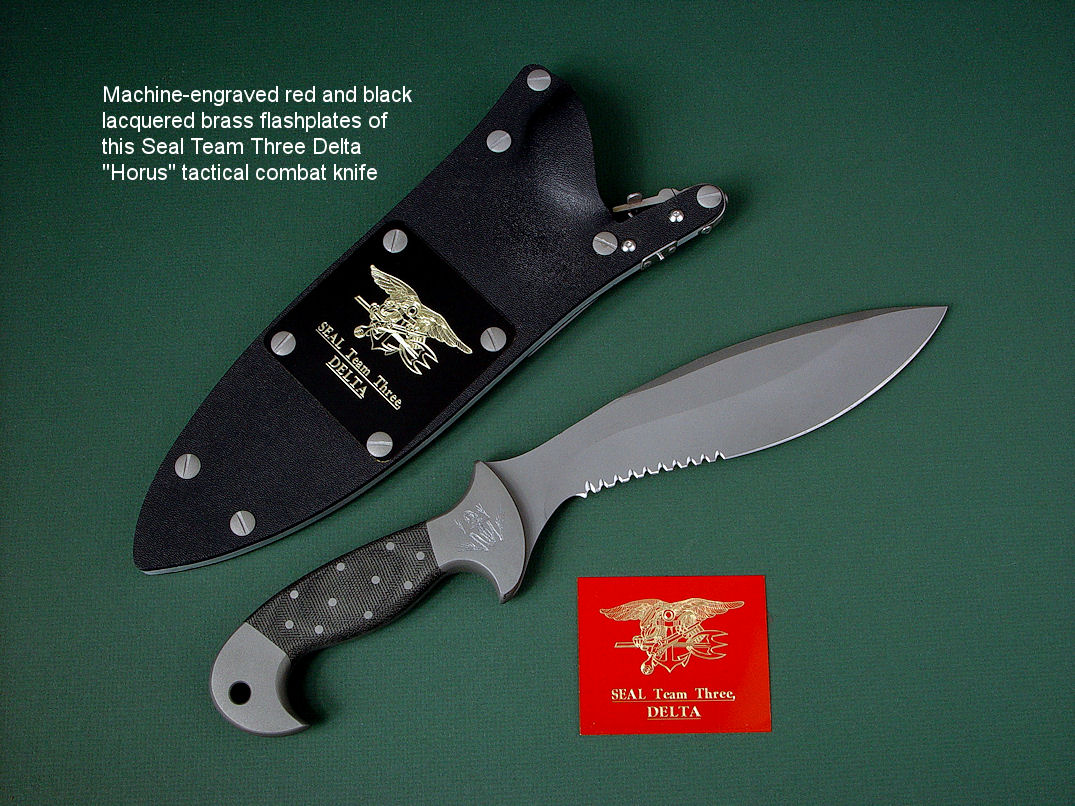
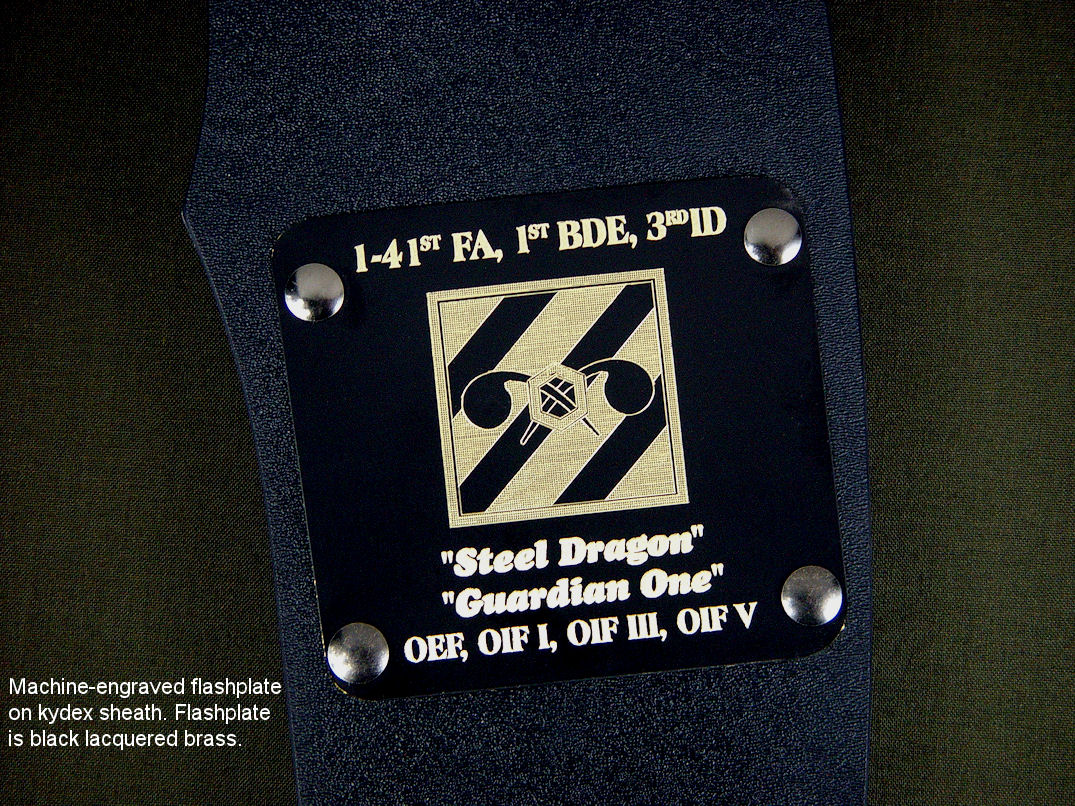
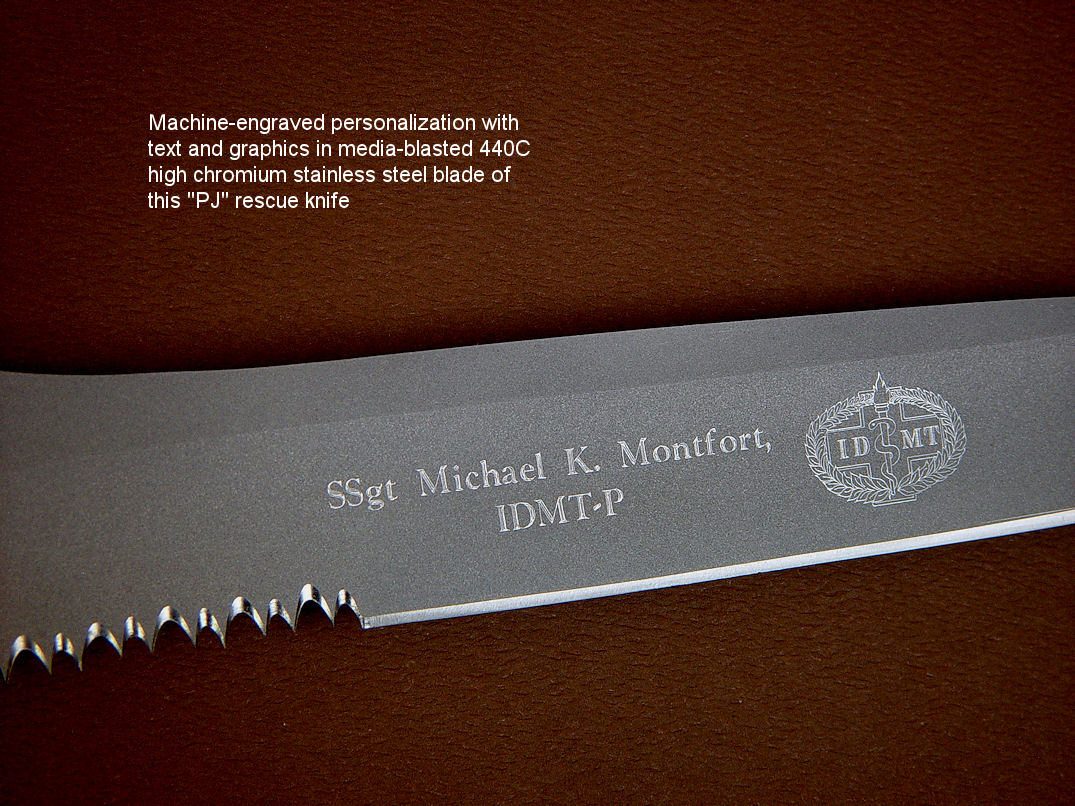
Machine engraving is done by machine, a computer driven X-Y-Z axis tool. The piece to be engraved is rigidly clamped or held, and a variety of cutters can be worked against the piece, cutting away metal or scribing a series of lines in the surface. The finest cuts are with a diamond-drag stylus, heavier cuts are with rotary carbide cutters, mills, and burnishers. Burnishers spin and drag across the work, carving a regular surface in it. Good machine engraving takes a skilled computer artist versed in CAD/CAM (computer aided design and computer aided machining) to get good results. There is also a lot to be said for spacing, text and graphic relationships, arrangements, and placement. On knives, you also have to be aware of wear areas and height lost to sharpening. In the custom handmade knife field, not much machine engraving is being done by the singular knife maker, but I'm happy to be able to accommodate my clients with this service. Some stunning and original designs can be created, as well as personalization, recognition, and commemorative pieces.
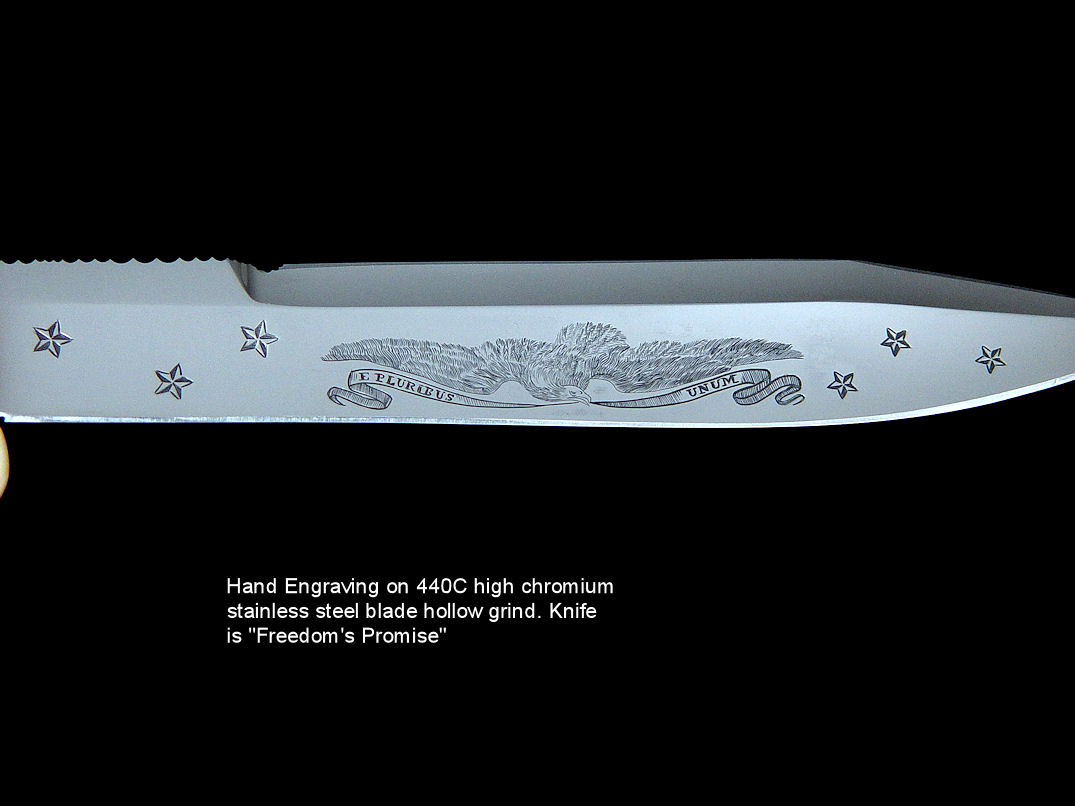
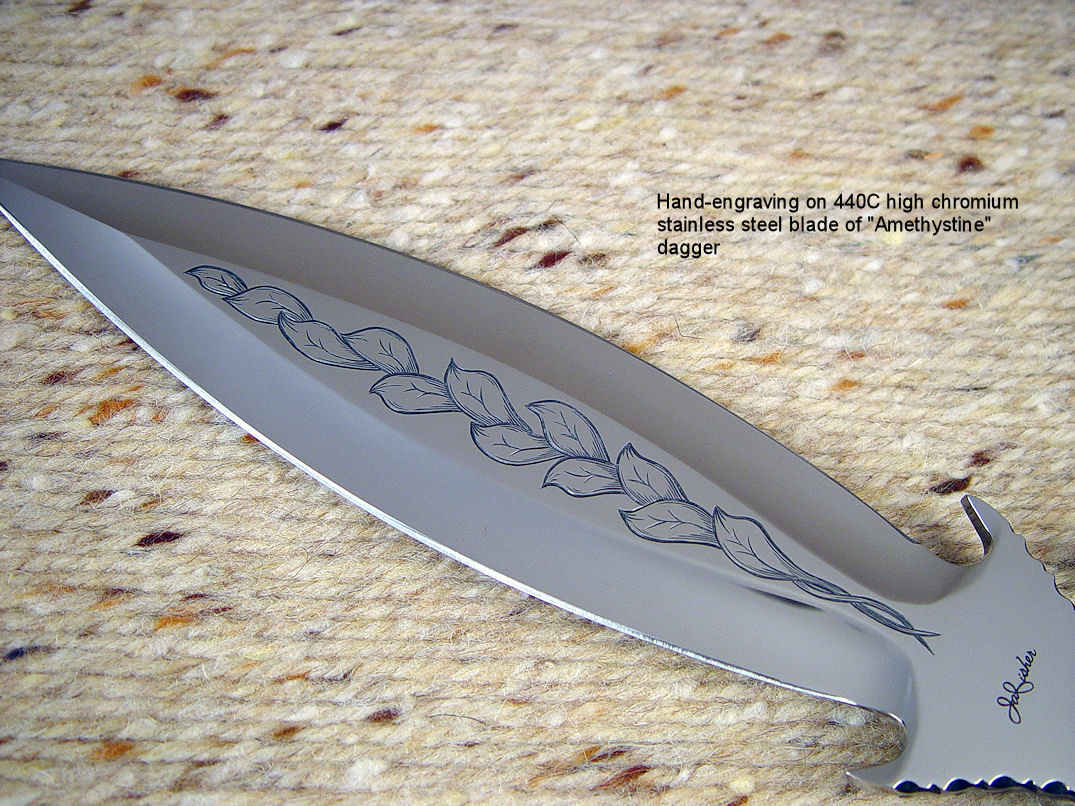
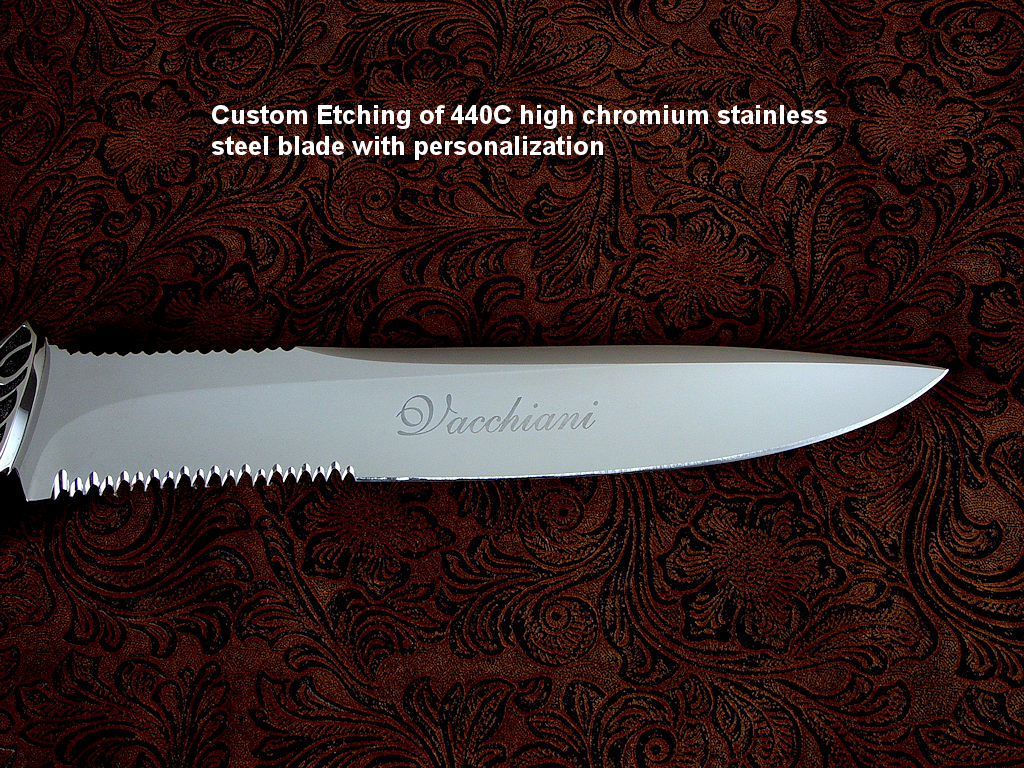
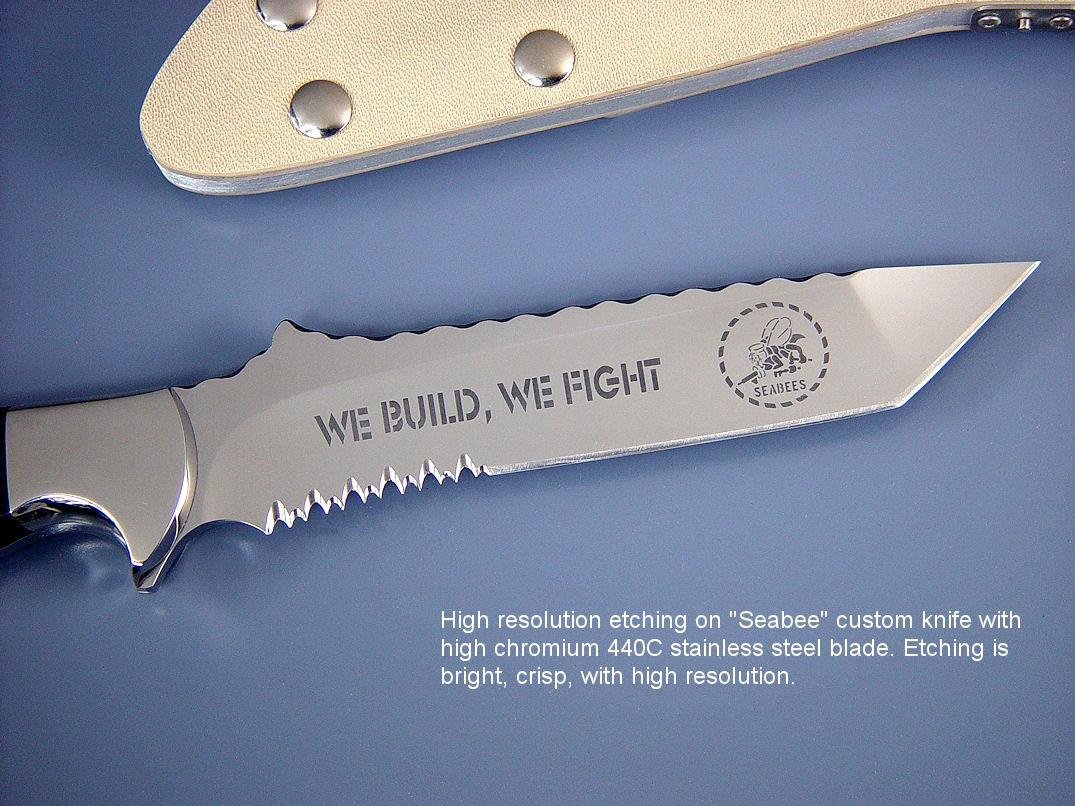
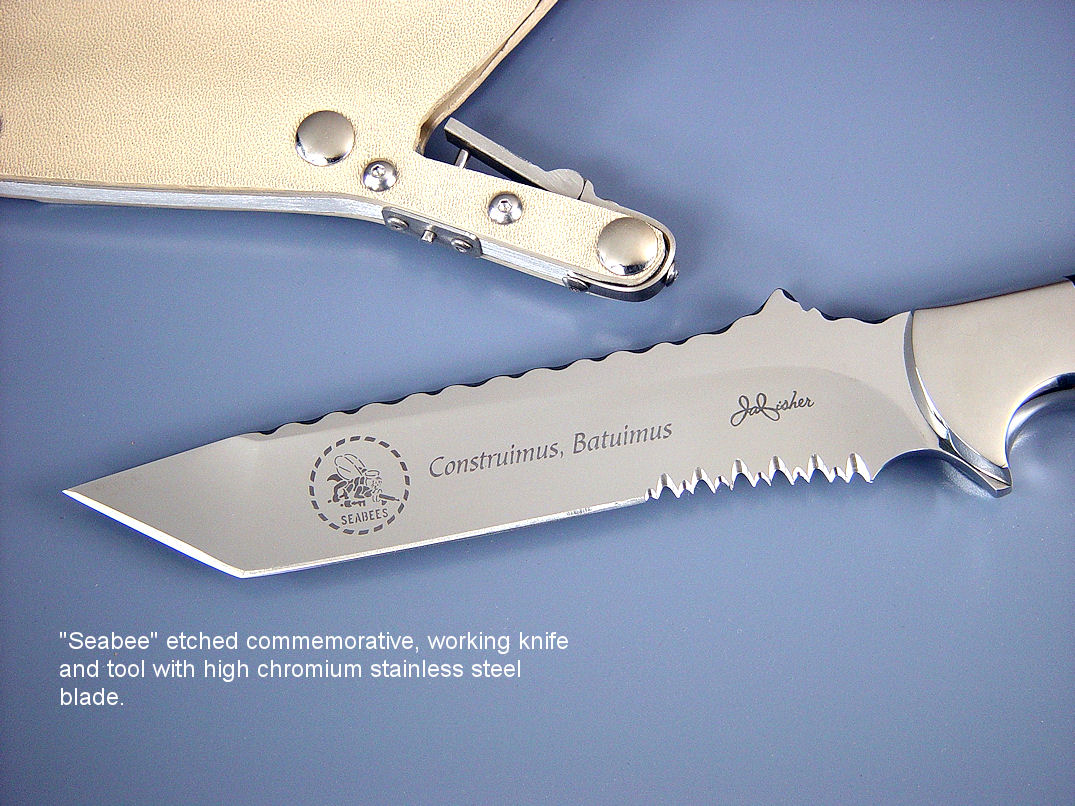
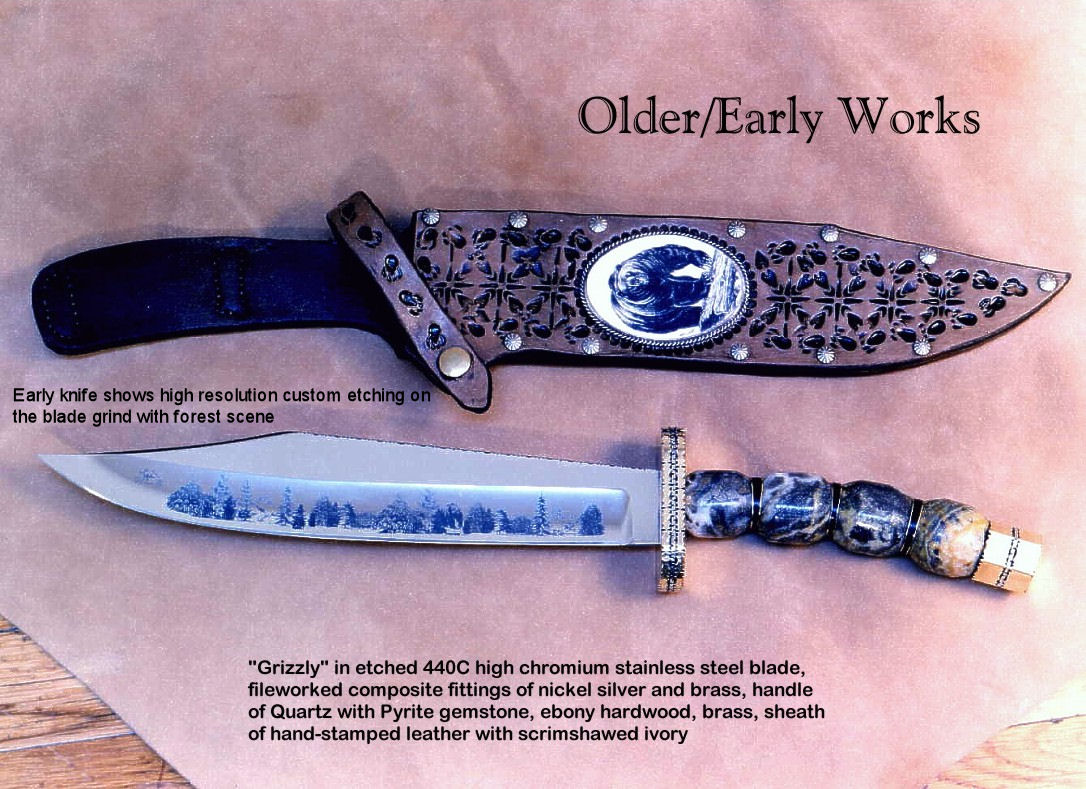
It's important to realize that knife blades lend themselves to images and text that have a smaller height to length proportion. For example, a round military insignia engraved on a blade would only be .75" high and .75" long, and thus would be very small and hard to see, but text could be .75" high and three inches long and would be very easy to read (See examples below). So, blade engraving excels in displaying text or long images. A nice arrangement is a logo, emblem, or insignia with the addition of textual elements to fill out the blade grind. I almost exclusively machine-engrave in the hollow grind, for several reasons. The grind is the largest area of the blade, and typically the flat is much smaller. Also, engraving in the grind is more punchy and significant, as the grind is a high visibility area that most makers will not perfect, much less add to with custom engraving. The grind is where my maker's mark is placed for the same reason, proclaiming the grind as a very special position and territory to create on any knife.
Most people might recognize machine engraving as originating in the awards and recognition industry. Though every trophy and signage shop may have machine engraving services, it is seldom that this process is applied artistically to knives. Usually award recognition deals only with text, and few graphics are included. In custom and handmade knife making, it's a relatively new art. It will be interesting to watch in this field, as there is great potential in this evolving process, skill, and technique. I offer a wide range of machine engraving here in my studio, I can work with almost any text and graphic images in high resolution and detail.
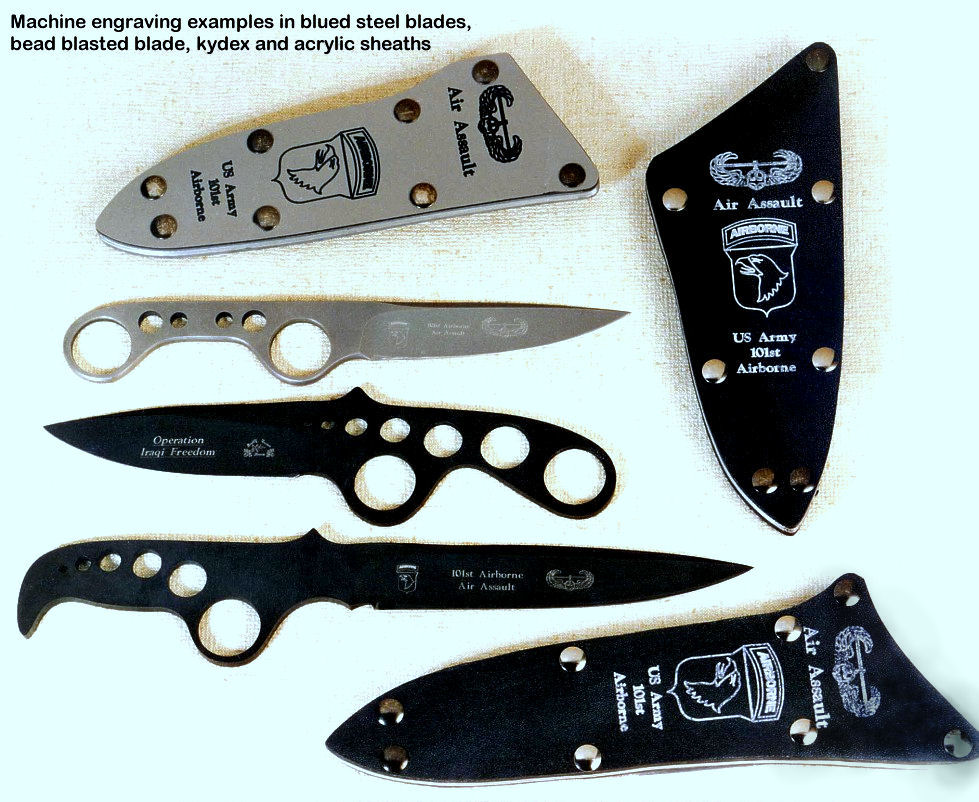
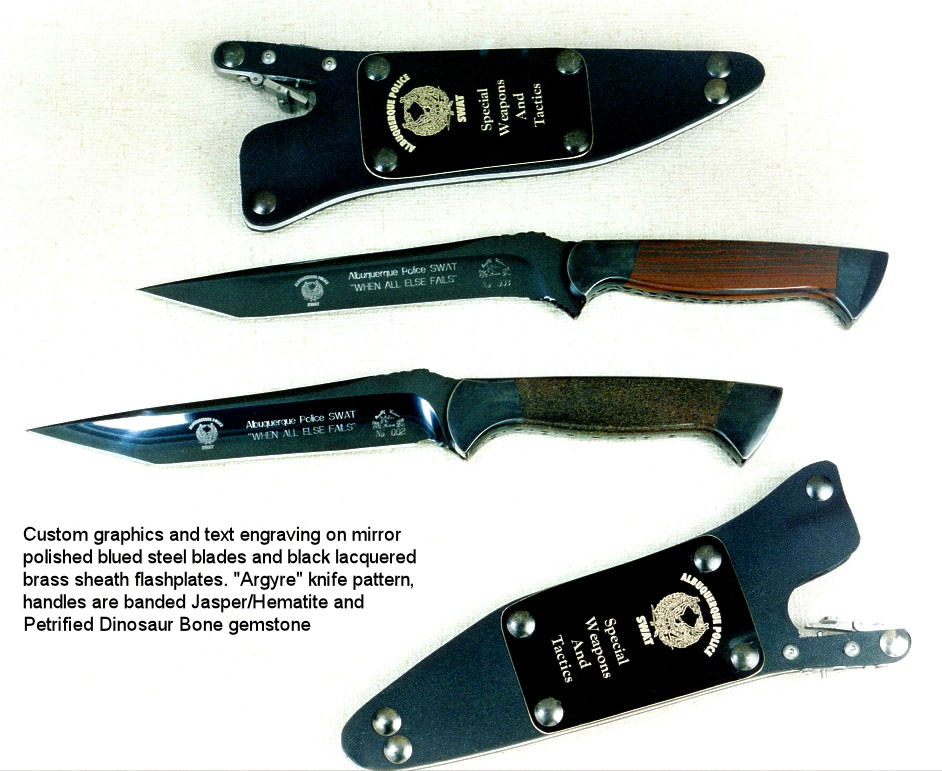
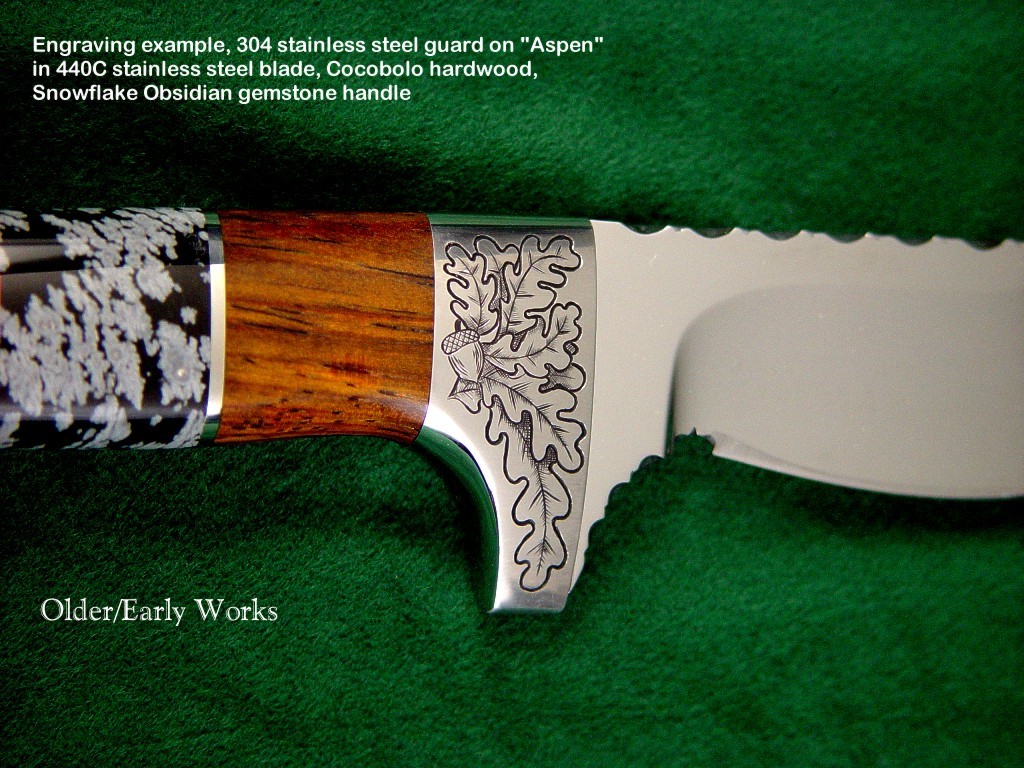
Engraving is an ongoing learning process. My early engravings are like most artists, rough and crude. You'll see some of them posted on this very site. Every artist should progress, and my journey is no different. I'll do my best to improve my engraving, as I will with every pursuit. In these arts, you never "arrive" at mastery, you simply keep working, keep applying, keep striving for a better result. Since man is never perfect, no engraving or artwork will be. Artists can only hope that progression will be demonstrated in their works, and patrons will continue to believe in their efforts.
Every engraver has his own style. That style may be copying another's work, or it may be copying the style of the school where he learned to engrave, or it may be truly unique. I strive toward the unique and original based on historic creations.
There are many fine engravers out there, and most have three styles of cuts that they do. These are "bank note" engraving (a deep relief scroll work style), fine English (a light, tiny scroll style) and Bulino (very small lines or dots recreating a high resolution image). These are all beautiful styles, and that is why they're so popular. The commonality of these styles also explains why they're accepted so readily in the trade. If you've seen some nice work in either of these motifs, you know what to look for in engraving. I even like to work in these styles now and again, but they are not the whole stock and trade of engraving. There are literally thousands of types of cuts one can achieve; the designs are boundless.
I read in one internet posting a response that only a few styles of engraving are "accepted" within the knife collecting community. According to the person who posted it (who claimed to speak from a position of knowledge on the subject) the only type of engravings found in history are these few styles, mainly scroll work. I was stunned. Today, you can pick up hundreds of texts on historical engravings. Every one of them is different, for man has been scratching and cutting metals for as long as he has had them. Before that, he scratched and carved pottery and stone. There are literally thousands of styles of cutting. I would encourage this "expert" to pick up a book that details Victorian engraving, Persian engraving, or bronze age engraving. There are Egyptian engravings, early engravings, and savage engravings. Historical styles of many kinds of artwork have developed into engravings. There are Gothic styles, Byzantine styles, Moorish styles, Roman, Pompeian, Greek, Etruscan, Blazonry, and Renaissance styles of artwork, all demonstrated by and featured in engraving. As I continue to improve my engraving, I hope to apply more of these styles myself, and not be confined to only scrollwork.
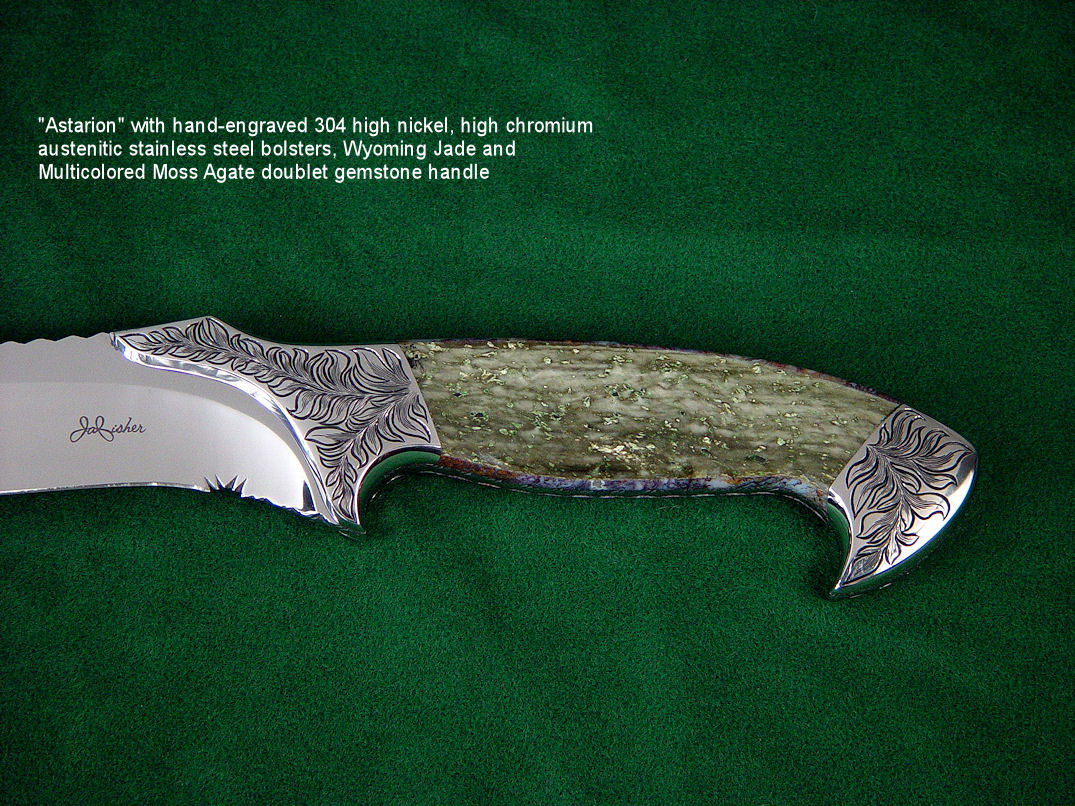
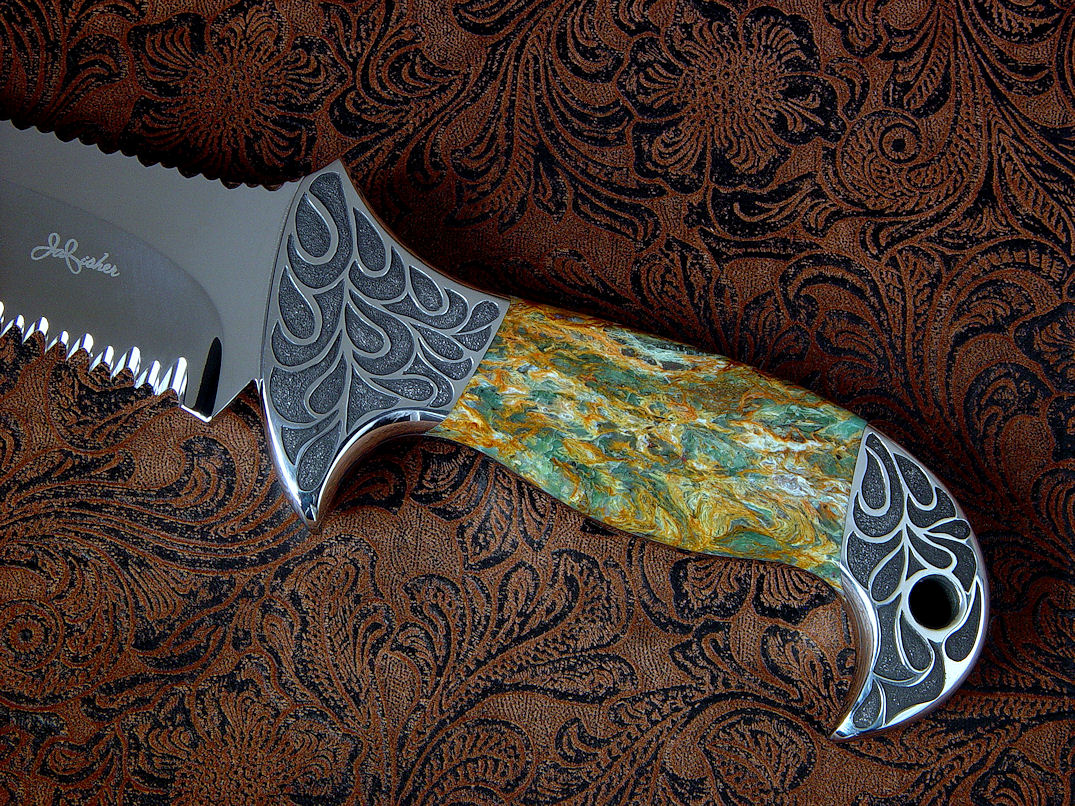
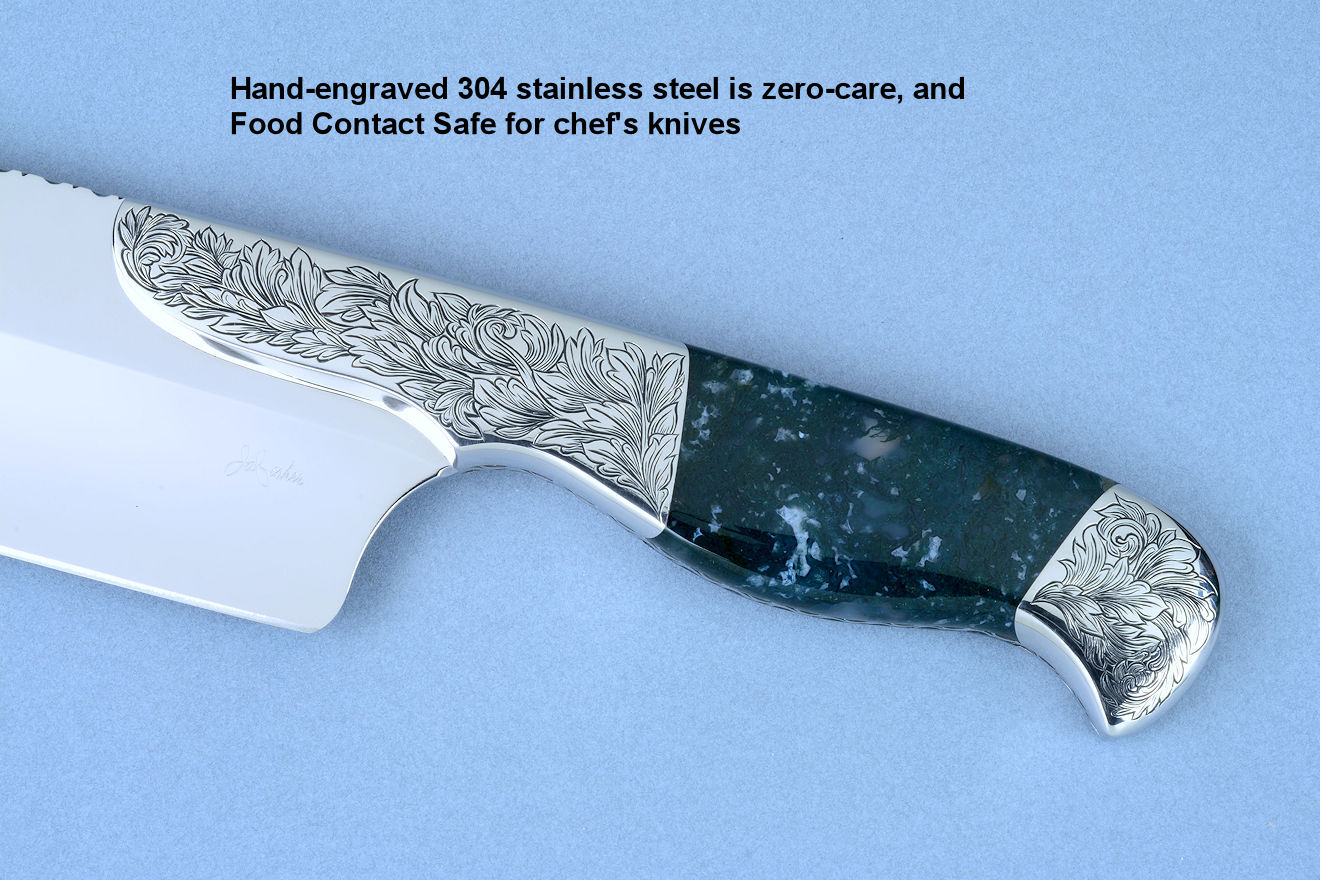
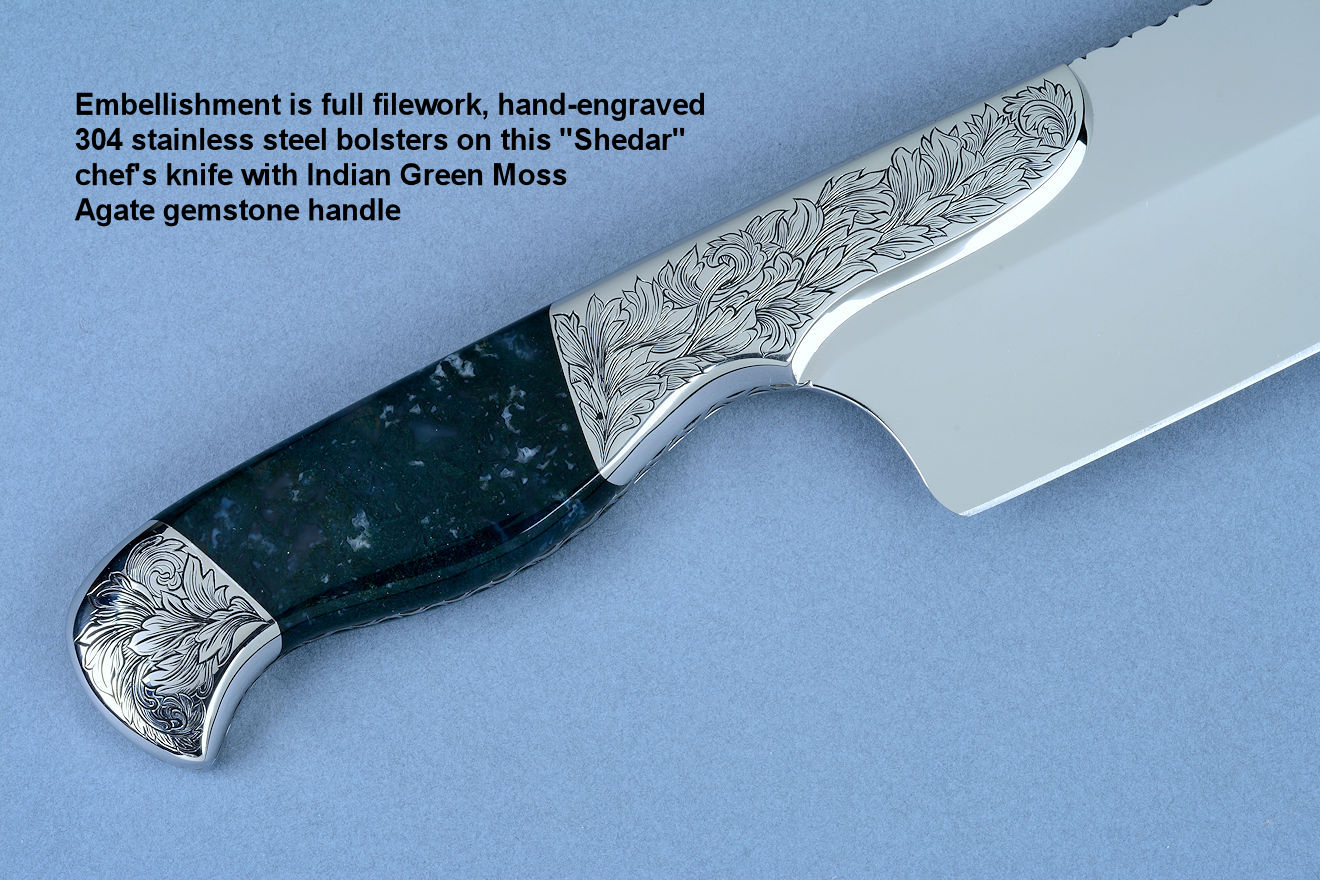
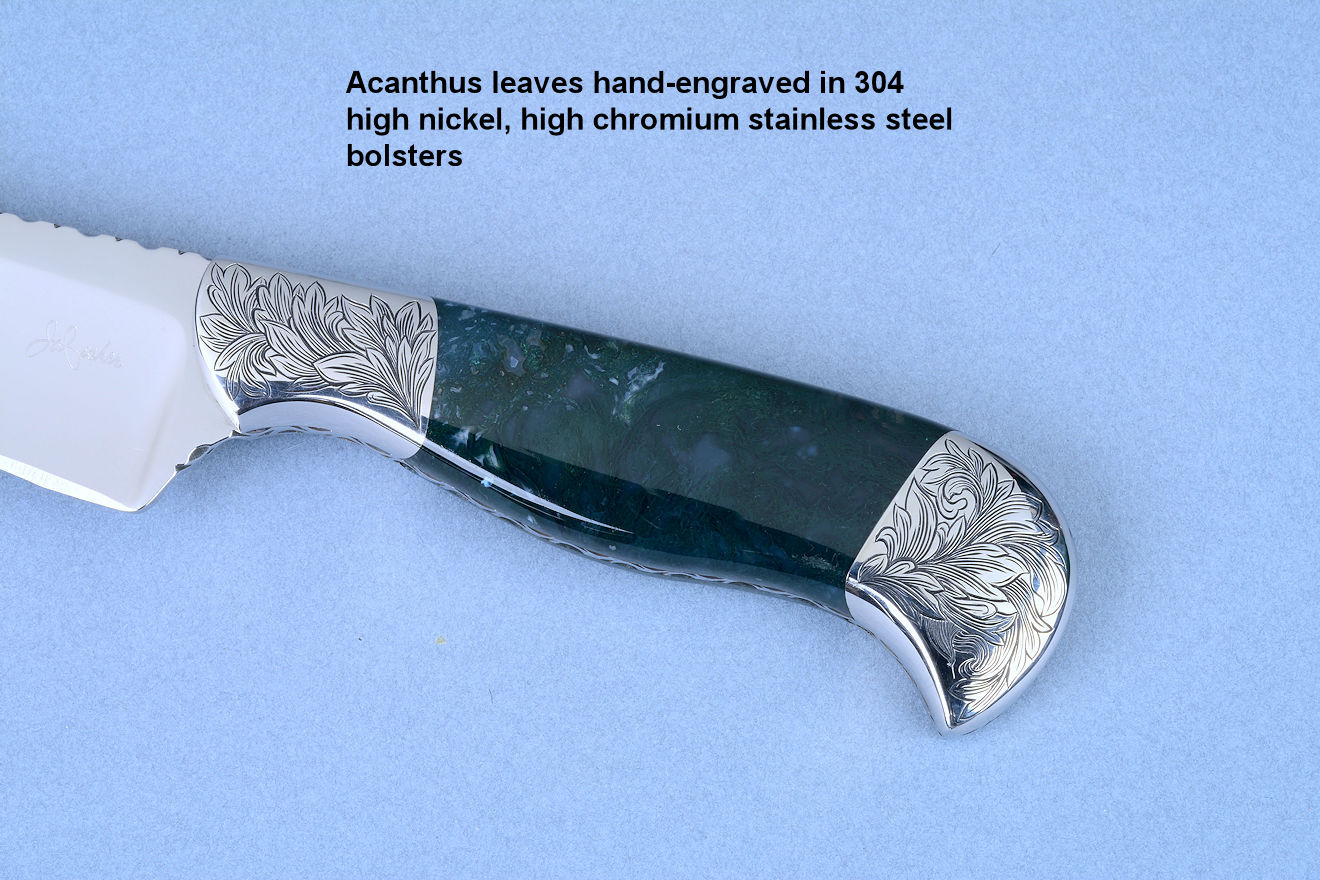
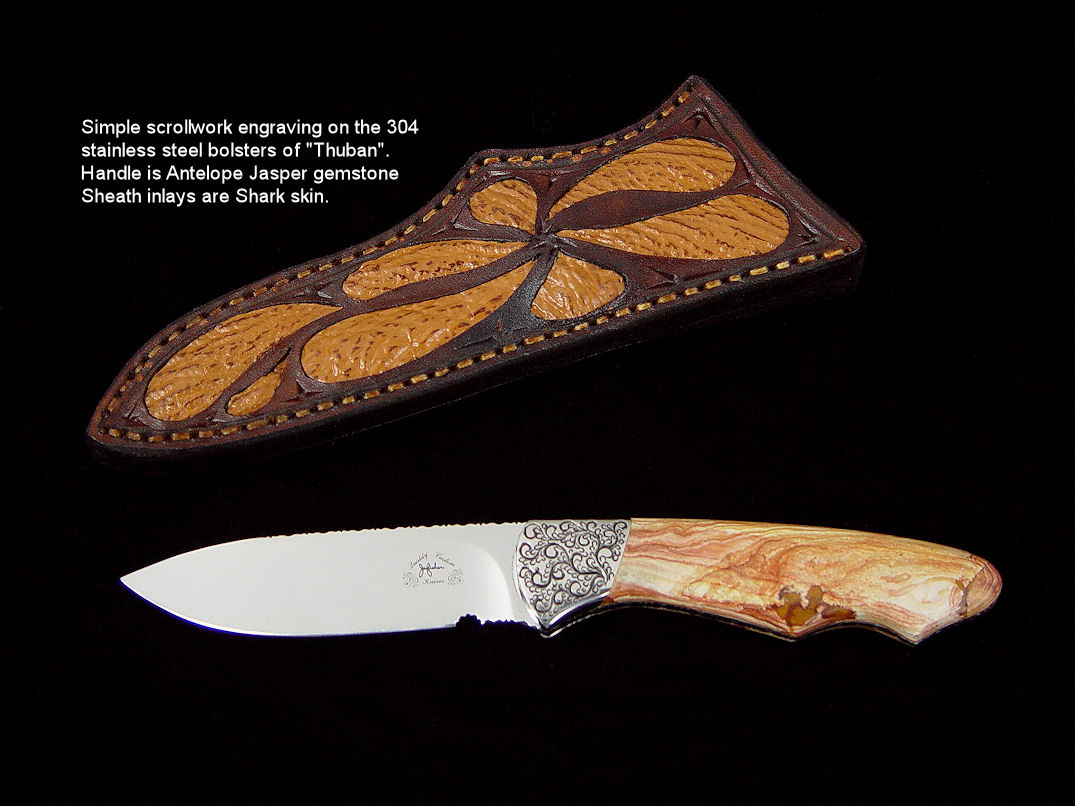
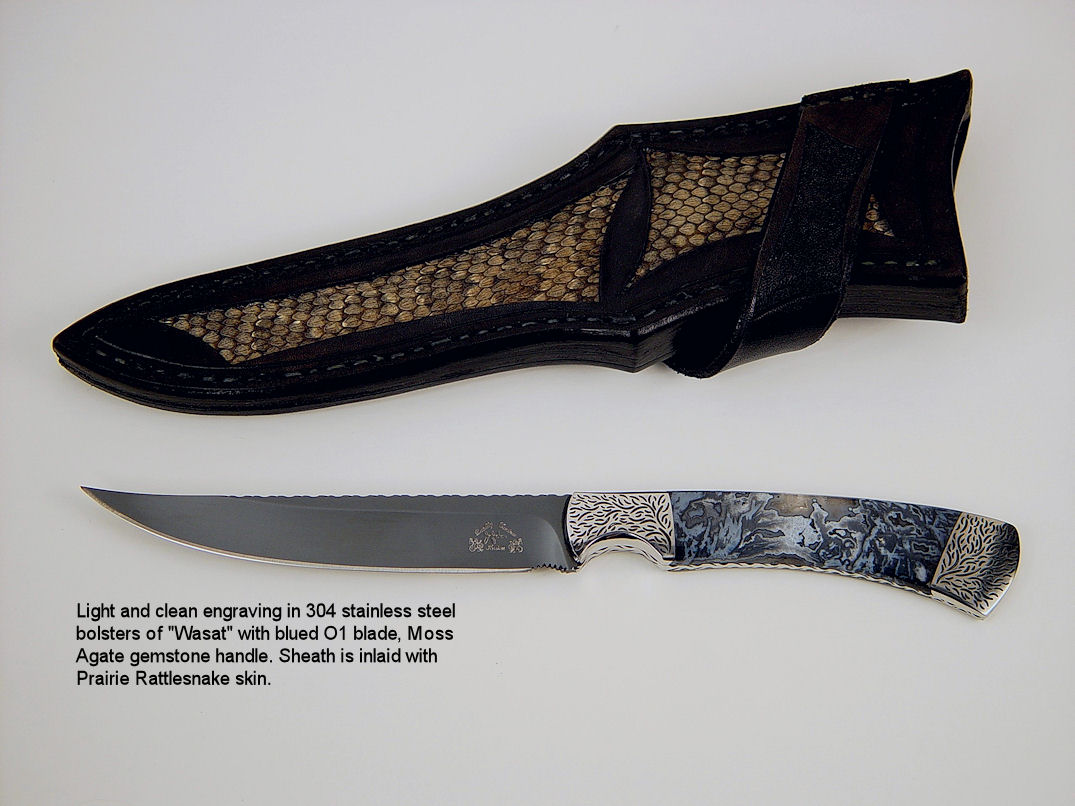
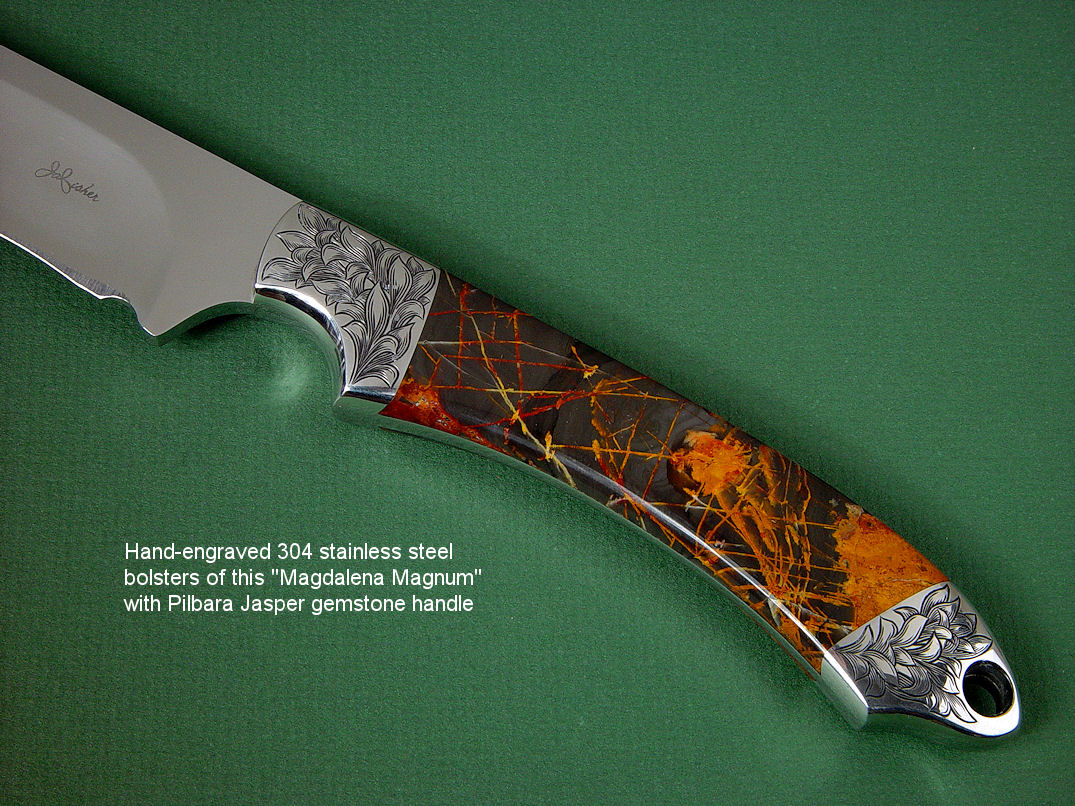
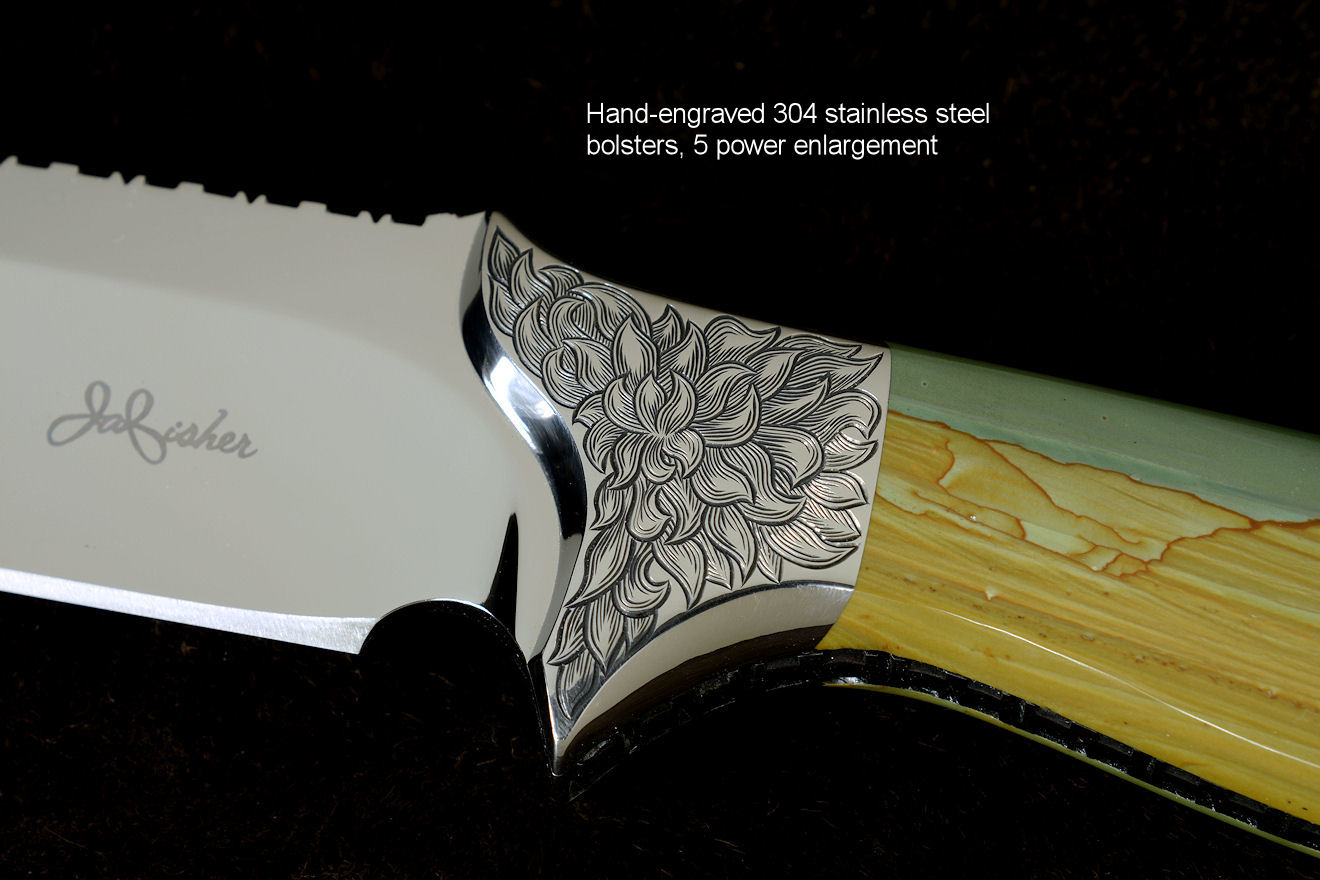
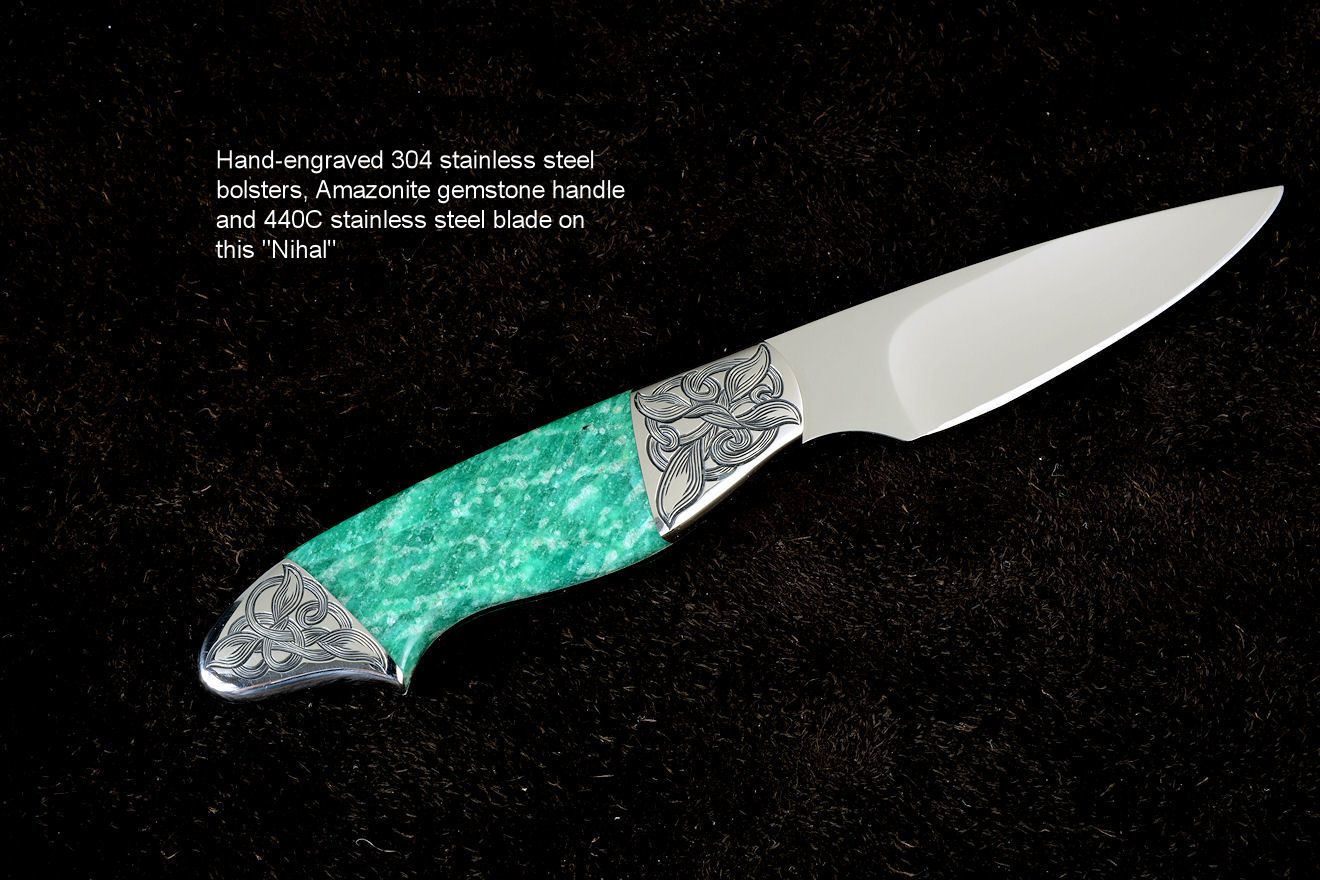
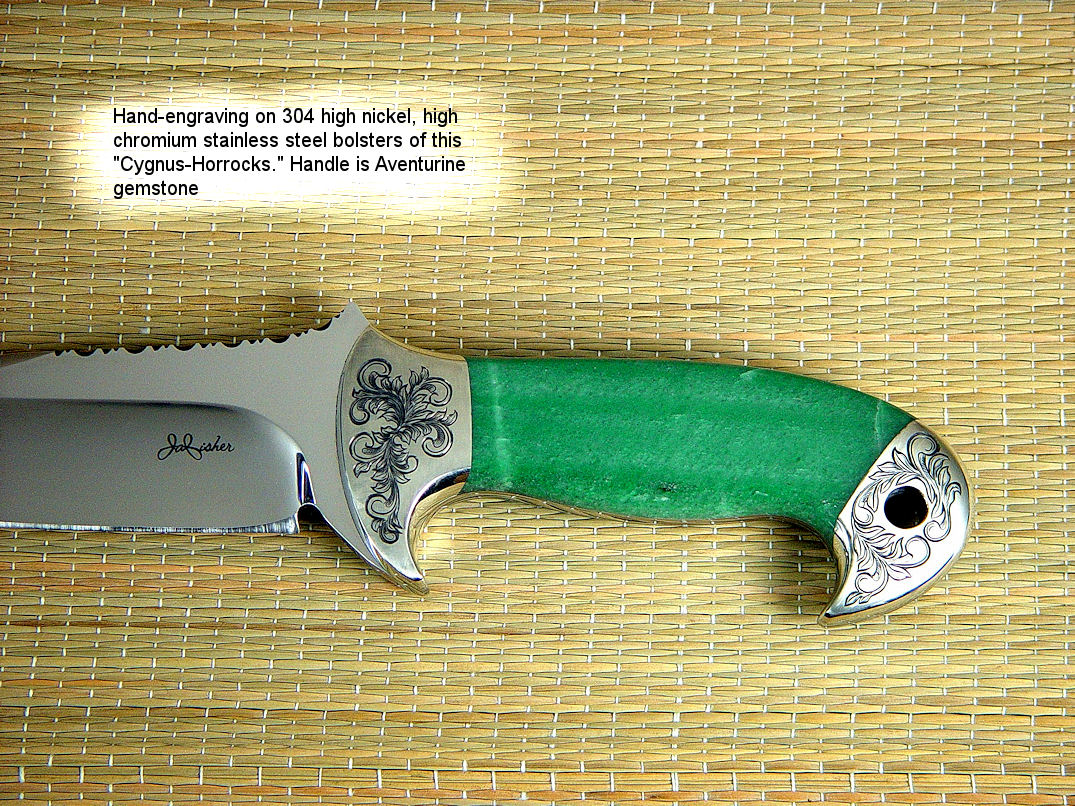
I try to match my designs to the knife style and flavor. This means experimenting with unusual, non-standard cuts. This also means cutting non-standard materials. For example, I engrave a lot of 304 stainless steel. I know of few engravers who do this. Why? Because it's up to 25% chromium and 8% nickel and extremely tough. It snaps off the cutting points of the hardest, toughest gravers with just a few minutes of cutting. It has to be cut with a pneumatic hammer assist machine because the hand alone is not strong enough to control and execute good cuts in 304SS. Why do I cut so much 304 stainless? Due to the high alloy content, this is a permanent, zero-care steel. The only thing that will corrode 304 is strong acids and caustics. Whereas many knife engravers prefer the clean (and relatively easy) cutting of carbon steel, the engraved carbon steel must be meticulously cared for, or it will rust at the slightest opportunity. With today's stainless steels and engraving adjuncts, why settle for steels that easily corrode? Why saddle my clients with having to constantly oil, wipe, and worry about their steels rusting, corroding, or pitting and their investment degrading?
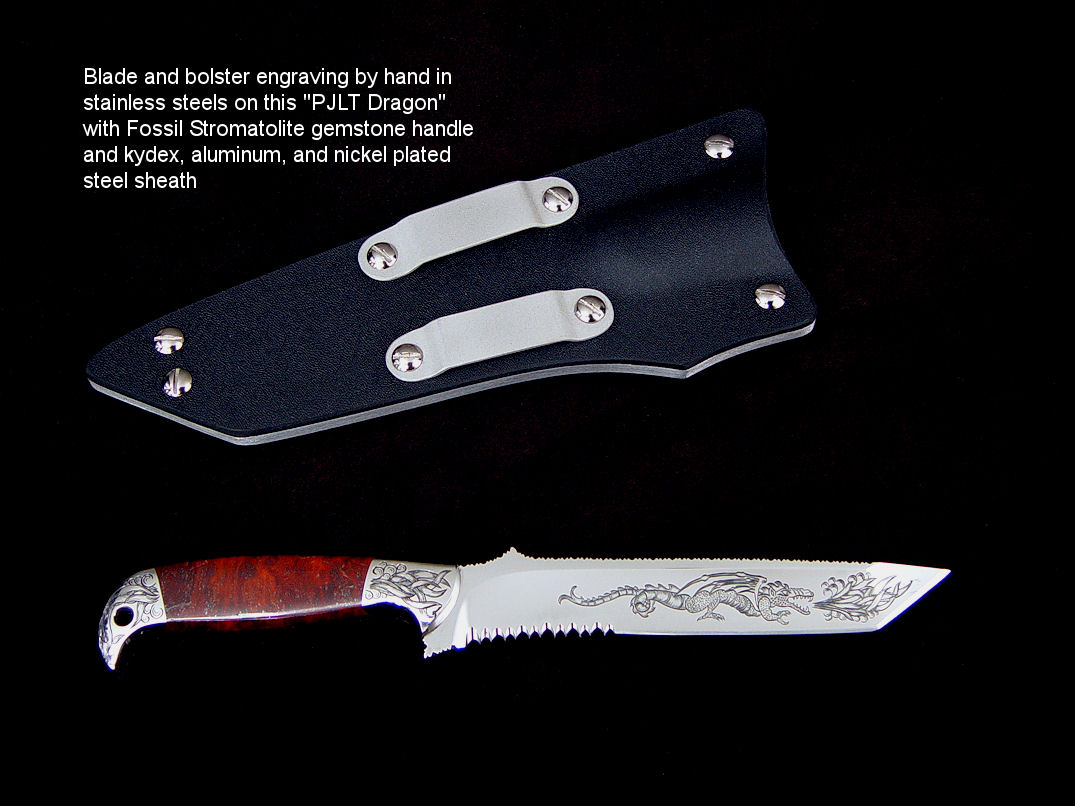
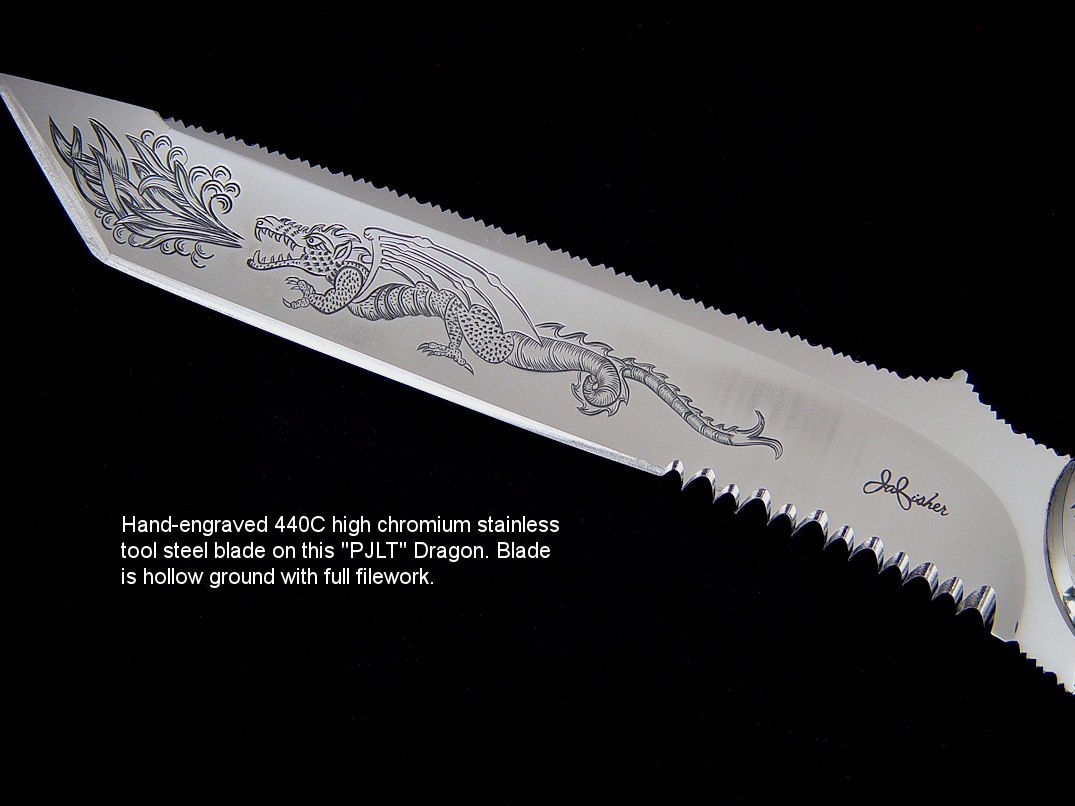
Of course, I can and have engraved carbon steel, and I also engrave standard blade and bolster metals, like 440C stainless tool steel, O-1 tungsten-vanadium high carbon alloy, ATS-34 high molybdenum stainless steel, CPMS30V, CPM154CM, mild steel, nickel silver, sterling silver, bronze, copper, and brass. I even hand-engrave titanium! I experiment with a wide variety of styles and cuts, striving for improvement on every piece.
It was once said that "Any style that is not boring is a good style." I agree.
Though I make custom knives, I reserve the right to work up the engraving design, pattern, and style to match the flavor of the piece, so I seldom accept artwork for the engraving from potential clients. This is different from personalization, such as etching a person's name, a military emblem, a logo, or text on a blade. For that, see Machine Engraving and What is Etching? above.
What I'm talking about is submitted artwork for hand-engraving like animals, people's faces, scenery, buildings, and any other artwork and graphics that a client may wish to have hand-engraved on a knife. There are a few reasons I don't offer this.
If you insist on personalized engraving or having a favorite image engraved on a knife, there are many custom engravers out there who will work with you. You may commission them to engrave any knife, including mine, and that may be a good option for you.
"Personalized" engraving is permanently marking metal with either machine engraving or hand-engraving. In this subject, I also includes etching, since good etching can be considered permanent in steel. This includes artwork, text, or graphics that are engraved or etched onto the blade, bolsters, guards, fittings, or parts of the knife, sheath, case, or stand. It is not generalized artwork, like leaves, geometric designs, or theme-based artwork.
What distinguishes personal engraving or etching from generalized, artistic, or maker-inspired etching or engraving is that the design, artwork, text, or graphics typically identify an individual or group. Most of the time, this is a person's name, but can also include artwork or graphics that are personal and important to just one person, the person who, ultimately, owns the knife. I use the word ultimately, since this would include gifts and legacy pieces, since people often purchase knives for others, mainly friends and family members. Sometimes, this personal artwork recognizes a military service or affiliation (see my Commemorative knives here), and sometimes it signifies a cultural heritage. Oftentimes, a client requests simply the name of the person to be engraved or etched onto the blade.
Believe it or not, I generally discourage personalized artwork and names. Though you can see many of these on my website, please understand that I have made a lot of knives in my career, and the actual number of highly personalized knives is very low.
The reason for this is because fine handmade knives will almost always outlast their original owner. Unless someone is using a working knife daily, nearly every single knife I make can and will last for generations. Knives that are used daily are working knives, and clients who request them rarely want to add the extra expense of personalization, since they intend to use them. The knives that clients typically request personalization for are often legacy pieces, made to be treasured, collected, and handed down.
In the mind of the person purchasing a personalized legacy piece, they may intend that the knife stay forever in the hands of the person whose name or artwork appears on the blade. This sounds like a great idea, but I strongly suggest caution here.
Life is full of changes, events, and circumstances. I've been doing this thing (life and knifemaking) long enough to know that sudden or drastic changes simply happen in people's lives, and not all of them good. I also know that fine knives are a serious investment, and knives by well-known makers typically appreciate in value. A valuable investment of a fine knife is tremendously devalued if someone's name is permanently marked on the blade.
I hate to imagine the worst, but I'm obligated to my clients to be honest and open about this, since it represents a considerable cost. If a knife has a person's name on it, or graphics and artwork that is specific or narrow enough only to be of interest to the owner, the knife is unlikely to ever be resold, even at a reduced value. This is very important to understand.
I don't want to be negative; I just want this to be very clear, since my clients deserve to know the truth. A personalized knife is not an investment knife. The person who owns it will not be able to recover or benefit from its value, no matter the circumstances. I know that many people who purchase knives do so because they understand that someone, sometime, may need to recover their investment, and that there is value in the work. This is not true for specifically personalized knives.
Now that you have read this and understand it, please know that you will see personalized knives on this website, and from time to time, I make them. When I do, since the knife is unsalable to others after the personalization is done, these knife orders must be paid for completely in advance, before the personalization happens. Also, the cost of the knife is not refundable, under any circumstances! That may sound like a heavy burden on the client, but when a knife is specifically personalized, from then on, no matter what, I can't sell it to someone else (and neither can the owner)! So if a client can't complete his obligation to pay for the personalized knife, I will be the one who loses all of my work and labor and materials and supplies, since I won't be able to sell the knife, either.
This is the reason that the entire balance of the project must be paid for before personalization is done to the knife. If that's only etching, or machine engraving, this can happen after most of the knife is complete. If it's hand-engraving, the balance must be paid before the blade is even heat treated.
Simply put, personalized knives cannot be resold, ever, by knifemaker or client, and the decision to personalize a knife limits the value to anyone who owns it, should the worst happen and they need to liquidate. When I make a personalized knife, it must be paid for in advance, and the cost is not refundable.
This is why I generally discourage specifically personalized knives.
I believe in sole authorship for a lot of reasons. The most important of them is that a singular idea or concept is carried through the entire piece, and demonstrated in every part or facet of the creation. This puts the individual style of the knifemaker at the forefront. His idea, his concept, his skill, his execution, his design, construction, and completion of the entire ensemble, including sheath, stand, and accessories are all commensurate. This brings the knife and ensemble to a higher level of coherent creation, and it also increases the value of the piece immediately and long-term, simply because sole authorship works by well-established makers are relatively rare.
A knife that is made by a knifemaker and engraved by someone else is a collaborative work, and not a sole authorship work. In modern knifemaking, this fact is conveniently ignored or suppressed in describing the knife. What do I mean? When you see a knife like this in publication, print, or display, it will be described as "A John Doe Knife" in bold and larger dominating text, followed by "Engraving by Jim Smith." It's never described as a "Collaborative Work by John Doe and Jim Smith." Usually, but not always, the engraver does not even sign the work or identify it as his own, which is, in my opinion, rather insulting as the engraver's contribution is just as important as the knife construction. I'll go so far as to say that the knifemaker creates a canvas for the engraver to work on, and it's often described as such. If you compare firearms, the canvas is often a manufactured rifle or pistol, and the engraver is the one who is featured and adds the substantial value to the piece. You might read that the pistol is a Colt, but the emphasis is on the artwork and engraving of the master who does the engraving. The talent and skill and execution of the engraver's art adds more value than the un-engraved and un-embellished firearm!
In a way, I suppose this predominant concept in the firearms industry is why knifemakers seldom engrave their own work. They see the firearms companies and owners farming out the embellishment, and figure that this is simply how it's done. Many knifemakers are simply not interested in learning or being accomplished at engraving. Likewise, the attitude of sheath making by someone else is often seen. I've also seen this approach in making knife stands and cases.
One may wonder why this practice is so prevalent in knifemaking (and firearms), but is extremely rare or even non-existent in other related trades, like jewelry making. Rarely, if ever does a jeweler create a piece and then have it sent somewhere else to have someone else engrave it, or carve it, or inlay it, or add gemstone to it.
The engraver applies his own familiar style rather than the style of the knife design, which is created by the knife maker. For instance, a modern switchblade style form created by the knifemaker might be engraved in a Victorian, Ancient Egyptian, or Mesopotamian style, and the two, at least to me, seem incongruous or at the least, uncomfortable. There is a feeling that something is just not quite right, the piece looks embellished, looks added to, and it's noticeable. Though I'll admit that many thousands of knives have been made this way and seem to sell well, so this may just be my personal interpretation.
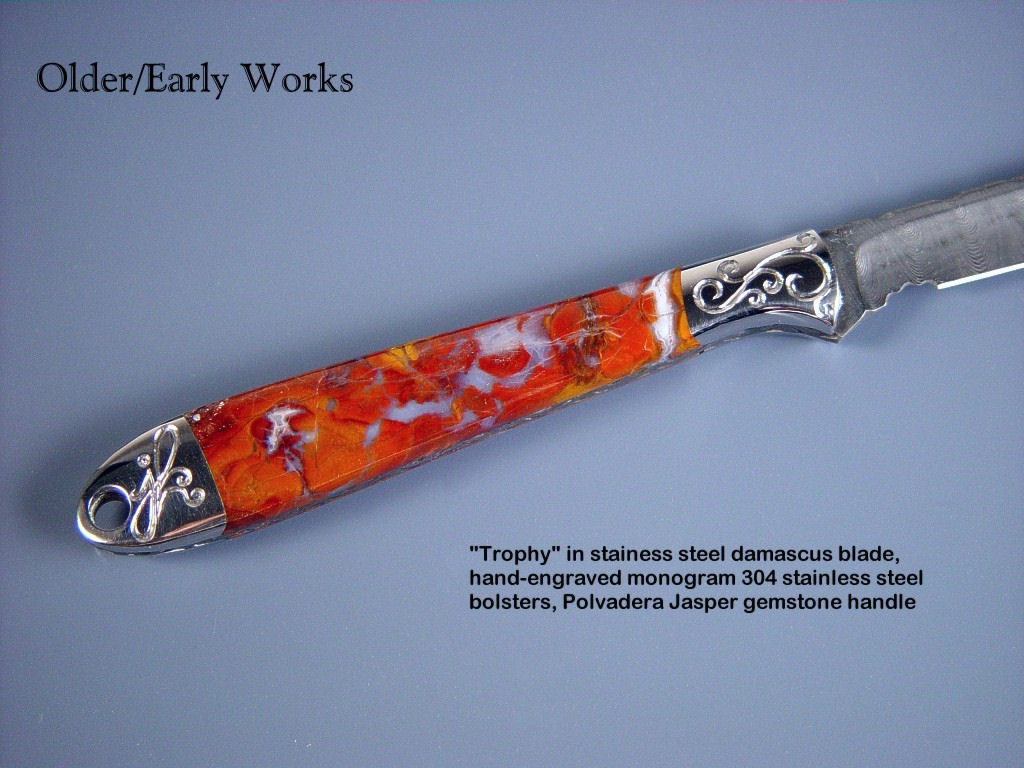
Engraving is a difficult and time-consuming art, and many makers are simply not willing or able to take it on. There are also the early works, before skill and style are defined, and we all have them. My own early engravings are rough and a bit crude, all my early work is, whether knives, blades, handles, sheaths, or stands. An artist has to push on through those and strive to create his own style of work. I know of no one creating in their own style that has not had to deal with the learning process. While some engravers and artists take classes and study a particular style (like banknote), they seldom deviate and create only banknote style engraving on all their works. Banknote is nice, but it's been done, over and over, and there are so many other stylistic components that depend on the knife shape, lines, form, and idea.
In the past, I've been asked to engrave other maker's knives or manufactured knives and it's not something I'll do. Conversely, if I make a knife and sell it, and the owner wants someone else to embellish it, I have no say in that, since I do not own it. I do wish that embellished knives were considered more like sculptural pieces. A sculptor wouldn't create the piece and then have someone else apply the detail of the form. A fine arts painter wouldn't paint all the colors except blue, and then have that added by someone else. A potter wouldn't create the form and fire it, and have someone else create and fire the glaze. If they do, they call those collaborative works and they are assigned an appropriate value. If it moves beyond this, and more people and hands are in the work, it becomes manufactured and we all know what happens to the value then.
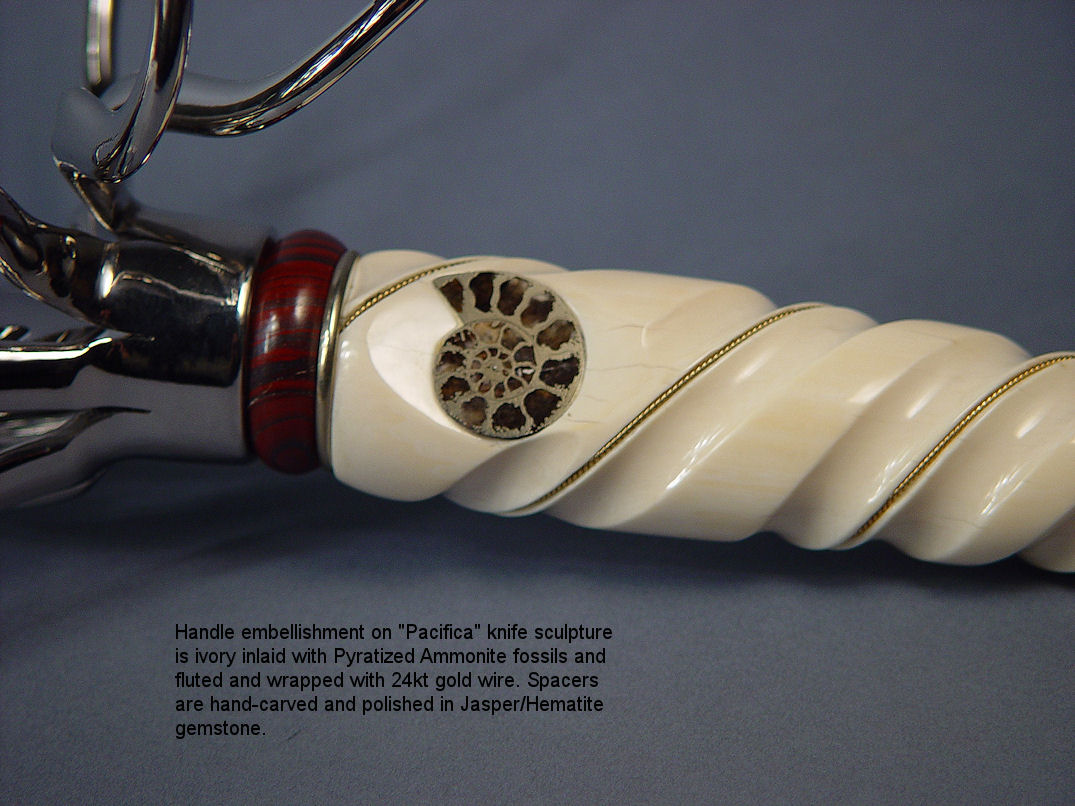
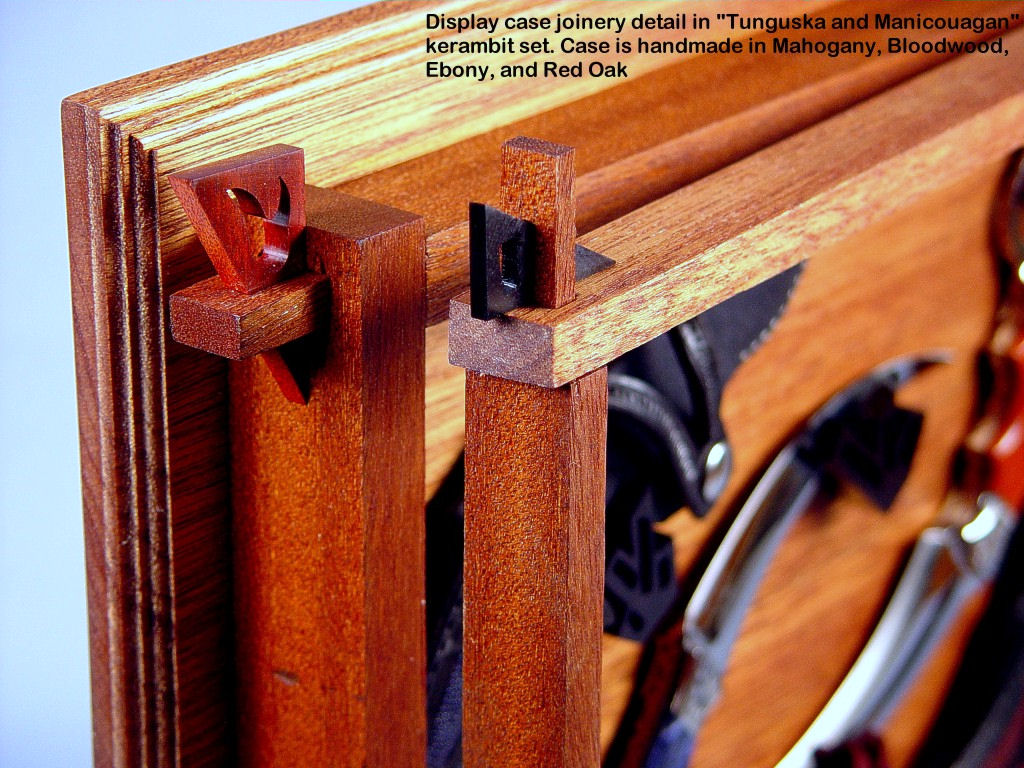
No, I also engrave and hand carve gemstone, scrimshaw ivory, tusk, and bone, inlay in wood, execute mosaics of gemstone material, inlay gem in metals, inlay metals in gem, carve the fittings and pins, and apply the same techniques of knife embellishment to sheaths, cases and stands. See pictures and details of those on the "Sheaths" page here, and the "Stands" page here.
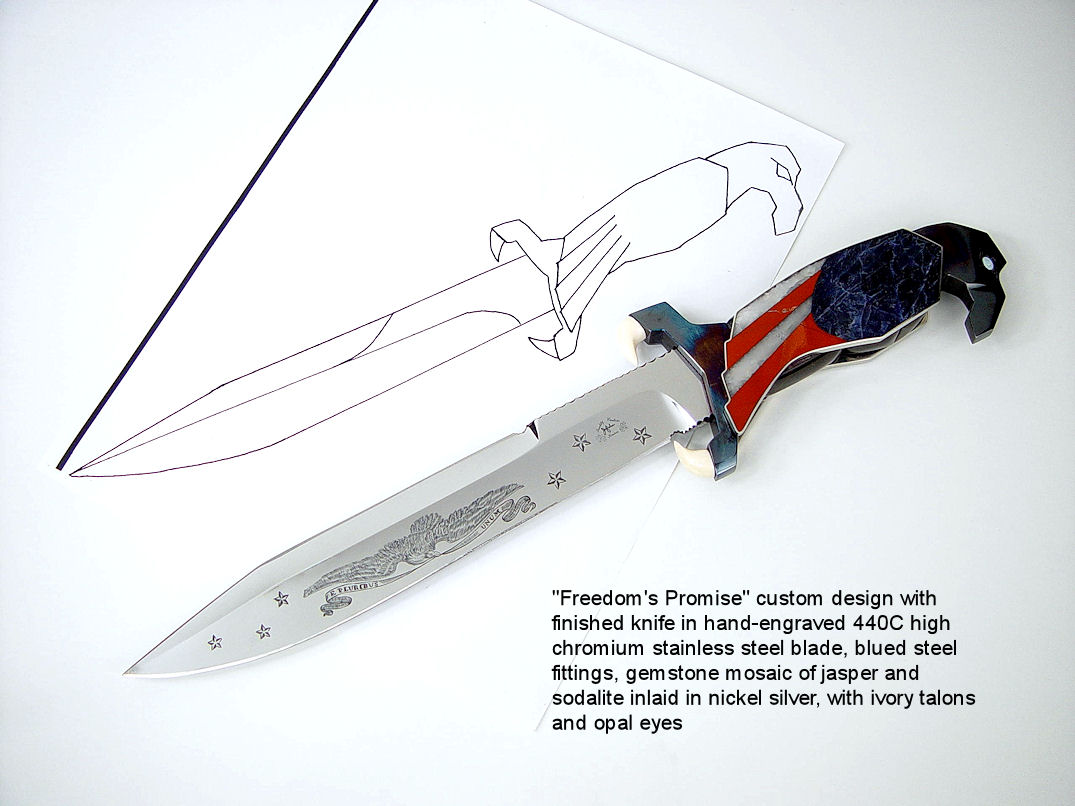
For an example, here is a picture of a knife with the original design draft. It has a hand-engraved 440C high chromium, mirror polished hollow ground stainless steel blade, hand-engraved with a custom design, and the handle is sculpted and has an inlaid blued steel pommel and guard, a mosaic inlayed gemstone handle, with guard inlays of carved ivory and pommel inlays of solid opals.
More about "Freedom's Promise"
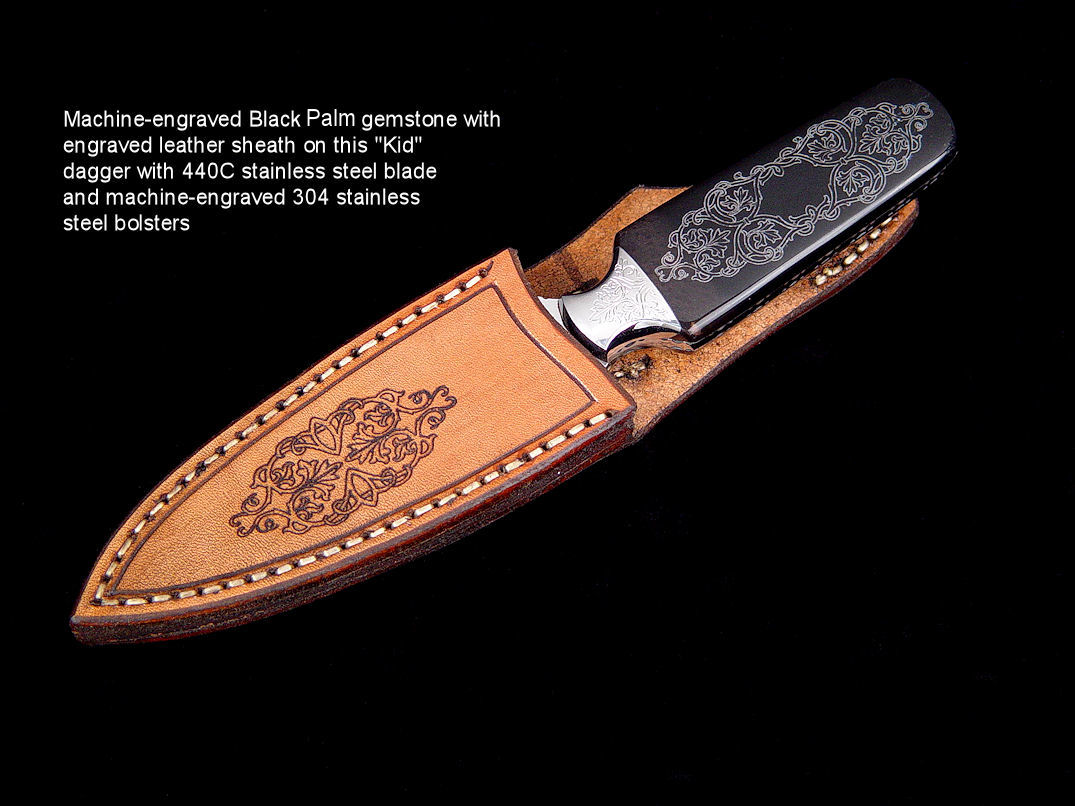
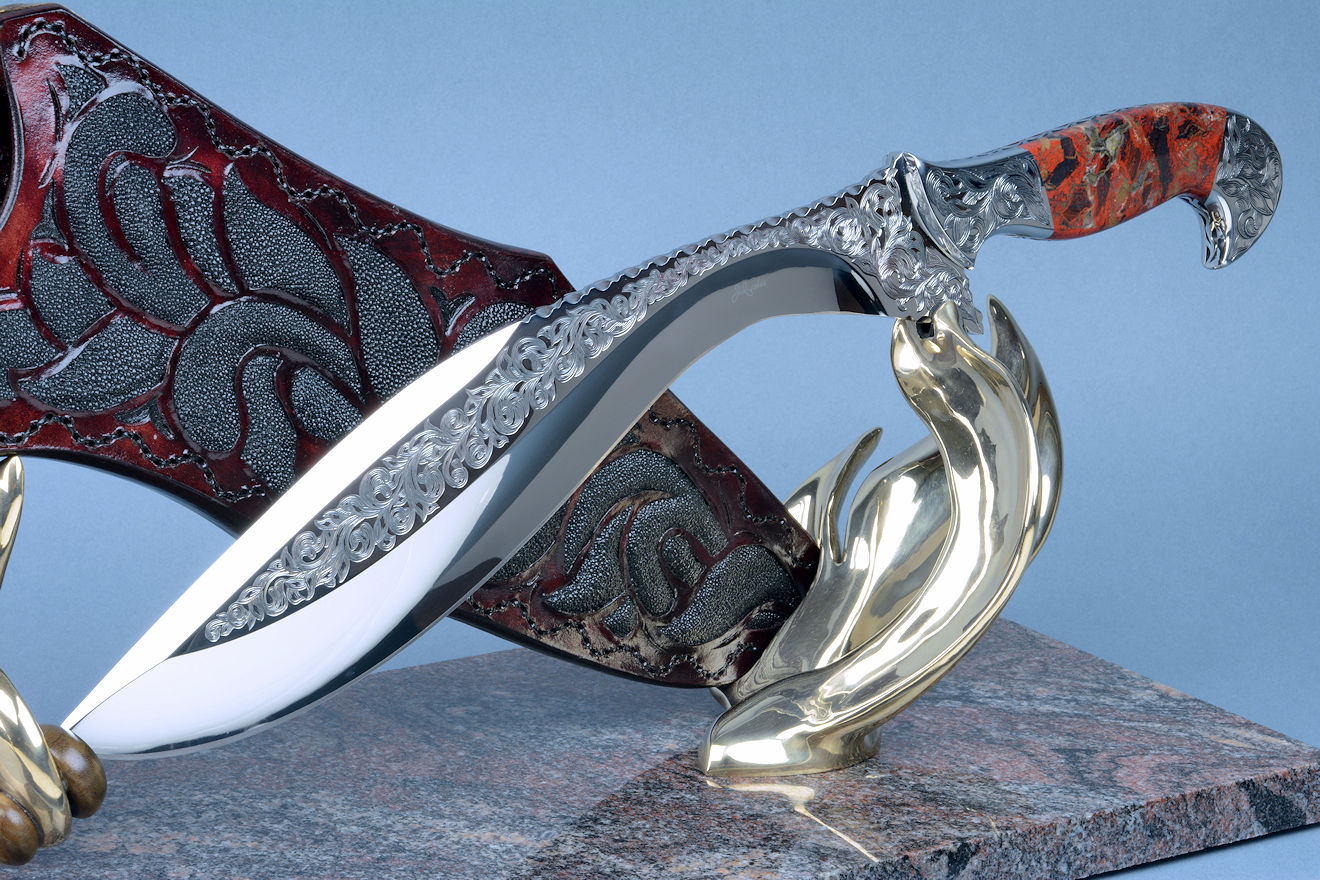
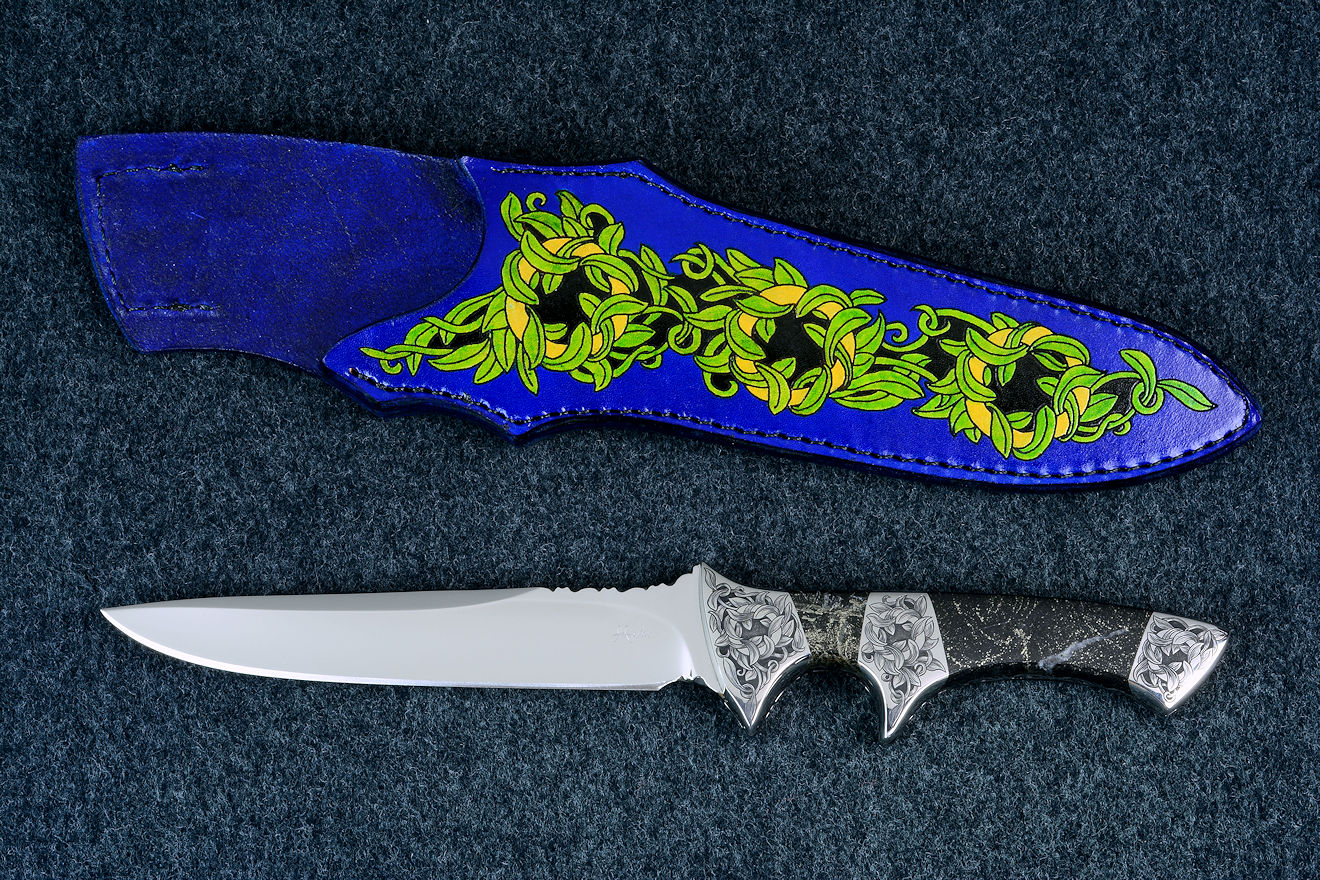
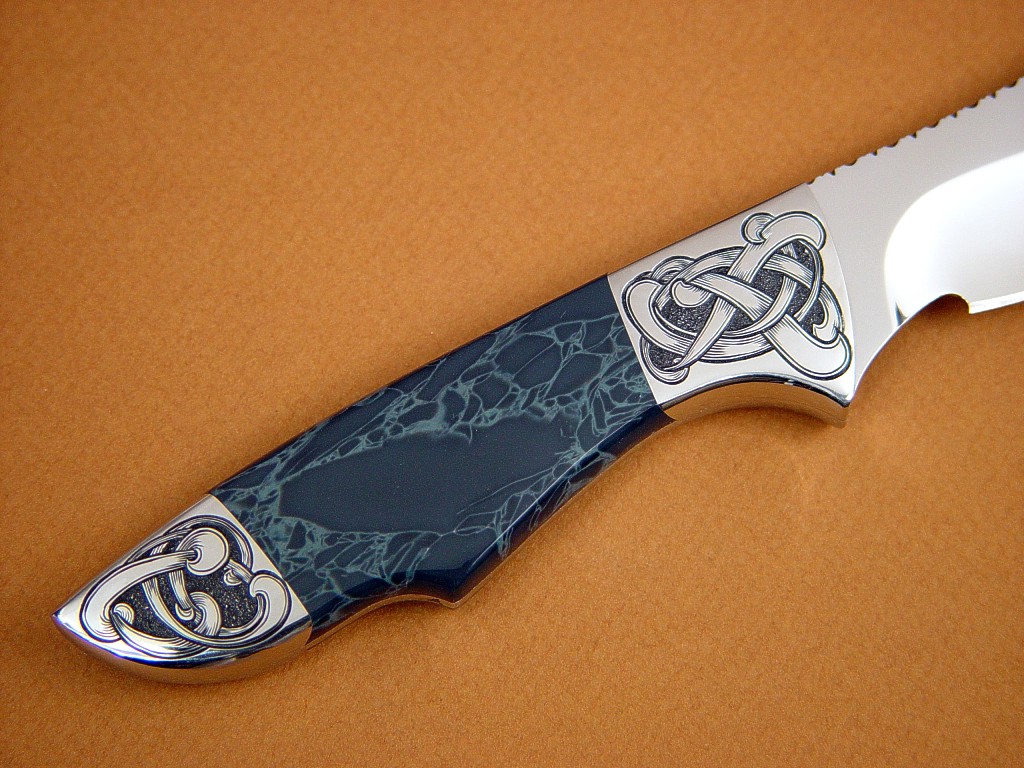
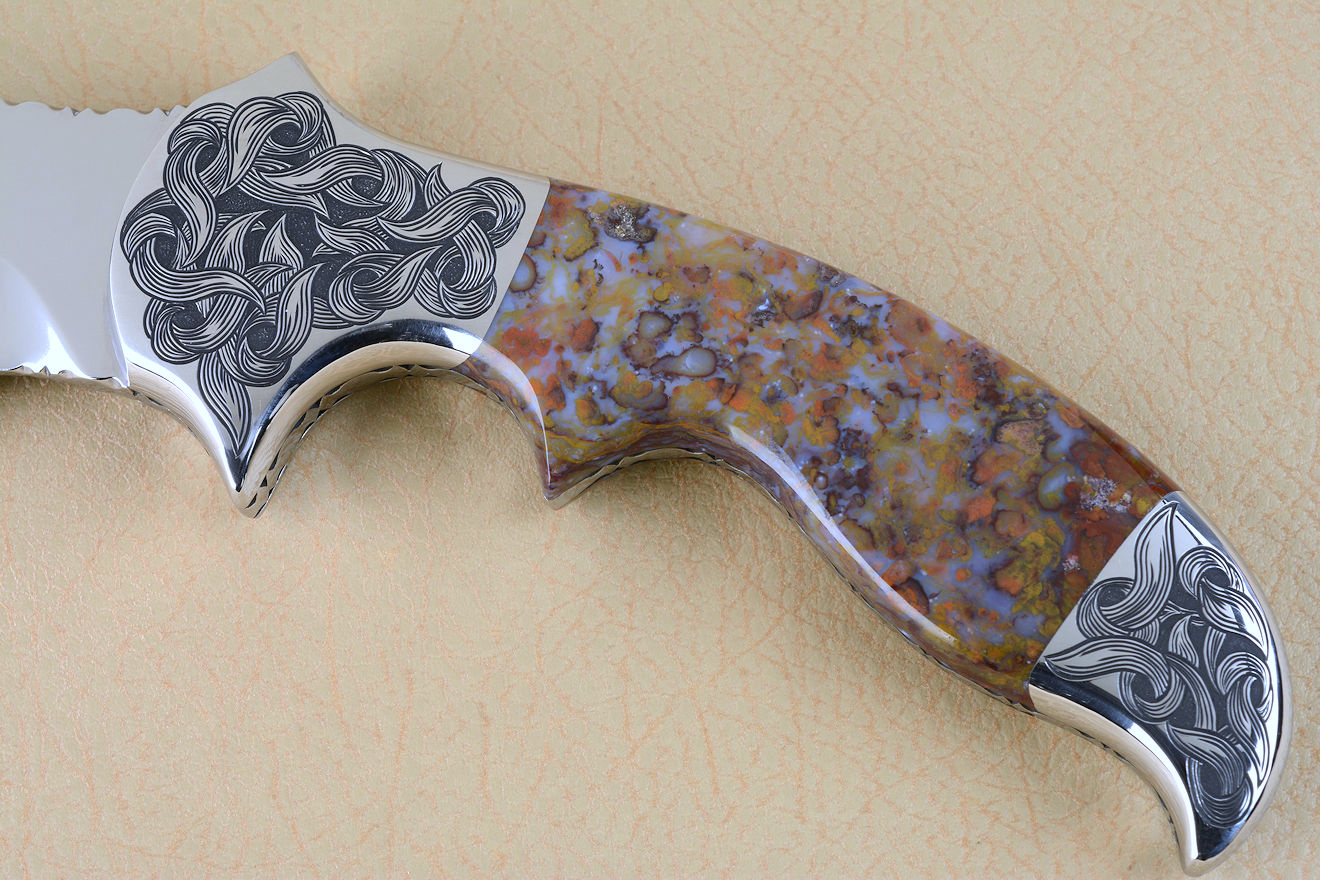
Here is a picture of a knife that has machine-engraved 304 stainless steel bolsters, matching engraved leather sheath, and a matching engraved Petrified Palm Wood Gemstone handle. The design is Victorian, and the gemstone engraving was cut with a fine diamond stylus into the hard jasper gemstone.
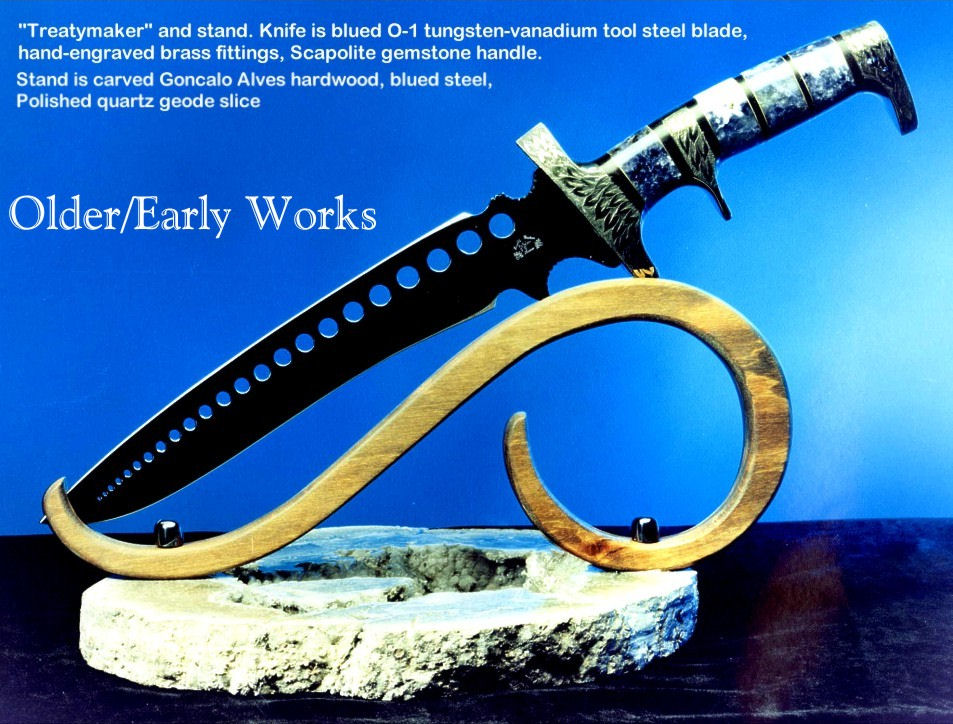
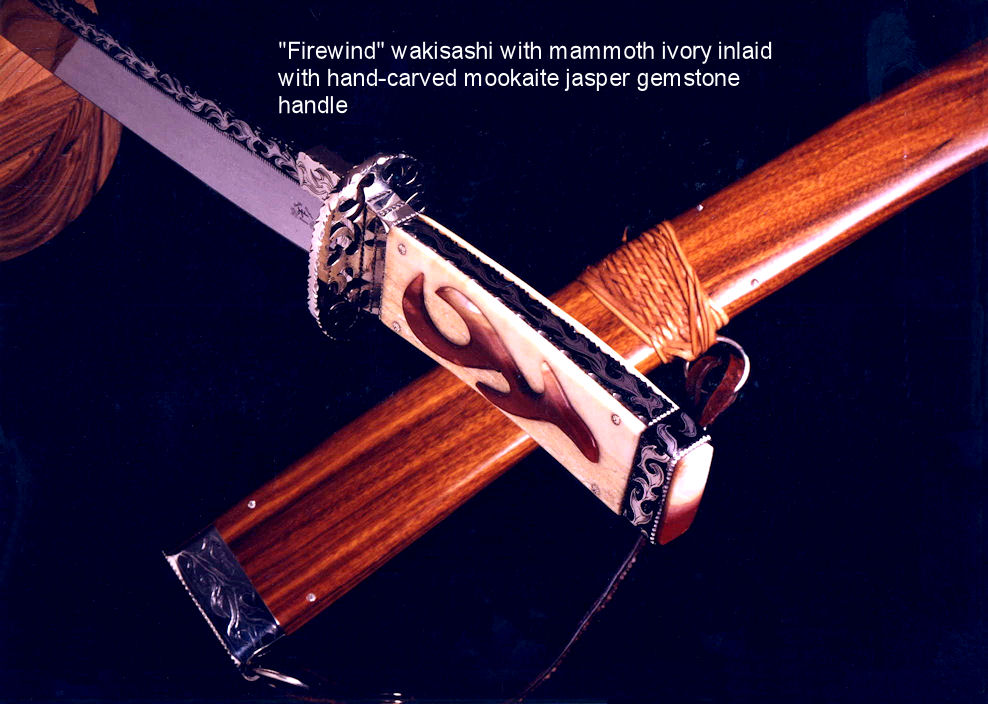
This older/early work is a wakishi short sword with hand-engraving throughout, including on the nickel silver tsuba and habaki, as well as the 304 stainless steel frame and pommel. The handles are floating mounted Mammoth ivory inlaid with hand-carved Mookaite Jasper gemstone flames. The pommel is inlaid with the same Mookaite Jasper. The engraved pattern continues on the sheath chape mouthpiece and chape tail (not shown) on the hard scabbard that is made of Canary wood (Arririba) hardwood.
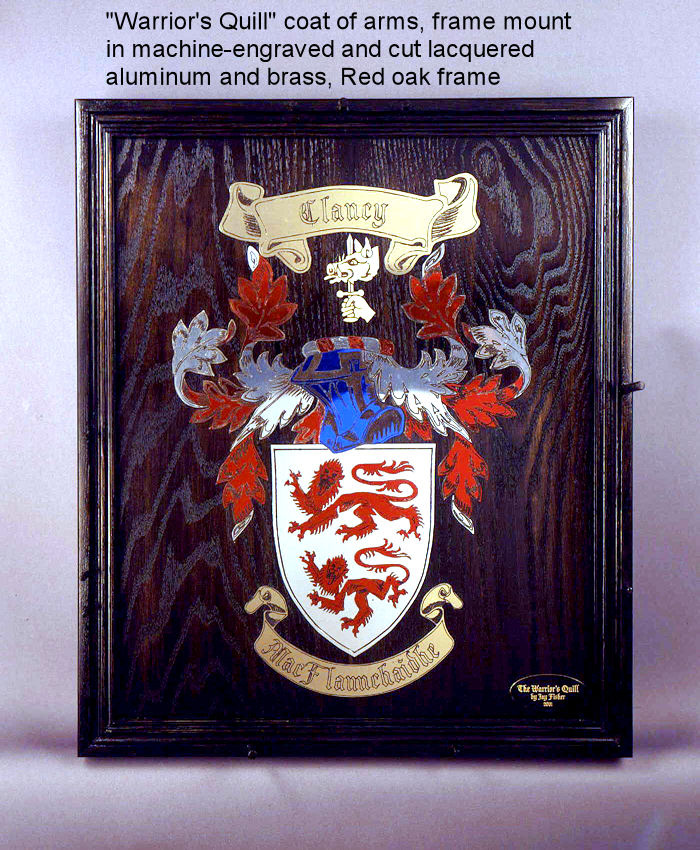
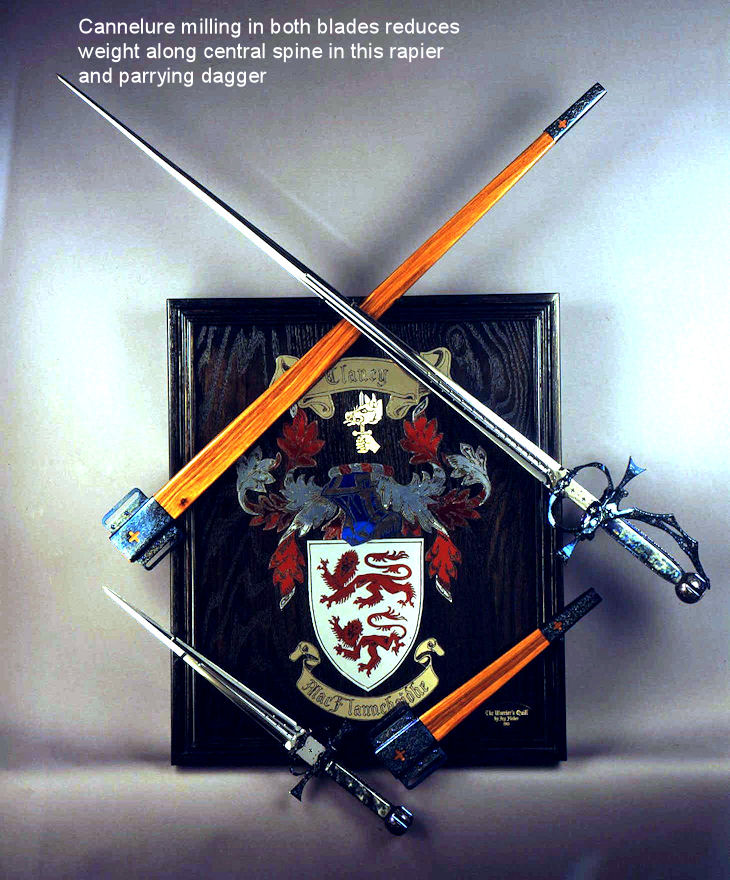
This is the backboard, frame and holder for the "Warrior's Quill rapier and parrying dagger.Coat of arms is made of and embellished with machine cut and engraved anodized aluminum and lacquered brass in a handmade and custom mosaic on an antiqued red oak handmade frame. The backboard which holds the sword is an independent work of handmade custom art.
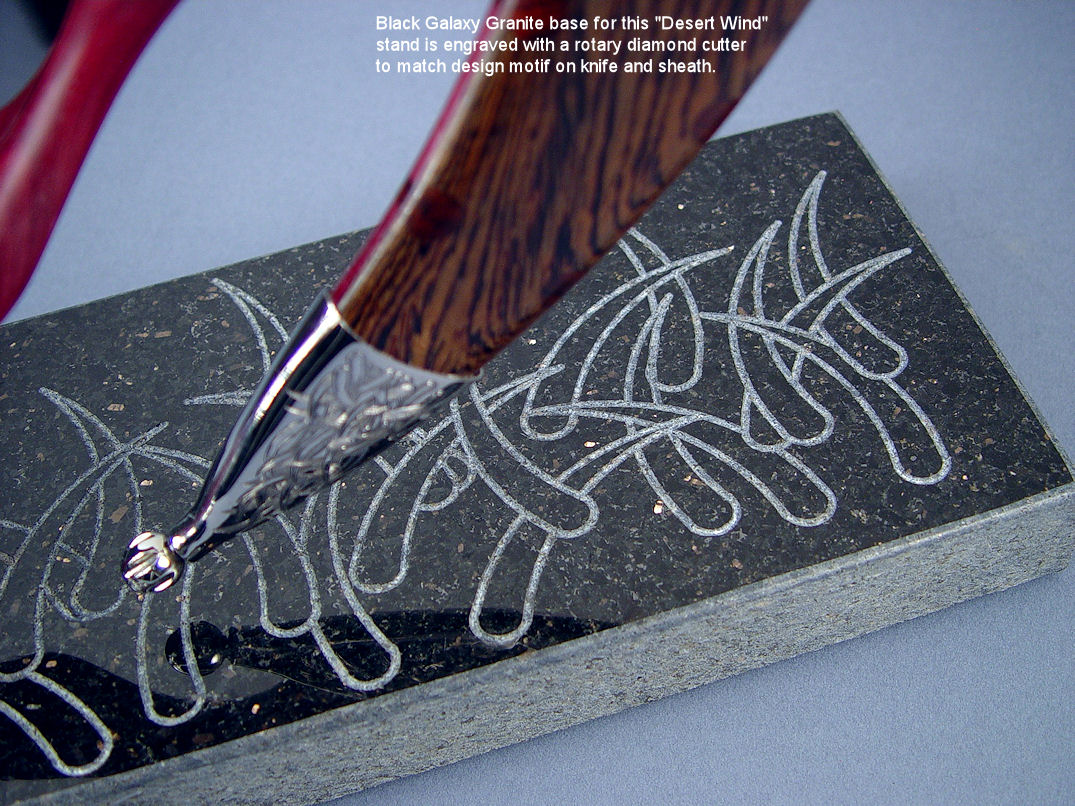
This is the base of the stand for "Desert Wind" Persian Dagger, with a 440C high chromium stainless steel blade, hand-engraved 304 stainless steel bolsters, Mossy Nephrite Jade gemstone handle, stainless steel engraved sheath, Wenge, Cocobolo, Purpleheart hardwoods, with custom display stand. The stand base shown in this detail is Black Galaxy Granite from India, with a machine-engraved pattern that matches the engraving on the knife bolsters and the stainless steel sheath chape. It is the same geometrical curve of the blade, repeated.
More about this Desert Wind
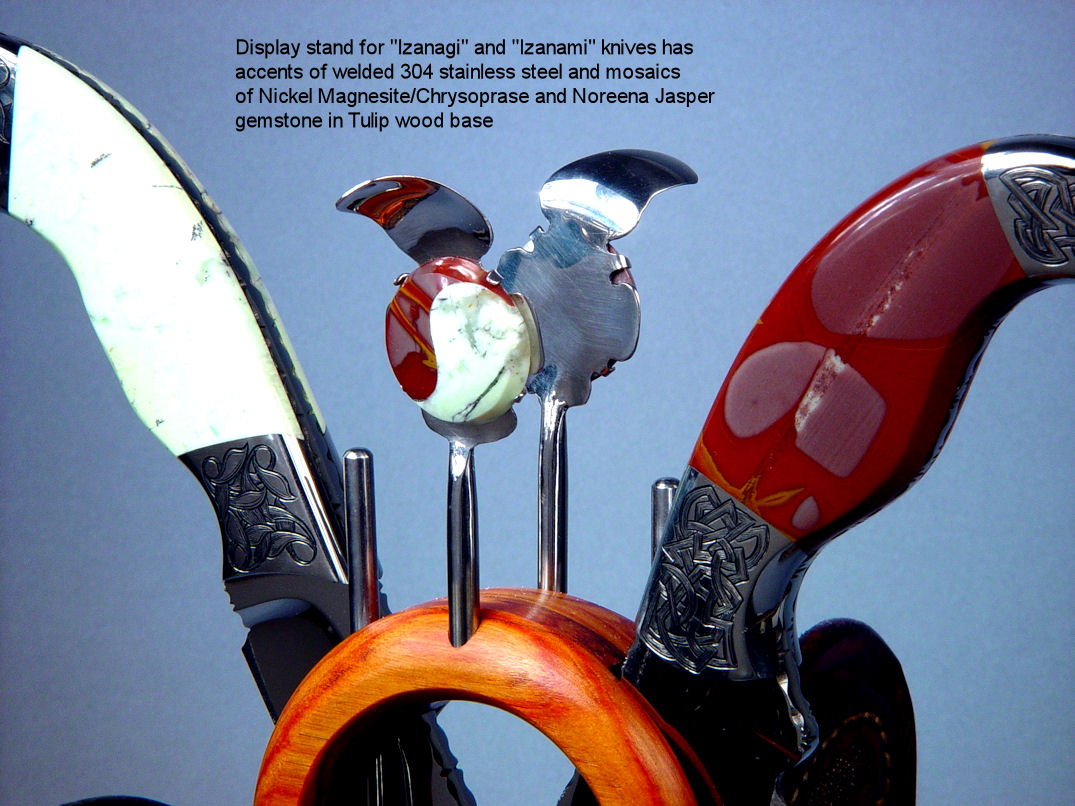
Here's some detail of the display stand for the pair of knives: Izanagi and Izanami. The hand-carved tulipwood components are fitted specifically to the knives and sheaths, the continuing theme of polished 304 high nickel, high chromium austenitic stainless steel runs throughout. The accents between the gemstone handles are hand-carved mosaics made of the same gemstone as the handles: Noreena Jasper and Nickel Magnesite/Chrysoprase. All of the stainless artistic forms are welded and shaped by hand; the piece is a representation that compliments the pair of unique, yet related knives with their theme.
More about this Izanagi/Izanami Stand
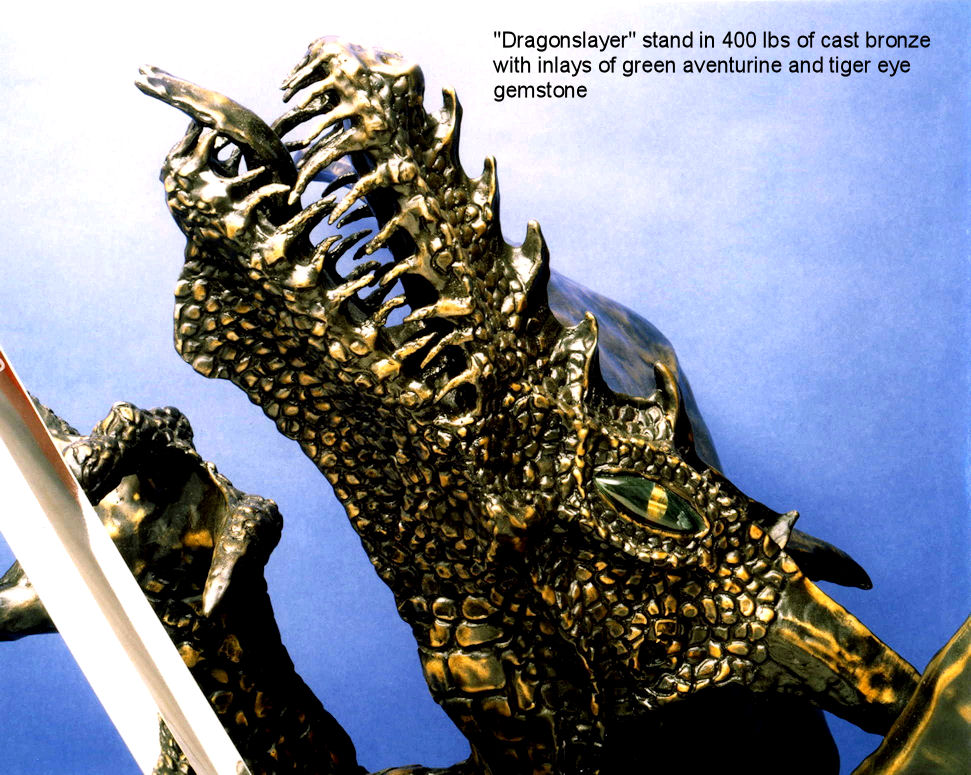
The head of my "Dragonslayer" sword sculpture is made of hand-sculpted cast bronze, cast by the lost wax process. The dragon is 400 pounds of bronze; and the eyes are inlays of gemstone mosaic of green Aventurine Quartz and Tiger Eye Crocidolite. The sculpture hold the sword and is dedicated to curing pediatric cancers. The dragon represents the "Black Dragon" of cancer, and the sword the modified caduceus of oncology.
More about Dragonslayer
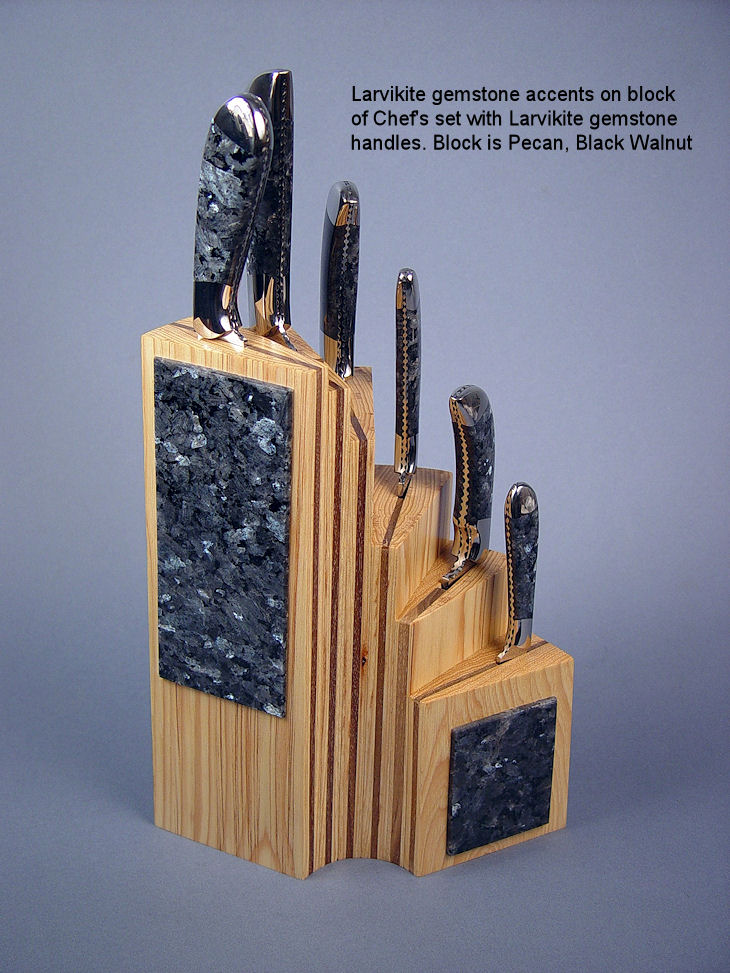
The sides of this custom handmade block for my chef's knives have panels of lapped and polished Larvikite gemstone. This embellishment blends the block to the Larvikite handles, and offers a perspective of what the larger pattern of this beautiful feldspar granite looks like in a wider scale. The granite is also very pleasing to touch, just like the handles of the knives, an important part of the knife experience.
More about this Chef's Set
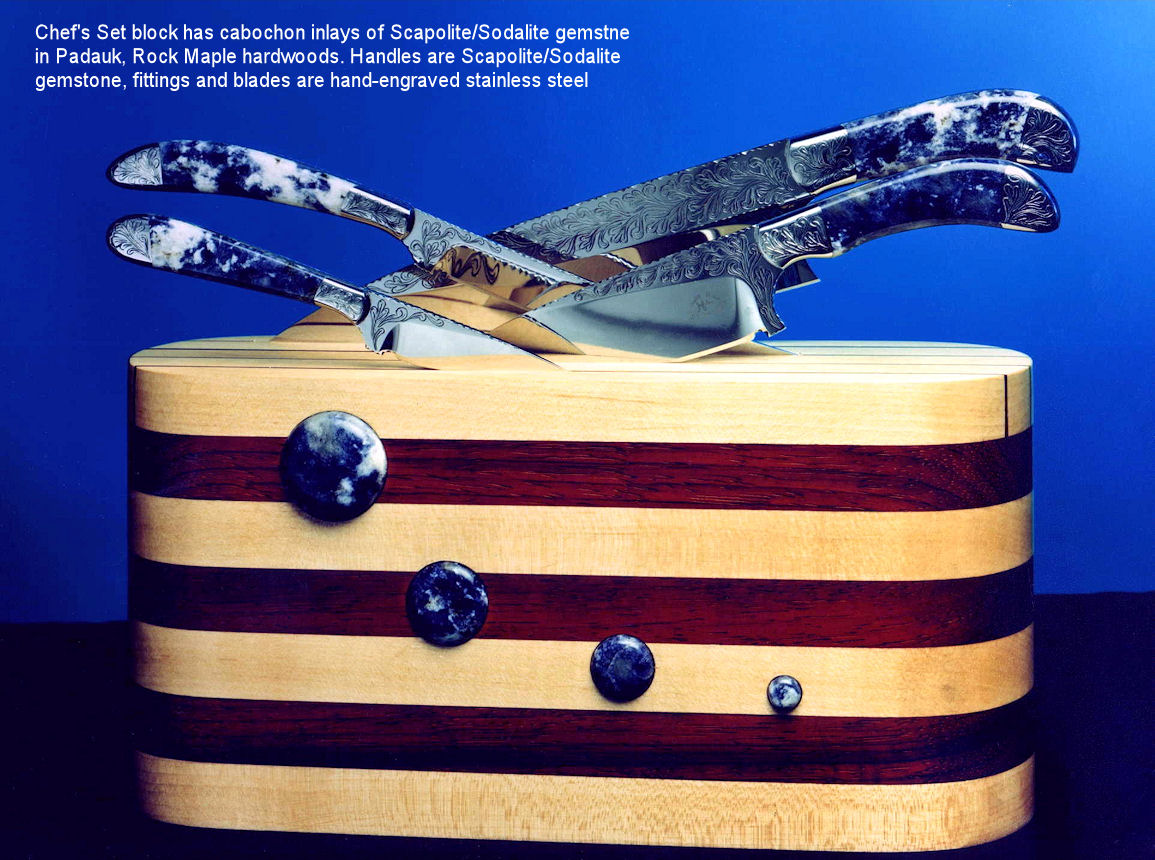
This Older/Early Chef's set has unusual handles made of Scapolite/Sodalite gemstone. This gem is florescent, that is, it's scapolite components glow bright yellow under a high ultraviolet light source (a black light). The gemstone is represented on the block in inlaid polished cabochons of Scapolite/Sodalite in graduated sizes just as the knives graduate in size on the block. The block woods are Padauk and Rock (hard) Maple hardwoods.
More about this Chef's Set
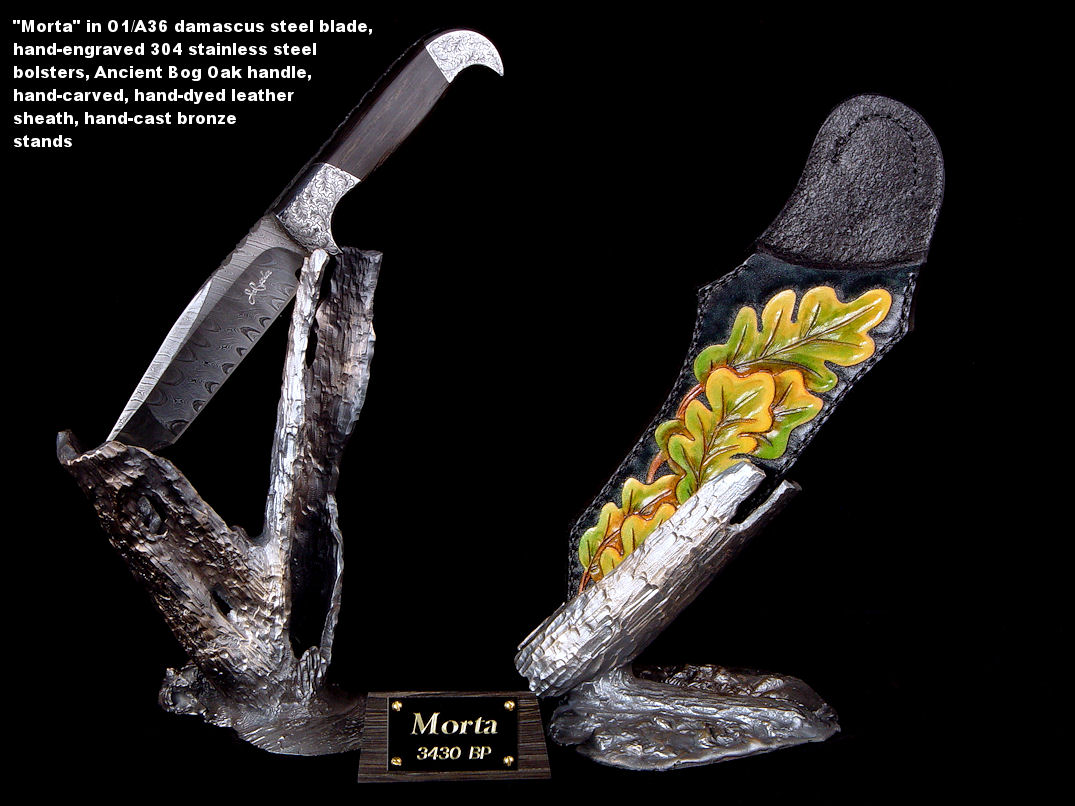
This beautiful knife design and elements are based on the bog oak handle that is over 3400 years old. The stands for the knife and sheath are made of hand-cast bronze, made by lost wax carving and process. They represent old oak trees trapped in a bog, and are each nearly three pounds of bronze. The design becomes a complete package, with the stands and nameplate of bog oak a continuing theme of the piece.
More about Morta
Below are a group of thumbnail photos with examples of other embellishment that is non just reserved for the knife. You'll see hand-carved stand components, mosaics, inlays, and unique applications of artwork and knife embellishment.
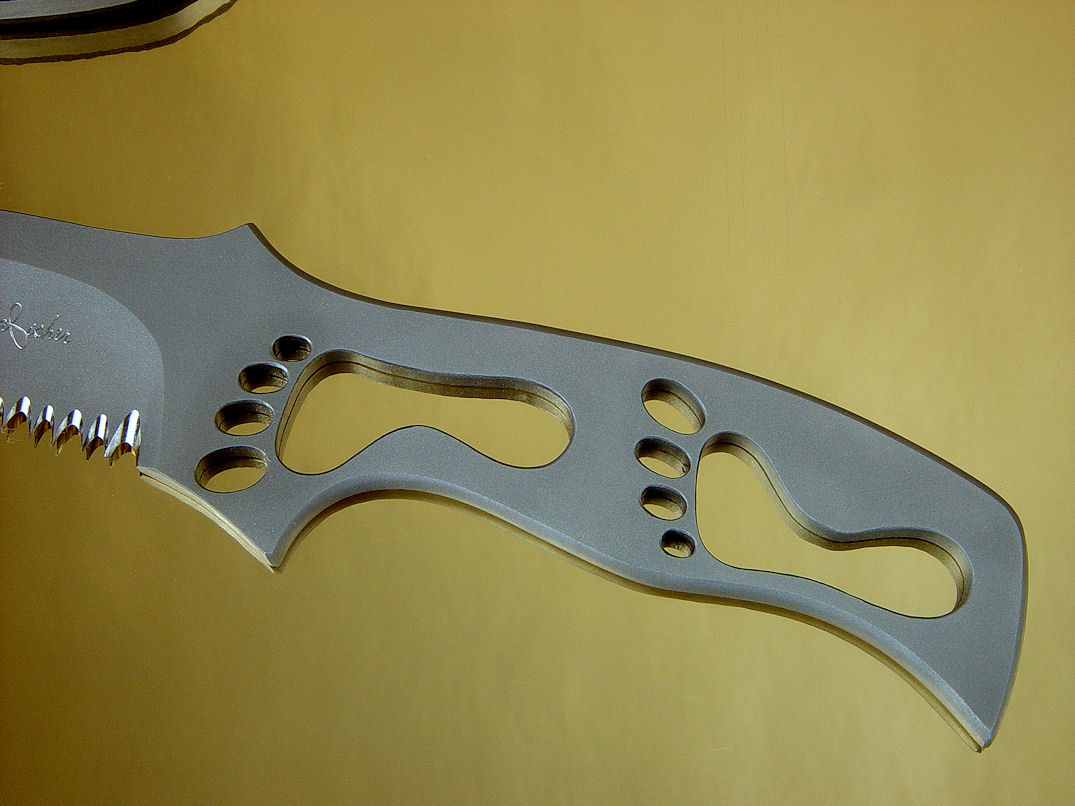
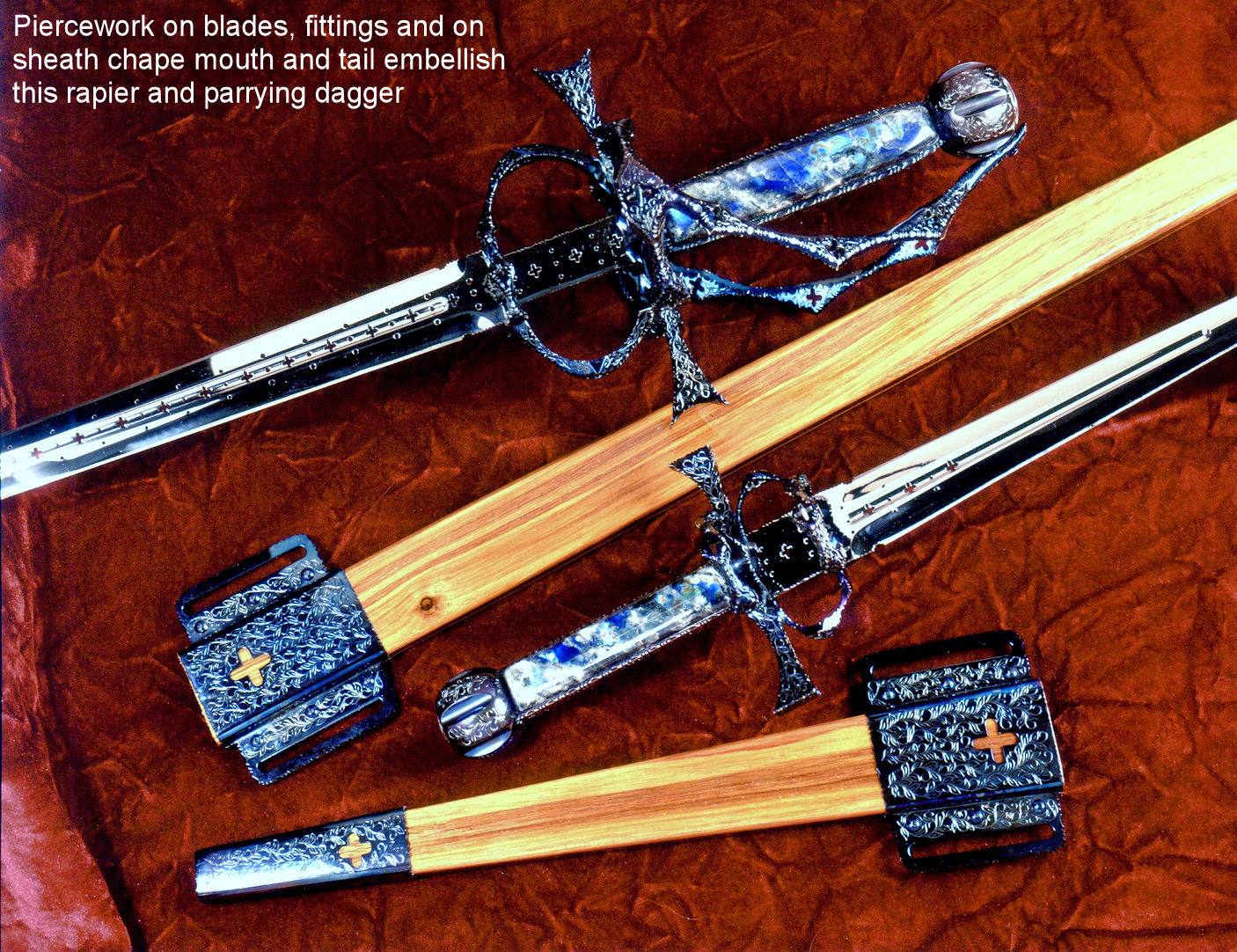
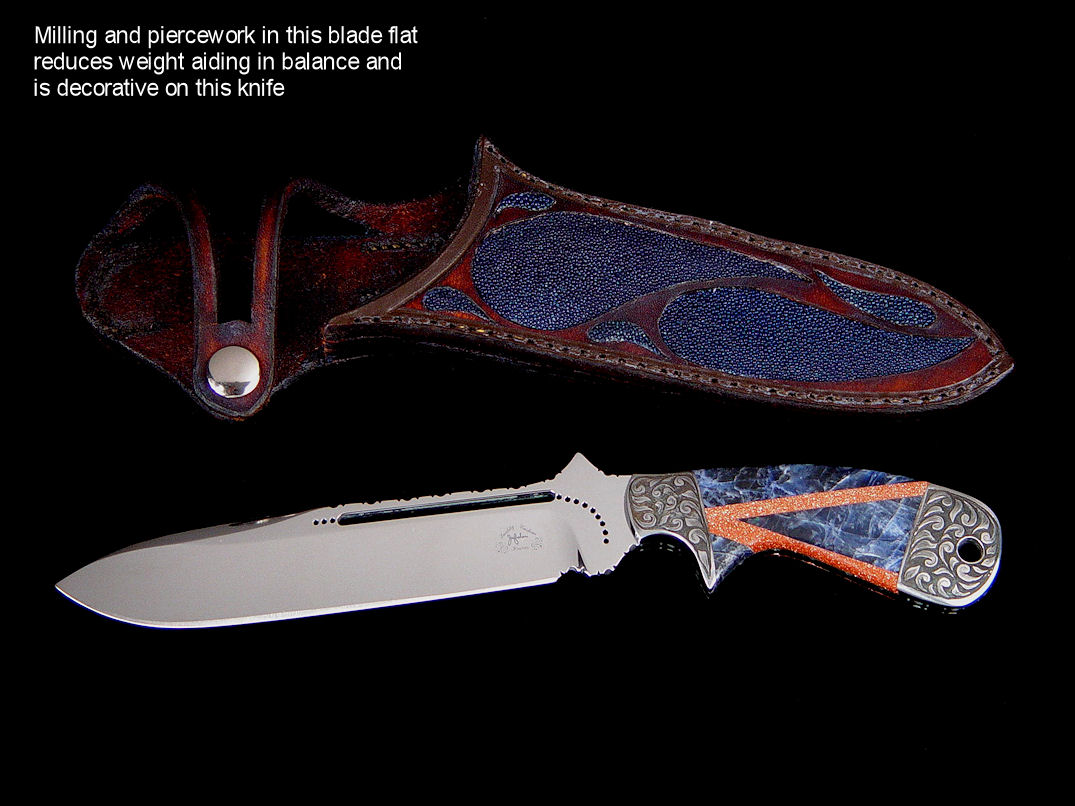
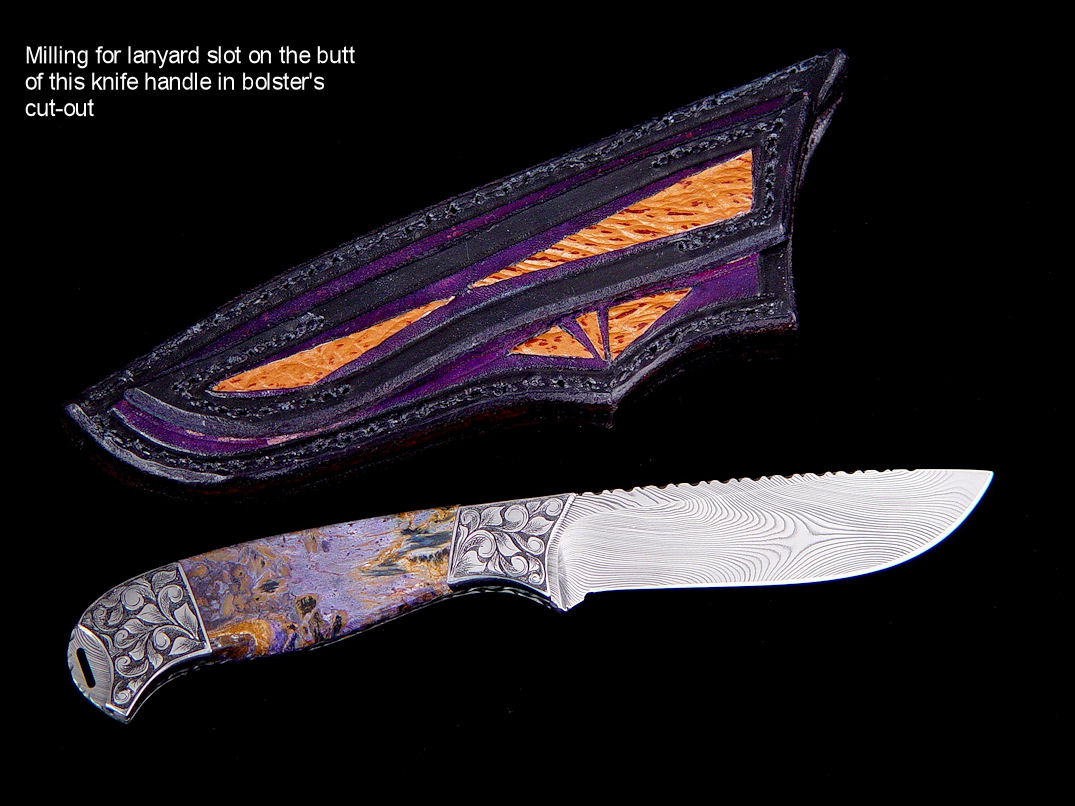
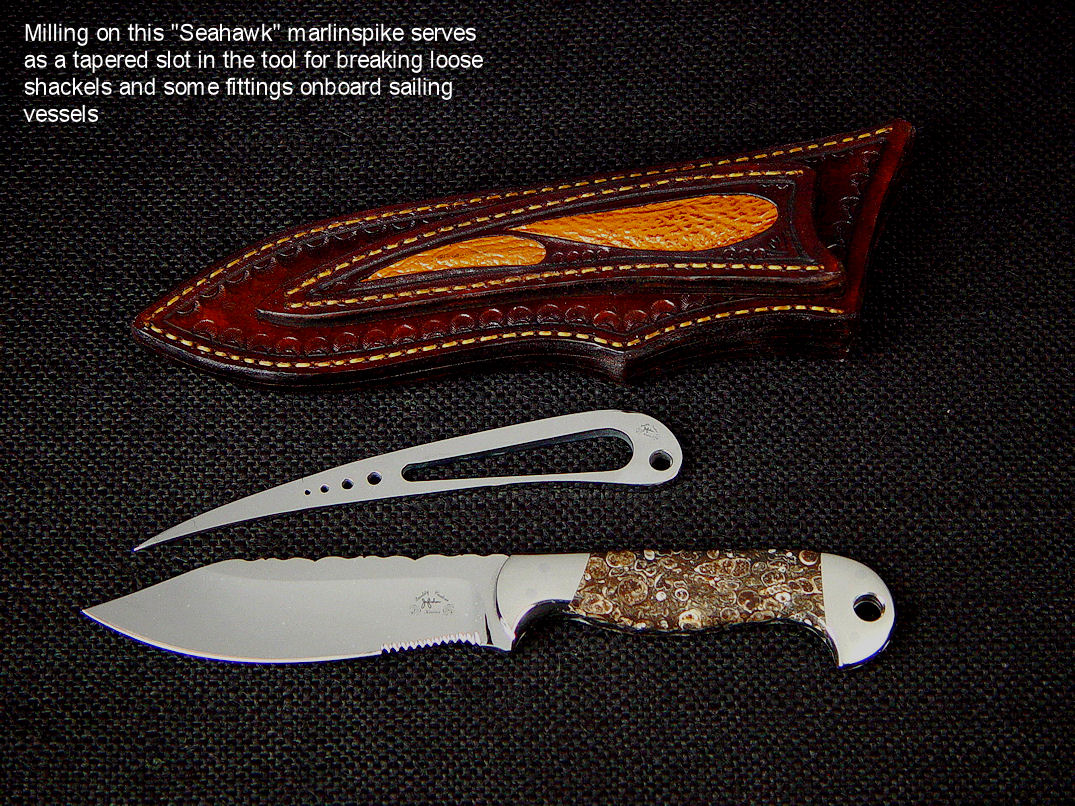
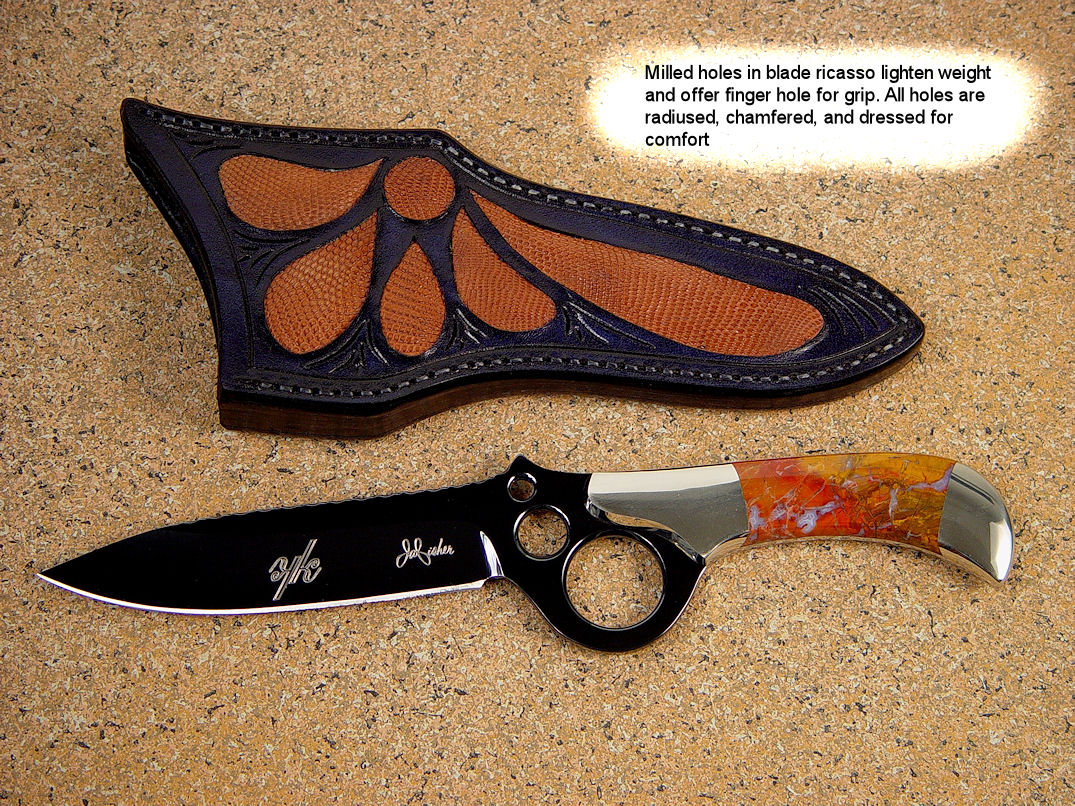
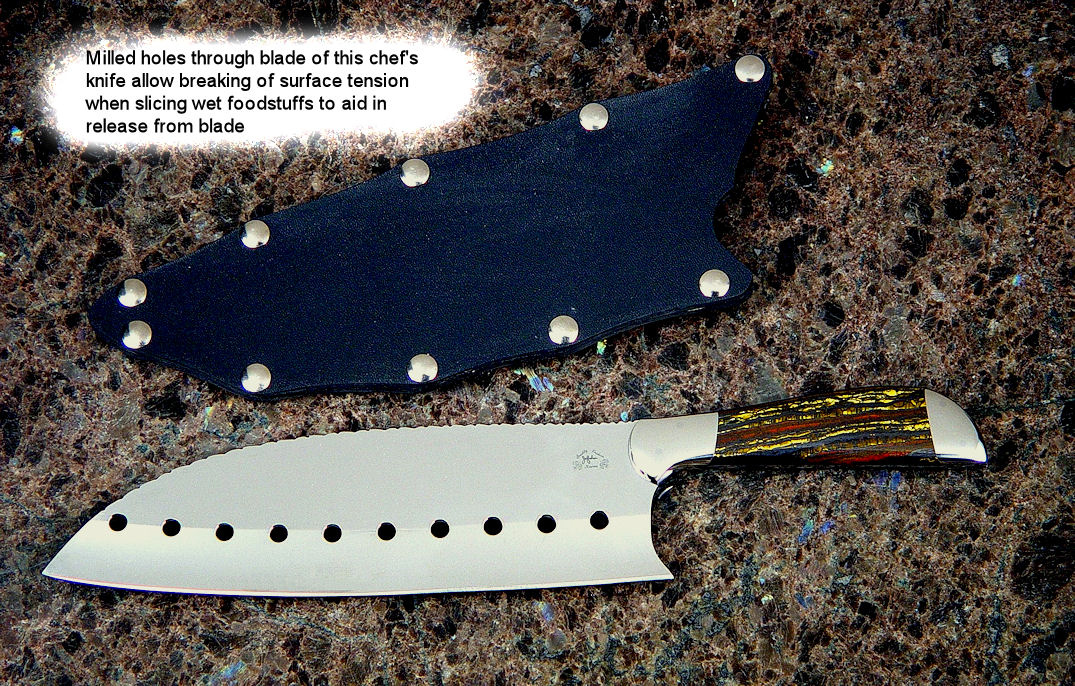
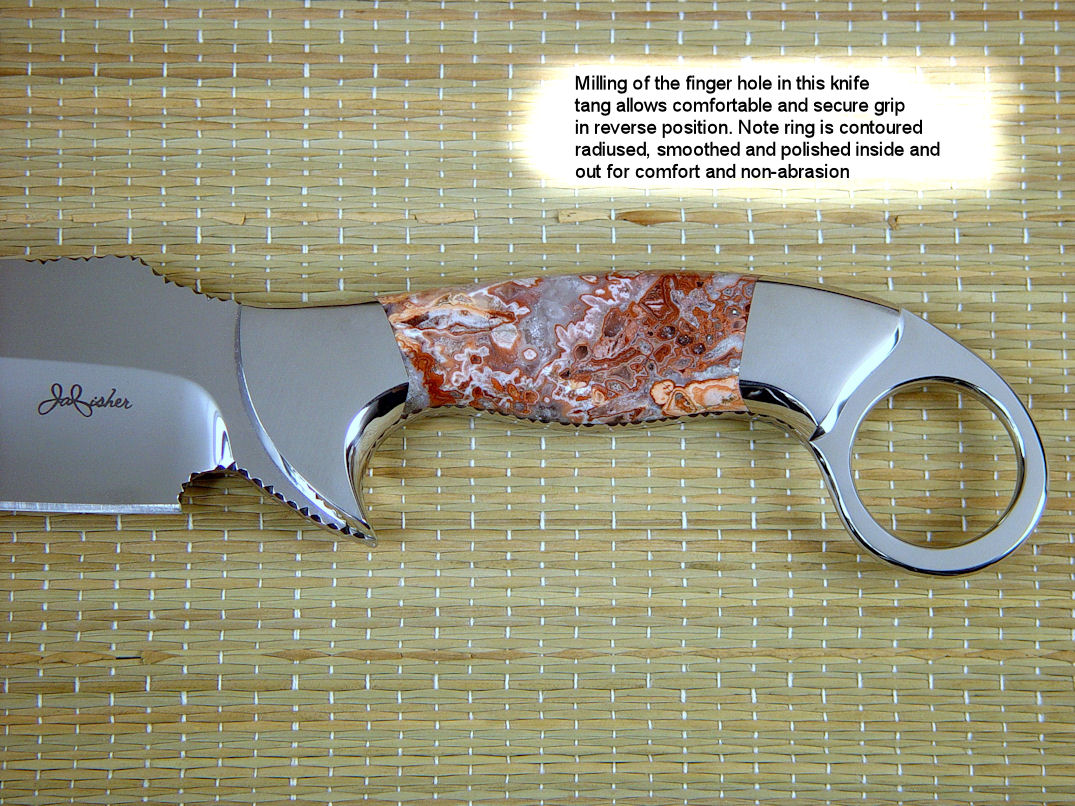
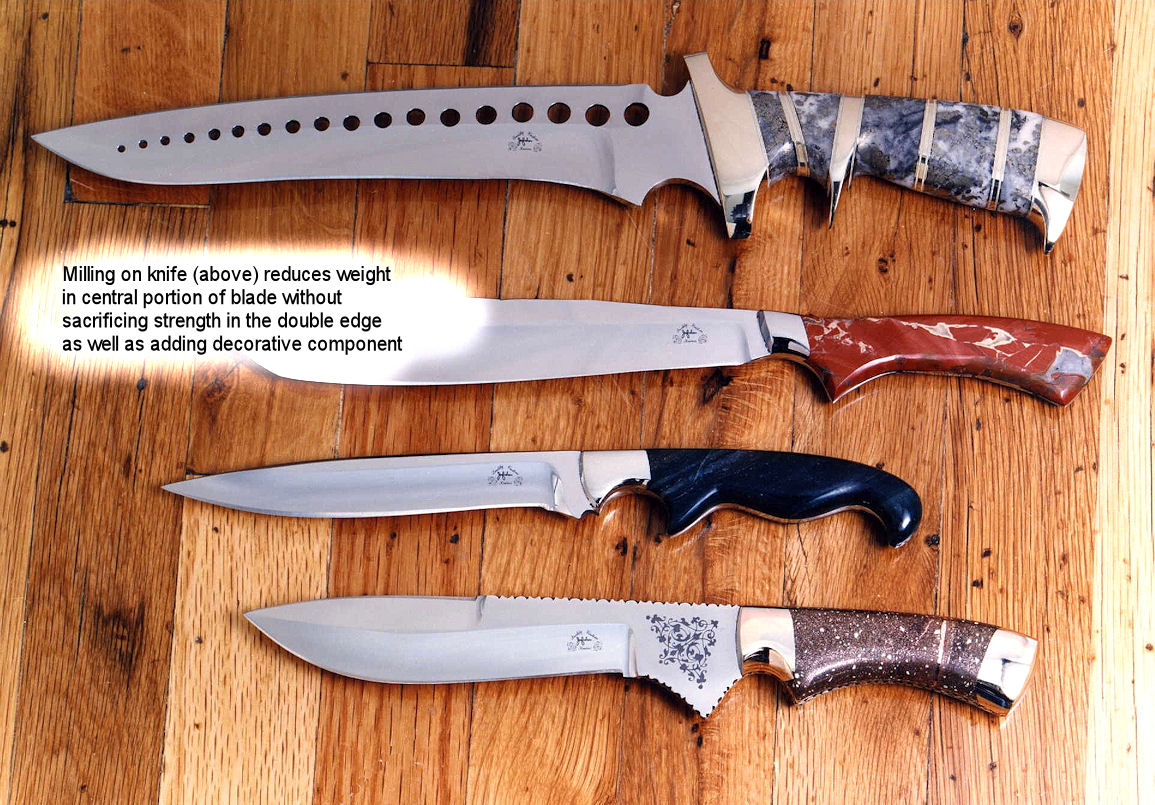
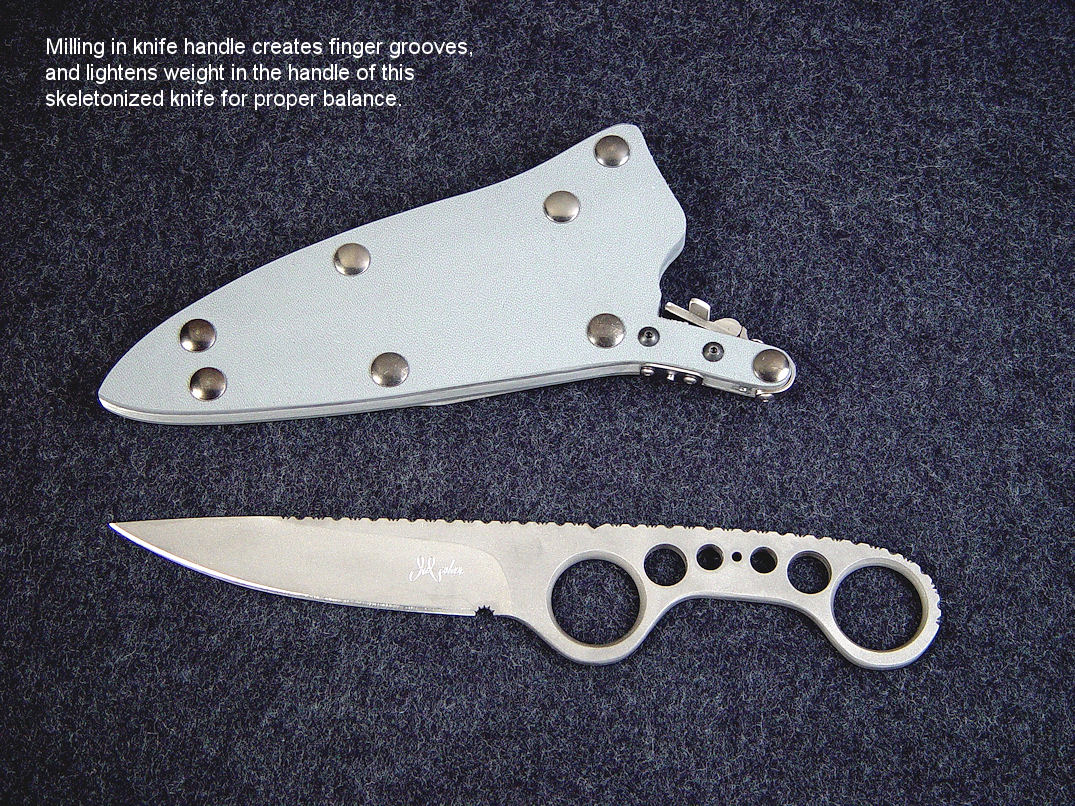
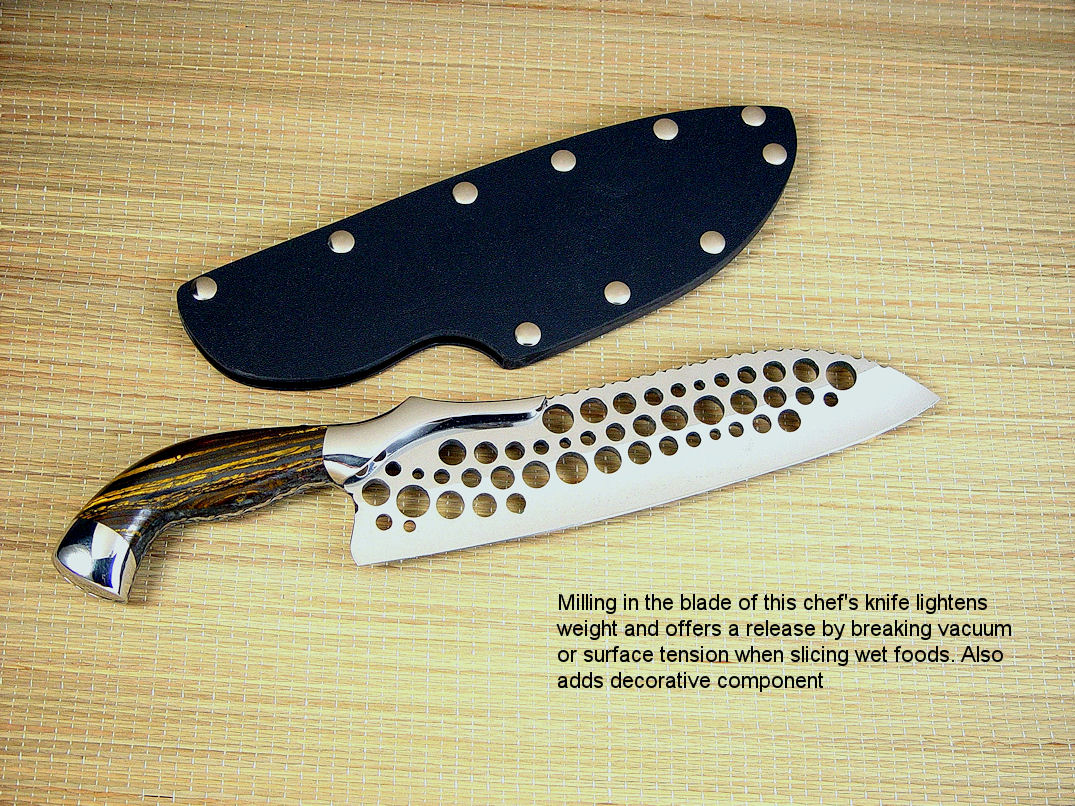
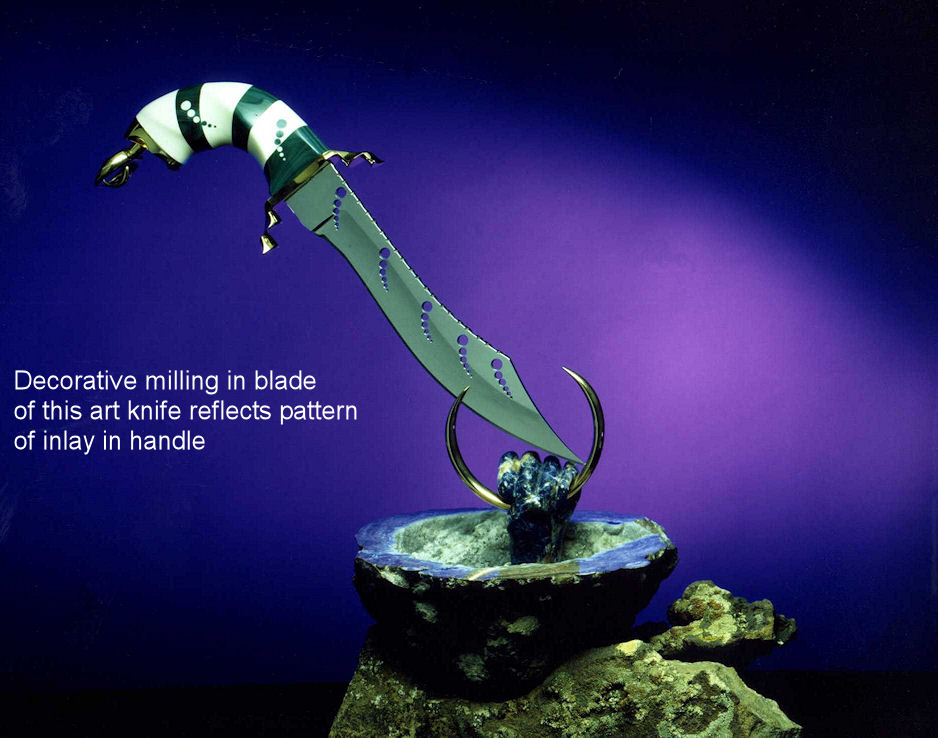
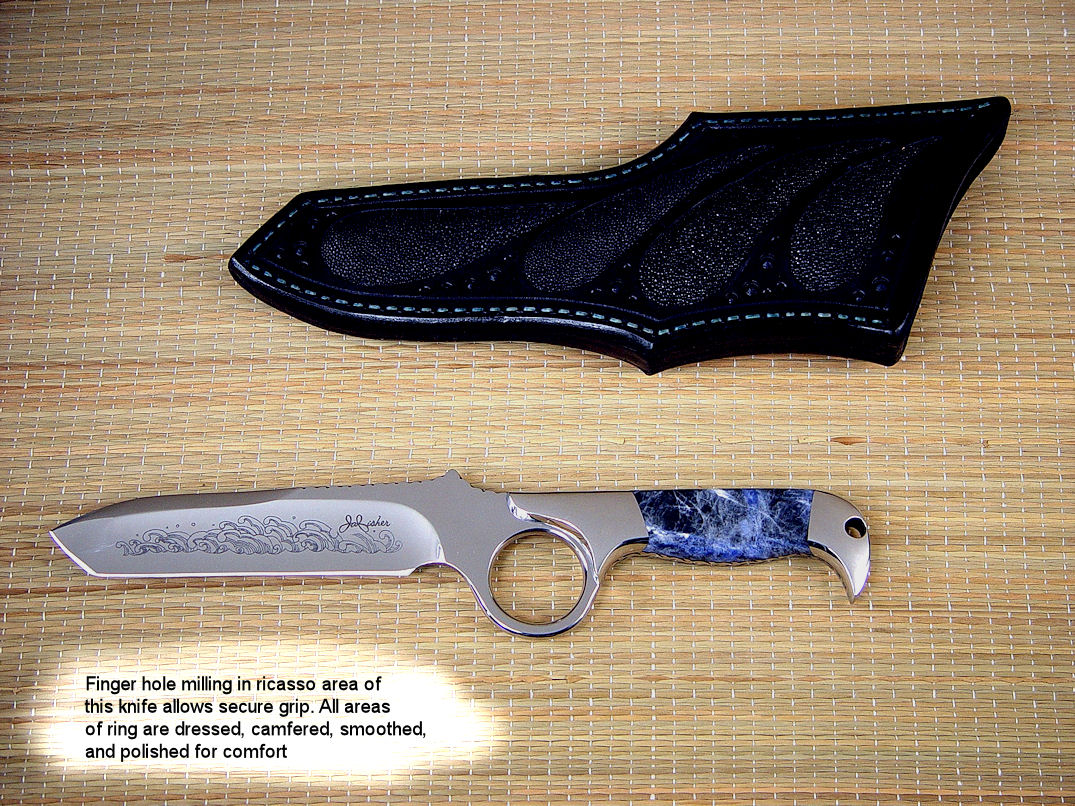
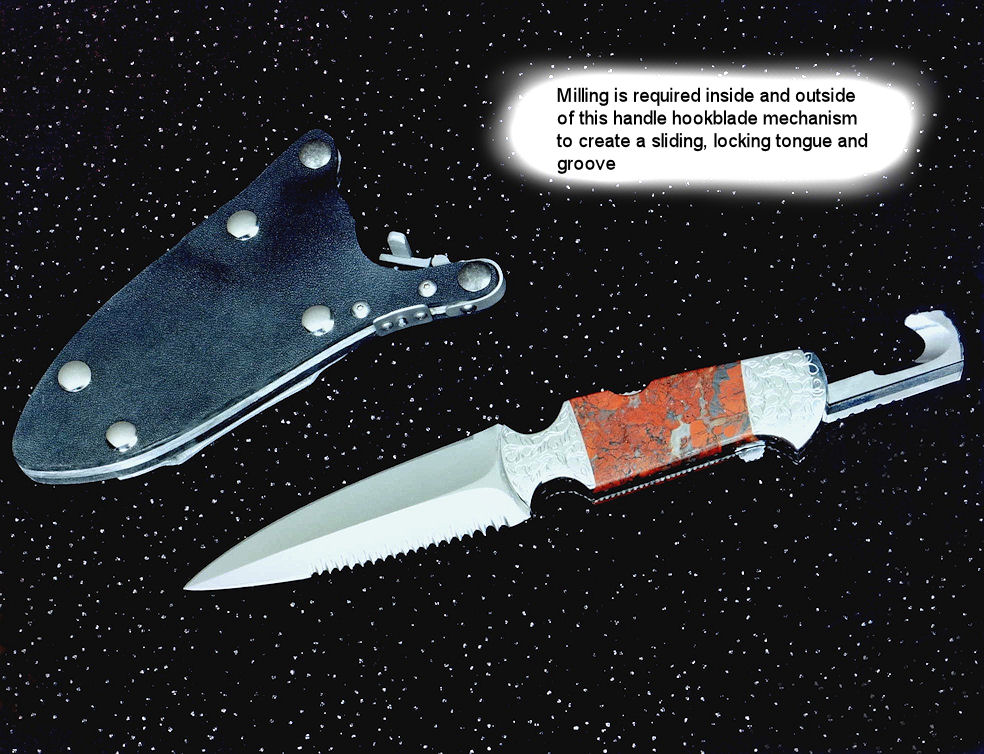
Millwork refers to any cuts on or through the blade that is done by milling, which also includes drilling holes in blades, bolsters or handle areas of the knife. There are several reasons for this practice:
Milled slots with fileworked edges, complex crosses, waving curved designs through the blade, carving, geometric arrangements, and precision attachment holes: all these are available. In my own knives, l make sure the milled angles, corners, edges, and shapes do not cause stress risers in the tool steel, which is another reason I heat treat my own blades.
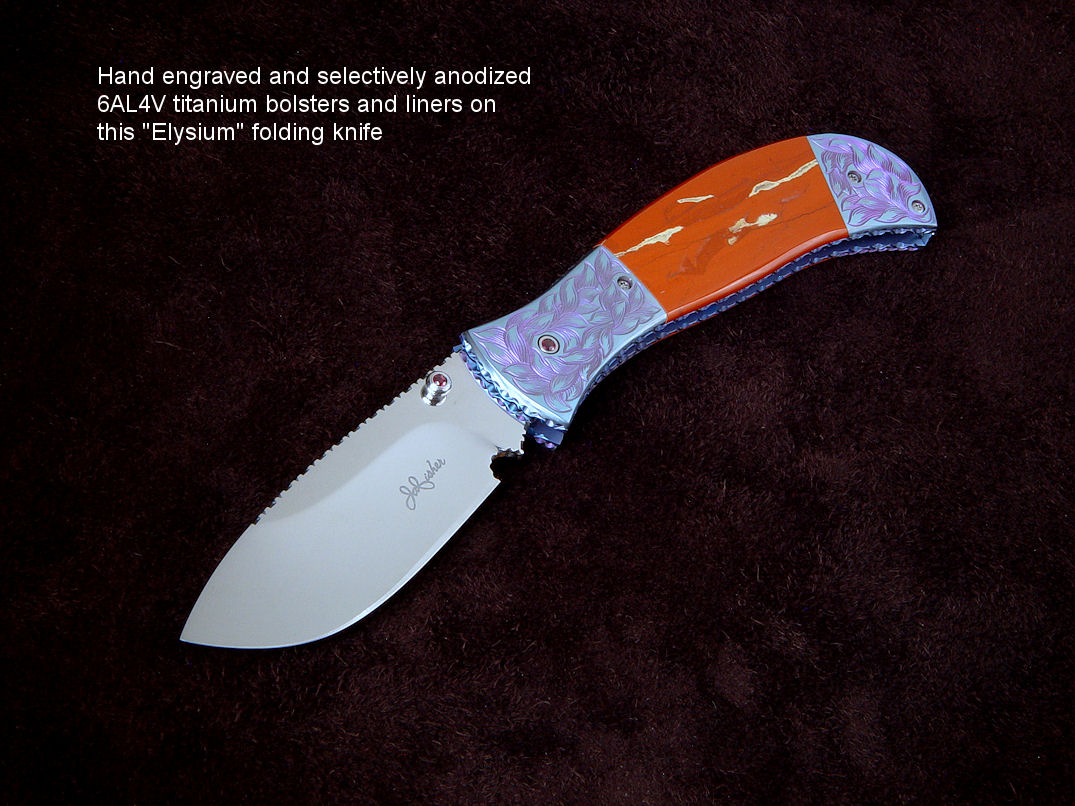
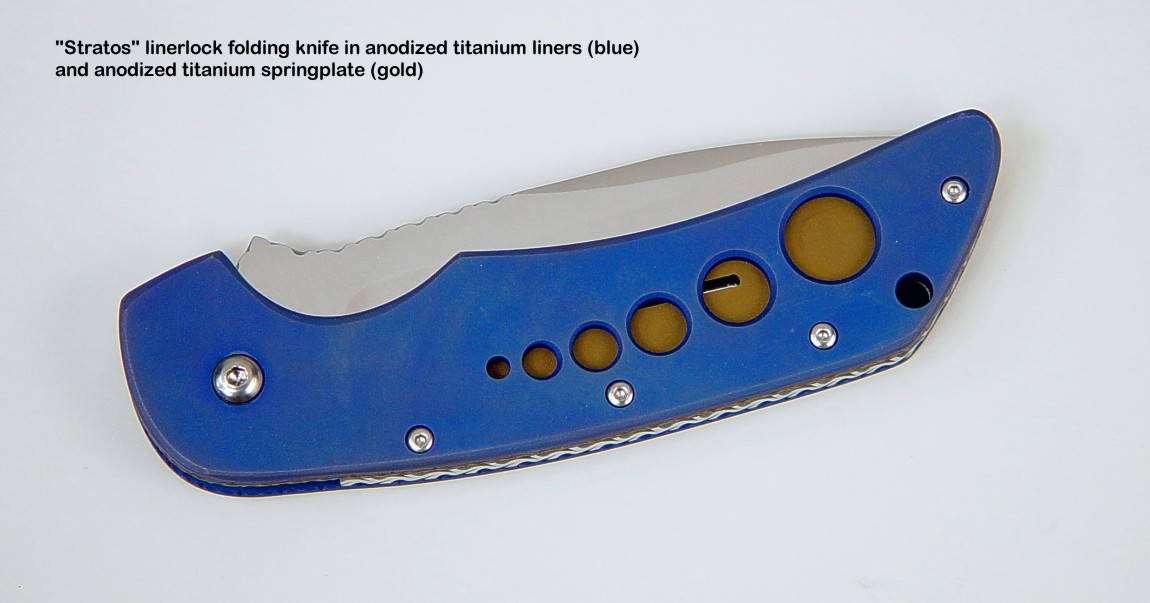
I mainly use titanium in my folding knives for springs and liners and sometimes handles. These are the necessary parts that support the scales, bolsters, and pivots while locking the blade. Titanium is used because it is strong, lightweight, and springy: essential when the handle of a folding knife must be larger than the blade in order for the blade to fit inside it and spring tension must be used to secure the blade open and closed. Titanium is not a hard or wear resistant metal; its advantage is that it is lightweight, tough, springy, and non-corrosive. It supports fine filework, and accommodates threads and milling well.
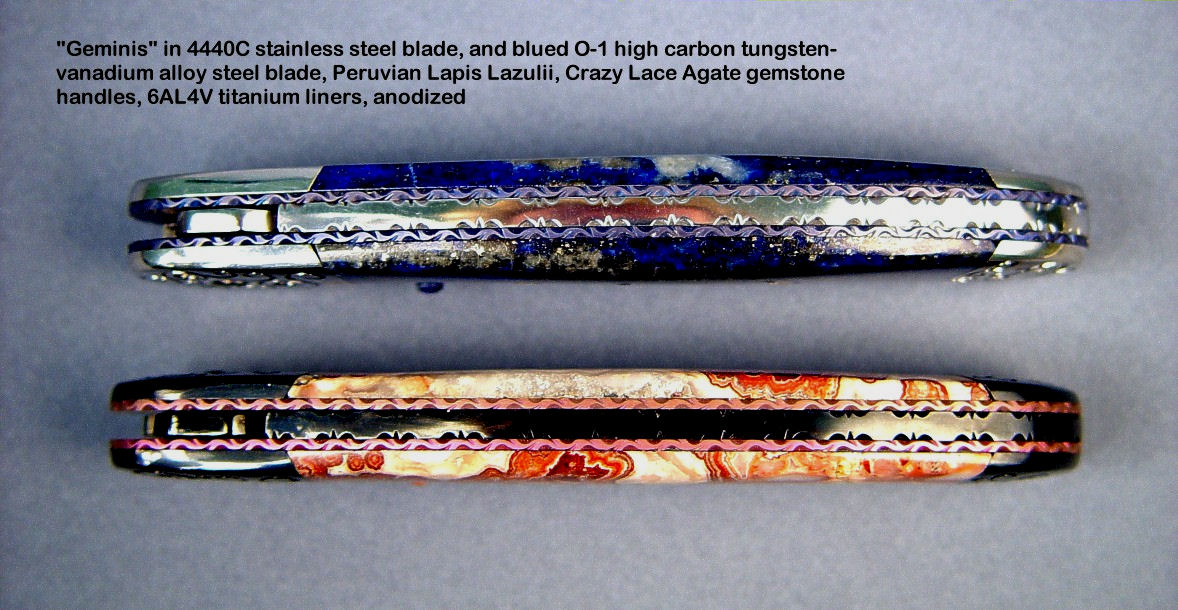
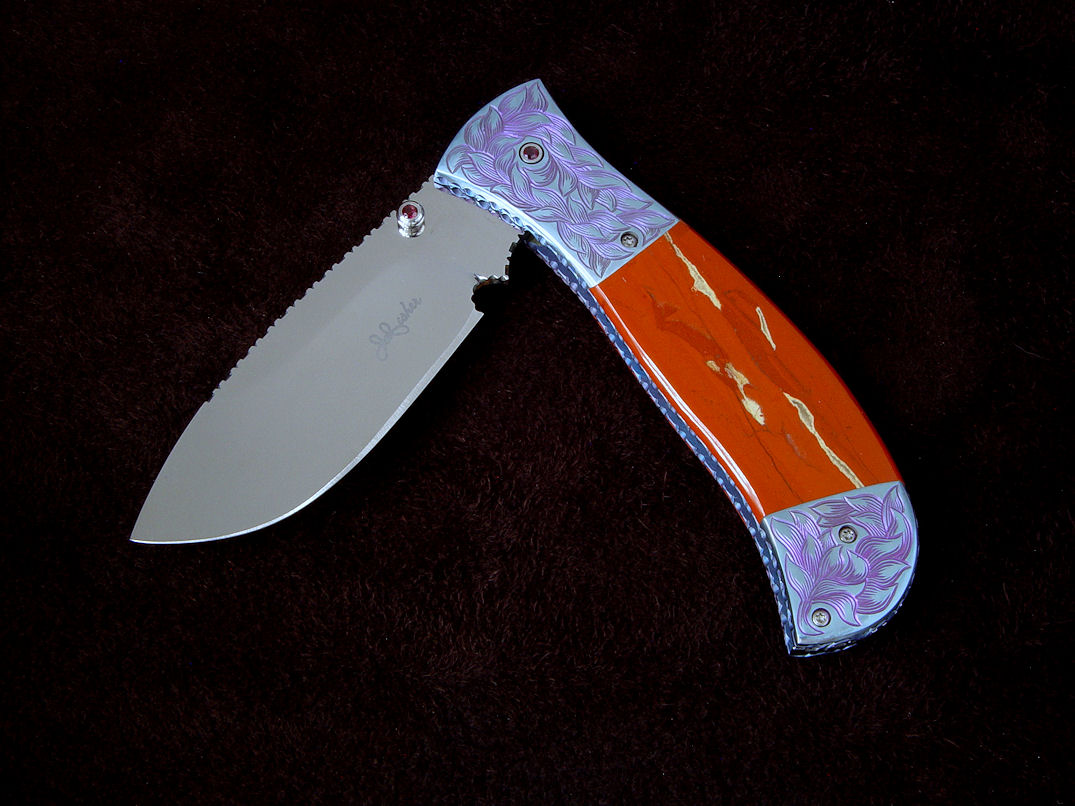
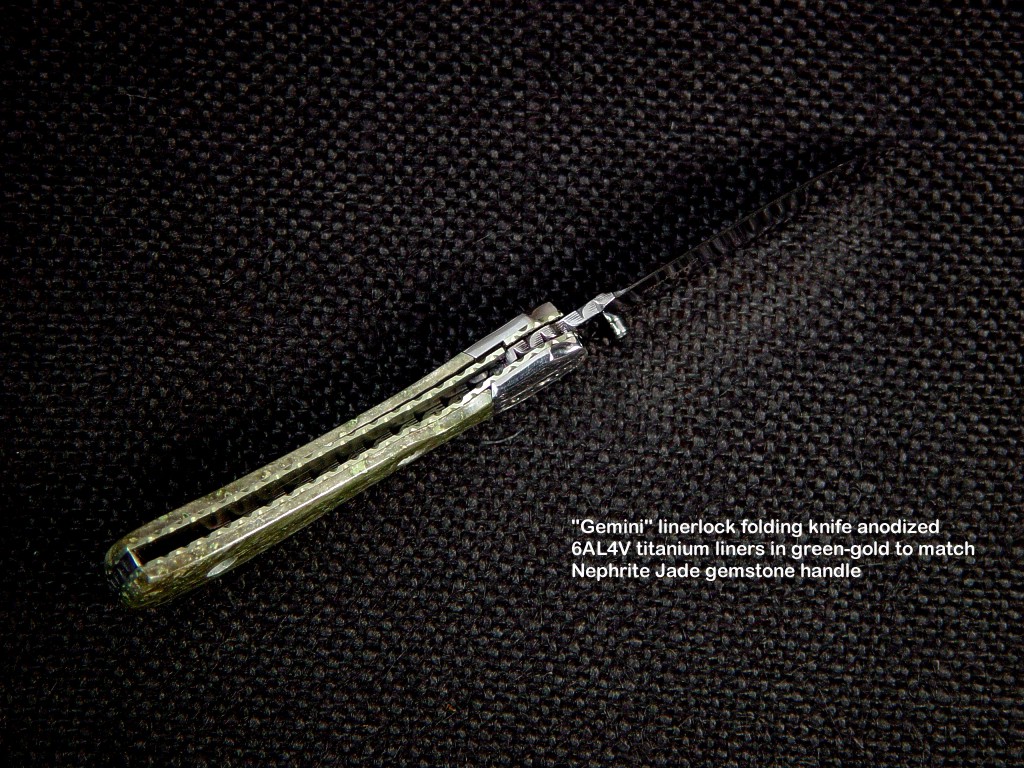
An important feature of titanium is the ability for the surface to be anodized. Actually called anodic interference coloring, anodization is a treatment where the surface is cleaned, etched, pickled, and bright dipped, then oxidized with a chemical bath and electricity to a passive nature. This process creates a significant oxide film thickness that causes optical interference, or more simply, the reflection of colors. This happens the same way as the colored reflection of an oil slick or soap bubble, the interference of two reflective layers allowing only a narrow range of light frequency to pass or reflect from the surface, thus creating a narrow range of color. The treatment is very thick as treatments go, in the order of up to .2 microns and is actually harder than the substrate titanium. It maintains the color for decades, perhaps indefinitely, as long as it is not physically abraded away.
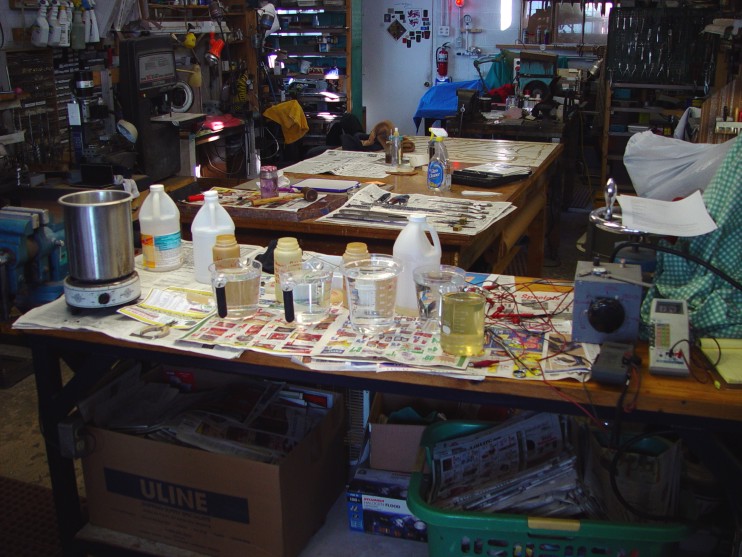
Though heat may be used to oxidize the surface of titanium, I use a more controlled chemical method. The method consists of cleaning, etching, pickling, and a bright dip, followed by the chemical anodizing treatment. This may be done several times, the colors can be contrasted on different parts of the titanium, or graduated for interesting effects. The process requires masking, finishing, an electric power supply, knowledge of chemistry, and a picture of the set up for the basic process is below, with some anodized knife projects.
Thanks for taking the time to view my "Embellishment" page for custom and handmade knives. Please check back, I'll be adding to this page as time and projects allow. Embellishment of fine custom and handmade knives is an evolving process, and I'm honored that you've come here.

| Main | Purchase | Tactical | Specific Types | Technical | More |
| Home Page | Where's My Knife, Jay? | Current Tactical Knives for Sale | The Awe of the Blade | Knife Patterns | My Photography |
| Website Overview | Current Knives for Sale | Tactical, Combat Knife Portal | Museum Pieces | Knife Pattern Alphabetic List | Photographic Services |
| My Mission | My Knife Prices | All Tactical, Combat Knives | Investment, Collector's Knives | Copyright and Knives | Photographic Images |
| The Finest Knives and You | How To Order | Counterterrorism Knives | Daggers | Knife Anatomy | |
| Featured Knives: Page One | Purchase Finished Knives | Professional, Military Commemoratives | Swords | Custom Knives | |
| Featured Knives: Page Two | Order Custom Knives | USAF Pararescue Knives | Folding Knives | Modern Knifemaking Technology | My Writing |
| Featured Knives: Page Three | Knife Sales Policy | USAF Pararescue "PJ- Light" | Chef's Knives | Factory vs. Handmade Knives | First Novel |
| Featured Knives: Older/Early | Bank Transfers | 27th Air Force Special Operations | Food Safety, Kitchen, Chef's Knives | Six Distinctions of Fine Knives | Second Novel |
| Email Jay Fisher | Custom Knife Design Fee | Khukris: Combat, Survival, Art | Hunting Knives | Knife Styles | Knife Book |
| Contact, Locate Jay Fisher | Delivery Times | Serrations | Working Knives | Jay's Internet Stats | |
| FAQs | My Shipping Method | Grip Styles, Hand Sizing | Khukris | The 3000th Term | Videos |
| Current, Recent Works, Events | Business of Knifemaking | Concealed Carry and Knives | Skeletonized Knives | Best Knife Information and Learning About Knives | |
| Client's News and Info | Military Knife Care | Serrations | Cities of the Knife | Links | |
| Who Is Jay Fisher? | The Best Combat Locking Sheath | Knife Sheaths | Knife Maker's Marks | ||
| Testimonials, Letters and Emails | Knife Stands and Cases | How to Care for Custom Knives | Site Table of Contents | ||
| Top 22 Reasons to Buy | Tactical Knife Sheath Accessories | Handles, Bolsters, Guards | Knife Making Instruction | ||
| My Knifemaking History | Loops, Plates, Straps | Knife Handles: Gemstone | Larger Monitors and Knife Photos | ||
| What I Do And Don't Do | Belt Loop Extenders-UBLX, EXBLX | Gemstone Alphabetic List | New Materials | ||
| CD ROM Archive | Independent Lamp Accessory-LIMA | Knife Handles: Woods | Knife Shop/Studio, Page 1 | ||
| Publications, Publicity | Universal Main Lamp Holder-HULA | Knife Handles: Horn, Bone, Ivory | Knife Shop/Studio, Page 2 | ||
| My Curriculum Vitae | Sternum Harness | Knife Handles: Manmade Materials | |||
| Funny Letters and Emails, Pg. 1 | Blades and Steels | Sharpeners, Lanyards | Knife Embellishment | ||
| Funny Letters and Emails, Pg. 2 | Blades | Bags, Cases, Duffles, Gear | |||
| Funny Letters and Emails, Pg. 3 | Knife Blade Testing | Modular Sheath Systems | |||
| Funny Letters and Emails, Pg. 4 | 440C: A Love/Hate Affair | PSD Principle Security Detail Sheaths | |||
| Funny Letters and Emails, Pg. 5 | ATS-34: Chrome/Moly Tough | ||||
| Funny Letters and Emails, Pg. 6 | D2: Wear Resistance King | ||||
| The Curious Case of the "Sandia" | O1: Oil Hardened Blued Beauty | ||||
| The Sword, the Veil, the Legend |
Elasticity, Stiffness, Stress, and Strain in Knife Blades |
||||
| Professional Knife Consultant |
Heat Treating and Cryogenic Processing of Knife Blade Steels |