Jay Fisher - Fine Custom Knives
New to the website? Start Here

"Nunavut"
Jay Fisher - Fine Custom Knives |
|||
New to the website? Start Here |
"Nunavut" |
||
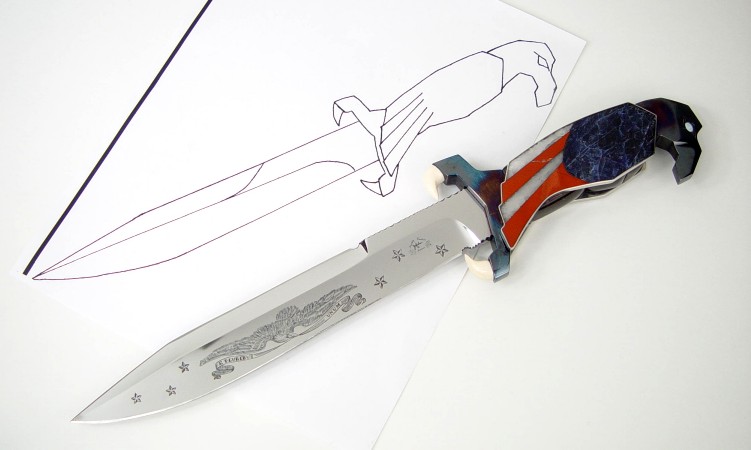
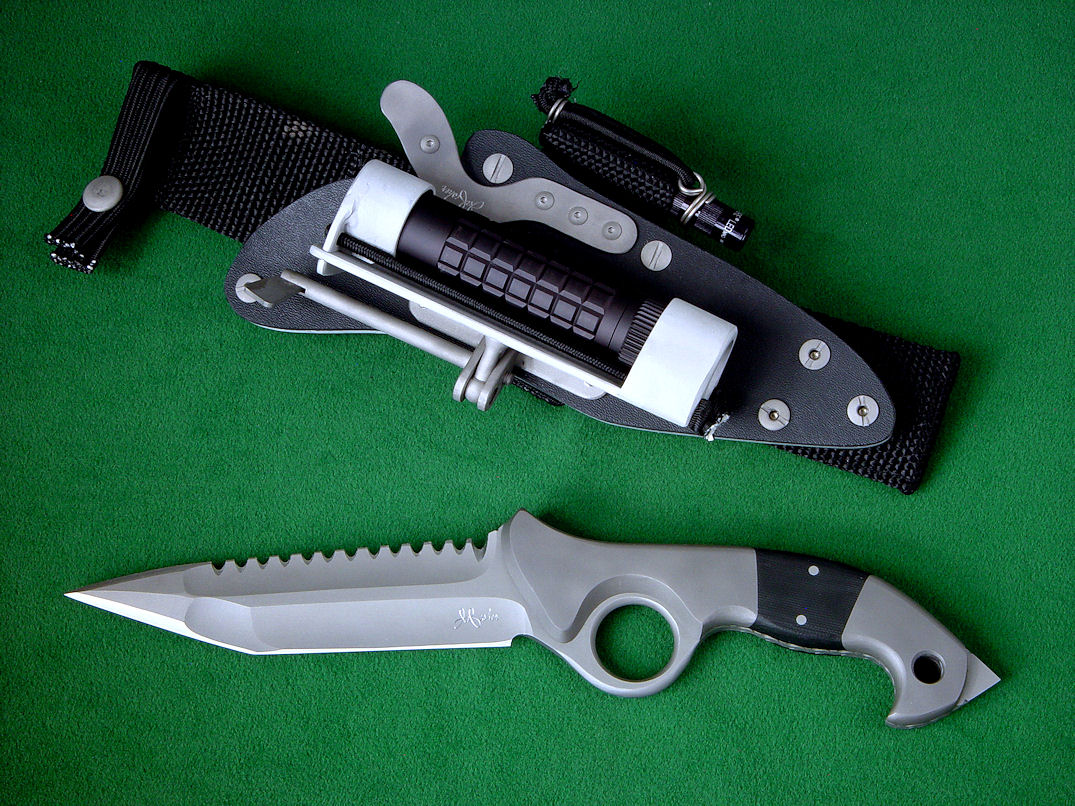
I developed this page (and will continue to do so) in order to have a place for people to go for information, education, and reason about the prevalent and unusual comparison between factory knives and handmade custom knives. I don't expect this page to be read by most knife enthusiasts and aficionados, as they understand the simple differences between these very different knife types. For those who don't, they will find clear, concise, and sometimes painful answers in these topics. I've gathered up all the topics that were sprinkled around my website pertaining to this prevalent misconception, and put them all on this page.
Please remember that what you read is my opinion, after over thirty years in this field and business as a professional. If you have over thirty years of your own professional experience in this field, please do share it with the world by developing your own website where we can see thousands of the works you have created. If your life experience is using blades for cutting, welcome to the human race, where everyone alive, sooner or later, uses a knife. Just like any tool that is then created as a work of art, a knife can be a simple affair, or a complex one, a plain tool or an investment grade work of art.
Most people agree that factory knives simply can't be compared to well made fine custom knives by established knife makers, yet people do this all the time. While most people would not compare a F150 pickup truck to a Lamborghini, some insist on comparing factory knives to fine handmade knives. It could be that they simply do not have experience with fine handmade knives, and do have experience with factory or cheap knives. On this page, you will learn the stark and clear differences between the two.
I had to smile where on one foreign knife forum, I was attacked for simply stating what is clear among the many limitations, failings, and shortcomings about knives in general, and factory knives in particular. They claimed that I attacked and impugned other knives and other knifemakers while trying to sell my own product which is somehow a bad thing. It seems that these guys want no one to say anything about any knife, no matter what hype, misinformation, unsubstantiated claims, references, or performance is stated. It seems that they prefer a world of ignorance, where anyone can say anything about any knife, and everyone politely gets in line and agrees. This may be the world they live in, but it is not mine. And it saddens me that this profession is limited, lowered, and disrespected because so much misinformation, nonsense, and ignorance about it has persisted for so long. This is my part to stop all that by simply telling some truths. Of course, not all countries have freedom of speech...
Please understand that what you read here is not an attack. An attack would be a call for rallying disenfranchised customers who have actual complaints, losses, and damages due them for the failings of inferior knives. This would take the form of a class action lawsuit, disclosure demands, and imminent litigation. This would take place as lobbying for congress to pass laws about knife performance, durability, or material claims, since there really are none. This would take place as campaigns against and boycott of companies and individuals that spread wives tales, mystical, unwarranted, or unsubstantiated claims about knives, their properties, their history and origin, their design, function, durability, and their construction. That would be an attack, not some experienced professional knifemaker's opinion simply resting on his own website.
What you are reading here is my own experience, and as you read, you'll recognize your own experiences about knives, I'm certain. You'll probably be able to relate your own encounters of knife failings, limitations, and advertising hyperbole because they are so prevalent in this industry and art. My goal is to simply tell the truth: the mechanical, design, functional, material, and experiential truth about an industry that is rife with misdirection, exaggeration, and outright lies. This is my profession; I am tired of the bull that permeates it, and I'll do my best to educate anyone who will bother to educate themselves about it.
If you are a knifemaker, a knife collector, a knife enthusiast of any kind, you would do well to learn about knives, modern knives, their place, their types, design, function, materials, construction, limitations, and advantages. For some reason, many people think that what they learned when they were kids, or what they learn on a factory website, popular movie or television show, or what they heard about from their friends in forums is good enough and complete enough for everything known about knives, swords, or edged weapons or tools. They may invest more time learning about the personal stats, scores, personal relationships, and earnings of their favorite sports player or Hollywood celebrity than about a tool or investment that they may use every day, or the tool that may save their life. Are you a person who knows more about your favorite musical group, artist, or entertainer than you do about knives?
Please understand that there is nothing right or wrong about any particular knife.
Please read that sentence again. The failings occur in what value, cost, or position of use any particular knife occupies. A cheap knife is fine, if made and sold cheaply. It is not acceptable if that cheap knife is accompanied by lies, falsehoods, lack of information, misdirection, and mystical claims by the purveyor in order to make a dollar, often much more than it's worth. And in this field, it happens all the time.
Here's an email from someone who just needs a good knife. They've gone the factory route, and can't seem to get the job done. Most people who use knives do so only occasionally, so they might not even notice a problem. But for someone who's livelihood depends on the performance of a simple knife, the longevity, durability, usefulness, and value of a knife is paramount.
Jay---
Thank you, thank you! Your website is the most informative & easy to understand &
set up to be user friendly. I was just surfing to find information to purchase skinning
knives for my husband and me and found myself staying up late to learn more about handles,
blades, steel types, uses, etc. There is much more to a knife than I thought, and you
make it interesting.
Any suggestions for a couple of farmers? We put down & field dress our own pigs &
steers. We use drop point B*** knives and I find myself constantly walking back to the table
to sharpen them during the process - we usually take care of 2 pigs at one time. Would like
good quality, don't mind sharpening a couple times, need a handle for my husband that is easy
to hold onto - he has arthritis & his grip is not always good.
Would appreciate any comments or suggestions from you.
Thank you again for your awesome website - you have sparked a new interest for me.
K.
My response:
Hello, K. Thanks for writing and thanks for your kind words about my site and work. K., there are several reasons that a knife will not hold an edge throughout the tasks you describe. The first and most predominant issue is usually the blade grind. The blade at and just behind the cutting edge should be thin, particularly with skinning, fleshing, and butchering knives. This will allow a very low edge face angle when sharpening, and thus, a very keen edge. Factory knives simply are not ground thin enough, because it takes a lot of skill and careful practice at the grinder to do this. Factory knives are quickly and lightly ground, quickly machine sharpened, and sent out the door. They are built with the expectation of one to two seasons of use and then they hope you’ll purchase another. They cannot be successfully and continually resharpened without first correcting the thick blade geometry.
Another concern is the steel. B*** makes most of their knives with 420 stainless steel. This is a very poor, cheap, and inferior knife steel, no matter what their web site claims. It does NOT have excellent wear resistance; it has poor wear resistance. This is due to a lower chromium content, so the very hard and wear resistant chromium carbide particles simply are not present. It cannot compare to many of the finer stainless tool steels like 440C, ATS-34, or even D2. It is the same steel used in cheap kitchen knives from China, so that should tell you a lot. The reason that they use it is probably because it is very inexpensive, and can be stamped out of sheet with a die press, so high production runs of blades are less expensive to produce. Compare this to the steels I just listed, which have to be sawn out individually with high cobalt, high alloy saw blades. For the user (you), this translates to a cutting edge that simply does not last due to low wear resistance.
A third concern is heat treating. How the blade is heat treated often remains unknown, and undisclosed to the customer. Is the blade the proper hardness? Unless it’s tested on a scientific, calibrated hardness penetration tester, you can’t know.
Okay, I’m sure you get the picture.
What I would suggest depends on what your specific needs are. If you want a blade that can dress 3 or more pigs without sharpening, you’ll have several choices that should be able to perform. If you’re after the ultimate in wear resistance, D2 or CPMS90V are hard to beat. These steels will maintain an edge for a very long time, but when they do need sharpening, usually a diamond hone is required. If you need a tougher, thinner blade, ATS-34 or CPM154CM can be ground very thin and are less brittle. There are others, of course. I remember many years ago, a professional elk hunting outfitter had me make him a skinning/field dressing knife from 440C. He had a B*** knife that he had to sharpen three times to get through a single elk. With the 440C blade, properly ground, heat treated, and finished, he dressed three elk without ever touching the blade…
For a custom handle for your husband, it sounds like he’ll need to get an idea of what shape works for him. For instance, can he grip a shovel handle easily, or does it need to be larger? How about the size of a pickaxe? This customization would only be available through a custom maker.
...please do find a custom maker who can get you the very knife or knives you need for your important tasks!
Thanks again,
Jay
Once or twice, an argumentative type will protest that my comments on this page are generalized. They think that in order to be validated, I should disclose names, manufacturers by company, and specific models, false claims, or types of product sold by exact number. Otherwise, they think my statements must be false... right?
The main reason I don't name names is that most people can see and understand the details that I list. It doesn't take a genius to know that if knife components have bad fit, it's easy to see, and I don't need to list every knife made that has a bad fit by manufacturer and model number. The same goes for poor finish, bad balance, and weak design and inferior handle materials. Anybody can spot a three-rivet handle, anyone can see the bad knife that does not have bolsters. Order from a small supposed "combat" knife manufacturer and you'll find out right away whether or not they even make a sheath to wear their knives! Most people can see the difference in a durable, well-made sheath and a flimsy, thin, weak (or non-existent!)sheath. If they can't, they shouldn't be investing in expensive custom handmade knives.
Interestingly, it seems perfectly acceptable to identify me by name, call me offensive or even profane names, and insult my opinions from an anonymous position such as a forum, bulletin board, or discussion group.
This prevalent practice is one of the reasons why large manufacturers aren't too troubled by the comments of a singular knife maker on his own website. These large manufacturers have plenty of defenders: guys who have spent their peanuts on factory knives that depreciate in every way the minute they are purchased, yet swear they are the best knives ever. Really? Then why can't they be resold... at a profit? In the rare cases where one or two models do sell for a few dollars more than they were purchased for because they were manufactured as "limited runs" and in "numbered lots," I'll simply ask, "What will their heirs think when the factory or manufactured knife is handed down?" Ask anyone who's bought "commemorative" knives from the back pages of a magazine and then tried to recoup their investment. The truth is a factory knife is a clone, and that will always be the case, a numbered, original clone with options.
If you are insistent on seeing individual knives named and detailed in their descriptive properties from manufacturers and knife companies, I'll refer you to my Funny pages. These are pages of interesting, humorous, and curious emails that people have sent me over the years, and I've included them for some clear understanding of why people write. After the fifth page of these, and after realizing that they clearly won't stop, I tried offering more responsive detail to the topics, so that others may benefit from the topic. If you are intensely supportive of factory knives, manufactured knives, or small boutique shop knives, I'll advise that you never, ever go and read any of these; you will most certainly become inflamed. While it's okay for some factory customers to be critics of my knives, it's not okay for a professional knifemaker who has been doing this for over three decades, making knives for some of the top military, counterterrorism, collectors, and knife-using professionals in the world to have an opinion based on his experience... ahem.
For a deeper discussion of this topic, my "Business of Knifemaking" page explains it in detail. The topic is called: The Truth Can be Painful.
Back to TopicsDear Mr. Fisher,
I wanted to take a moment and send a word of thanks to you and your organization for having such an informative website.
I was trolling the web for grinding ideas when I happened upon your site, and I have to say, wow. I am a hobbyist maker
on my best day, but, I do have a set of successes that I take pride in. I have a severe aversion to making "crap," so
when I get solid advice on making a better product by veterans, I am all ears.
When I first started in on your site I thought, gee, this guy is full of himself. However, even if you are a cutlery steel
sales rep with tons of book smarts behind you, I think there is no better schooling than listening to those who have trod
where you are now treading. Your site should be sold as hokum repellant.
Seriously, thank you for giving of your knowledge and time to those of us who need a good tuning up occasionally.
Much respect,
Brian
When I started making knives decades ago, I was a bit stunned to realize that there are many people who consider handmade or custom knives not too different than factory made or manufactured knives. Though these same people wouldn't dare make the same comparison with handmade custom jewelry, firearms, and works of art, it seemed that knives were exempt from this distinction, that knives were only products of a simple craft. These same folks consider knife makers as craftsmen, not artists, not creative, and their works not too different than that of factories.
The attitude of comparison is so prevalent in this field that I started illustrating the exact distinctions between well-designed individual works of fine craft and art in handmade knives from factory or poorly produced and manufactured knives on this very website, only to face an onslaught of criticism, negativity, and opposition. For a great point by point comparison, take a good hour or two to read the Tactical Combat Knives page on this very site. Here, you can see the exact limitations, shortfalls, and comparisons of factory or badly made knives in impressive point by point detail. I'm not generalizing; the points are specific and clear. Truth is, most of these masterminds will not take the time to read and educate themselves, choosing rather to share their ignorance than back it up with any troublesome facts. These empty hats then establish running conversations on forums, blogs, and websites determined to defend their factory knives, and attack what I have written on this website. They'll even send me emails directing their rage, simply because they have invested their money in large and small factory knives, and expect me to change my entire belief system to adhere to their spending habits. This continues to this very day.
If someone disagrees with what I write and my opinion, I do not write them raging, incoherent, and fitful emails and comments demanding that they change their entire website, yet that is exactly what some of these people do to me. It's not for me to try to get in their heads and figure out why they do this, but it is quite humorous to see grown men throwing tantrums over a knifemaker's individual opinion. Seems in their mind, I'm not allowed an opinion, unless it agrees with their take on the subject, which is clearly weak and tenuous. If they really believed what they complain about, they could steadfastly claim the reasons, man up with their money, and make a fortune on factory knives while putting individual knifemakers out of business. Do you ever wonder why this is not so? Why haven't the factories overtaken individual makers in volume and quality if factory knives are so great? Why?
You are correct if you assume this is one of the reasons for this very page, my own specific and clear counter to some of those rants. This is my site, and I'm allowed my own opinion here. By the way, the negative attacks, rants, anonymous spews, malicious claims, and flaming emails are one of the reasons why forums are limited in their scope and interest. I know dozens of guys, real knife professionals, who have once posted and participated there, only to leave in disgust. I did. You seldom see any of the very successful makers there, and that is why, several years ago, I quit posting on all forums. There is nothing wrong with most of the knives there, the knife makers who make them, and the people who buy them, but there is a distinct direction of attack and inflame, incite and stir, in order for more conflict, and thus more traffic to occur. This is like the high school kids who gather outside the school after hours to watch a fight between two well-known enemies. Or the look-e-loos who slow down to gawk at an accident scene. People watch conflict. There is some strange attraction to it, perhaps because deep inside, we wonder where our own interest lies, and what we may have to do to respond to impending chaos.
The very same spew happens on blogs, too. Anonymous posters who think the world is in need of their very specialized and detailed opinions decide they will ingratiate themselves into the world of professional knife making by droning on about the products of a real, established, and successful knife maker to make themselves feel better, hoping to curry agreement between other anonymous and ignorant readers. What they don't realize is that merely by posting my name (and other knifemaker's names), they've driven more traffic (and ultimately more knife clients) to this and other maker's sites where readers can get a real education on knives from professionals. This translates to a better understanding of knives in general, so perhaps this is not all bad!
Because name is everything in this field, I felt obligated to respond to some of these comments, not merely to defend my name and reputation in this field, but to plainly and clearly educate those who read about the differences, and to let them know why custom and fine handmade knives are sought after, valued, and cherished by their owners. The long-term investment value of fine handmade knives is also well-established, and knives by well-known makers are known to be one of the top investment opportunities, appreciating year after year. We're not talking about making 5, 20, or 100 dollars on a knife resale; we are talking about making thousands of dollars, hundreds of percent increases on knives resold that have been made by well-established individual makers. For example, I recently saw a knife I made back in the late 1990s for sale for nearly three thousand dollars on a public site. I sold the knife originally, brand new, for $300.00. A ten times increase in value is a pretty good investment, and you won't find that kind of appreciation in any factory knife. Another example is a knife I sold at a show for $600.00, and I was quite happy with the sale, when I found out that within a month, the same knife sold for $3000.00. In a month. A month!
In case you're thinking that this site is just another blog, just another opinion, please take a few hours to visit a bit of this site. I won't ask you to look at every knife, just take a serious, good look around. There are thousands of knives I've made here, and hundreds of pages of real information. This is not some passing blog opinion, this is my professional experience in the world of knifemaking for more than the last three decades. I do believe I've earned some consideration for my contribution to this field.
If you believe I'm doing this to promote my own work, please note that I'm always busy with orders and professional knife consultation and do not need to convince knife clients of the value of what I do. In reality, it's difficult to get a knife from me, I'm sad to say, simply because demand is high and production is low in the handmade field. The reason for this page is education. People need to know the realities of the factory knife/handmade knife markets, and so very little worthwhile information about the trends, directions, and movement of hand knives is available. It's my contribution to our community, a community that has been my experience since the late 1970s, year in, year out, for decades, a community that is generally kind and supportive and deserves the truth.
While you may be able to find handmade custom knives selling for less than they were purchased for, this is not the norm, unless the knives are used and scarred, the popularity of the maker and knives has declined, or the seller is desperate to make a sale and move his collection. The last reason I listed seems to be the most prevalent. I know of several collectors who have fallen on hard economic times and have had to liquidate their collection of knives. Unfortunately, trying to sell them on forums or online auction sites is a cheap, desperate attempt to move the pieces without paying for the services of a professional dealer, and I don't recommend it. A good dealer knows the market, has access to clients, and can help the owner move the knife more efficiently, but some guys forego this step in order to save a buck. So, the knife sits on a forum for a while, and then the guy tries eBay, or Crag's List, where the likelihood of sales is even smaller (or the price lower), particularly for fine, handmade, or custom knives. For more helpful information on this topic, please read this section on my Business of Knifemaking page.
Custom and handmade knives by established big-name knife makers are typically much better designed, constructed, finished, embellished, and accessorized than factory knives, though factories in recent years have made substantial improvements in their offerings. This seems simple and clear to most people who know this trade, but you might be surprised how many uneducated people think there is no difference. Every time I stumble on or have reported to me that my name is being used in this type of comparison, I remember the two little old ladies that shuffled up to my table at an outdoor art and crafts show in Scottsdale Arizona back in the mid '80s. They looked over my table display and one of them picked up a modest knife to look at the price tag. The astonishment and incredulity washed over her face as she loudly blurted out, "One hundred dollars... for a knife?"
They couldn't wait to slam the knife back down to the table and scurry away. Neither one of them cast one glance in my direction, standing just a few feet away behind the table. They didn't have a clue what it takes to design, construct, finish, and sell a handmade knife, and would be overwhelmed if they knew. After forty years of making and thirty as my full-time career and my only source of income, they might well be astounded to know that most of my knives start at over twenty times as much, and that I'm tremendously busy with backorders and knife consultation, and that I've made and sold literally thousands of knives this way. How could this be? After all, it's just a knife!
When a person decides they want to try to make a knife, it's usually an enthusiastic affair. Knives are attractive to hold and use, everyone likes a good knife, and they can be beautiful and functional. The initial enthusiasm slowly gives way to determination at the difficult process. Sure, a simple knife can be made simply, just as many manufactured knives are made today, and this simple, repeatable process can even be automated to produce hundreds, or even thousands of knives per run.
Though the initial project may be a modest one, it doesn't take long for a new maker to realize the difference between quality workmanship and rough shaping, between premium materials and plain, between a high value finish and quick surfacing. I've met plenty of new makers in this career, and the one thing each will tell you is that making a knife by hand is a hell of a lot harder than it looks.
Claims of superior cutting performance are made to distract the customer from poor finish, bad fit, weak or amateur design, or lack of the service aspects of the knife.
As you can probably imagine, my take on factory knives gets a lot of interest and comment. Most reasonable people understand the simple differences between handmade custom art work and factory produced products, but once in a while someone will claim that my comments are disingenuous or outright wrong. It's okay to disagree, but be prepared to defend your argument if asked to do so with reason and intelligence. I do appreciate the web traffic they send my way, as long as they spell my name right and include my URL.
An example of one of these non-reasoning complaints is one presented by just such a person that factory-made automobiles are better than handmade automobiles, therefore, handmade automobiles are inferior, and that is why there are few handmade autos. If this person is talking about small shops custom making individual autos, he couldn't be more wrong. The most expensive, most valuable autos in the world are made individually, by hand, in small groups in custom shops. Though they might be occasionally referred to as production autos, mere dozens exist. The custom shops of Bugatti, Lamborghini, McClaren, and Pagani are not prolific high volume production shops, and one could not dispute the extremely high value of their autos. Do they perform well? Of course they do, but how can you compare them to a Hundai which may be a better value per mile? What about fine racing cars, worth millions of dollars? Do these complainers think Indi cars and dragsters are made in some production factory? And what about performance? Sure, they can go fast, but how convenient are they to park; what kind of mileage do you get on alcohol and nitromethane?
Apart from this slight oversight, the complainer decided that the only valid comparison of factory knives to handmade custom knives is one of cutting performance. Performance is a hot topic with knife factories for several reasons. The first is that a measurement of cutting ability is entirely subjective and something that can be constructed, guided, arranged, and presented to portray their particular knife in a good light. Performance of cutting chores in repetition is something everyone, especially those ignorant of value can understand. Knives can cut, be bent, hammered through sheet metal, and abraded. Would you do this to your fine firearm? Who would purchase the IIRC, the Colt Third Model Dragoon given to the Sultan Abdulmecid by Sam Colt in 1853, engraved by Gustave Young and toss it in the back of their pickup truck after plinking cans at the dump? It's worth six million, and I bet it doesn't shoot any better than a Ruger.
If you really think that cutting rope, paper, or special cutting testing has any value whatsoever, please divert from this page for a while and take a good, hard read of my Knife Testing page. There, you'll get substantial and significant facts about the knife testing field, how it's constructed on assumptions, errors, and directed for sales and how no cutting tests by any method are valid when it comes to hand knives. What? Did I just write that? You bet I did, and when you read the page, it will become crystal clear what this is all about. Knife Testing page.
Okay, I don't have any million dollar knives... yet. But this is the grist of the discussion and it stuns me how uninformed these types can be. Would they have compared the cutting ability of the solid gold dagger made by a big-name contemporary knife maker and valued at a million dollars to a common factory knife mounted to a folding pliers? By gosh, that gold sure holds a lousy edge! It would fail any cutting competition, no matter how many beer cans filled with water or hanging ropes it was tested on. So, obviously, it's an inferior knife, and the guy purchasing it is a fool....right?
Taking the same type of argument: is a fine watch better than a cheap watch because it performs better? How could a mechanical antique pocket watch keep better time (perform better) than a modern electronic watch made in China? Obviously, it can't. Even if it kept perfect time, it would have to be rewound, thus reducing the performance. Yet the old watch is worth hundreds, maybe thousands of dollars more.
Does a Vacherin Constantin Tour de l’Ile keep better time (perform better) than a Timex? If it doesn't, then how in the world could one justify the 1.5 million dollar price tag? Could it be that there is much more to the Vacherin than meets the simple requirements of time keeping performance? Could it be the method of construction, the multitude of significant features, the quality of the creation, the reputation of the maker, or the long term investment value known in wide collecting circles that contribute to the value? Could it be that the same features exist in fine custom handmade knives, or is it only about cutting?
By the way, any piece of tool steel, of any type, when geometrically identically ground, shaped, and finished, when properly heat treated and tempered, will cut exactly the same whether it is made by hand by a knife maker, or made in a factory by automated machinery. There is no great mystery to heat treating, sharpening, and finishing the tool steel, this is all fairly simple and documented. Why you see claims of superior cutting performance is to distract the customer or client from poor finish, bad fit, weak or amateur design, or lack of the service aspects of the knife. So, it is not the steel performance that becomes the key here. Otherwise, all knives would look alike, be ground alike, and perform alike, and be made of the same steel, right? So is there more than the steel type and edge sharpness?
Of course there is more, just as there is more to fine handmade knives than there is to factory knives. Just as there is more to fine art than bad art, just as there is more to fine guns, fine jewelry, fine artistic pursuits in every realm. Why is it then that modern knife artists can not be taken as seriously as a fine artist, sculptor, or performer? It is an unusual factor of this tradecraft that I will go into in more depth in my upcoming book.
Do you ever wonder why only blades and specifically cutting edges are the only thing tested? Why is no one testing handle mounting methods, bedding and bonding, bolster construction, fit, finish, balance, or the complex interface of the knife handle with the hand? Why is no one testing sheaths, ever: their potential for security, durability, safety for the user, wear and accessibility options? Why is no one testing stands, cases, or displays? Why is everything, everything of any concern, the cutting edge alone? Could it be that there is more, much more to the knife? Could it be that testing cutting edges is simply a distraction from the rest of the knife which is inferior? More
If you don't understand the difference between simply doing a task and making an investment, you're probably on the wrong website. However, this site is open to all comers and skeptics, and I can only hope that the reader will become educated as to that difference. There is a reason that most fine handmade and custom knives appreciate in value year after year, and are sought after by collector's, users, and knife aficionados. There is a reason that cheap factory knives are cheap, depreciate in value the moment they are purchased, and strive to present themselves by the best cutting performance value alone. There is a reason that factory knives and boutique shop knives are not known for, purchased, and sold for their investment value. When was the last time even the factory itself touted the great investment value of a cheap knife? They don't present their products as investment grade, as worthy of collection or even appreciation of art, because simply, they know what their market is.
To detail the discussion within the simple limitations of performance, please consider this:
Hopefully, you're as sick of these comparisons as I am, but I bet you can add some of your own. The leading thought for the guy who challenges me to make a knife that "outperforms" a $100 cheap piece of junk is this:
It's good to understand that these same critics do not have access to the finer things, and their evaluation is based on photographs and information provided to the general public alone. One might think that this is enough to make a value-based decision, but it is not. The true evaluators are ones who not only have the public information about the knife, but also have an actual understanding of it based on their personal and direct possession of the work. Simply put, they have the knife, and are able to judge it personally, intimately, and as actual users, owners, and clients. They have voted with their money, not just an opinion, and the opinion of a person who has never even touched the knife is worth considerably less. Frankly, a critic's frivolous opinions are insignificant. In my own work, since my knives are not returned, and since most clients go on to order or purchase more knives and projects from me, the depth of their understanding of the value of their judgment can not be questioned by anyone who is not one of them!
My clients vote with their money; get over it.
We've all heard about those legendary blades. Born of the Samurai, forged from the mud of mount Fuji, quenched in the torsos of their enemy slaves. It's time some things were set straight. I don’t know of anything that has been more hyped than early Japanese steel. The reason steels were folded hundreds of times was to define and clarify the grain, because the grain was so bad to begin with. The reasons blades were made by laminating hard steel over soft steel was because the steels used could not be both hard and tough. Read more details about that at this bookmark on the Blades page. Differential tempering creating the intriguing temper lines (incorrectly called hamon lines) was needed because the steel could not be both hard and tough at the same time, so the cutting edge was left hard while the spine was tempered back.
There are good, finely made knives made by individuals in every country, not just Japan. The interesting thing to note is that there are more Japanese style blades, swords, and knives in the United States of America than are in Japan (John Yumoto, The Samurai Sword). Note that as early as 1958, 70% of the long swords in existence were in the United States of America. I haven't seen any recent data, but I'm certain that the US holds the record for the amount of swords and knives in private hands when compared to every other country in the world. This has more to do with freedom than need, history, culture, or tradition.
Here's an excerpt from my email response to a client interested in why his friend was smitten with Japanese swords and their obviously weak construction:
Japanese swords and steels are full of interest, truly some of the great masters of their time created fine swords in their day. But the steels were poor, thus the many folds, to refine the grain to run along the length of the blade rather than across it. Like a piece of wood, you wouldn’t want a staff cut and fashioned across a board’s grain rather than along it. This is very simple really, but it’s been way-hyped. When they talk about folding, it seems like an immense amount of work, but it really isn’t. A simple fold, repeated, becomes 16,384 “folds” (actually layers) after only ten folds. So why not hype it as being “folded” twenty thousand times? Yeah, ten times.
And the hamon line? Differential tempering. Needed because the steels could not be both hard at the edge and flexible at the spine at the same temper. Modern steels can be. An interesting thought would be that if ancient Japanese sword smiths had access to modern tool steels, would they use them? Of course they would, as all of the masters throughout time used the best tools, technology, and techniques that they could! I believed Michelangelo used a pointing frame for sculpting too, but hid it from his contemporaries.
I’m glad you noticed the handles. The total failing of all of even the historic works of Japanese blade smiths are the handles. Birch was popular, covered over with a layer of rayskin applied with fish glue, wrapped with silk cord. Just how durable, strong, resilient, or trustworthy is that? No one will out-and-out say it, but it’s a very poor way to handle a knife, sword, or weapon of any kind at any time in history. If it were a really good way, why wouldn’t we see it on modern works, like your .45?
Okay so it’s all historic, and when I get asked to do this type of handle, I decline. It’s been done, it’s history, it’s a reproduction, and anything I would do would be just a rerun. There are makers though, who thrive on this.
More about this directional grain elongation and arrangement at this link.
Modern tool and die steels are hard and tough, made with the best metallurgy and chemical design we know. That is why industry relies on fine modern tool steels. Ask the company that’s making a die to stamp out medical parts for a dialysis machine, machine tools to make the helicopter gears of an HH 60G Pavehawk, or shears to fabricate the sheet metal of a car. They're using high tech, high quality tool steels that have been highly refined, and double poured in a vacuum and high purity environment. They are not using carbon steels, or hand-forged steels, ever. Want water-resistant ball bearings at four and a half times the strength of carbon steels? They're the best we've ever made them, and they're made out of 440C. What are the steels used to make the tough, hard, and wear-resistant dies that stamp out factory knife blades? Why, D2, 440C, ATS-34. Are plain carbon steels used to create high temperature, high wear valve seats, machinery, and cutting blades? No, plain carbon steels are inferior steels: they rust, wear, corrode, and have markedly higher failure rates than high alloy stainless tool steels They are plainly weaker in tensile strength. Their advantage? They are easy to work with, easy to machine, and cheap to make a knife (or anything else) with. And they can be hand-forged in an open furnace, like wrought iron and other decorative pursuits and hobbies. By the way, what people call "wrought iron is, in reality, mild, low carbon steel painted black. They do this to suggest a relationship to a historically valued iron of antiquity. More about the iron of antiquity at this link, detailing how it is different than low carbon (mild) steel, and why people incorrectly do this to make their steel items sound better.
I’ve got to acknowledge this though: many steel foundries that pour some the best machine grade tool steels are in Japan (some are in Germany and others in India). Good old American technology, used by a foreign country, often with raw materials that we send them...and when I was a kid, "Made In Japan" meant the worst sort of cheap junk you could find. How Japan has benefitted and grown from those days; perhaps we have a lesson to learn from them after all. By the way, the basis for this achievement came from W. Edwards Deming, an American. Do an internet search and read up on what Deming gave our conquered enemies after WWII; it will open your eyes.
Look, there are some decent knives originating from many other countries including Japan. Please don't buy the typical hype of an historic association of ancient Japanese sword smiths with modern mass production factories. There is not a descendant of a Samurai sword maker hammering out that knife blade in a clay-lined forge with humble helpers tending the bellows, quench-water blessed by priests, and weeks of meticulous hand-sharpening with rottenstone. These knives are mass-produced in a factory by automated machinery.
Back to TopicsThe Inevitable Comparison
If you're buying a cheap knife, that's okay. Cheap knives are a big business worldwide for a reason. People need knives. The issue gets complicated when owners of these cheap knives seek to compare them with fine handmade and custom knives.
No one can seriously expect to compare factory knives with fine handmade and custom knives, and it surprises me that it happens so often. When a person buys a factory knife, it's usually a decision based on economy first, and function second. Factories work hard to create and maintain brand loyalty, and guys fiercely defend their purchases of factory knives, manufactured knives, and boutique shop knives. These guys will go on bulletin boards, knife forums, and any public venue they can to defend their purchases.
There is simply no comparison between the fine construction, unique materials, and craftsmanship that exists in well-made knives individually crafted by a knife maker who has mastered his trade. Every successful individual knife maker makes a knife that is superior to factory knives, or he wouldn't be in business very long. If he's been in business a long time, it's a pretty good indicator that he makes an excellent knife and runs a good business. If it is his full time professional job, and completely supports his family, he's serious about the knives he makes. If he's been successfully making knives for decades, he knows knives. No one has lucky breaks for decades.
One can also argue that a factory that has been in business for a long while is also successful, and knows their market. Otherwise, they would be out of business. The differences are in the market. While factories are geared for economy and volume, a custom individual maker is geared toward extremely high quality.
The knife factory typically makes thousands and thousands of mass-produced knives. Rather than a passion, their industry is simply a business of manufacturing. Manufacturers are governed by the bottom line.
When carefully considered, these comparisons translate to a simple personal statement:
I'm in this business to make the best knife I can for your money.
Factories are in it to make the most money they can for the cheapest product.
It's funny to read how this statement (used in several places on my site) itself has become the target of attack. Guys read what they want to into it, claiming it means something else; that it is some perverted attack on factories when I'm in the same business as they are... really?
So, in my commitment to education in this field, I will slowly and clearly explain so there is no misunderstanding of what the words mean. That factory is not going to take the time to do this for you; they have no commitment to service in their own industry. But I do, and that is why you are able to read what I'm writing here. Read more about service on my six points at this bookmark.
"I'm in this business to make the best knife I can for your money." This seems pretty clear. I am a professional; this is my business; a client exchanges money for my product. In exchange, I am committed to make the best knife I can for his money, and have, for decades, done this over, and over, and over. I'm not trying to cheapen his knife by cutting corners, I'm not limited by materials and techniques; I'm not focused on cranking out massive volumes of clones of knives. I'm not cutting corners by using automated machine finishing; I'm not neglecting contouring, shaping, and accessories. I make true custom knives that are directly made to order; I feature hundreds of designs and will fit the knife to my client's own hand, his own purpose, with his own artwork, dedication and even a unique stand or case if he requests it. I do not have an advertising department to pay, I do not have a loss control supervisor, a management team, a labor force, or shareholders that I have to make a profit for. I do not have to gear knives toward sales of a hundred thousand units, I do not buy materials and supplies in bulk. I do not have the overhead of a large facility, I do not have a company softball team. Hell, I don't even have a company song!
How is this different from factories, large or small? If you don't get it yet, please read on:
"Factories are in it to make the most money they can for the cheapest product." Factories are not professionals, they are a factory, a large entity of workers assigned different duties within the company. For instance, an accounting worker could claim he is a professional accountant, but he would not claim to be a professional knife maker. A guy (or gal) who works on the line pushing the button on an automated disc sander that grind-sands 20 blades at once is a professional machine operator, but they are not a professional knife maker. The guy who drops the boxes at the end of the packaging machine is not a professional knife maker, and neither is the head of the company; he's a CEO and owner. What this means is that there is NO communication between a factory and a client: absolutely none based on professional knife making. Just try to reach that CEO and ask for a custom knife; I dare you. Factories have tremendous overhead: facilities, automated equipment, loss control, advertising, labor forces, management, softball teams and rah-rah company events. This overhead has to be paid for; they have to cut corners somewhere in order to make money for their shareholders. Where do they cut? Why, the products, of course, and this is why they don't finish, don't contour, don't offer premium materials, don't offer a variety of designs, use plain steels, don't grind properly, and offer next to nothing in accessories for their product. They must be able to sell knives by hundreds of thousands in order to still make profit, so they direct the knives to the masses. Their idea of custom is a unique number somewhere between 67,895 and 67,897. Get it?
So, if I don't have the overhead that they do, why do my knives cost so much? It's the market. Why does an NBA player get paid so much? Because his work is in high demand, people recognize the value, and can afford it. Why does a studio actor get paid so much, when a community theatre actor does the same thing? Because his work is in high demand, people recognize the value, and can afford it. Why does a successful painter sell his art for so much? Because his work is in high demand, people recognize the value, and can afford it.
To none of these would a blog, forum, or internet flamer complain, but for a knife maker? Well, it's just not right! Because the successful professional knifemaker's work is in high demand, people recognize the value, and can afford it, they offer more. How does this work? Time for some economics 101.
There are simple reasons things cost what they do.
Here is an easy way to understand this:
How do these three factors affect the transaction, the business, and its success?
I could get into the economics and global impact of these, expound upon transaction restrictions and regulations, detail the components of various business models, but this is really enough for most people to understand, even for the complainers who can't seem to see the differences.
The same guys who insist on comparing handmade custom knives with factory or manufactured knives often complain that I'm too hard on factory knives. Is it being too harsh to reveal the truth? The complaints are typically rooted in one of the three factors above.
The demand argument: They just don't understand the demand. Why would my fine handmade custom knives be in high demand? They don't see or acknowledge the multitude of specific knife details made on the hundreds of pages of this website. It's like saying: I don't like Joe NBA player's work, so why would anyone else like his work? Evidently someone does, or he (and I) would be out of business.
The value argument: They don't see the value. To them, a knife is just a blade and handle, something to cut with. They don't value the materials, finish, accessories, embellishment, or execution. Worse, they don't understand a following, an appreciation of those who do understand and value the works I do. It's like a painter whose work you don't care for. You see he has a following (people who value his work) but just don't "get" his work. Evidently, someone recognizes the value of the work, or he (and I) would be out of business.
The means argument: They don't have the means. This is, perhaps, the most persistent (yet unacknowledged) reason. Maybe these guys who defend factory knives have spent their own hard-earned money on them and feel the need to defend their purchases. Maybe they hope that the value of their dollars are well-applied, and they won't be seen as mere consumers of a mass-marketed manufactured product. Perhaps they can't afford a fine handmade knife, so try to berate them while building up the image of their factory knife purchase. This is all part of class warfare between the have and have-nots, and it's based in simple jealousy. Evidently someone has the means or I would be out of business.
When you openly compare factory knives to knives made by well known established knife makers, you open the conversation to reveal the differences in glaring reality. Then, the details are fair game for comment from this (and other) professional knife makers. The most important thing to realize is that:
Factory or manufactured knives depreciate from the moment of purchase.
Fine handmade custom knives from well-known makers appreciate from the moment of purchase.
Though there are a few good knife boutique shops and knife production factories that make a decent product for a modest price, none can compare to finely handmade knives. If there were a valid comparison, you would see factory knives selling for over a thousand dollars each. All custom knife makers would be out of business because of the intense volume of production knife factories. Instead, what you see is custom knife makers with deep backlogs of orders, significantly appreciating values, and high demand. When was the last time a knife manufacturer put a client on a one, two, or three year wait?
I read in an Internet post once that the writer believed factories excel over custom makers because they have quality control inspectors and trained metallurgists. Evidently, the guy who wrote this has never had any contact with a real production factory. Quality control in factories is a woman sitting at the end of a line, looking for a bent or discolored blade coming out of the end of an automatic tumbling machine which is used to put the finish on two hundred blades at once. Quality control inspectors look for workers who slow up the production line, cost the company money, and are safety hazards that bump up their insurance rates. They look for ways to make more profit while spending less on the product. No one is sitting at the end of the line with a ten-power magnifier scanning the grinds, looking for hairline cracks and uneven grind lines or a flaw in the finish.
A good custom maker constantly examines all the facets of each individual knife, comparing how his operations and results interact with each other, improving his skill and execution on every single knife. Though he is concerned with safety and loss control, he does not pay for or pass on these expenses to his clients. If a change is needed in his studio or shop, he makes it, without review by the safety department, analysis by the accounting department, and companywide education plans and schemes initiated by the training department.
And trained metallurgists? Please. Just like individual knife makers, knife factories do not smelt their own ore, forge their own blades, and many do not even do their own heat treating. No knife factory is going to be bothered with someone analyzing tool steels when the exact methods of steel alloy composition, heat treatment, and usage are carefully and clearly prescribed by the steel manufacturer.
These hyped-up concepts of high quality factory work are pervasive in every industry, and they're promoted by industries that want you to think that they are more than they really are. I spent 15 years in industry; you can read about my background here. I know how factories, plants, and production facilities are run: low budget, low quality, with lots of hype and advertising. Get as many units as possible of the product out the door as fast as possible with as little investment as possible. Cut corners on safety, health insurance, retirement, and quality left and right to save a buck. If you think you know how bad industry is, talk to someone who's spend 15 years there, and they'll probably tell you it's a lot worse than you imagined. They even give bonuses for workers who figure out how to cut corners! If the unions let them, that is...
You often get just what you pay for, and sometimes a great deal less. A good custom knifemaker will understand and be able to illuminate the difference and advantages of his knives and knife making skill compared to both other makers and factories. The points listed below and on other areas of this site will help you get the facts from my perspective. Some readers may disagree with my concepts and opinions, but after about 40 years of making fine custom and handmade knives, and about 30 years as a full time professional knifemaker to the military, counterterrorism units, police, collectors, and professional knife users, this is what I have learned.
Look, there are many decent factory knives, suitable for many uses. Factories have had many years to determine what makes a knife attractive and saleable, and what makes the knife buyer have loyalty to the factory. Not all factory knives are junk, just most of them. And none of them are better than custom knives by well known makers. If you need a cheap, junky knife to use and abuse, without concern for quality or value, you can buy the latest popular factory knife and that will work okay for you. But if you buy knives like that, you're probably not even reading this...
Please remember this simple, clear fact: knives by custom makers appreciate after they're purchased, and factory knives immediately depreciate.
Hello Mr. Fisher,
As the title of this email already says, each time I am visiting your website (daily :) ) I become even more and more impressed.
You are for sure the best knifemaker alive and not only for your gorgeous work but also for your vast knowledge.
Any visitor, no matter of his profession will definitely find in your website a reason to go further, to learn more and to
improve reaching for perfection. I never tried to find a fault in your work as I am sure it would be a waste of time, the way you
are judging things, the sack of knowledge behind each and every thing you make is enough to know that you are facing a very fine
educated man and craftsman.
I simply adore your courage to face and combat the lies promoted by the huge "sharks" on the market, never seen this before and maybe I will never see it again; it requires arguments, self trust and motivation for the good of the customers. Once again thank you very much for all your efforts to share your vast knowledge with us! May God bless you for long and peaceful years in the Sharp Instinct Studio! :) All the best,
--A.
Factories are limited by their process.
Artists are limited by their vision.
It's often said that you get what you pay for. If you're looking for a cheap knife, that's okay; this is probably not the website you should be looking at. For those who insist on comparison and a quick education into the differences between manufactured knives and knives by well-known custom knife makers, here are some points to chew on:
Boutique shops (pre-production, semi-production, and other monikers) are small manufacturers, with a dozen or more people making knives or assembling knives typically made by CNC machine or imported from foreign manufacturers. They can be recognized by their name; they use the name of one person, or one knifemaker who may or may not have made knives on his own before starting the small manufacturing firm. They may also use the word "tech" or "pro" in their names; this is quite common and an attempt to advertise the technical aspect of their work in a positive way, or suggest a professional presence.
Another technique is to pay known knifemakers to use their designs, thus capitalizing on the maker's name while making cheap knockoffs. They would like you to think they are specialized, run in small or limited batches, or even make custom, made-to-order knives, but they are not and do not. They are simply small manufacturing companies, or small assembly companies that sell knives.
One of the most offensive claims is the "Made in America" claim they paint their products with. Watch for sentences carefully constructed in their business description. For instance one claims, "The high tech components are assembled and hand fit by dedicated and caring craftsmen here in our facility." Okay, that means assembled from parts; where do the parts come from? How much of a craftsman does it take to assemble something; anything? Watch any "How It's Made" show on the Discovery Science channel, and you'll see plenty of assembly line work. Are these people craftsmen: simply repeating the screwing, riveting, or assembling of parts? That's not what most people would call a craftsman; rather more specifically, they are an assembly line worker. The company that makes these claims says their knives are "American Made." That's simply not true or accurate, the reality is that they are "American Assembled." Humorously, that same company claims their blades are "cryogenically tempered," and there is no such thing. What they are referring to is cryogenic treatment which is not a tempering process in any sense of the word; it's a quenching and aging process. This demonstrates to me that they don't even know what heat treating is about, I'm guessing because they don't heat treat their own knife blades. Yet they pay numerous knifemakers money for using the maker's name to endorse a particular design they then have the pieces of the knife putzed up on a CNC mill in a foreign country.
Boutique shops can be the very worst offenders of truth. Why? Because they attempt to sell knives for hundreds of dollars, much more than knives sold by large foreign production factories, so they feel obligated to try to aggressively sell their products using every advantage possible, including lies, misrepresentations, and inflated or emotional claims. Sometimes, they make their knives, and then ship them out to engravers, scrimshanders, and other artists who embellish them as an afterthought and then the knives find their way back on their website with another digit added to the price. Their products are not particularly better than the large factory or foreign made knives, as they are also factories, only smaller. In order to entice the customer to buy, they make outrageous claims so the customer thinks they are purchasing something superior to other knives. The basis for their claims is often either a misrepresentation or an outright lie. They hope you'll never find this website, never read this section, because surely, you will become educated as to their misdirection and outright lies.
Please understand that lying, exaggerating, and using emotional pitches for the sake of advertising is not illegal! It breaks laws only if a product is switched with another you thought you purchased (bait and switch) or if concrete claims incite a lawsuit. Because knives are generally low priced items (at least boutique shop knives are), the only reasonable method of recovery from misrepresentations is via a class action lawsuit, where one or several persons sue on behalf of a larger group. Since the money received from any individual knife sale for a knife that has been misrepresented is rather small, typically no one is going to initiate this type of legal action, because the personal benefit is small. Nevertheless, advertising writers know that they better not make actionable claims in order to avoid this legal hassle and the destruction of their business. They also know the power of the word, and they will do anything, write anything, say anything that paints their product as superior. There is nothing wrong with claiming superiority, if their product does indeed have benficial traits. But when they are selling a CNC-manufactured product no different than one made by a foreign mass producer, they typically stretch the claims as much as possible, even misrepresenting and lying about factors of the knife and materials, just to make the sale.
Since buyers have loyalty because they have invested, they don't want to look the fool for being duped, even when facts and details about this bad advertising practice are revealed. Often, they carry the ball for the boutique shops, finding like minds in online forums and at factory knife shows to agree with their investment decisions.The company is then emboldened to making new and sometimes ridiculous claims, claims not based in any facts or evidence.
Like any business, I, too, have to advertise. The only difference is that I clearly, accurately, and concisely describe every facet of every knife in clear physical reality. I relate who buys my knives, why they buy them, and how they use or collect them. My business is one of accuracy, not vague claims. When I describe the steel I've made a blade with, I describe it using AISI, ASTM, and SAE classifications, not some vague mystery designation. When I give a Rockwell hardness, it is because the actual knife blade has been tested on a verified, calibrated apparatus, and I never give a range of hardnesses or vague numbers. When I describe the grind, it is done with succinct, clear language, and I describe why every particular knife is made the way it is. You can clearly see that I work in truthfulness, not vague generalities, and as a service aspect to my business and profession, I describe every material, its properties, its use, and its value in the military combat, counterterrorism, hunting, chef's, working, and collecting genres of my trade.
Why most boutique shops and factories don't do this is beyond reason. I suppose it's because the guy writing the advertising copy is an ad writer or website developer, and not a knifemaker. I also suspect that these very boutique shops and small factories know that their product does not merit serious description, does not stand up to scrutiny, and is generally inferior to—or similar to—large foreign manufacturers. So they think they need a leg up on their competition. They exaggerate, they mislead, they tell stories, and they lie. This does the tradecraft of knives no good, and it's my obligation to point this out for the good of our profession, and as a service to people who are genuinely interested in knife facts before they purchase.
Consider that some of the worst offenders don't even make a sheath for one of their knives. Not one sheath to be found; sheaths are not their concern; you don't need to actually wear one of their knives into the field, into service, or into combat. If you intend to, they may recommend a company who makes absolutely terrible hot-formed single thickness kydex sheaths held together with black colored brass eyelets, which is one of the weakest, cheapest ways to sheath a knife anyone has ever devised. I write about this in great detail on my comparisons topic on my locking knife sheaths page.
Here's a section included because I want you, the reader, to see the ploys and spot them when these boutique shops use them. This way, you can simply spot the ploys these companies use and protect yourself in the process.
Let's go, bit by bit, for fun, and see what these players are bloating and lying about. Maybe you can even spot the misleading activity and know which particular knife companies I'm describing:
I could go on and on; these websites are is full of weak, junky claims, falsehoods, imaginative imagery, and bunk.
Just look at the knives. Poorly ground, thick and blocky blades, three hollow rivet handles, no bolsters, machine-made jigged and choppy handles, coated finishes, shallow, wavy serrations, heavy thick tangs, and the best... no sheath to wear your knife at all. Yet guys go on to purchase from them, sing their praises, and follow like mindless sheep. How sad for our profession.
My suggestion is that if you need a knife in this price range, go to a custom knifemaker, or even to an imported knife manufacturer. You'll get just as good a knife, and perhaps pay less. But you won't get to talk about how your knife is made of mystery material by a secret process hidden in the tomb of a mountain. You won't be able to sell the magic, but you will be able to know exactly what the steel is, what to expect, and how to maintain it to get the most reliable and durable performance from it.
Then, you can make up your own story: about the jungle, the grass, and perhaps a mermaid on a stormy night...
Back to TopicsI don't need to sell everyone a knife.
I just want the right knife to go to the person who wants it.
I had a good laugh when one frustrated e-mailer nagged that I was just a capitalist, and my site was designed to sell only my knives. What would he have me do? Sell factory knives? Other maker's knives? Let my family starve in the dark? This is another curious thing about the internet. Some people think that it should be free from commerce, unless it's something they are buying, or simply an educational source, or should reinforce the knife buying decisions they have made.
Yes, I make and sell knives; that is my business and career. You bet I'm trying to sell my knives. This is my business, and it's my professional responsibility to do the best job I can to illustrate why my knives are a better purchase, immediately and in the long term. I don't need to sell everyone a knife, and I can't. I just want the right knife to go to the person who wants it, along with the highest level of knowledge and intelligent reason about the knife materials, construction, and use. The only place you can buy a Jay Fisher knife is through this website, or to find one that a client is reselling. If he is reselling it, you shouldn't be surprised to find that he's selling it for more than my new knives currently on order on this site!
Unless you purchase a knife immediately available on this web site, you'll have to wait. Like most well-known makers, I have a substantial waiting list, which is as it should be. Ever hear of a factory putting you on a waiting list? Of course not, their knives are mass produced. Another point to illustrate the differences.
Do I recommend only my knives? This is a funny question. Why, of course I do; my banker wouldn't have it any other way!
Seriously though, if my style of knife does not suit you, or if you need a knife immediately, or if you want a really good, well-made or custom knife, please do some internet research and go to one of my contemporaries for your purchase. There are a substantial group of knife makers out there who can make you a fine custom knife that is far better than a knife bought from a factory, large or small. Please look for them; they deserve your patronage, and you deserve a good knife. You also deserve to know everything possible about the knife, its materials, construction, care, use, service, and value. Only a custom knifemaker can offer that to you.
Back to TopicsI spotted some traffic coming from a forum where guys had downloaded a picture of one of my PJLT combat knives and proceeded to complain that the knife (supposedly belonging to one of their "friends") had been purchased for $2300.00. The banter went back and forth, ad nauseum, with misstatements, ignorant claims, exaggerations, outright lies. For instance, the knife pictured and claimed to have been sold for $2300.00 was actually sold for considerably less than half that.
Still, they just couldn't see how a knife could be worth more than 300 or 400 bucks, no matter how it was made or by who. They kept coming back to the materials, namely the blade steel, over and over, as if the blade steel was the determinant factor of a knife's value. I write about these ridiculous notions and misconceptions on numerous sections on my Blades page. It didn't matter to them that my PJLT pattern has a very long history and high performance reputation among United States Air Force Pararescuemen who actually use this knife; all that seemed to matter to them was the blade steel.
These geniuses go on to claim knowledge and experience with other steels, with other makers, and clearly try again and again to compare handmade custom knives to factory knives. the very subject of this page. No one even considered the grind geometry, the fit, the finish, the balance, the design, or the service of the knife in its potential use in the field. The knife they pictured has a 42 component locking stainless steel, corrosion resistant aluminum alloy welt frame, and double thickness stainless screwed waterproof knife sheath, clearly the finest combat knife sheath made in the world today, but all they could say was that the steel was 440 (actually 440C, since that matters). Did they even stop to consider the cost of that sheath? It is significant. The knife has bolsters. None of the common factory or boutique shop knives they compared the PJLT to had any bolsters, and the bolsters on the PJLT are made of 304 high nickel, high chromium austenitic stainless steel. Hardly anybody makes bolstered knives; that's just too much trouble to make a knife that strong. If other makers of combat knives do (rarely) step out and use stainless steel for fittings, they use the softer, less corrosion-resistant 410 stainless steel, less corrosion resistant, less durable, and never heat treated to reach its highest condition). They also use (worse) brass or nickel silver. Did the commenters consider the cost of that personalization, custom digitizing, or accessories? Did they consider any of the dozens of other factors that are detailed in significant facts and illustrations on my huge Tactical Combat Knives page? Nope, it's just about the steel type, which they would know well, being all trained machinists, and metallurgists, and knife makers themselves... whoops; they are none of those.
And no one, not a single one of them considered my professional track record, experience, longevity, history, and the actual value of my work, a value that keeps me continually in orders and consultation.
They tried to demean the knife and the client's purchase and claim that the knife was made by one of my sons, as a collaborative piece, and that somehow it was a lesser knife for that. This is an outright lie, as first, the knife they identified was made by my own hands, and is a sole authorship piece. Even if it was a collaborative knife, it would be made to the same extremely high standards as if my own hands had made it; all of our collaboratives were made this way. This is why there is a waiting list for both my sole authorship knives and my collaborative works in the studio, and the demand shows no sign of letting up.
This demonstrates how ignorance festers and steams on the web. Not a one of these chatterers owns one of my knives, and clearly, they never will. It's like the owner of a cheap car complaining that an extremely fine, hand-made vehicle could not be worth the price because they are both made of steel and rubber. Is the determining factor of any object's value based solely on economy? Because if it is, these guys would have the United States Air Force Pararescueman who owns the knife turn it in for a cheap piece of plastic handled junk from China, simply because they, as authorities posting anonymously on the internet, can't afford it, so nobody else should.
This illustrates, unfortunately, an attitude that currently seems to dominate conversations, media, and even politics, the attitude of "Haves vs. Have-nots." Those who do not have, and may not desire some item, lifestyle, location, or view take it upon themselves to tell others how they should live, what they should buy, how much it should cost, and, in effect, how much I should make for what I do. Would they do the same for an NBA basketball player, a Hollywood celebrity, or even their doctor? How about the mechanic that lives down the street, the health care worker in their family, or the teacher who teaches their child? Where does this stop? The only way, perhaps, for them to see the jealous, shallow, and vain attitude that they display so willingly to others is to have them be the recipient of such judgment. Tell these guys how much they should earn, no matter how good of work, how much experience, how much value they instill in the fruits of their labor, and the conversation would quickly change. Also be sure to tell them that they can not buy an expensive tactical knife, ever, because their compadres on some anonymous forum get to decide what they have and how they spend their money.
I force no one to purchase the fruits of my creation, the yield of my labor and efforts. People buy my knives because they want to. To have someone else, usually a stranger, tell you what to buy and what not to buy is surrendering your own freedom to decide. Conversely, I do not go on forums trying to run down their choices for what they purchase. Clearly, a cheaper knife is simply that, and there is a reason for this, detailed in clear and voluminous detail on this very site on this very page. If a cheap knife is all a person can afford, and it is what he wants, I will not fault him or try to decry how he spends his money. Since the sales of cheap tactical-style knives is a billion dollar a year industry, they have many friends who can claim that their cheap knife is just as good as a fine handmade custom knife, while they ignore the clear distinctions and differences.
Yet, I believe, time and with information, clarity and reason will prevail. If only people would educate themselves about knives the way that they can rattle off sports figures' stats, dates, scores, and game plays, maybe they would actually know something about the world of fine handmade custom knives.
More about this topic on my Business of Knifemaking page at this bookmark.
The jealous poison their own banquet, then eat it.
--Anon
Ignorance deprives men of freedom because they do not know what alternatives there are.
--Ralph Barton Perry
Philosopher, 1876-1957
I read this rather interesting comment by a big name American knife factory: "Heat-treating or tempering the blade helps the knife hold its edge longer and makes it easier for you to re-sharpen the blade. It’s the heart and soul of the blade in our humble opinion."
It's sad that a major manufacturer decides to post such drivel and misinformation on their web site, and an example of how advertising has left knowledge, learning, and valid information about their products to advertising writers who obviously don't know much about the product at all. Just for fun, let's take a look at this.
The beginning of the sentence is "heat treating or tempering-" Well? Which is it? One or the other? Hopefully, it's both! Heat treating is the overall process, a combination of heating and cooling to obtain desired conditions or properties. Tempering is only a part of the heat treating process. Hopefully, all the blades are heat treated, and hopefully, all their blades are tempered as well! Bad writing should not occur from the IT department that creates and maintains their website. Incidentally, IT means Information Technology. How informative is their statement?
Better yet, let's talk about the heart and soul of the blade. Their opinion is not humble, it's just ridiculous. A knife blade is an object, a piece of steel, and I will soundly claim it has no heart or soul! If this company has somehow discovered a muscular pump circulating life's blood inside the knife blade to keep it alive, then their discovery ranks with some of the most important in medical history! And to have a soul, too, well, the theological institutions will have to rewrite all of their texts and historical documents to reflect this stunning revelation, at once!
It's astounding to me that someone along the line of management approved of this drivel to explain their mission and belief. How is the buyer of their product supposed to trust the other claims they make and the level of quality of their knives if can't clearly state the very basics of heat treating knife blades, and then go on to claim a knife has a heart and soul? It's selling the dream, the idea, the emotion of a knife, not the quality, execution, process, materials, finish, or service. Perhaps this is because they are lacking in those other characteristics and want to distract their potential buyers with emotional nonsense.
While makers who are also artists (like me) may claim that a knife design is inspired by a creative thought, idea, object, or history, we don't (and shouldn't) claim some mystical, magical, emotional property for a piece of tool steel. More about that on my Business of Knifemaking page at this bookmark.
Back to TopicsFactories, knife makers, and salesmen always need something new. That is because they must continually sell the hyperbole, to generate interest in their product. Usually, this is because of poor overall product design. In knives, the fit and finish and balance and accessories are all labor-intensive high skill areas of production, and the fine hands-on workmanship required to make a fine finish, fit, balance, and accessories often does not happen. Factories and low quality makers then rely upon gimmicks, tricks, hype, and envy to sell their product. So, every couple years, a new steel hits the market and all the guys are talking about it. It's on the forums, in the magazines, and in discussions at shows. It's the future of knife making, lots of sales are made based on it, and then it just fades away as another gimmick steel name starts dripping off the drooling tongues of dealers, suppliers, factories, collectors, and makers. Read more about this and other knife truths at the heading: "What's wrong with factory knives?" above. It does not mean that these popular steels are not worth investing in, they may well be. But will they replace all tool steels in knife blades? Of course not, because every steel has its advantages and disadvantages.
Though there are very good tool steels, there is no super steel. You can read more details about this on my FAQ page at the question: "Is there an ultimate blade?" here. My military, police, professional collectors know that with most production knives, the hype is thicker than fertilizer at a feed lot. Yes, there are some very good knives out there, made of fine steels. I even use many of the steels I've identified above because they are good steels. But more attention should be paid to design, fit, finish, balance, accessories, and service, because these factors are what is woefully lacking in most knife purchases and ultimately, it is these factors that determine the value of a knife. This point is so important, I've decided to give it it's own page here.
Back to TopicsComparing factory knives to handmade custom knives is like comparing a hand-rolled Cuban cigar to a pack of cheap smokes.
About ten years ago, I happened to see my name coming up in a popular knife forum on the internet, and guys were piling on defending their
favorite knife blade grind geometry. They didn't like what I had to say on my site, and were
fiercely defending their opinions. It's curious that rather than ask me outright to clarify my opinions, they chose to
comment on a forum...
I felt compelled to respond:
Hello all of you who've commented. I'm sorry you didn't bother to just write and ask me to clarify some of my points on my website, but I do appreciate the traffic and interest.
When I write about factory knives on my site, I am talking about the cheap stuff, most of it coming out of foreign factories. If you have a personal favorite factory or boutique shop knife, by all means, purchase and collect those types of knives. Everyone has a different idea and desire in fine knives.
Most of you who comment here know a great deal more than the typical public. The public who is new to knives might simply want to know why a handmade knife is different, and why they may wish to spend their hard-earned money on a handmade or custom knife. Most of the knives they've seen are cheap foreign factory knives, and I'm simply describing the differences. If you're buying a knife to use up, abuse, and eventually throw away, that's one type of purchase. If you're buying a knife that will appreciate year after year, that's another type of purchase. The two are very different.
My information on my website is simply my opinion, after having made knives for many (30) years. It is my full time professional occupation and has been for over 20 years. My opinions are derived from having made knives for other professionals: military, police, chefs, collectors, and museums in my career and their direct input and feedback. These guys use knives more than I ever will, and I listen to, respect, and continue to build knives for them the way they request. That is what being a custom maker is all about.
If my views differ from yours, that's okay, too! When I write about convex grinds, I'm talking about axe grinds. When you are talking about convex grinds on this post, I think you are talking about what us older makers call a "taper" grind. I think it's simply a difference in semantics. On my site, I do mention that I make taper grinds, too, and that I find them most useful on thinner stock blades. They do have a purpose, can be made extremely sharp, and if they are made on thin stock have great longevity. I've made many knives this way. I've also made axe grinds. Knives that are used to chop need to be made this way. Not all knife grinds are alike, there is no set standard guaranteeing one is absolutely the best grind ever. If there was, don't you think that all the other grinds would be discarded? Any grind that has sufficient thinness can be made sharp at the cutting edge. Any grind. Any.
The point I'm trying to illustrate on my site is that as a knife is used up, sharpened again and again, more stock will have to be removed behind the cutting edge to keep it sufficiently thin. If the blade is thick, you'll simply have to remove more stock. A hollow grind is thin, so it may be able to be sharpened more often without spending a large amount of time and effort to removing or relieving the blade behind the cutting edge. I also state on my site that a hollow grind is not a grind suitable for chopping or high impact, though a hollow grind, if made well, can be strong. Most guys who use a knife professionally know that a knife is not an axe.
If I'm still entitled to my own opinion, I'll offer this: I know that guys can go on and on about the intricacies of grind geometry and complex angles, micro crystalline structure, wear characteristics, and steel alloy components, and these are important. My question is: are they also looking at fit, finish, balance, design, service, and accessories? These are what I believe sets knives apart, in addition to steel type and grind shape. I think they are important enough that I've given them their own page on my site here.
Want to know more about obsessive-defensive knife owners? Read the next section.
Back to TopicsThis site is about my work, but I've also included a generous amount of my opinions about knives, steels, blade geometry, handles, bolsters, guards, sheaths, stands, and cases. I've described at great length the materials and techniques used to build a modern custom knife, and I've made it clear that these are my opinions based on over forty years making knives, over 35 years as a full time professional knifemaker (this is my real job!). Most of the people reading this are interested in knives, some are enthusiasts, and some are a bit obsessive. Some of the obsessive types are not obsessive in a constructive way, and they are what I term: "obsessive-defensive."
What this usually means in the knife world is that they've spend a good deal of their money on a knife that is manufactured and then they've read somewhere on this site that a particular feature, material, process, or presentation of their factory knife is poor or cheap, and they feel the need to obsessively defend their purchase. Sadly, this will not make their money go any farther, no matter how many times they recite how great their knife is, how well made, how valuable, or how unique. They will often go on all the knife forums and bulletin boards posting over and again to anyone who might read that their knife is superior, better than other knives, made of better materials, of higher value, or any number of details to justify the dollars they've spent. They may even claim that their purchases are an investment, but this is foolish, as no factory knife sells for more than it is purchased for, unless it is very, very old. They won't convince the masses of their opinion, they won't increase the value of their factory or poorly-made knife, but they will spend countless hours trying.
I get emails from these types. Not very often, but they do come in. Usually, the emails are in the form of constructive criticism about some comment I've made that might directly apply to their knife purchase or collection. They simply want me to change what I've written, to reflect their opinion, and because this site gets so much traffic, it might change many more minds in the handmade knife world.
Stubborn me, I won't cooperate, and don't even answer their email. So they go on to the next venue, bulletin board, posting, web site, or comment box until they reach agreement and find themselves a happy home.
You'll see this type post often on knife forums, usually anonymously. This allows them their rant, they may even find sympathetic voices, but it does not relieve them of the buyers remorse they have for a cheap knife.
What is the answer? It's simple really, and I've repeated it countless times on this website. A fine knife worthy of investment will appreciate in monetary value over time, a knife that is not worthy will depreciate. I'm not saying that a factory knife or poorly-made knife does not have its place in the world; it does. In the utility arena, where knives are abused, uncared for, and eventually discarded, this type of knife reigns. But to compare them to fine handmade collector's or investment knives is just ridiculous.
For those who are obsessive-defensive, I'll offer this: Trying to change the value or opinions of the entire world by writing to individual websites or ranting on bulletin boards and forums is as rational as trying to push a rope up a wall.
Back to topicsThe best critics are my clients; they speak with their money.
Though there are many differences between fine handmade and custom knives and factory, manufactured, or poorly made knives listed above, I've created a special page that details six distinctions by name with details. The differences are Fit, Finish, Balance, Design, Accessories, and Service. If you don't recognize these distinctions, please read about them on the page.
Back to topics